Lightspeed Magazine, Issue 51, page 29


He’s just a kid, really. No more than seven or eight. So it would probably be very strange and confusing for him, and no doubt a bit frightening. When he grows up, he will probably try and take up his father’s mantle, but I’ve never really given it much thought. I didn’t him give much focus, I’m afraid.
The Djinn says at the end, “We have much work to do.” Do you envisage this short story as the beginning of a series? Or is this a more mythic walk off into the sunset?
If it were the beginning of a series, it would be the start of the djinn trying to pick up the pieces of the realm, maybe get the prince on the throne when the time was right. But for the most part, it’s a brand new dawn and a brand new world. A new beginning for both of them. So I could continue, but I’m not planning on it. I’d like to leave this cycle open-ended.
I love the idea of the desert having the capacity to kill the sun. Was that something you’d always planned or did it come to you as you were writing?
That was actually one of the first ideas I had regarding the story. I had a big, badass phoenix to kill and I needed a really cool way to do just that. If felt very fitting, having the desert smother the sun.
What are you working on now?
I’m currently working a bundle of shorts, of which this story is the first. I like that. Both a beginning for me as an aspiring writer and for the stories I want to tell. And there’s more to this dawn than meets the eye, I guarantee you that. Who knows? If I like the way those shorts come out, you may just see me back here in Lightspeed.
ABOUT THE AUTHOR
Liz’s short stories can be found in places like Apex Magazine, Strange Horizons, Daily Science Fiction, and This is How You Die: Stories of the Inscrutable, Infallible, Inescapable Machine of Death. She creates the webcomic Things Without Arms and Without Legs and writes love songs to inanimate objects. Her previous incarnations include circus manager, refuge worker, artists’ model, research officer for the Order of Australia Awards, farm girl, and extensive work in the not-for-profit sector.
Author Spotlight: Gwyneth Jones
Laurel Amberdine
I very much enjoyed this fairy tale—somewhat modernized and occasionally humorous. What fairy tales do you like best, and did any particularly influence this story?
I love fairytales, myths, and legends. I read the Andrew Lang and the Oxford collections over and over when I was a child; I’ve also always liked Hans Christian Anderson stories, because they are so cruel. If I name a favourite, it would have to be the story sometimes called “The Seven Swans,” but originally (I think) from Morocco, and called “Wudei’a Who Sent Away Sudei’a” (The Girl Who Sent Away Seven). It’s the one about a little girl who believes she’s an only child, until she discovers at the age of twelve or so that she had seven brothers, but owing to their childish bad behaviour when she was born (something about being sent to the well for christening water, and breaking the jug), her father cursed them and they flew away in the form of Seven Crows. It’s my favourite because my father used it as the base for the epic, serial fairytale he told us over years when we were small. “The Grass Princess,” and other stories in the collection Seven Tales And A Fable, were influenced by several English twentieth-century fairytale writers, maybe not so well known now: Eleanor Farjeon, Barbara Leonie Picard, and particularly the melancholy, ironic, slightly sinister tales of Nicholas Stuart Grey.
You can find out more about my fairytale backstory online here:
homepage.ntlworld.com/gwynethann/7TalesIntro.htm
steelthistles.blogspot.co.uk/2011/06/fairytale-reflections-23-gwyneth-jones.html
Why grass? Does that have some symbolic meaning?
Grass is ordinary and relentless, like the domination of the family and the rules of everyday life. It ties things (and princesses) down, with countless tiny, tough threads, a mass of them, almost impossible to sever, and even if you break free, these tiny threads leave scars.
You state that “nobody ever found out” why the grass claimed the princess, but do you have an idea who or what was behind the magic, or are you happy to leave it as a mystery?
In the story, I’m happy to leave it as a mystery. In the light of what I think the grass means (see above), I suppose “nobody ever found out” is ironic. The people who “never found out” are the people who form that relentless imprisoning net of ties that bind, without ever being conscious of what they’re doing.
I noticed that no one in the princess’s kingdom is specifically named, not even the princess herself, while minor characters in other realms seem to have more of a solid identity. What was your thinking behind this choice?
I first wrote this story a long, long time ago: I’ve revised it since, but some of the original features (like this odd absence of names) seemed like they shouldn’t be changed. I think probably the answer is that this is Damien’s story. Characters in his adventures get names. Characters in the framing story, like “The King,” “The Magician,” “The Queen,” and even “The Princess” don’t get names.
Despite the title, the story revolves around Damien. He’s tricked into futile-but-lucrative quests by a greedy magician, and only coincidentally saves the princess after he’s badly hurt and has given up. He doesn’t even want to claim his “reward.” But both the princess and Damien are equally scarred at the end. What are you saying with these contrasting ordeals?
Nothing too complicated. Just that the fairytale hero who has all the adventures and the fairytale heroine locked in a tower all her life (or similar) may not be as poorly matched as they look. Likewise, the fairytale heroine who loses her lover and has to take on the Glass Mountain challenge, etc. (in different versions of the Cupid and Psyche story), and the prince who stays at home, deceived by villains, until she wins him back in the end.
At the end, the princess says the story is only beginning. Do you have any idea what happens next, and would you consider writing that story?
I have no idea what happens next, or whether the princess and Damien were even happy together. I would not consider writing their story. What I’d hope for them is that, whatever happens, both of them always remember that moment (the eucatastrophe, as Tolkien calls it) when everything seemed right.
Are there any projects you’re working on that you’d like to share with our readers?
I’m looking forward to seeing my novella “A Planet Called Desire” come out in Gardner Dozois and George Martin’s Old Venus anthology next year. I’ve just finished re-editing my pseudonym Ann Halam’s backlist of ghost and horror stories, which are now available as ebooks, including the Children Of The Night award-winning The Fear Man. That was a lot of fun. There’s also a new book in the Bold As Love world in the pipeline, but this time for Young Adults. Right now I’m preparing a pre-show talk on The Time Machine, for a local theatre, and then I’ll be getting started on a story for Lynne Jamneck and S.T. Joshi’s Lovecraftian anthology.
ABOUT THE AUTHOR
Laurel Amberdine was raised by cats in the suburbs of Chicago. She’s good at naps, begging for food, and turning ordinary objects into toys. She recently moved to San Francisco with her husband, and is enjoying its vastly superior weather. Between naps she’s working on polishing up a few science fiction and fantasy novels, and hopes to send them out into the world soon.
Author Spotlight: Kat Howard
Lee Hallison
You’ve talked about your interest in Greek mythology before. Did you consider the Greek gods and their relationship to lying when you were generating this story?
Actually, I didn’t consider Greek mythology at all while working on this one. Another one of my interests is mentalism and close magic, and the idea for this story came from doing some reading on those topics. I was interested in the idea of magically making people believe a lie, even one that isn’t so attractively presented as great mentalism is.
The idea of magical lying is delightful. How did you come up with Quentin’s gift—are you a liar or have people lied to you?
The very first spark that turned into Quentin’s gift came, like so many good things, from Twitter. I believe it was the excellent writer Elizabeth Bear whose biography used to read, “I tell lies to people for money.” And it’s such a great description of part of the writer’s job (the other part, of course, being that we tell truths to people for money) that it stuck in my head, and made my want to do something with it.
And of course I’ve told lies—even outside the world of fiction—and been lied to. That’s the way of things. I think being able to only speak the absolute, brutal truth is as much of a curse as dropping snakes and toads from your mouth every time you speak. Not that people should be pathological about it, but there are times when stepping sideways from the truth is kinder.
The title refers to a meaningful exchange—tell us more about what Thea has given Quentin in exchange for his magic.
Oh, that is an excellent question, and one I’m going to leave as an exercise for the reader.
What are you working on next? Will you revisit the world you’ve sketched here, or this idea, in a future story?
At this point, I don’t see myself coming back to the world of this story, even though I find Thea very compelling. But I don’t like to completely rule it out, and risk making myself a liar.
In terms of new projects, I have a novella coming out from Subterranean Press in September. It’s called The End of the Sentence, and I co-wrote it with the brilliant Maria Dahvana Headley. If you like deathless prisoners and mysterious letters and monsters and ghosts and love, you might enjoy it. I’m always working on new short fiction, and I have a novel in progress as well.
ABOUT THE AUTHOR
Lee Hallison writes fiction in an old Seattle house where she lives with her patient spouse, an impatient teen, two lovable dogs, and the memories of several wonderful cats. She’s held many jobs—among them a bartender, a pastry chef, a tropical plant-waterer, a CPA, and a university lecturer. An East Coast transplant, she simply cannot fathom cherry blossoms in March.
Author Spotlight: Sherwood Smith
Patrick J. Stephens
This novella was excerpted from a longer work. Could you go into how you pursued excerpting this and the process you went through in maintaining the story in regards to the larger work?
I see novels as intersecting arcs. This particular arc I thought might lift away from the much bigger work; however, in order to help it stand alone, I changed some names and situations.
You have a history of creating incredibly diverse and unique cultures and worlds. For “The Rule of Engagement,” what was the inspiration for this particular plot?
The novel that it is a part of is the culmination of several stories. I don’t know that I can identify inspirations, other than that which you get after years and years of reading history, memoirs, letters, as well as novels. My process is more like a movie going on in my head, or rather a TV serial. The set of novels this is a part of are a season in the show, and this story is an episode.
In accordance with your keen sense of creation, your characters are very vibrant. Which character do you identify with most, and which was the most fun to write?
Oh, they are all fun to write. I don’t really identify with characters. I’m the watcher at the window. They have been cavorting in my head for decades and I love them all dearly, especially the ones with the most warts.
This story was originally printed in an anthology called Lace and Blade, by Deborah J. Ross. In the description for the anthology, the stories are equated to swashbuckling stories such as the Three Musketeers and the Scarlet Pimpernel. What do you feel “The Rule of Engagement” brings to these types of stories?
I guess it is the mannered side of those tales, in which wit is as significant a weapon as steel. I like both comedies of manners and swashbucklers, and mixing them together gives me maximum fun.
What can we expect from you in the future?
That set of novels that I mentioned! And outside of that, a sort of urban fantasy set in Los Angeles, which focuses on old women getting powers. The first story in that (also separated out as one arc) came out summer 2014 in Athena’s Daughters. The novelette is called “Commando Bats.”
ABOUT THE AUTHOR
Patrick J. Stephens recently graduated from the University of Edinburgh and, after spending the entire year writing speculative fiction, came back with a Master’s in Social Science. His first collection (Aurichrome and Other Stories) can be found on Kindle and Nook.
MISCELLANY
IN THE NEXT ISSUE OF
Coming up in September, in Lightspeed …
We have original science fiction by Saundra Mitchell (“Starfall”) and Sam J. Miller (“Boy on the Rocks”), along with SF reprints from the new anthologies Monstrous Affections and The End is Now.
Plus, we have original fantasy by Sarah Pinsker (“No Lonely Seafarer”) and Matthew Hughes (“Under the Scab”), and fantasy reprints by Aliette de Bodard (“Prayers of Forges and Furnaces”) and Rhys Hughes (“Eternal Horizon”).
All that, and of course we also have our usual assortment of author and artist spotlights, along with feature interviews with authors Mary Robinette Kowal and Diana Gabaldon.
For our ebook readers, we also have “Giliad,” a novella reprint from Gregory Feeley and a pair of novel excerpts.
It’s another great issue, so be sure to check it out.
• • • •
Looking ahead beyond next month, we’ve got a lot of great short fiction to share. We’ll be featuring work by writers new to Lightspeed such as Megan Kurashige, Steve Hockensmith, Nik Houser, Sequoia Nagamatsu, Will Kaufman, Vajra Chandrasekera, Joseph Allen Hill, Shale Nelson, Marie Vibbert, Bonnie Jo Stufflebeam, and Sunny Moraine. And naturally we’ll also be featuring the return of some folks who have appeared in our pages previously, including Kat Howard (another one!), Maria Dahvana Headley, Damien Angelica Walters, Matthew Hughes, Jeremiah Tolbert, Marissa Lingen, Caroline M. Yoachim, Sarah Pinsker, Megan Arkenberg, and Brooke Bolander.
Then, in October, be sure to check out the next two installments of the Women Destroy! series of special issues, with all-women written and edited double-issues from the our sister magazines, Nightmare and Fantasy (coming out of retirement for this one special issue!).
So be sure to keep an eye out for all that goodness in the months to come. And while you’re at it, tell a friend about Lightspeed.
Thanks for reading!
STAY CONNECTED
Here are a few URLs you might want to check out or keep handy if you’d like to stay apprised of everything new and notable happening with Lightspeed:
Website
www.lightspeedmagazine.com
Newsletter
www.lightspeedmagazine.com/newsletter
RSS Feed
www.lightspeedmagazine.com/rss-2
Podcast Feed
www.lightspeedmagazine.com/itunes-rss
www.twitter.com/LightspeedMag
www.facebook.com/LightspeedMagazine
Google+
plus.google.com/+LightspeedMagazine
Subscribe
www.lightspeedmagazine.com/subscribe
Subscriptions & Ebooks
Subscriptions: If you enjoy reading Lightspeed, please consider subscribing. It’s a great way to support the magazine, and you’ll get your issues in the convenient ebook format of your choice. All purchases from the Lightspeed store are provided in epub, mobi, and pdf format. A 12-month subscription to Lightspeed includes 96 stories (about 480,000 words of fiction, plus assorted nonfiction). The cost is just $35.88 ($12 off the cover price)—what a bargain! For more information, visit lightspeedmagazine.com/subscribe.
Ebooks & Bundles: We also have individual ebook issues available at a variety of ebook vendors ($3.99 each), and we now have Ebook Bundles available in the Lightspeed ebookstore, where you can buy in bulk and save! We currently have a number of ebook bundles available: Year One (issues 1-12), Year Two (issues 13-24), Year Three (issues 25-36), the Mega Bundle (issues 1-36), and the Supermassive Bundle (issues 1-48). Buying a bundle gets you a copy of every issue published during the named period. So if you need to catch up on Lightspeed, that’s a great way to do so. Visit lightspeedmagazine.com/store for more information.
• • • •
All caught up on Lightspeed? Good news! We also have lots of ebooks available from our sister-publications:
Nightmare Ebooks, Bundles, & Subscriptions: Like Lightspeed, our sister-magazine Nightmare (nightmare-magazine.com) also has ebooks, bundles, and subscriptions available as well. For instance, you can get the complete first year (12 issues) of Nightmare for just $24.99; that’s savings of $11 off buying the issues individually. Or, if you’d like to subscribe, a 12-month subscription to Nightmare includes 48 stories (about 240,000 words of fiction, plus assorted nonfiction), and will cost you just $25 (about $11 off the cover price).
Fantasy Magazine Ebooks & Bundles: We also have ebook back issues—and ebook back issue bundles—of Lightspeed’s (now dormant) sister-magazine, Fantasy. To check those out, just visit fantasy-magazine.com/store. You can buy each Fantasy bundle for $24.99, or you can buy the complete run of Fantasy Magazine—all 57 issues—for just $114.99 (that’s $10 off buying all the bundles individually, and more than $55 off the cover price!).
ABOUT THE EDITOR
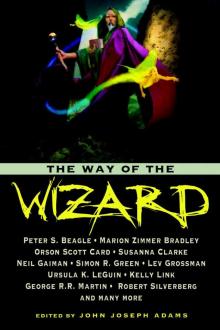
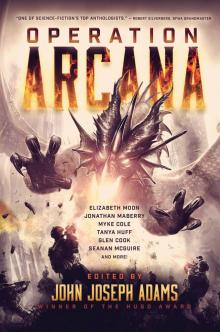
John Joseph Adams, in addition to serving as publisher and editor-in-chief of Lightspeed, is the series editor of Best American Science Fiction & Fantasy, published by Houghton Mifflin Harcourt. He is also the bestselling editor of many other anthologies, such as The Mad Scientist’s Guide to World Domination, Armored, Brave New Worlds, Wastelands, and The Living Dead. New projects coming out in 2014 and 2015 include: Help Fund My Robot Army!!! & Other Improbable Crowdfunding Projects, Robot Uprisings, Dead Man’s Hand, Operation Arcana, Wastelands 2, and The Apocalypse Triptych: The End is Nigh, The End is Now, and The End Has Come. He has been nominated for eight Hugo Awards and six World Fantasy Awards, and he has been called “the reigning king of the anthology world” by Barnes & Noble. John is also the editor and publisher of Nightmare Magazine, and is a producer for Wired.com’s The Geek’s Guide to the Galaxy podcast. Find him on Twitter @johnjosephadams.