Nightmare Magazine, Issue 80 (May 2019), page 10


I tend to start with a cool idea, then develop it. For instance, “Ten Excerpts” started with me going “I’d really like to write a story in the form of an MLA bibliography,” while “Leviathan” was “I want to write something dark and Dishonored-y involving whaling ships.” Often, the story ends up changing so much in the process of writing it that the final product bears no resemblance to the original idea—for instance, both of my upcoming stories in Fireside initially started out as the same story-seed (pun entirely intended) about motherhood, faerie plants, and odd children, but then split into two as I worked on them!
As for themes, I feel like it hardly needs stating at this point that food crops up a lot in my fiction. Not just food, but the cultural assumptions and strictures surrounding appetite, hunger, and consumption—“Ten Excerpts” is a pointed middle finger at how colonialism Others and declares monstrous the very cultures it, itself, is in the process of devouring.
The paper titles and sources have absolutely wonderful (and sometimes punny) titles, many of which I would like to read! I take it you have much experience writing academic papers—can you tell us about how you chose the structure for this story, and what were some of the bonuses or challenges that resulted from a unique format?
As I like to tell people, I just survived a three-year MFA in Illinois. During that MFA, I took a literature course on the American Gothic, and later, did a number of independent studies of my own design to follow up on specific subgenres of this that interested me. All of these involved producing an annotated bibliography at some point, so I got pretty good at it, and also increasingly fascinated by how annotated bibliographies consist of interlocking components that tell a story larger than the sum of its parts. Because academic notions of objectivity be damned—a story is exactly what a bibliography is telling, one that has been deliberately constructed.
This wasn’t my first exposure to academia; I have an MA in English Lit from back home in India. As such, I was uniquely positioned to notice the despairingly white, cishet, male, and Western limitations of my professor and classmates’ perspectives as we critiqued material that often dealt with transgressive gender, atrocities against people of colour, and colonialism. This got me thinking about how Western academia has been a tool of colonialism, and how racist perspectives and practices are absolutely built into its existing frameworks.
I’d already had the idea to write a story in the form of an annotated bibliography. Now I realized that I could do a lot more by using content to subvert the form, rather than playing it straight. Using the master’s tools to flip the bird to the master’s house, if you will.
What I loved is how we get subtle glances of the history and lives of the characters, and the threads bringing it all together grow clearer and more sinister as the tale unfolds; the story is rich in detail and creepy elements, and it lingers in the brain, a dark and sensuous satisfaction. When you write short stories like this, are you tempted to explore the characters more in future work, or do you find that once a story is told, it is closed for good? Somewhere in between?
Oh, definitely—I have a longing to write a whole series of sequels to “Never Yawn Under a Banyan Tree,” for instance, following the adventures of Meena and Rupsha. “Ten Excepts,” though, is about how colonialism-in-academia steals and rewrites conquered people’s stories—and how diasporas also engage in (albeit much more positive) processes of retelling and remaking their heritage into their own, new stories. We never will know the truth of Regina’s story; all we have is versions of it that people have made up to serve their various purposes. Besides, sometimes, you can make an ending more effectively horrifying by stopping just short of explicitly revealing what happens next, and letting the reader’s imagination do its worst instead.
Care to tell us about one of your most memorable meals?
Oh no, why would you ask me to choose? Okay, I’m going to cheat. First, here’s one of my perennial favourites: mutton biryani, Bengali-style; full of potatoes and ghee and saffron. Second, here’s the most memorable thing I ate recently: deep-fried ricotta fritters at a pub in Ann Arbor. They were so good!
I see you have stories forthcoming in Fireside and The Dark, which is very exciting! What else is next for you? Any long-form projects in your future?
Hah! Maybe if I can conquer immigration stress enough to finish this novella. Ask me again in a year.
ABOUT THE INTERVIEWER
A. Merc Rustad is a queer non-binary writer who lives in Minnesota and is a Nebula Awards finalist. Their stories have appeared in Lightspeed, Fireside, Apex, Uncanny, Nightmare, and several Year’s Best anthologies. You can find Merc on Twitter @Merc_Rustad or their website: amercrustad.com. Their debut short story collection, So You Want To Be A Robot, was published by Lethe Press (May 2017).
Coming Attractions
The Editors | 101 words
Coming up in June, in Nightmare . . .
We have original fiction from Megan Arkenberg (“The Night Princes”) and Alanna J. Faelan (“The Taurids Branch”), along with reprints by Laird Barron (“In a Cavern, In a Canyon”) and Gary McMahon (“Strange Scenes from an Unfinished Film”).
We also have the latest installment of our column on horror, “The H Word,” plus author spotlights with our authors, and a book review from Terence Taylor.
It’s another great issue, so be sure to check it out. And while you’re at it, tell a friend about Nightmare.
Thanks for reading!
Stay Connected
The Editors
Here are a few URLs you might want to check out or keep handy if you’d like to stay apprised of everything new and notable happening with Nightmare:
Magazine Website
www.nightmare-magazine.com
Destroy Projects Website
www.destroysf.com
Newsletter
www.nightmare-magazine.com/newsletter
RSS Feed
www.nightmare-magazine.com/rss-2
Podcast Feed
www.nightmare-magazine.com/itunes-rss
www.twitter.com/nightmaremag
www.facebook.com/NightmareMagazine
Subscribe
www.nightmare-magazine.com/subscribe
Subscriptions and Ebooks
The Editors
If you enjoy reading Nightmare, please consider subscribing. It’s a great way to support the magazine, and you’ll get your issues in the convenient ebook format of your choice. All purchases from the Nightmare store are provided in epub, mobi, and pdf format. A 12-month subscription to Nightmare more than 45 stories (about 240,000 words of fiction, plus assorted nonfiction). The cost is just $23.88 ($12 off the cover price)—what a bargain! To learn more, including about third-party subscription options, visit nightmare-magazine.com/subscribe.
We also have individual ebook issues available at a variety of ebook vendors, and we now have Ebook Bundles available in the Nightmare ebookstore, where you can buy in bulk and save! Buying a Bundle gets you a copy of every issue published during the named period. Buying either of the half-year Bundles saves you $3 (so you’re basically getting one issue for free), or if you spring for the Year One Bundle, you’ll save $11 off the cover price. So if you need to catch up on Nightmare, that’s a great way to do so. Visit nightmare-magazine.com/store for more information.
Support Us on Patreon or Drip, or How to Become a Dragonrider or Space Wizard
The Editors
If you’re reading this, then there’s a good chance you’re a regular reader of Nightmare and/or Lightspeed. We already offer ebook subscriptions as a way of supporting the magazines, but we wanted to add an additional option to allow folks to support us, thus we’ve launched a Drip (d.rip/john-joseph-adams) and a Patreon (patreon.com/JohnJosephAdams).
TL;DR Version
If you enjoy Nightmare and Lightspeed and my anthologies, our Patreon and Drip pages are a way for you to help support those endeavors by chipping in a buck or more on a recurring basis. Your support will help us bring bigger and better (and more) projects into the world.
Why Patreon and Drip?
There are no big companies supporting or funding the magazines, so the magazines really rely on reader support. Though we offer the magazines online for free, we’re able to fund them by selling ebook subscriptions or website advertising.
While we have a dedicated ebook subscriber base, the vast majority of our readers consume the magazine online for free. If just 10% of our website readers pledged just $1 a month, the magazines would be doing fantastically well. So we thought it might be useful to have an option like Drip and Patreon for readers who maybe haven’t considered supporting the magazine, or who maybe haven’t because they don’t have any desire to receive the ebook editions—or who would be glad to pay $1 a month, but not $3 (the cost of a monthly subscriber issue of Lightspeed).
Though Lightspeed and Nightmare are separate entities, we decided to create a single “publisher” Drip and Patreon account because it seemed like it would be more efficient to manage just one page on each platform. Plus, since I sometimes independently publish works using indie-publishing tools, we thought it would be good to have a single place where folks could come to show their support for such projects.
Basically, we wanted to create a crowdfunding page where, if you enjoy my work as an editor, and you want to contribute a little something to help make it easier for us to produce more cool projects, then our Drip or Patreon is the place to do that.
What Do I Get Out of Being a Backer or Patron?
Well, you get the satisfaction of helping to usher the creation of cool new short fiction projects into the world! Plus, the more support we get, the better we can make the magazines and compensate our authors and staff. By becoming a supporter via Patreon or Drip, you help fund our growth and continued publication of two award-winning magazines. Of course, if you’re already one of our ebook subscribers (thank you!), you are already supporting us. This is for those who prefer to read the issues each month on our free websites, or wish to support our efforts more generally.
By becoming a supporter, you are also bestowed a title, such as Dragonrider, or Space Wizard, or Savior of the World and/or Universe, thus making you instantly the envy of all your friends.
Thank You!
If you’ve read this far, thanks so much. We hope you’ll consider becoming a backer on Patreon or Drip. Those URLs again are d.rip/john-joseph-adams and patreon.com/JohnJosephAdams.
Thanks in advance for your time. We look forward to hopefully being able to make the magazines—and my other publishing endeavors—even better with the support of people like you.
About the Nightmare Team
The Editors
Publisher/Editor-in-Chief
John Joseph Adams
Managing/Associate Editor
Wendy N. Wagner
Associate Publisher/Director of Special Projects
Christie Yant
Assistant Publisher
Robert Barton Bland
Reprint Editor
John Langan
Podcast Producer
Stefan Rudnicki
Podcast Editor
Jim Freund
Podcast Host
Jack Kincaid
Art Director
Christie Yant
Assistant Editors
Erika Holt
Lisa Nohealani Morton
Reviewers
Adam-Troy Castro
Terence Taylor
Copy Editor
Melissa V. Hofelich
Proofreader
Devin Marcus
Webmaster
Jeremiah Tolbert of Clockpunk Studios
Also Edited by John Joseph Adams
The Editors
If you enjoy reading Nightmare (and/or Lightspeed), you might also enjoy these works edited by John Joseph Adams:
ANTHOLOGIES
THE APOCALYPSE TRIPTYCH, Vol. 1: The End is Nigh (with Hugh Howey)
THE APOCALYPSE TRIPTYCH, Vol. 2: The End is Now (with Hugh Howey)
THE APOCALYPSE TRIPTYCH, Vol. 3: The End Has Come (with Hugh Howey)
Armored
Best American Science Fiction and Fantasy 2015 (with Joe Hill)
Best American Science Fiction and Fantasy 2016 (with Karen Joy Fowler)
Best American Science Fiction and Fantasy 2017 (with Charles Yu)
Best American Science Fiction and Fantasy 2018 (with N.K. Jemisin)
Best American Science Fiction and Fantasy 2019 (with Carmen Maria Machado) [Forthcoming Oct. 2019]
Brave New Worlds
By Blood We Live
Cosmic Powers
Dead Man’s Hand
THE DYSTOPIA TRIPTYCH, Vol. 1: Ignorance is Strength (with Hugh Howey) [Forthcoming 2020]
THE DYSTOPIA TRIPTYCH, Vol. 2: Burn the Ashes (with Hugh Howey) [Forthcoming 2020]
THE DYSTOPIA TRIPTYCH, Vol. 3: Or Else the Light (with Hugh Howey) [Forthcoming 2020]
Epic: Legends of Fantasy
Federations
The Improbable Adventures of Sherlock Holmes
HELP FUND MY ROBOT ARMY!!! and Other Improbable Crowdfunding Projects
Lightspeed: Year One
The Living Dead
The Living Dead 2
Loosed Upon the World
The Mad Scientist’s Guide to World Domination
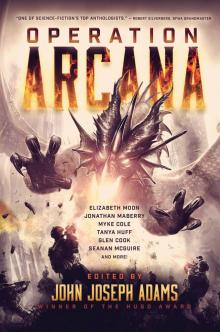
Operation Arcana
Other Worlds Than These
Oz Reimagined (with Douglas Cohen)
A People’s Future of the United States (with Victor LaValle)
Press Start to Play (with Daniel H. Wilson)
Robot Uprisings (with Daniel H. Wilson)
Seeds of Change
Under the Moons of Mars
Wastelands
Wastelands 2
Wastelands: The New Apocalypse [June 2019]
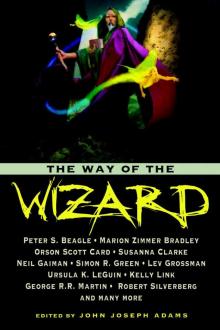
The Way of the Wizard
What the #@&% is That? (with Douglas Cohen)
NOVELS and COLLECTIONS
Beacon 23 by Hugh Howey
Shift by Hugh Howey
Dust by Hugh Howey
Bannerless by Carrie Vaughn
Sand by Hugh Howey
Retrograde by Peter Cawdron
Machine Learning: New and Collected Stories by Hugh Howey
Creatures of Will and Temper by Molly Tanzer
The City of Lost Fortunes by Bryan Camp
The Robots of Gotham by Todd McAulty
The Wild Dead by Carrie Vaughn
The Spaceship Next Door by Gene Doucette
In the Night Wood by Dale Bailey
Creatures of Want and Ruin by Molly Tanzer
Break the Bodies, Haunt the Bones by Micah Dean Hicks
The Chaos Function by Jack Skillingstead
Upon a Burning Throne by Ashok K. Banker
Gather the Fortunes by Bryan L. Camp
Reentry by Peter Cawdron
Half Way Home by Hugh Howey
The Unfinished Land by Greg Bear
Creatures of Charm and Hunger by Molly Tanzer
A Dark Queen Rises by Ashok K. Banker
The Conductors by Nicole Glover
The Chosen One by Veronica Roth
Visit johnjosephadams.com to learn more about all of the above.
John Joseph Adams, Nightmare Magazine, Issue 80 (May 2019)