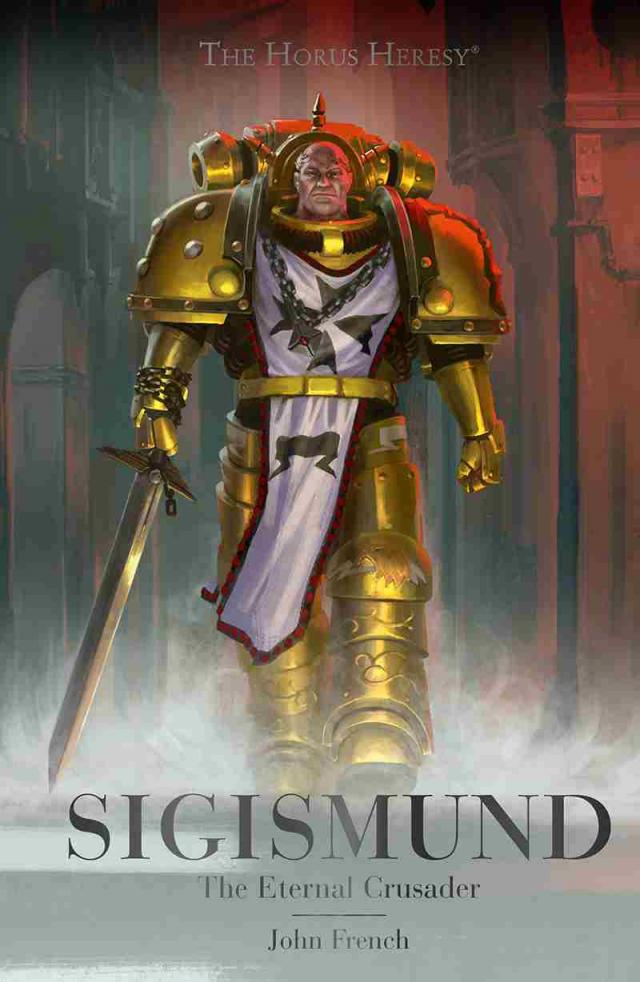
Sigismund: The Eternal Crusader, page 1


Further Reading From The Horus Heresy
Book 1 – HORUS RISING
Dan Abnett
Book 2 – FALSE GODS
Graham McNeill
Book 3 – GALAXY IN FLAMES
Ben Counter
Book 4 – THE FLIGHT OF THE EISENSTEIN
James Swallow
Book 1 – THE SOLAR WAR
John French
Book 2 – THE LOST AND THE DAMNED
Guy Haley
Book 3 – THE FIRST WALL
Gav Thorpe
Book 4 – SATURNINE
Dan Abnett
Book 5 – MORTIS
John French
Book 6 – WARHAWK
Chris Wraight
SONS OF THE SELENAR (Novella)
Graham McNeill
FURY OF MAGNUS (Novella)
Graham McNeill
ANGRON: SLAVE OF NUCERIA
Ian St. Martin
KONRAD CURZE: THE NIGHT HAUNTER
Guy Haley
LION EL’JONSON: LORD OF THE FIRST
David Guymer
ALPHARIUS: HEAD OF THE HYDRA
Mike Brooks
The Horus Heresy Character Series
VALDOR: BIRTH OF THE IMPERIUM
Chris Wraight
LUTHER: FIRST OF THE FALLEN
Gav Thorpe
SIGISMUND: THE ETERNAL CRUSADER
John French
Order the full range of Horus Heresy novels, audio dramas and audiobooks from blacklibrary.com
CONTENTS
Cover
Backlist
Title Page
The Horus Heresy
One
Two
Three
Four
Five
Six
Seven
Eight
Nine
About the Author
An Extract from ‘Luther: First of the Fallen’
A Black Library Publication
eBook license
THE HORUS HERESY
It is a time of legend.
Mighty heroes battle for the right to rule the galaxy. The vast armies of the Emperor of Mankind conquer the stars in a Great Crusade – the myriad alien races are to be smashed by His elite warriors and wiped from the face of history.
The dawn of a new age of supremacy for humanity
beckons. Gleaming citadels of marble and gold celebrate the many victories of the Emperor, as system after system is brought back under His control. Triumphs are raised on a million worlds to record the epic deeds of His most powerful champions.
First and foremost amongst these are the primarchs, superhuman beings who have led the Space Marine Legions in campaign after campaign. They are unstoppable and magnificent, the pinnacle of the Emperor’s genetic experimentation, while the Space Marines themselves are the mightiest human warriors the galaxy has ever known, each capable of besting a hundred normal men or more in combat.
Many are the tales told of these legendary beings. From the halls of the Imperial Palace on Terra to the outermost reaches of Ultima Segmentum, their deeds are known to be shaping the very future of the galaxy. But can such souls remain free of doubt and corruption forever? Or will the temptation of greater power prove too much for even the most loyal sons of the Emperor?
The seeds of heresy have already been sown, and the start of the greatest war in the history of mankind is but a few years away...
‘It’s not safe, sir.’
Solomon Voss looked at the face of the soldier who had come running from the clearing edge as the cargo-lifter’s ramp dropped. The rain was falling in thick, vertical lines the colour of milk. The lifter’s engines were still turning. Its turrets pivoted, quad-cannons watching the vegetation line. Stacked globes of pale green plant matter rose in bulging towers. Red needles, the length of a human arm, projected from their sides. The air smelled like honey and medicae-spirit. Somewhere in the not too far distance, the crump of an explosive blast rolled in the air over the drum of the rain. Voss grinned to himself under the brim of his hat – one day when all this was over, he wouldn’t be surprised if he ended up missing places like this.
‘You are my liaison,’ he said to the soldier, picking up his pace to get clear of the landing zone.
‘Major Ulthara, Ramalisian Eighty-Eighth, yes, sir,’ she said, now striding by his side. Milk-white rain was streaming from her rain cowl and cloak. She was very tall, he noticed, narrow features to her face, silver campaign studs bonded to her chin and jawline. A veteran. He watched her eyes moving across the vegetation line.
Behind them, the quartermasters and loading crews had already pulled the supply containers out of the lifter and were hurrying to clear the zone themselves.
‘Where do we pick up the next hop along the line, major?’
‘Sir, it would be best if you re-embarked. The zone is not cleared for civilians.’
‘I am cleared, major,’ he replied, and pulled the data-wand from under his cloak, and held it out to her. She took it, pulled out a data-slate and snapped the wand in place without breaking stride. The screen of the slate lit, fizzed with data, and then became a cascade of cypher runes. She barely blinked, he noted – a hard one this. You did not end up in the forward group of the VII Legion’s First Crusade by being any other way, but even so, it was impressive – the personal cypher seal of Lord Rogal Dorn usually caused at least some reaction.
‘All right,’ she said, and started to stride faster, turning towards where a wall of rockcrete screens rose to enclose a cluster of smaller landing pads. ‘The next move up into the mountains lifts in six minutes, next after that not for another ten hours.’
Voss sped up to keep pace as they turned the corner of one of the screens. Four gunships sat on the metal landing plates. Black and amber yellow, scorch marks dragged down their backs from the rocket pods mounted on their spines. Pale rain drummed on their hunched wings. Ground crew were already snapping access panels shut. Tech-priests and servitors were trying to drone out a machine prayer over the sound of the rain. The first gunship’s engines lit and roared down their attempts at piety.
The major headed for the nearest gunship. Its engines started as they made for it. A figure was suddenly in front of them, towering, the red gaze of its eye-lenses looking down at them, water running from its warplate. Voss snapped his will down on the instinct to run. He had been around the Legiones Astartes countless times, had got used to them to the point that the primal dread they invoked in humans was barely a murmur in his pulse. But every now and again their presence caught him and spun him back to that first time he had looked up at one of the Emperor’s warriors, and known that he was looking at death given form.
He swallowed in a dry throat as the Space Marine held him in its gaze.
‘You are not permitted here,’ it said.
Major Ulthara held up her data-slate. The code cyphers from Voss’ data-cylinder were still flowing across the screen. The warrior took it in with a glance.
‘This is a Legion lift, major, full armament,’ it said. ‘The battle zone is active.’
The engines of another gunship lit. Rain and jet blast buffeted Voss.
‘He needs to get to the Lord Templar,’ said Ulthara, ‘and you have seen the clearance.’
‘I can read and heed the will of my lord, major. It was merely a caution.’
The warrior nodded, turned, and moved to the last gunship. Ulthara and Voss had to jog to keep up with his stride. Voss could see the open belly of the gunship, the huge figures in yellow-and-black armour locked into harnesses inside. A single warrior was moving down the central walkway between the warriors, his back to the open ramp, head bare, slapping his palm against the shoulder guards of those he passed. Voss and the major reached the ramp and climbed up. Helmed heads turned. Behind them the ramp was beginning to shut.
‘What is this?’ came a voice that growled louder than the building shriek of engine power. The bareheaded Space Marine had turned, had looked at them with dark eyes framed by beard and scar tissue. Campaign and command glyphs marked his armour beside a patchwork of dents and scars. A twin-axe device in black sat on his right pauldron, the clenched fist of the Imperial Fists Legion on the other. Ulthara gave a quick salute and began to hold up the data-slate, but the Space Marine was looking at Voss, who found himself smiling despite himself. ‘You had better have an incredibly good reason to be here, poet.’
‘I’m not a poet,’ shouted Voss over the sound of the engines. ‘There is more to wordsmithing than poetry.’
‘So you said before,’ said the Space Marine. He shrugged and grinned. ‘I am still not convinced.’
‘You wouldn’t know the difference between poetry and rhyme anyway,’ shouted Voss.
‘True enough,’ replied the Space Marine with a bark of laughter, before looking at Major Ulthara. ‘Get yourself and the poet strapped in, major. We don’t want a talent like him to take a fall and find he has choked on an overly long word.’
The gunship lurched. Ulthara tugged him to a set of mortal-size harnesses beside the ramp. Voss started to strap himself in, hands finding the fastenings and buckles without having to look. Old habits, built up from a lifetime of observing and recording war from its front lines, sliding back into use. The ramp sealed behind them with a thump. Amber light flooded the compartment.
‘You know Lord Captain Rann?’ said Ulthara, leaning close as the engine noise rose. The gunship rocked as it lifted.
‘That he does,’ said Rann.
Ulthara’s head jerked up, surprised that he had heard her over the din of the engines. Rann was still standing, one hand hooked through a bracket on the ceiling, rocking with the movement of the gunship. He was grinning at them.
‘I knew the Great Solomon Voss when I was just, what, a line warrior on Rennimar? Still a long way to go for me but he was most definitely the “Great” even back then, am I not right, poet?’
‘I would hardly say so,’ shouted Voss in reply.
‘Trust me,’ said Rann to Ulthara. ‘You don’t gain the admiration of the primarch by being less than brilliant. He is a reckless idiot, too, but we all have to have something worth forgiving.’
‘You were on Rennimar?’ asked Ulthara. The gunship was shaking now as it pushed up through the air, G-force squashing Voss back into his harness.
‘Yes,’ said Voss.
Rann’s grin spread. ‘Rennimar, Catraonparis, Nis and a few more. Seen more of war than half the Imperial Army.’ Rann’s dark eyes flicked to Voss. ‘Just had to see one more, eh?’
‘Have to witness the future being made while we still can,’ Voss shouted back with a smile.
‘You say that like you think this is going to end,’ said Rann.
Voss shrugged. ‘Don’t you?’
‘I try not to think too much,’ said Rann, ‘it’s bad for my health.’
Shadows followed Voss as he walked down the length of the cavern. A glow-globe bobbed behind him, clutched by a floating servo-unit. This deep in the mountain, he could barely feel the detonations on the surface. The gunships had come in just ahead of a bomb storm that was sweeping the range. One gunship had taken a direct hit and come into the hangar cavern with its left wing in burning tatters. Voss had noticed the bullet holes and blood marks still on the cavern walls when they disembarked; the Imperial Fists had taken this warren of caves only a day before. In five hours, they would begin an assault on the next tier of mountain peaks. Four days and it would be over, Rann had said. Voss did not doubt it; he had seen the warcraft of the sons of Dorn often enough to know that they did not let their tongues outreach their swords.
Voss paused. Ahead of him, alone in the quiet dark, Sigismund, Lord Templar and First Captain of the Imperial Fists, stood next to a stack of munition crates that formed a makeshift table. Parchment maps and active data-slates sat in neat arrangement, edges and corners aligned. The Lord Templar looked down at the information spread in front of him, his hands crossed behind his back, his posture upright. Only his eyes moved, the light caught in them flickering as they moved over the plans and data laid out in front of him. Voss felt his stride falter. There was a quality of threat to the Lord Templar’s stillness, a pressure wave of force held back.
‘You are the remembrancer,’ said Sigismund.
‘Yes, my lord,’ said Voss, his step dropping back to where it had been.
‘You do not call Captain Rann “lord”,’ Sigismund said, and turned to look at Voss. ‘But you do me?’
‘Yes, lord. I do not know you, and I do not presume.’
Sigismund looked at Voss for a long moment. His face was wide, handsome features pulled across bones and muscles bulked by gene-
craft. There were small scars too, some jagged, others razor fine. An off-white surcoat hung over unadorned yellow armour, edged with black and bearing the obsidian fist of the VII Legion. A sword hung at his back.
‘You do not know me,’ said Sigismund, ‘but we have stood in the same places before, and you have heard of me just as I have heard of you.’ It was as though all the Lord Templar’s being were directed down the line of his gaze. ‘You could have talked to me before, but you did not. You chose to come now. Why?’
Voss swallowed. His throat was dry again. No introductions, no circling or discussion of the current campaign or how Voss had come here – after the first touch of swords, a straight cut to the centre.
‘I have heard that you have said this crusade will never end,’ Voss said, and took a step forwards, pulling out his slate and data-quill.
‘I believe that,’ replied Sigismund.
‘My lord, the Emperor has withdrawn to Terra. Your own Legion goes to join Him. The Imperium’s borders now touch the galaxy’s edge. There are almost no enemies left.’ He paused. Sigismund’s face was still, the touch of any emotion invisible to Voss’ eyes. ‘My lord, the war is ending. All know it, all believe it… except you. I came here because I want to know why.’
Sigismund was quiet for a moment, and then he gestured to a crate for Voss to sit at.
‘Then let me give you an answer,’ he said.
ONE
FROM DUST
The storm wind breathed across the Ionus Plateau. Summer heat and dry winds had pulled the dust up into the air so that now a layer of cloud lurked on the horizon, flickering with lightning, bruise-dark smudged with ochre. The plain had once been an ocean, or so the story ran. The waters had long since drained away, leaving dust where there had been a seabed and mesas of stone that had been mountains beneath the waves. The tombs of long-dead kings stared down from those mountains at the drift camps at their feet. They were called camps even by those who had been born in them. They were home to the millions that the great war for and against Unity had pushed from the cities and hives to the north and south. Alleys tangled through walls made from scrap and fabric. Smoke rose from cooking fires, along with the cries of the dying and the songs of the living. On and on it went, rolling beyond sight to meet the edge of the world.
This was the land taken by the lost. Even for the despots who hungered for dominion, it was a shunned place. The monarchs who had bored their palaces and tombs into the mountains had left their mark on the land in the form of stories of enchanter kings and tales of ghost voices laughing from the mouths of deserted palaces. It had been an empty place for millennia, but then new armies had marched across the world: gene-wrought armies in skins of metal. Cities became pyres as warlords new and old tried to make new realms or hold on to what they had. Refugees had come to Ionus, first a few and then tens of thousands. They had made homes and had children, and done what humanity does even as the world is falling into fire – they had survived. Now the wars were supposed to be over. From many warlords there had come one who called Himself ‘Emperor’, and He had proclaimed the tattered realms He had conquered not many lands but one. One Imperium.
For the people in the drift camps of Ionus, this new Unity had been neither a blight nor a triumph. As with all the other wars in all the other years, the new peace was a distant irrelevance. Life remained as it had been, balanced on sharp edges, unsoftened in its cruelty. The stories of the old kings of the mountains had become the founding myths of murder gangs that ran the alleys at night with sharp knives and crowns of blades. Spring winds sometimes brought poison from the north. Those of autumn, the smell of the dead left on the mountain slopes for the carrion birds. In winter, ice clotted the gathered dew, and in summer Sol breathed furnace heat and summoned thirst to steal the spit from people’s mouths. There was no change, nor hope, just the certainty of struggle.
Sigismund could taste the storm on his teeth like he was biting copper. He was breathing hard as he twisted down an alley between two shacks. Behind him the cries rose, ululating up into the storm wind. They were close.
He reached the dead end of the alley and looked behind him in time to see a figure come around the corner at a run: wiry muscle and scarred skin dusted with white ash, a mask and crown of jagged metal, bones and skin hung on cords. The blade in the figure’s hand was a hooked smile of plasteel. It was a Corpse King, one of the gangs that hunted and harvested in this part of the drift.
Sigismund jumped up, grabbed on to the edge of the roof, and hauled himself up. He started running, boards shaking under his strides. Ahead of him, a metal pylon jabbed up from the roof into the darkening sky. The storm was a dark wall, curving up from the land into the heavens. Behind him, the Corpse King vaulted up the side of the alley and landed in a crouch. In the distance, the storm spoke. Thunder growled through the air. Lightning sparked in its depths. It was an angry god of a storm.