The Summer We Buried, page 1


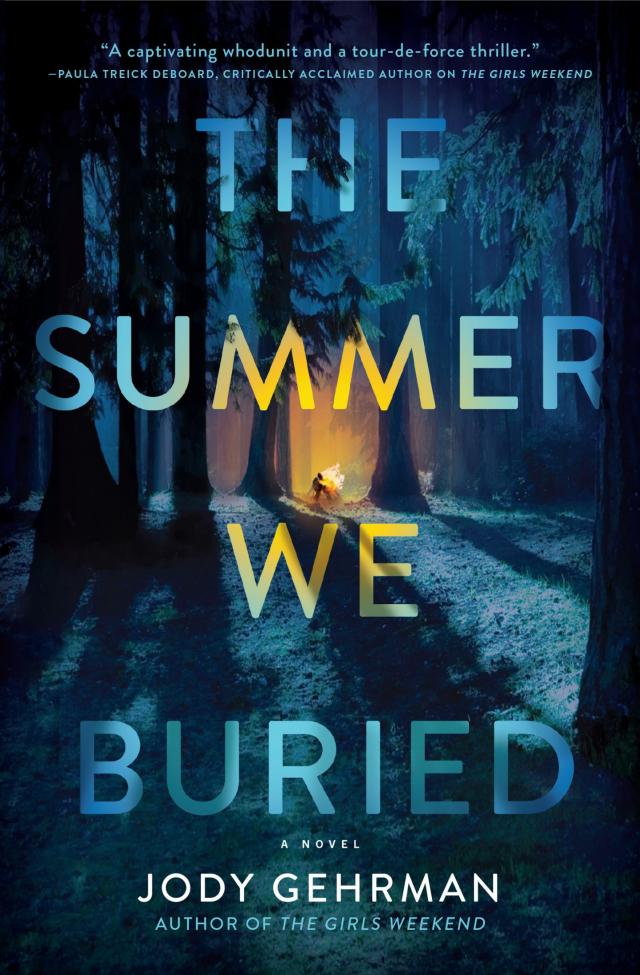
THE
SUMMER
WE BURIED
A NOVEL
JODY GEHRMAN
For my mom,
Charlotte Garner,
who sparkles.
ACKNOWLEDGMENTS
MY DEEPEST THANKS go out to the creativity, support, and hard work of all the people who helped make this book a reality.
First and foremost, I thank my lucky stars for my agent, Jill Marr, who is always in my corner. James Bock and Jessica Renheim, my perceptive and brilliant editors at Crooked Lane Books, pushed me to make this novel so much sharper and more vivid. A big thanks to everyone at CLB for your tireless work on my behalf, especially Melissa Rechter, Rebecca Nelson, and Madeline Rathle. Special thanks to Kara Klontz for her inspired cover design.
Lisa Rosenstreich, thank you for all of our therapeutic walks, for reading my first draft, and for encouraging me to find the story I needed to tell. You suffered through my long, meandering monologues as I tried to pinpoint who these characters are and where their journeys might lead.
To my family, thank you so much for your ongoing love and support. Thanks to the Big Moon Music crew, especially Rose Bell, Stacey Sheldon, and Alicia Bales for putting me back in touch with my singer-songwriter self. Wendy James and Kate Morein, thanks for squealing over cover designs and helping me see the big picture when I get stuck. Ellen Weed, you are a gem among friends and an inspiration.
Last but far from least, my gratitude goes out to David Wolf. You’re the only person on the planet who can make lockdown not just tolerable but kind of fun. Let’s make music together until we die. I love you.
CHAPTER
1
SHE WALKS INTO the room, and I know it’s her. In spite of the big Jackie-O sunglasses, the fake name, I’d know that walk, that smell, that hair anywhere. She glides into my office with the long, confident strides of a runway model, bringing with her a faint cloud of amber. The hair is the real giveaway, though. She could have a paper bag over her head, and I’d know her so long as I could see her hair. It’s the inky dark of raven feathers, a blue-black, and it falls to the middle of her back, slithering like a cat’s tail—that same unconscious animation, like it’s somehow both under her control and separate from her.
How long has it been? Fifteen years? Twenty?
“Hello, Jasmine Jones.” I do nothing to disguise my sarcasm. “What brings you here today? Are you looking to map out an ed plan?”
She takes off her sunglasses with one quick jerk. Her fingers, as always, are covered with rings. “Hello, Tansy.”
“Selene.” I lean back in my chair and take her in.
She’s wearing a floaty blue sundress, scuffed cowboy boots, and a butter-colored leather jacket. She’s still beautiful, I note, though the years have left their mark. She’s got a scar above her eyebrow I never noticed before, and parentheses around her mouth. Her body is still lithe and compact as ever—five feet of muscle and sinew. The tendons in her neck are taut, giving her the aggressive look of a cobra about to strike.
“Been a while.” Her eyes move over me, over my office, taking it all in.
“Sure has. Did you move back to Sonoma?”
“I’m renting a little yurt outside of town. Don’t worry, though, I’m not here to catch up. I came to ask a favor.” She sits in the chair opposite my desk. She doesn’t perch on the edge as if ready to bolt, like most of my visitors. She leans back into it, settling in like she plans to order a round of martinis or three.
I fondle my paperweight, a mermaid under glass. “Cutting right to the chase, as usual.”
“It’s not a social call.”
An eruption of laughter escapes from me, sounding nervous and shrill. “I’m not expecting social niceties, okay? This is where I work. You came here under an assumed name. I don’t appreciate being ambushed and I—”
“Don’t be so dramatic.” She stares out the window, distant and arctic. “I need something. You owe me. I came to collect my debt.”
“Your debt?” I say it louder than I mean to. With a quick glance around—these walls are thin—I lower my voice. “Are you serious right now?”
“Let’s not play games, Tansy.” Her hazel eyes hold mine. There’s something there I don’t like—something hard and determined that tells me I can’t just brush this off as a weird thing that happened at work. “We both know it’s true. I saved your life. You’re welcome. Now I need something, and it’s time to pay up.”
“That is—” My voice shakes. I take a deep breath to steady it. “—a gross oversimplification.”
“You can tell yourself whatever you like, but it doesn’t change the facts.” The hardness in her jaw reminds me of warriors, of samurai. She glares at me, willing me to back down.
I say nothing.
She lounges again, taking my silence for agreement. “I have a daughter. She’s a student here.”
I return my attention to the mermaid paperweight. The concept of Selene with a daughter is incomprehensible. I shudder to imagine what that was like—growing up with her tests, her mind games.
Again, Selene takes my silence as an invitation to go on. “Her name’s Jupiter. She’s in a thoroughly messed up relationship. I want you to help me get her out.”
“Out?” My eyes widen at that. “What do you mean, out?”
“He’s abusive.” She leans forward, the tendons in her neck going even more taut. “I’m going crazy with worry.”
For a moment, as our eyes meet, I feel myself softening. I steel myself against it. This is the slippery slope I always fell down in the past. Give Selene an opening and she’ll have you dancing like a puppet before you know it.
“I think you have a fundamental misunderstanding about what we do here,” I say, trying to sound distant and professional. “I’m a college guidance counselor. Breaking up relationships—even abusive ones—is way outside my job description. Have you thought about going to the police?”
She huffs out a breathy, incredulous laugh. “Cops? Yeah, right.”
“If you think she’s in danger …”
“She’s in love with the little bastard. He’s rich and entitled, with a powerful family.” She shakes her head. “You think I’d come here if you weren’t my only hope?”
Would she? I don’t know. During our whirlwind two-year friendship, Selene manipulated me all the time. I was eighteen when we met in a creative writing class at the local community college. She was twenty-eight, exotic and fascinating in ways I didn’t even know human beings could be. Her life contained so much more than mine. She’d been a stripper in New Orleans, a speed freak in San Diego, a money launderer in Seattle. She’d been married to a bank robber who ended up in jail. I was drawn to her hard edges, her grit. She was a survivor, already tested by life in a thousand ways. By contrast, I felt sheltered and unformed, as soft and bland as a lump of dough. The stories she told as we sat in her candlelit geodesic dome, drinking wine and listening to Bob Dylan, beguiled me. Only later, once I’d run from our friendship and gotten some distance, did I understand the many ways she had controlled and manipulated me from the very beginning.
“How old is your daughter?” I ask, cautious.
“Eighteen.”
The number registers with a hollow thud in my belly. Our friendship imploded eighteen years ago. Could Selene have been pregnant when all of that went down? Did she have a baby growing inside her the whole time, an unseen witness to the terrible things we did?
I shake my head. I don’t want to think about any of that. I’ve been blocking out memories of Selene for almost two decades; for my own mental health, I plan to keep blocking them, thank you very much.
I circle back to my reason for asking the question in the first place. “Eighteen makes her an adult. I know it probably doesn’t feel like it—she’ll always be your baby, right? But legally—”
“He won’t let me see her,” she blurts, raising her voice to talk over me. “He could have her locked in the basement for all I know.”
This throws me. “Wait, what?”
Her fingers grip the arms of the chair, knuckles white. “The little shit blocked my number on her phone, so I couldn’t get in touch with her. Naturally, after weeks of silence, I show up at their place, just wanting to make sure she’s okay. You know what he did?”
I blink at her, pulled into the story in spite of myself.
“He has the nerve to meet me at the door and tell me I’m a ‘toxic influence’ on my daughter and that she’s ‘disconnecting’ for a little while. Disconnecting! Like I’m an appliance she can unplug and not the woman who carried her for nine months.”
In the pocket of silence, I ask, “How long has it been since you’ve talked to her?”
“Months.” Selene glares out the window, simmering with resentment.
I get the feeling there’s something she’s leaving out here. “Have you thought about ‘running into’ her away from the boyfriend? Say, here on campus, or her favorite café?”
Her lips curve into a moue of distaste. “I shouldn’t have to stalk my own daughter.”
I shrug, like, It’s worth a shot. Again, I sense she hasn’t told me the whole story. The Selene I knew would use any means necessary to confront someone she cared about. I let the silence stretch out, wondering if she’ll get to the real issue or keep dancing around it.
Selene meets my eye, and for the first time since she walked in, I see something vulnerable there—a complicated mixture of need, fury, and embarrassment. “There’s
“Jupiter took out a restraining order against you?” I say it softly, knowing this is hard for her to admit.
“Colton did.” She spits out his name like something rotten. “He got her in on it, too. Because of the day I went to their apartment.”
With creeping dread, I ask, “What happened?”
I catch another flash of sheepishness before she buries it under righteous indignation. “I may have pushed him. Not hard, but he’s a lawyer’s son and a spoiled little snowflake, so he knows how to make the most of it. According to the police report, I assaulted him in the foyer of his own home.”
Neither of us says anything for a long moment.
Selene inches closer, lowering her voice to a whisper. “I need you to help me do this the right way, or so help me God, I will do it the wrong way. You know I will.”
I swallow. The aura of danger Selene always carries with her fills the room, making the silence dense. I turn in my chair and open my window, desperate for air. The muted cacophony of campus reminds me I’m here, in my world. I’m safe. A cool breeze pushes through the screen, and the tang of coming rain catches at the back of my throat.
“I don’t see how I can—” I begin, but she cuts me off.
“Get her to come see you,” she says. “Become her counselor.”
“Normally, students initiate contact.” I try to make my tone brisk, matter-of-fact, a case closed shrug just starting to take shape in my shoulders.
She shakes her head. “I know you can figure it out. You like to play by the rules, but you also know how to bend them when you feel like it.” Each syllable gets harder and more staccato, like a hailstorm building on a tin roof.
I look away. She’s got me pegged.
“And what then?” I keep my gaze fixed on the green stretch of lawn outside. Students wander across it in shorts and T-shirts, underdressed for the storm that’s moving in from the west, closing fast. The clouds hang low on the horizon, and I can see gray streaks of rain bleeding into the hills.
From the corner of my eye, I see her stand and shove her sunglasses back on. “One step at a time, Tanzanita.”
Hearing her old nickname for me, I can’t help twisting back around to look at her.
But she’s already at the door, yanking it open with that same maddening confidence she walked in with, that runway model-meets-commanding-officer strut.
When she’s got one foot in the hallway, she looks back over her shoulder and smiles with a radiance that startles me. I’d forgotten she could turn that sort of thing on and off at will. It’s one of her more frightening superpowers.
“Good meeting,” she said. “I’ll be in touch.”
I have a terrible feeling this is one promise she’s going to keep.
* * *
I turn onto Moonview Road around six that evening, my Subaru full of groceries. Dust rises under my wheels as I curve through the oak grove and drive over the bridge that spans the swollen creek. It’s Friday, and my brother Tim is coming to visit tomorrow with his husband Jay. Tim’s an amazing cook. I know he’ll bring plenty of provisions, but I’ve stocked up on wine, sugar, and carbs just to be safe.
Marius stands in his driveway as I pull up, wearing mustard-colored Dickies, his Carhartt jacket, and a wool beanie. His pants sit low on his skinny hips. He’s staring up at the roof of his house.
I slow my car and zip down my window as I pass. He turns, and his dear, gingery face lights up in a smile. It’s a sad smile—the same sort of smile he’s offered me ever since Scottie died. We’re comrades in the same war, and we greet one another with the weary melancholy of soldiers.
“How’s it going?” I say, loud enough to be heard over my engine.
The evening sun has painted the sky in syrupy pinks and smears of amber. He’s backlit, so it’s hard to read his expression. The golden red of his stubbled jaw lights up like neon.
“You mind if I ride with you?” His hazel eyes scan my face as his hand thumps the top of the Subaru.
I flinch at the sound, thrown. Usually we just call out hello and I cruise past. The last time I had a real talk with Marius was before Jessica moved in.
“Ride where?”
He squints toward my place, about a quarter mile down the road, on the western edge of the property. Marius doesn’t like to use words if he doesn’t have to. It’s one of the many things I both love and hate about the man. He’s economical with language, as if every word he utters costs him thousands.
“Of course,” I say without thinking. “Hop in.”
Marius is my ex. We were together for almost eleven years, off and on. Our band, The Insatiables, was a pretty big deal, at least with a certain crowd. We were never on the cover of Rolling Stone, but we did get little sidebar mentions once or twice. The summer Marius and I were twenty-eight, we toured the country in a rundown van, performing everywhere from dive bars to concert halls. We had a bluegrass-tinged R&B sound that struck the right note for a certain quirky fan base.
I miss making music with Marius. Sometimes I even miss the feel of his arms, the easy cave he made when he wrapped me up and held me tight. Plus, Marius and I were always good together in bed. I miss that too. Mostly, though, I miss the music.
And, of course, our bass player Scottie. I’ll never stop missing him.
As we bump along the dirt road, Marius stares out the window, squinting at the setting sun. His reddish stubble is turning into something more like a beard. He has a rugged profile, Viking-like, his eyes turning greener in the glare of sunset.
“What’s up?” I’m trying to stay calm, but there’s something about the set of his shoulders I don’t like. After my encounter with Selene, my nerves are already a little jangled. I’m not sure I’m up for whatever bombshell he has planned.
“I just wanted to let you know …” He hesitates, yanking off his black beanie and rubbing a hand over his short hair, palming it so it spikes in crazy directions. “This is harder than I thought.”
I can’t stop the impatient huff that escapes me. Then I realize, rushing him will only make him more inhibited. Better to get this confession over with, whatever it is, and to do that I need to make him comfortable. I recognize the agitation in his face, the nervous hands working at the insides of his coat pockets.
We pull up in front of my cottage and he shoots out the door. As if this little car ride was my idea; like he’s a prisoner escaping. Masking his discomfort as helpfulness, he waits for me to open the hatchback. As soon as I do, he fills his arms with groceries and lugs them toward my cottage. At least I’ll get some help. It seems like a poor bargain, though, given how nervous Marius’s silence is making me.
Marius walks right into my cottage without hesitation. The property is twenty-three acres, and the nearest neighbors are a mile away, so we never lock our doors. I cast a wistful glance at the two bottles of red wine in the grocery bag I’m carrying. A big glass is just what I need to sand off the edges of this jagged day. I wonder if it will seem rude to pour myself a drink right away, a little liquid courage to help me endure the bad news Marius is about to deliver.
That makes me sound like an alcoholic. I’m not. It’s after six on a Friday and I just saw Selene Rathbone again for the first time in eighteen years. If this isn’t a good excuse for a drink, I don’t know what is.
Marius has my fridge already half full of milk and eggs and cheese by the time I get to the kitchen. He takes my bags from me as I round the corner, putting the groceries away with an efficiency that startles me. I guess over the years, he’s memorized the layout of my kitchen. It’s not like he’s here all that often, which is why this catches me off guard. We moved onto this property ten years ago, back when Marius inherited it from his parents. I moved out of the main house and into the cottage seven years ago, when Marius and I broke up. By then, we’d been together so long we were like family. Besides, I’d grown so attached to the land I couldn’t imagine living anywhere else. Sonoma County rents had skyrocketed, too, so I couldn’t afford much more than a shitty, soulless apartment in a dicey neighborhood.
Then Marius started seeing Jessica. She’s a perky, clean-living brunette with dewy skin and a smile that glows in the dark. A yoga teacher and holistic living guru on YouTube, she spends her days doing downward dog and making delicious vegan recipes for her ever-present GoPro. She’s got like a million followers. Between that and their organic, sun-grown weed farm, Marius and Jessica (Messica, as I like to think of them) do pretty well. Plus they have zero overhead, aside from property taxes. Their house is three thousand square feet of walnut floors and built-in bookcases, wall-to-ceiling windows looking out over Valley of the Moon. Their deck has been featured in Sunset magazine for its innovative raised beds and eco-friendly solar-lit water fountains. It’s a stunning place.