Don't Stop Me Now, page 1


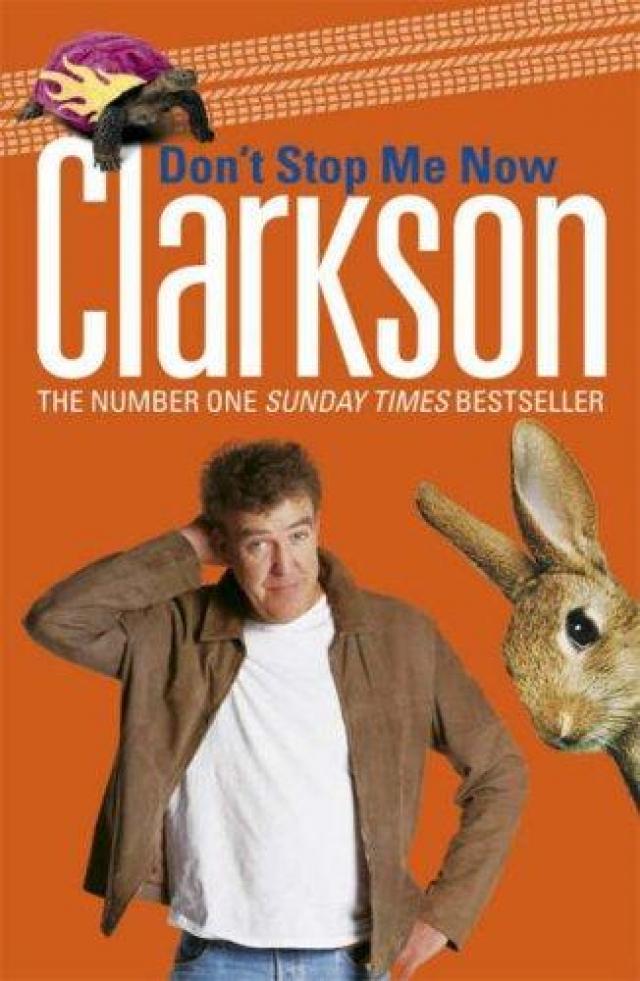
Don’t Stop Me Now
Book Jacket
PENGUIN BOOKS
DON’T STOP ME NOW
Jeremy Clarkson began his writing career on the Rotherham Advertiser. Since then he has written for the Sun, the Sunday Times, the Rochdale Observer, the Wolverhampton Express and Star, all of the Associated Kent Newspapers, and Lincolnshire Life. Today, he is the tallest person working in British television.
Jeremy Clarkson’s other books are Clarkson’s Hot 100, Clarkson on Cars, Motorworld, Planet Dagenham, The World According to Clarkson, I Know You Got Soul and And Another Thing: The World According to Clarkson Volume 2.
Don’t Stop Me Now
JEREMY CLARKSON
PENGUIN BOOKS
PENGUIN BOOKS
Published by the Penguin Group
Penguin Books Ltd, 80 Strand, London WC2R 0RL, England
Penguin Group (USA) Inc., 375 Hudson Street, New York, New York 10014, USA
Penguin Group (Canada), 90 Eglinton Avenue East, Suite 700, Toronto, Ontario, Canada M4P 2Y3
(a division of Pearson Penguin Canada Inc.)
Penguin Ireland, 25 St Stephen’s Green, Dublin 2, Ireland
(a division of Penguin Books Ltd)
Penguin Group (Australia), 250 Camberwell Road, Camberwell, Victoria 3124, Australia
(a division of Pearson Australia Group Pty Ltd)
Penguin Books India Pvt Ltd, 11 Community Centre, Panchsheel Park, New Delhi – 110 017, India
Penguin Group (NZ), 67 Apollo Drive, Rosedale, North Shore 0632, New Zealand
(a division of Pearson New Zealand Ltd)
Penguin Books (South Africa) (Pty) Ltd, 24 Sturdee Avenue, Rosebank, Johannesburg 2196, South Africa
Penguin Books Ltd, Registered Offices: 80 Strand, London WC2R 0RL, England
www.penguin.com
First published by Michael Joseph 2007 Published in Penguin Books 2008
1
Copyright © Jeremy Clarkson, 2007
All rights reserved
The moral right of the author has been asserted
Except in the United States of America, this book is sold subject to the condition that it shall not, by way of trade or otherwise, be lent, re-sold, hired out, or otherwise circulated without the publisher’s prior consent in any form of binding or cover other than that in which it is published and without a similar condition including this condition being imposed on the subsequent purchaser
978-0-14-191832-7
To everyone except John Prescott
The contents of this book first appeared in Jeremy Clarkson’s Sunday Times motoring column. Read more about the world according to Clarkson every week in the Sunday Times.
Contents
Peugeot 206 GTi
Volvo S60 R
Koenigsegg CC
Caterham Seven Roadsport SV
Lamborghini Gallardo
Mazda RX-8
Noble M12 GTO-3R
TVR T350C
Porsche Carrera GT
Honda Accord Tourer Type S
Bentley Continental GT
Porsche Cayenne Turbo
Porsche 911 GT3
BMW 53od SE
MGSV
Fiat Panda
Kia Rio
BMW 645Ci
Mazda3
Lotus Exige S2
Aston Martin DB9
Autodelta 147 GTA
Subaru Legacy Outback
Mercedes-Benz CL65 AMG
Mitsubishi Warrior
Ford Sportka
Toyota Corolla Verso
Mitsubishi Evo VIII
Land Rover Discovery
Corvette C6
MG ZT 260
Ariel Atom
Dodge Viper
Audi S4 Cabriolet
Mercedes-Benz SLK350
BMW 1 series
Bentley Arnage
Hyundai Accent
Subaru Forester
Citroën C4
Maserati Quattroporte
Renault Vel Satis
Maserati MC12
Porsche 911
Mercedes-Benz CLS 55 AMG
Fiat Multipla 1.9JTD
Peugeot 1007
Lexus GS430
Nissan 350Z Roadster
BMW M5
Vauxhall Monaro VXR
Rolls-Royce Phantom v. Maybach
Aston Martin V8 Vantage
Ford Mustang
Volkswagen Golf R32
Bugatti Veyron
Mini Cooper S Convertible
Volkswagen Jetta
Jaguar XK Convertible
Alfa Romeo 159
Peugeot 206 GTi
Look, can we get one thing clear this morning? Your butcher is no better than my butcher. Your local branch of Morrison’s is no better than my local Tesco and your favourite village in France is no better than my favourite village in France. It’s very rare these days that you find one product that is demonstrably better than its competition: Pepsi and Coke, O2 and Vodaphone, Miyake and Armani, Eton and Harrow, Tory and Labour.
And if you do find something that has a clear advantage over its rivals, I’ll wager that there’s something wrong with it. Skiing in America is a classic case in point.
Sure, the runs are less busy and more varied than the runs you get in Europe. There are shorter queues too. But don’t think this means you spend less time standing in them.
It’s not that Americans won’t fit through the turnstiles – their skiers are actually like twigs: it’s the politeness.
‘Hey, buddy, after you.’ ‘No way, friend, you were here first.’ ‘I sure was not.’ ‘I’m in no rush.’ ‘Me neither. Say, you on vacation?’ ‘Sure am. Soaking up some rays.’ ‘You know it.’ ‘Hey.’ ‘Say.’ And so it goes on.
In the time it takes two Americans to decide who should get into the chairlift first you could have got half of Germany up the Matterhorn.
Living in the south-east is another example: it’s better in every way.
But then you do get more for your money up north. And all the best countryside’s up there.
So, you see, things are never so clear-cut.
Except when it comes to the new Mini. First, everyone likes it. This is Michael Palin and David Attenborough rolled into one cutesy bite-size package. Even non-car people are drawn to it like vegetarians to a bacon sandwich.
The looks and the cheeky chappiness would have been enough to win it many, many friends, but it’s also fabulous fun to drive. The basic One is a hoot, the Cooper is hysterical and the Cooper S is a riot.
They’re even doing a 200-bhp Works version these days. And that is the motoring equivalent of fish and chips at the Ivy: it appeals on every single conceivable level.
Maybe, if I’m hypercritical, the back of the Mini’s a bit cramped and maybe the image has been tarnished a bit in London by an estate agency that has bought thousands. But if you don’t live in the capital and you don’t have children who are 15 feet tall, I can’t think of a single reason why you would consider, even for a moment, buying anything else. Think of it as the Yorkshire Dales with Liverpool house prices in Chelsea. Or Vail run by the Swiss.
That’s exactly what I was thinking on Monday morning as I peered out of my bedroom window at the 180-bhp Peugeot 206 GTi that was being delivered. It seemed so pointless. No, really. Why would anyone be interested in such a thing when for a little bit less money they could have a slightly more accelerative Mini Cooper S? By the time I’d finished my coffee and was ready to leave for the week in London I’d pretty much decided to leave it where it was and use the Mercedes instead. Well, it was a lovely day and I saw no point in spending time in a hot box.
I don’t know why I changed my mind. Guilt perhaps? A sense that I have to drive everything, no matter how stupid or pointless it might seem? Or maybe it’s because I spotted the air-conditioning button on the Pug’s dash and thought: ‘Oh, it won’t be that bad.’
Whatever, I loaded my suitcases in the back and with the temperature nudging 75°F headed for London.
After half a mile I was suspicious. After a mile I was angry. It may have an air-conditioning button but it sure as hell doesn’t have air-conditioning. The Rolls-Royce system works with the power of 30 domestic refrigerators. Peugeot’s works with the power of an asthmatic in Bangladesh blowing at you through a straw.
There are some other issues, too. For instance, the hand-stitched instrument binnacle. Imagine one of those 14-year-old boys who hang around provincial bus stops at two in the morning. That’s what the interior of the Pug looks like. Now imagine him in a pair of hand-made Church’s shoes. And that’s what a hand-stitched instrument binnacle looks like in there. Like it’s been nicked.
Plus, I’m blessed with stupidly tiny feet. For someone so tall, it’s absurd that I have to totter around on a pair of size nines. However, they were too big to fit on the clutch properly. And goddam, it’s hot in here. It’s noisy, too, because now I’m having to drive down the damn motorway with the damn window down. Why the hell didn’t I take the Mercedes? In some ways this was all a bit depressing. I used to love hot hatchbacks because they did two jobs for the price of one. They were cheap to buy, cheap to run and as practical as the shopping trolleys on which they were based. But, then, on the right road, at the right time, they could set fire to passing woodland.
I’m getting old, though. I don’t want a practical shopping trolley and I don’t much want to set fire to the woods either. Furthermore, those who are young enough to want both things could not possibly afford to insure this car. Anyway, who’d want to when they could have a better-made, better-equipped, faster, cheaper and cheekier Mini? With air-con-bloody-ditioning.
The next day the Pug drove me even madder. Have you tried to drive through London in a car with a manual gearbox while talking on the phone? It’s like rubbing your head and patting your tummy while defusing a bomb.
On Wednesday I used the 206 to go to the Top Gear base and, I have to admit, on a quiet country road it was quite good fun. Nothing like the hot hatches of yesteryear that sang soprano; it was more a torquey tenor. But that’s okay when you’re 43; it means you don’t have to stir the gearbox so much.
It wasn’t the speed that impressed most, though, it was the handling. It would sail round corners at velocities I would deem silly or even suicidal in other cars, some of which cost an awful lot more than £14,995.
I must confess, I found myself driving this little pocket rocket much faster than was entirely sensible. And I loved it. By the time I arrived I felt 18 years old again.
All day, as we made the show, I kept walking past the 206 and thinking: ‘Actually, that’s a very pretty little car.’ And it is. Less cute than a Mini but prettier, certainly, and, with those huge alloys and fat tyres, more businesslike.
On Thursday I drove it round the Top Gear track and it was simply staggering. I’m loath to use the word perfect, but the combined effect of variable-assistance power steering, dual-rate springs, sharp dampers and truly magnificent front seats that nail you in place is that you can absolutely fly.
The Mini’s good but the Peugeot’s in a different class. It’s like comparing Iron Maiden to Led Zep.
And part of the difference is down to weight. The Mini really is an Iron Maiden and the Peugeot really is a hot-air balloon.
Sadly, on Thursday night I went to a party where I quaffed champagne until I didn’t know my name any more. This meant that when I woke up in Chipping Norton today I couldn’t for the life of me remember where the Peugeot was. I miss it.
Sunday 15 June 2003
Volvo S60 R
Have you ever wondered what happened to all the engineers? Two hundred years ago, the world must have been full of men in frock coats inventing new ways of doing everything.
Conversation at the pub now is terribly dull. ‘What did you do at work today?’
‘Oh, nothing much. Tried to look up the secretary’s skirt for a bit, then did some filing.’
Imagine, however, what it must have been like in 1750.
‘What did you do at work today?’
‘Well, I invented a steam engine and then this afternoon I developed a new way of keeping time. You?’
‘Oh, same old same old. I came up with a new way of tunnelling and then I designed the pressure cooker.’
All over the world there were people saying, ‘See how that sparrow makes its nest, using its beak to intertwine the twigs? It has given me an idea for something I shall call a washing machine.’
I’ve been watching Adam Hart-Davis’s new series on BBC2. It’s called What the Tudors and Stuarts Did for Us and it’s been going on, unnecessarily, for weeks. It seems the answer could have been given in two seconds: ‘Everything.’
In the space of a gnat’s blink, we went from a species that ate mud to full-on civilisation, with blast furnaces, steam engines and new ways of making sure the roof on your house didn’t fall down.
It must have been easy when the Victorians came along to look at what had already been achieved and think: ‘Well, there’s nothing left for us to invent.’ But, unbelievably, they kept on going with their railway engines and their iron ships and their electricity.
Even as the twentieth century trundled into life, you couldn’t go for a walk on any cliff top without bumping into someone who was muttering and making notes. John Logie Baird, for instance. He started out by inventing self-warming socks, then he developed jam before, on a stroll through Hastings, deciding to come up with radiovision – or television, as we now call it.
To us that seems incomprehensible. I mean, I went for a stroll this morning and decided to design a time machine, but I have no clue how I might go about it. Baird, on the other hand, went into a shop, bought a hat box and two knitting needles and, hey presto, the next thing you know we have Robert Kilroy-Silk.
Those were exciting times. The Victorians had the Great Exhibition of 1851 to showcase their wares and their brilliance. They saw mechanical engineering as the future of the world, the one thing that separated us from the beasts and the flies.
Now we have electronic engineering, which is not only stratospherically dull but also fills us with fear and dread. Ever since 1968, when Hal went bonkers and ate the crew of Discovery One, we’ve been brought up to be frightened of it.
Computers, we were told by James Cameron in The Terminator, would one day finish mankind, and Prince Charles agrees. He sees a time when nano-robots will learn to push buttons and end the world in a nuclear holocaust.
I’m not so sure. In fact, I have no fears at all about a robot the size of a human hair climbing on to a table – how, exactly? – and pushing the erase key, because we can be guaranteed that either the robot or the computer will have broken long before the bomb ever goes boom.
Think about it. Paddington station is still as beautiful and as functional as it was when Brunel built it, almost 150 years ago. Now compare that with the mobile phone you bought last September. Ugly, isn’t it? And where’s the camera and the electronic diary and the video facility? Not that it matters, because it started out by not working in Fulham and now it doesn’t work at all.
Have you still got the video recorder you bought back in 1985, or the camera? Of course not. They went wrong years ago. And it’s the same story with DVDs. I bought one of the first portable players for a monstrous £850, and already it’s fit only for the bin.
And this brings me to the new Volvo S60 R. Apparently it’s a four-wheel-drive, four-door answer to BMW’s M3. Hmm. A slightly optimistic boast when you look under the bonnet and find the 2.5-litre turbo engine develops 300 bhp. That’s a lot, for sure, but if the M3 is your Gare du Nord, 300 is only halfway through the Channel tunnel.
And I’m sorry, but turbocharging is positively James Watt.
Volvo ploughs on, however, saying the S60 R has, and I quote, ‘the most advanced chassis of any road car’. It’s called the Skyhook system because in comfort and sport modes it feels as though the car is suspended from above rather than propped up on such crudities as the wheels and suspension.
There’s more, too, in the shape of active yaw control, two traction controls and a setting called advanced that, we’re told, turns the S60 into a pure racing car.
It all sounded too good to be true. And it was. I borrowed one, drove it to the Top Gear test track and selected the advanced setting that unhooks the car from the sky. But way before I had a chance to decide whether I liked it or not, in fact way before I’d got round the first corner, the whole thing broke. A message on the dash said simply: ‘Chassis settings. Service.’
Another car was duly delivered and I spent a day pushing buttons so that now I have a definitive verdict for you. Comfort makes the car comfortable. Sport makes the car less comfortable. And advanced makes it uncomfortable.
So far as handling’s concerned, it didn’t seem to make any difference what setting I selected so, after much careful deliberation (three seconds), I put the whole thing in comfort and went home.
That said, I rather liked the Volvo. In the past I’ve never really seen the point of the S60. Buying one was like deliberately sleeping with the plain, boring girl rather than her bubbly, pretty German friend, but the R version with its new nose and big alloy wheels is pretty too.
Strangely, it doesn’t feel that fast. Oh, I’ve read the figures and I’m sure they’re right, but this is not a rip-snorting terrier, constantly surging up to corners faster than you’d like.
All cars have a motorway cruising speed at which they settle when you’re not really concentrating. Mostly, it’s 80 or so, though when you get up to something like the Mercedes S 600 it’s more like 110. In the Volvo, however, I kept finding myself doing 60.