

Plastic Polly, page 1


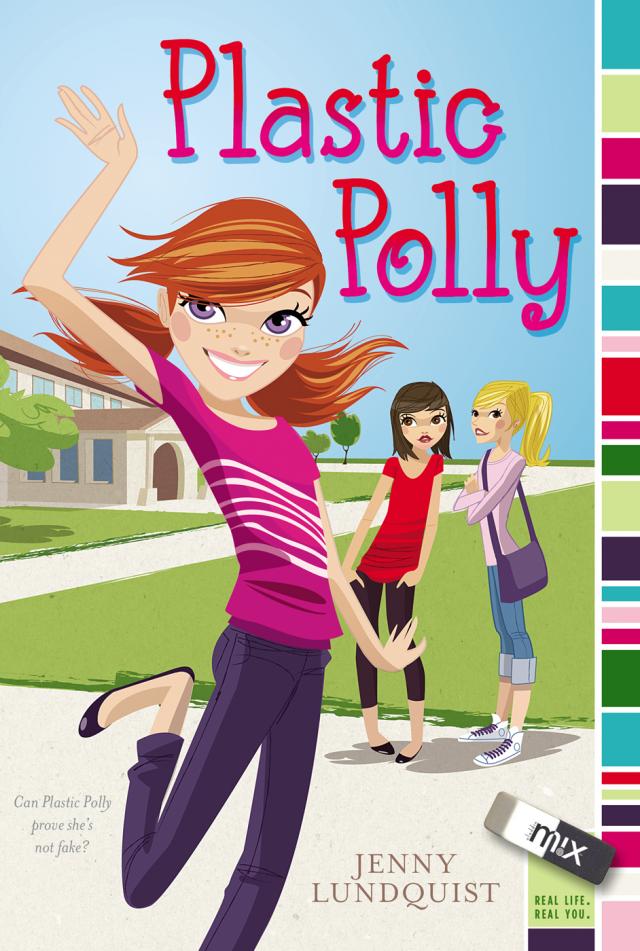
Contents
Chapter 1
Chapter 2
Chapter 3
Chapter 4
Chapter 5
Chapter 6
Chapter 7
Chapter 8
Chapter 9
Chapter 10
Chapter 11
Chapter 12
Chapter 13
Chapter 14
Chapter 15
Chapter 16
Chapter 17
Chapter 18
Chapter 19
Chapter 20
Acknowledgments
Sneak Peak of ‘Seeing Cinderella’
About Jenny Lundquist
To my parents, Thomas and Pamela Carroll.
I have never doubted your love.
Chapter 1
True Confession: Every time I hear someone call me Plastic Polly, I imagine myself slowly turning into a life-sized Barbie doll, one phony piece at a time.
I’M STANDING IN FRONT OF MY EX–BEST FRIEND, ALYSSA Grace. She’s on the other side of the salad bar, scooping for a cherry tomato that doesn’t want to be caught. Looking at Alyssa, you’d never know how stubborn she is—she’s so tiny and slight, her thin white-blond hair wisping around her face, that it seems like the slightest brush of wind could knock her over. But Alyssa can hold a grudge as deep and thick as the roots of the old maple tree in my backyard.
I haven’t spoken to Alyssa in over a year. Not since the first week of seventh grade, when she ditched Kelsey and me. We ignore each other in the hallways and at football games and dances. But today I want to tell Alyssa the truth: that I miss her. That having only one best friend—instead of two—has left me feeling lopsided.
My two friends next to me, Melinda Drake and Lindsey McCoy, don’t notice I’ve frozen. They’re still chattering about the banners for Groove It Up we posted all over campus this morning.
I spear the cherry tomato with my fork and drop it onto Alyssa’s plate. “Here.” I flinch because my voice sounds squeaky—the voice I used to have in sixth grade when I got nervous. Not like my voice now—the one I practice every day in the shower.
Alyssa looks up at me, and I hold my breath, wondering if she’ll walk away. But instead, she gives me a tentative half grin. I smile back and try to think of something to ask her. If she still takes voice lessons from that old woman who never brushed her teeth—we used to call her Lady Onion Breath. If she still goes to thrift shops. If she still eats chocolate ice cream with crushed-up pretzels.
Before I can say anything, Melinda, who thinks our popularity is a license to be nasty, snaps at Alyssa, “Hey, you with the hideous hair and unibrow. Can you move, already? The rest of us would like some tomatoes too.”
Alyssa doesn’t look at Melinda, but from the way her knuckles whiten around the salad spoon she’s clutching, I know she heard. And whatever chance I had to talk to her slips away.
The half grin on Alyssa’s face twists into a sneer. “Hey, Plastic Polly. How’s it going? Heading over to Fakeville?”
Several students turn and stare at us, and I feel my face flush. Sure, I know half the school calls me Plastic Polly behind my back. But no one ever says it to my face. And hearing it from Alyssa, it feels worse. Like a sharp stab in the back—especially since it was Alyssa herself who invented the name.
If Alyssa had said it when we were alone, I could have let it go. I could have apologized for what Melinda said, could have asked Alyssa all about her life and hoped she’s not still mad at Kelsey and me. But too many people are watching us. And after all, I am a member of the Court. We don’t apologize.
I lift my chin and stick a hand on my hip. My other arm drops gracefully to my side, and my arm bracelets jangle to my wrist. I look confident. In command.
I know this because it’s a move I’ve practiced a million times in front of the mirror.
In my best haughty voice I say, “Do you mean over there?” I point to the Court—the table where the popular kids sit—and nod. “We’re talking about Groove It Up, but if you hate us so much, maybe you shouldn’t bother trying out.”
The minute the words leave my mouth, I regret them. Groove It Up is a talent show competition between Winston Academy and our rival, American River Middle School. It is the social event of the fall, and it’s always planned by members of the Court. This year is an even bigger deal than usual, because it’s the competition’s fortieth anniversary and the winning school will receive two prizes. First, the members of the school’s Talent Team will get to perform on Good Morning, Maple Oaks. And the entire school will be treated to a private concert by Shattered Stars. They’re a really popular band whose members all grew up here in Maple Oaks. They’re too famous to play in small towns anymore, but somehow the city council talked them into it.
I posted the sign-up sheet for tryouts this morning before school started. After first period I went to check on it and saw Alyssa’s name written at the top. Alyssa has an amazing voice, and when we were in Winston Academy’s elementary section—when we were still friends—she would tell Kelsey and me how she couldn’t wait to grow up so she could become a famous singer. She must be dying to land a slot on the Talent Team, hoping we’ll win and she’ll get to be on TV.
Alyssa’s face crumples, but then her expression quickly hardens and she raises her voice. “So you’re saying the tryouts are rigged? Only the Court suck-ups have a chance?”
Now more people are staring at us. “What? No, of course not.” Although—and I would never admit this to Alyssa—in a way the auditions are rigged. Kelsey, my best friend and this year’s PlanMaster, has decided the cheerleaders, who are so good they won the state championship last year, will make up half of our Talent Team. She’ll break the girls up to perform in groups of two or three and then bring them all together for our final act. So even though tryouts haven’t even happened, half the slots are unofficially taken. Kristy Palmer, captain of the cheerleading squad, has been practicing with her girls for weeks. I told Kelsey that seemed to me like allowing the star player of a baseball team to bat in every inning.
“Polly, Melinda, Lindsey!” Kelsey calls from across the cafeteria. “Get over here!”
Alyssa smirks. “Later, Plastic. Your master is calling you.”
I scoop up my cafeteria tray, shoot Alyssa an irritated glance, and follow Melinda and Lindsey over to the Court.
The Court is a long rectangular table in the middle of the cafeteria. Directly above the table is a skylight—so the sun can shine down upon the chosen few of us who are allowed to eat there. Winston tradition dictates that the most popular eighth graders sit at the Court, as well as a few seventh graders who will take our place after we graduate.
Normally I get a small thrill as I approach the Court. I know it’s not cool to admit this, but I adore feeling everyone’s eyes on me as I saunter over to my usual spot. Outwardly I pretend to be bored, like it’s no big deal. But inside I’m loving it. Especially when I catch people like Jenna Huff—who used to laugh at me and make fun of my squeaky voice when we were in Winston’s elementary section—watching me.
It makes me feel like, Ha! Look who’s laughing now!
Today, though, I can’t bring myself to sit down right away. I take a detour to the condiment area, where I fill up tiny plastic cups with my four favorite salad dressings. I like to drench pieces of lettuce in the dressing. I call it salad fondue. Out of the corner of my eye I watch Alyssa. I’m hoping she comes over. Maybe then I can apologize.
“Hey, Polly.” I look up and see Kate Newport, a girl who likes to hang around Kelsey and me, hoping we’ll invite her to the Court. She’s wearing a white tank top and a pink flippy skirt. It looks exactly like the outfit I wore to the pep rally a few weeks ago, when Kelsey announced she’d selected me as her Vice PlanMaster.
“Like my outfit?” Kate says.
“Um, sure. That’s a super cute . . . necklace you’re wearing.” And it is. It’s a small pink-and-white rhinestone medallion on a silver chain.
Kate smiles like she just won the lottery. “Really? If you like it, you can have it.” In a flash the silver chain is dangling from Kate’s finger, the medallion ticktocking above my salad.
“No, Kate, really. That’s sweet, but I don’t want your jewelry. Put it back on.” I push the necklace toward her just before it dips into my salad dressing. “Please.”
“Okay, but here’s a bracelet. It’ll look good with the ones you’re already wearing.” Kate thrusts a silver bangle at me. “Friends share, right?”
“Um, sure.” I stick the bracelet onto my wrist. “I’ll give it back to you tomorrow.”
“Oh, no. Keep it. It’s yours,” Kate says, and practically skips away.
Here’s the thing about being popular: Sometimes popularity is like your own personal good luck charm, a talisman that bestows favor, whether it’s a bracelet, fifty holiday grams from people you barely know, or guaranteed invites to all the middle school events.
I glance over at Alyssa again. She’s finished up at the salad bar and starts over to the condiment table. When she sees me, she changes direction and plunks down at an empty table just behind the Court. I sigh and look away.
But here’s the other thing about popularity: It doesn’t come cheap. Sometimes it makes you choose one best friend over another. And you can never admit to anyone that sometimes you wonder if you made the wrong choice. Because if you admitted that, they’d just laugh and say, “You’re popular. What problems could you possibly have?” So instead, you keep your mouth shut,
It’s just easier that way.
“Polly!” Kelsey hollers. “Are you keeping vigil over there, or what? I have an important question to ask you!”
With one last look at Alyssa, I turn away and head to the Court.
And stick a fake smile on my face.
Chapter 2
True Confession: No one at school ever told me I was pretty until after I became popular.
“FINALLY,” KELSEY SAYS WHEN I TAKE MY USUAL SEAT at her right side. As the most popular eighth grader at Winston Academy, Kelsey sits at the head of the Court. “I need you to settle a disagreement between Melinda and me.”
Everyone sitting at the Court—which today includes a few football players, Kristy Palmer and a couple of other cheerleaders, and Kelsey’s soccer teammates—turns to stare at me.
“Okay. What is it this time?” Lately Melinda has been saying we should have certain rules at the Court, like Monday you have to wear pink, or Friday is jeans day, but Kelsey—who never wants to be like anyone else—thinks it’s a stupid idea. And when it comes to clothes, neither of us trusts Melinda. She’s great at selecting an insult but less accomplished when it comes to fashion. Today Melinda’s wearing a bright yellow sundress with brown polka dots, and frankly she looks like a talking banana.
Kelsey flips her long hair, which is as black and sleek as a panther’s mane, over one shoulder and says, “Melinda thinks we should all wear the same costume to Kristy’s Halloween party, but I say no way. What do you say?”
“Come on,” Melinda begins. “The party isn’t for a few weeks, and—”
“I already bought a costume,” I say, cutting her off. “And there’s no way I’m taking it back.” I’d take Kelsey’s side even if I hadn’t already bought a costume. When you’ve been best friends since kindergarten, that’s just what you do.
Kelsey grins triumphantly. “See? Two against one. Too bad, Melinda.”
Melinda stabs at her salad and grumbles. “It’s not fair. Just because you have a best friend who—”
“What was that?” Kelsey cocks an ear.
Melinda looks up and suddenly seems to realize everyone is looking at her. “Nothing.”
Melinda changes the subject and begins talking about a reality show she saw on TV last night, but I don’t pay attention. I’m looking over her shoulder, at Alyssa. In the window behind her several red and gold leaves from the maple trees drift slowly to the ground like lazy sailboats. I remember how Alyssa’s dad used to pay me and Kelsey and Alyssa a penny for every leaf we picked up in their front yard. Kelsey and Alyssa always fought over the red ones.
“Earth to Polly,” Kelsey says. “What’s with you today? You seem distracted. And you took forever at the salad bar.”
“Some girl was giving Polly a hard time.” Melinda points her fork at me. “And Polly was just taking it.” Melinda’s voice is disapproving, like she’s tattling on a small child who’s just done something very naughty. Sometimes I catch her staring at me with a puzzled, distasteful expression on her face, like she can’t figure out how I became popular. And lately Melinda’s been taking her chronically cranky mood out on me—especially when she feels like me and Kelsey are ganging up on her.
Before I can remind Melinda that I did stick up for myself (and still feel bad about it), Kelsey says, “That’s your problem, Polly. You don’t assert yourself. Someone messes with you”—Kelsey pounds her fist on the table—“you squash them.”
“Squash them?” I laugh.
“Like a bug. And anyway, what girl was giving you a hard time?” She turns to survey the cafeteria, eyes narrowed.
“Some ugly girl from my history class,” Melinda says. “She’s no one.”
“Her name is Alyssa,” Lindsey says. “She’s usually pretty nice.” Lindsey quickly glances at Kelsey and me, to see if she said the wrong thing. As a seventh grader Lindsey is careful to stay on everyone’s good side. So I smile back at her to let her know everything is fine.
Kelsey pales, and after the conversation turns to another topic, she leans over and whispers, “Alyssa Grace?”
It sounds weird to hear Kelsey use Alyssa’s last name. Like she’s a stranger. Like Alyssa isn’t the girl we once bought special best friend necklaces with—a heart split three ways.
“She’s sitting behind Melinda,” I whisper.
Kelsey turns, and we both watch Alyssa. “Why is she sitting there?” Kelsey whispers. “Doesn’t she usually eat lunch with her choir friends?”
“Yes.”
Kelsey and I glance at each other—both of us silently acknowledging that, even though we don’t talk about Alyssa, we’ve kept track of her the past year.
“Um, Kelsey?” A girl I don’t know—a seventh grader, I think—tentatively steps forward. “Mr. Fish says he needs to see you. R-right now.” Sweat breaks out on her upper lip, probably because she was forced to approach the Court without an invite.
Mr. Fish is the teacher adviser for Groove It Up. He seems nice enough to me, but Kelsey can’t stand him. She gives a long-suffering sigh before leaving.
Afterward I get drawn into a conversation about the upcoming football game, and whether I think the Winston Wildcats will win on Saturday. I smile and nod, since I’m expected to care, but the whole time I’m watching Alyssa.
Sometimes I wonder what life would be like if the ground hadn’t shifted, elevating Kelsey and me—turning us into middle school royalty—while Alyssa was thrust to the bottom of the middle school heap. Back when the three of us had sleepovers every Friday night at Alyssa’s house, Kelsey and I would sing off-key to stupid pop songs on Mr. Grace’s old karaoke machine. Every now and then Alyssa would join in—overpowering us with her diva voice. But usually she’d make funny faces and dance crazily around the room—like a chicken doing the hokey pokey—and we’d all laugh till we fell to the floor in hysterics.
“Hey, Pretty Polly,” says Derek Tanner, a football player sitting next to Kristy. “I’m going to get a soda from the vending machine. Want one?”
I nod and tell him thank you. In the past couple weeks Derek’s started showing up at my locker, buying me sodas during lunch, and insisting on carrying my backpack in between classes.
After he leaves, Kristy and Melinda giggle, and Lindsey whispers, “He totally likes you.”
“Maybe.” The girls are convinced Derek has a crush on me, but I just can’t get all that excited about it. I mean, yeah, Derek’s really cute. But he also has this weird look on his face all the time—like he’s constantly surprised by the smallest things. Plus, he smells like cardboard. Don’t ask me why.
Also, I happen to know (since he mentions it at least once a day) that Derek is trying out for Groove It Up and really wants a slot on the Talent Team. If it weren’t for the fact that Kelsey intimidates most of the boys at Winston, I think Derek would be buying her sodas. You know, go straight to the top, and all that.
I watch while Derek lingers in front of the soda dispenser, scratching his head and looking baffled—like the machine’s playing a practical joke on him. Then I turn to the girls. “What if he only likes me because I’m on the planning committee?” I ask. “Or because I’m popular?”
“So what?” Melinda looks genuinely confused.
After that, Kristy tells us about the camping trip she went on with her family over the weekend.
“That sounds super fun,” I say, watching Alyssa while I talk. “I love camping.”
Melinda turns to me. “Didn’t you tell Kate Newport last week that you’d rather stick a needle in your eye than go camping?”
“What?” I turn my attention back to the girls. “Oh, um . . .” Okay, I did say that. I wasn’t trying to be totally fake to Kristy or anything, but I’ve noticed people sometimes get upset when you disagree with them over the smallest things. Like if someone says, “I really like lemon drops,” and you say, “I don’t like lemon drops,” the other person gets all offended. Like you’ve just said you don’t like them.
So in my opinion it’s just easier to agree with people.
“Um . . . I forgot,” I say.
“Hey, hey, hey, it’s the PlanMaster herself!” says Toby Markowitz, another football player, as Kelsey plunks back down in her seat. “Death to American River!”





