

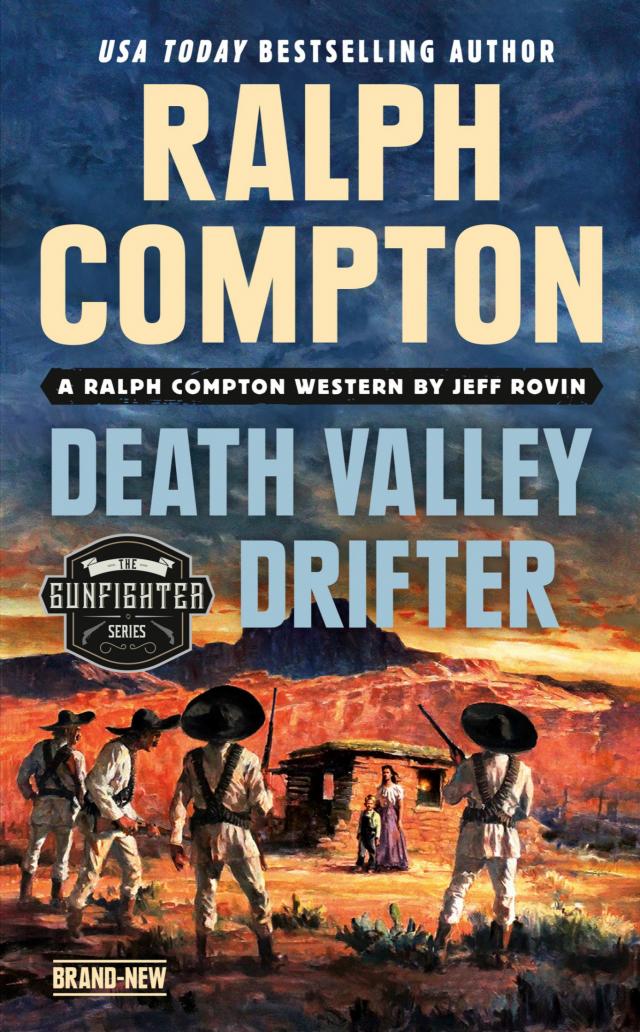
Death Valley Drifter, page 1


BERKLEY
An imprint of Penguin Random House LLC
penguinrandomhouse.com
Copyright © 2020 by The Estate of Ralph Compton
Penguin Random House supports copyright. Copyright fuels creativity, encourages diverse voices, promotes free speech, and creates a vibrant culture. Thank you for buying an authorized edition of this book and for complying with copyright laws by not reproducing, scanning, or distributing any part of it in any form without permission. You are supporting writers and allowing Penguin Random House to continue to publish books for every reader.
BERKLEY and the BERKLEY & B colophon are registered trademarks of Penguin Random House LLC.
Ebook ISBN: 9780593100769
First Edition: September 2020
Cover art by Dennis Lyall
Cover design by Steve Meditz
This is a work of fiction. Names, characters, places, and incidents either are the product of the author’s imagination or are used fictitiously, and any resemblance to actual persons, living or dead, business establishments, events, or locales is entirely coincidental.
pid_prh_5.6.0_c0_r0
Contents
Cover
Title Page
Copyright
The Immortal Cowboy
Epigraph
Prologue
Chapter One
Chapter Two
Chapter Three
Chapter Four
Chapter Five
Chapter Six
Chapter Seven
Chapter Eight
Chapter Nine
Chapter Ten
Chapter Eleven
Chapter Twelve
Chapter Thirteen
Chapter Fourteen
Chapter Fifteen
Chapter Sixteen
Chapter Seventeen
Chapter Eighteen
Chapter Nineteen
Chapter Twenty
Chapter Twenty-One
About the Authors
THE IMMORTAL COWBOY
This is respectfully dedicated to the “American Cowboy.” His was the saga sparked by the turmoil that followed the Civil War, and the passing of more than a century has by no means diminished the flame.
True, the old days and the old ways are but treasured memories, and the old trails have grown dim with the ravages of time, but the spirit of the cowboy lives on.
In my travels—to Texas, Oklahoma, Kansas, Nebraska, Colorado, Wyoming, New Mexico, and Arizona—I always find something that reminds me of the Old West. While I am walking these plains and mountains for the first time, there is this feeling that a part of me is eternal, that I have known these old trails before. I believe it is the undying spirit of the frontier calling me, through the mind’s eye, to step back into time. What is the appeal of the Old West of the American frontier?
It has been epitomized by some as the dark and bloody period in American history. Its heroes—Crockett, Bowie, Hickok, Earp—have been reviled and criticized. Yet the Old West lives on, larger than life.
It has become a symbol of freedom, when there was always another mountain to climb and another river to cross; when a dispute between two men was settled not with expensive lawyers, but with fists, knives, or guns. Barbaric? Maybe. But some things never change. When the cowboy rode into the pages of American history, he left behind a legacy that lives within the hearts of us all.
—Ralph Compton
No plan of operations extends with any certainty beyond the first contact with the main hostile force.
Helmuth von Moltke the Elder
PROLOGUE
THE NIGHT WAS warm, and the desert wilderness was dark as the two men galloped from the camp. Shouts trailed them like the smoke from the campfire, clinging yet growing fainter by the moment.
It was not their camp, and the box tied to the saddle of one man did not belong to them. They had acquired it in a breeze-soft but lightning-fast attack that left their victims stunned—and momentarily horseless, the thieves having cut the reins of their mounts.
But the four uniformed people at the camp—one of them possibly a woman; it was difficult to be certain in the firelight—were not helpless, and they had a desperate reason to mount a pursuit. That was why the robbers had fled quickly. They had pressed their horses hard, the animals’ footing uncertain in the deep sand and entangling scrub. The mounts were starting to show resistance, especially the palomino with the blond mane. The other horse, black as the sky and spotted here and there with white, paid more attention to its resolute rider—the man with the box.
Though they raced swiftly north, the man on the blond stallion regretted their flight. He was angrily chewing down on the tall strand of prairie grass he had picked during their approach, using it to keep his mouth moist as the hot night air rushed in. There hadn’t been time to drink from the deerskin, first for fear of making noise and then for being a distraction as they fled. They had to get away, he had been told. Now.
Frustrated by his uncooperative horse and by the retreat, the tall man had kept pace with his partner before stopping and simultaneously executing a quarter turn to the left so he was facing the other man. The second man galloped past several paces. He stopped abruptly to rein partly around.
This man’s face was a long, featureless shape in the dark. The reins were wrapped around the wrist of his left hand. In his right, he was still holding the revolver he had drawn back at the camp. It rested protectively on the small lockbox, the leather handle atop the metal container slung around the pommel. There had not been time to open the box and remove its contents; until then he wanted it where he could see it, feel it knocking as he rode. He also could not destroy what was inside. The items might be needed by his own people. Aggie, if it came to that.
“What the hell is wrong with you?” demanded the man who had stopped second.
“We have to go back!”
The long face grew rigid. “Mister, you’re taking orders, not giving them—”
“And you’re being reckless. Those men back there—they’re veterans. You know as well as I do, soon as they rally they’re coming back hard! Best to take the four of them now when we can set an ambush!”
“Veterans enough not to ride stupidly into a trap. They may be making torches right now. They think we’re hiding, they’ll burn brush. We outrun them. That’s the plan!”
“Your plan is a puzzle, my friend!”
“You’re wasting time!”
“And you’re being reckless! Those boys are Rebs still fighting a war! You saw how they ran us from Mexico to here—they’re not going to stop. Which says to me we fight them now when we have a jump, or we fight them later when we don’t.”
“They’re not the only ones still fighting a war.”
“What does that mean?”
“I can’t say more.”
“Who the hell am I gonna tell anything to out here?”
The other man raised the gun and glared at his companion. “Damn it—ride. Now.”
The other peered into the dark, still—and disappointed. “Or what? You gonna shoot me?”
“If I have to.”
“For this or for something else?”
“What are you talking about?”
“I saw you and Aggie before we set out.” He let that register, then added, “I was coming to say my goodbyes to her.”
The other man hesitated. “I’m sorry. Truly. But I wouldn’t draw on you for that.”
“You sure?”
“I’m sure of this. I’d rather have you dead here than go back and get caught. They will cut you up for what they need to know.”
“Even if they did, I couldn’t tell them much, thanks to you. ‘Some kind of war’s being fought, only I don’t know what that means.’”
The other man said nothing, but his stance was defiant. The rebellious rider’s mind was churning things fast. Something was not right. His behavior back at the camp, their urgent departure—he would say fearful, if he did not know his companion better.
“You could have killed them back in Ensenada, too,” the stubborn rider went on. “But that rider showed up—who was he?”
“Goddamn it, there’s no time. You coming . . . or staying? Last chance.”
The man on the spot did not move. His hand was a few inches from the sheath strapped to his hip. It held his second Bowie knife; he had left the other one in a tree about a half inch from a man’s cheek. Close enough to make him talk without inhibiting his ability to do so. He would not be able to reach the remaining knife in time—not if the other man meant what he said.
And the idea of drawing on his old comrade in arms tasted bad inside his cheeks.
Both horses complained simultaneously. The hot night air was picking up, and there were unfamiliar sounds in the night, on the ground and in the skies.
“You haven’t even told me why we’re here!” protested the man with the Bowie knife.
“Look, keeping secrets wasn’t my choice. Those were orders.”
The other man considered that, then shook his head. “Then this is my choice. Kill me if you want, but I run to fights. I don’t run from them.”
And that was the last thing he said before the second man’s arm moved, and the gun swung, and the man who was struck swore
CHAPTER ONE
DAMN YOU. . . . DAMN . . .
Those were the last words he remembered. They were the only words he remembered. The man came to lying on his chest, knowing nothing more except that he was alive.
That much was plain anyway. It was not memory.
As he became dimly aware of his surroundings, and the thick black night in his head became too bright day, he realized he did not actually remember anything more than those words. He did try to answer the involuntary first question, Where am I? He knit his forehead. As his mind struggled to get its footing, he found himself wondering: What am I doing here?
The question was brusquely shoved aside by a hard, angry pulsing throughout the entirety of his skull. He asked himself, Have I been drinking?
He did not know. Like the sweat that permeated his skin, some insistent and rational piece of him pushed to the fore.
One puzzle at a time.
The man opened his eyes to slits and fought through the pain in his head to have a think about what he did know. It was day. He saw blurry yellow-white ahead of him, felt the sun on his back and left cheek, on the backs of his bare arms. He was aware of grit along the outsides of his gums. And his head hurt worse for the effort of just letting in the light. He knew that, too.
The man’s face was lying on its right cheek. When he found the strength to inhale deeply, he also found that there was sand in his nose. His nostrils were partly lying in it. He made a valiant attempt to snort out the grit, mostly succeeding after three tries; then he tried to raise his face. The sand clung like pepper on a fish. That was no concern. What was: The instant he moved, the right side of his head kicked as though there was a bronc in his skull trying hard and regular to get out. The man dropped back into the hot, dry sand. As consciousness returned more fully, he realized that his back burned. His chest did, too, because the hot sand clung there, too, stuck in every pore from his exposed waist to his neck. There was something crawling inside his ear, too small to be a scorpion—probably a fly. He shook his head a little, and it buzzed away with noisy protest.
You remember bugs, he thought, able to visualize them.
The man’s fingers were lying beside his thighs. They were swollen from the heat. He felt along his legs. They were not bare, though he had no idea why he was wearing just long, sweat-soaked underwear bottoms. Worse than that, even as his head cleared and he could picture garments and feel textures, he still had no idea where he was or how he had gotten here. And as the man started to think, he realized one thing more.
He had no idea who he was.
He thought hard. What little he remembered—from when, he also had no idea—came when he used his tongue to try to spit out more sand.
A picnic lunch. A sunny beach. Sand in the food. But—was that recently?
He knew what he felt, and also what he smelled and heard—both, nothing. Not a horse, which surprised him. It was time to see. When he finally opened his eyes, they instantly smarted from the sun, which was white and washed-out. But at least he could see the daylight, the sand, and a bit of scrub. When he closed them, all he could see were shadows of a horizon and the foliage against ruddy eyelids. Nothing else appeared to him, not even what he looked like. There was just a deep black well without a bottom or a reflection.
As time passed—perhaps minutes, maybe only seconds; pain had its own way of measuring things—he gave some attention to the sweat that greased his body. It was thick and heating his outsides to near broiling, sucking all the moisture from inside. Moving his mouth, he realized it was not only sandy, but he could not clear it because his tongue was too dry to try to spit. And then, as he slowly raised a hand to where his head hurt—the plumped hand seemed to weigh as much as an iron mallet—he became aware that not all the moisture on his scalp was perspiration.
There was a sticky patch of blood clinging to his hair like morning dew in hell. His fat, shaking fingers spider-walked along the thin trail that ran from the top of his head to deep behind his right ear.
The man’s fingertips crept back in the other direction along his scalp, and he let out a raspy yelp of pain as he found the open wound toward the front of his crown. At first he wondered if he had somehow survived a scalping—how did he remember what that was, but not his name?—until his crablike exploration found just a gash in the hair wide and damned painful but not very deep.
He had been struck. He remembered a lightning flash behind both eyes. And right before that, before he swore—
A figure indistinct in the dark. Very near with a six-shooter in his hand.
The figure was not shooting. But he was coming toward the man. He remembered, suddenly, his own horse, dark brown with a blond mane. He must have been riding swiftly, since the animal was breathing heavily. Everything else about the animal—saddle, gear, what weapon he might have been carrying—he could not picture or recall. Or what he had been doing right before that. Or why. Or where. It must have been something in this desert, though he could not picture anything.
Well, a companion and a horse—that’s something, he thought. Was the horse nearby? He would have to open his eyes and get off the damned ground to find out.
Mustering his energy was almost as difficult as trying to remember things. Rising came in jagged spurts, like a marionette being lifted by its strings. It happened with great effort and initially generated little progress. The man dragged his arms from his sides, all stiff and unhelpful joints below the shoulders. He finally planted his palms on the ground, inhaled, and pushed up. Sand clung to half his face as it was lifted from the scalding, sweat-dampened ground. There was a blade of grass stuck to his lower lip, held there as if it were peeling skin. His arms shook, but he locked the elbows. His head screamed, but his mouth was too parched to give the pain more than raw, airy voice. A weak hiss escaped his throat, and then he settled into the rhythm of the pain. He closed his dirty, blistered lips and breathed through his nose, painfully sneezing out the dirt. He lost strength for a moment and fell down, plunking his chin on the sand to support the weight of his aching head. He feared that if he gave up now, he would never get up. He pushed up again.
The grass and some of the sand had come free, his exposed skin baking under the sun. His elbows locked again, and he remained upright. It took a moment for his dry eyes to focus, longer to adjust to the brilliant daylight.
The man did not like what those hurting eyes settled on.
There was an ugly rusty shape about two feet in front of him. It was a scorpion. He knew that it was a danger. But even a horse would know that much. Fortunately, the devilish-looking thing seemed as unmotivated as he was in the white sunlight. Nonetheless, it was best to get away. Pressing his palms to the hot ground and having more reason to get up than he had a moment before, the man rose slowly.
He grunted, his head hammering angrily, but at least his arm and back muscles did not complain much. Breath came without pain. He could not have been here long enough for them to have stiffened, he decided. With effort, he got onto his knees, hovered there until he was steady, then looked around.
There was nothing to hold on to. No tree—and no horse. That was concerning.
“You . . . better . . . get . . . up,” he muttered dryly.
His tortured voice and pronunciation were not familiar to him.
The man got his bare feet under him one at a time. Sand shook from his chest and arms. He locked his knees and stood. His head argued against rising and then being upright, but he remained like a newborn foal, shifting balance from side to side and accepting that here he was. The pain made him feel nauseous, but there did not seem to be anything in his belly to regurgitate.
You didn’t have time or vittles to eat, he thought. Or both.
Only when the man was sure of his footing did he back away from the scorpion—which seemed, by its stillness, utterly uninterested in him. For all he knew, it was dead. Now that he could see more of his surroundings, he noticed a tarantula nearby. The brown-haired thing was on its back, its legs curled inward. It appeared dead. Maybe the two predators had struggled, the scorpion winning the fight but losing the war. It could be they had never even met, had been scuttling just out of range. Perhaps the spider had failed to find shade or water or whatever it was that a spider required.


