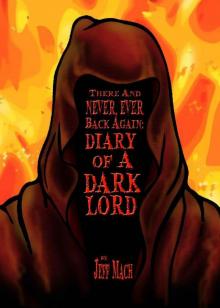
There and Never, Ever Back Again, page 2


“Why not?”
It’s not simply about defiance, of course. I might not agree with every grimoire, but I’ve sought and found and read every single strangely-bound collection of oddly-dancing words I could possibly find. (That’s part of why I’m writing this; always try to leave the ladder with more rungs than when you found it.) And all the runework and the study and the alchemy and the conjurings and the battles of wits with the speaking dead, they’re essential, as well, if you would pursue a left-hand path. You can’t gain sorcerous dominion without the work and the risk.
This is the heart of a Dark Lord. This is why societies—rightfully, mind you—push us out. Society needs those who are abhorrently different; from us come science, medicine, homicide, religion, cultural improvement and cultural disruption. Society needs us, but it often doesn’t want us.
We become their leaders, their witch-doctors, their eccentrics—or their ostracized.
That is what makes our magick dark. We question the world. We question our realities. We seek out change when sameness is safety and comfort. We are makers and shatterers. We are phoenixes; both incineration, and new birth. We’re not the only ones who do that. But we’re the ones who fit in least. And when you don’t put in the effort to fit in, you signal that you are some kind of threat to the culture. Even if you might be a positive threat, you still activate societal antibodies.
So all dark magic starts with stepping outside of unseen barriers, not of magic, but of tradition and taboo. They fear you, so they name you after the things which terrify them--the primordial night, the unseen, the unknown.
Is there such a thing as Dark Magic?
If there isn't, make some.
Making A Monstrous Army
I have never met an Orc with decent self-esteem.
Contrary to popular belief, Orcs are not ugly. They’re frequently asymmetrical, which can be jarring to other sentients, since normal humanoid bilateral symmetry tends to see deviation from regularity as deformity. (Yet we claim not to fear malformed humans; is that true?)
Oh, the cave-dwellers have tusks, sure. That's a reason to dislike their faces. Then again, we fear the canines of the Orc…but we enjoy those of the dog. Why is that?
It's because dogs are domesticated, unthreatening. If they were sentient, we might call them slaves.
Orcs refuse to be slaves to Man. And Man can’t handle it.
The Orcs and I have a long understanding. Because I provide them with a target-rich environment? Sure, that’s a bit of it. But I actually offer something better and far more meaningful. I accept them.
For humans believe that Man and Orc cannot coexist. Humans say that the Orcs are vicious predators who would see everyone else dead or in servitude.
And of course, humans wouldn’t lie, would they?
They never do that.
They surely asked the Orcs before labelling them as enemies.
Because that’s consistent with human history, is it not?
Humans have pretty much never recorded an encounter with Orcs that ended in peace.
That’s got to be the Orcs’ fault.
Humans believe that Orcs need extermination. Personally, I believe they need therapy.
I don’t make monsters.
Definitions make monsters.
You make definitions.
Do you know why you fear the things that go bump in the dark?
Because you’re the ones who drove them into the dark to begin with.
On How To Win Friends and Enemies, And Then Kill Them Both
Since this appears to be the moment at which The Chosen One is gathering her band of stout-hearted, deathwish-possessing colleagues, it might be a good time to talk about alliances.
(How they flock to her now, guided by the reputation of the sage at her side. It’s very dramatic that they’re all risking death, of course. On the other hand, in your ordinary medieval-era culture, the average lifespan is about 40. There’s a reason Beowulf wasn’t particularly planning on a long retirement.)
Still, who would possibly dare to step forward in front of a multitude and promise that they’ll put their lives on the line to uphold ultimate good? Anyone who likes parades, getting laid, and having drinks bought for them in taverns, that’s who.
It would be cynical to say that the White Wizard gathers allies because he wants to be surrounded by admirers. It would also leave out the fact that he likes to be surrounded by an abundance of meat shields in case something goes wrong.
In contrast to the Wizard's widespread appeal, it’s sometimes said that Dark Lords care and are cared about by none but themselves. That is primarily a discussion for later, but it does open a few pestiferous questions that the forces of Light tend to leave out of their calculations on a distressingly regular basis. Starting with:
How in the Eleven Hells would that even work?
Seriously, who would ally with someone whose goodwill is based entirely on convenience? Why fight, other than very temporarily, beside someone who will supposedly turn on you as soon as their own objectives are achieved? If Dark Lords won’t remain true to their words, if they’re consistently treacherous, how would they ever raise up armies?
Either one would need a steady stream of lies, or a convenient superabundance of overly-foolish allies. In either case, bear in mind that gullible comrades are a weak spot; after all, if you can deceive them consistently, that does not speak well of their ability to see through the ruses and feints of your enemies. Anyone who’ll fall for “Oh, your friend who was asking inconvenient questions? Managed to slip and land on his own ten-foot halberd. Very sad” – yeah, anyone who’ll believe that more than, say, zero times is going to be utterly at a loss the next time an enemy army pretends to charge them, and flanks around in a pincer motion instead.
But hey! Heroic deaths are exciting, right?
So okay. Assume some of your allies are just idiots. That can’t be the whole truth, so the rest must be taken in by the aforementioned constant stream of falsehoods—
Yes, that’s one way to do it. But it presupposes the idea that The Dark Lord is one miserable son of a bitch. Because this would bring us to another logical question: Why amass tremendous power only to live a lie?
Theorize that Dark Lords are, as claimed, simply evil beings of deception with no motivation to do anything other than act in their own benefit. Even were this the case, the whole problem of living a lie is that you become known for what you are not, instead of what you are.
That’s not beneficial to you. It's pretty pointless to fight your way towards power, only to lose the identity which made the fight worthwhile.
Why become Dark Lord simply to enact the fantasies of others? Why struggle through all that pain and difficulty only to be a character actor?
And how do you plan to get anywhere if you don’t have a consistent model of reality which interacts well with the outside world? Propaganda hits the emotions just fine, but doesn't translate well into accomplishment. For example, a few Chosen Ones back, the White Wizard told one of his protégés, “Fear not the night, for you carry within you the light of truth.”
Kid was eaten that same night by a boggart. If there was any light inside that youngster, all it did was serve as seasoning.
The White Wizard has promised an end to the reign of Darkness, by which I believe he means some anthropomorphic personification of evil.
It doesn’t make much logical sense, but it sure sounds exciting.
I’ve promised my allies the Sun.
We’ll see who lied, later.
I Didn't Choose The Exiled-At-Spearpoint Life; The Exiled-At-Spearpoint Life Chose Me
Those who begin to summon demons, on seeing something they can’t handle coming through the Gate, sometimes abjure: “Come forth, but not in that form!” And by this they mean that they want access to the power, but not the corresponding pain and madness which lap at its fringes.
Sometimes they get what they want. Usually, they get what they deserve.
When I am hard-pressed, I sometimes ask myself: did I ascend a blood-etched throne simply to be the incarnation of someone else’s imaginings?
The answer is never, never, and never, and thus reminded, I redouble my efforts and go on.
The people are, as it has been said, a great beast—and no simple, civilized beast like a werewolf or a momrath, but a huge, angry, amorphous mass, all too ready to set fire to anything they don’t understand. Individual humans may be wise; large groups of humans have the intellect of rocks, if rocks had the capacity for spite, petty jealousy, and a desire to be entertained by the misfortunes of poorly-dressed celebrities.
They will steal your sense of self, because they’ll repeat what they think you are until the murmurs of it echo through the hallways of your home and the alleys of your mind. And to a Dark Lord, the steel bar inside you, that thing you’ve relied on since the beginning, honed and strengthened, that sense of self, is more valuable than the throne. Because with it, if you had to, you could win another throne; without it, you will lose this one.
That’s part of why they want to take it away from you. They may not understand on a conscious level, but they recognize you have some quality, something inside, which will not let itself be moved against your will; that it's not inborn, but the product of your own sweat and shaping. They fear that thing. And rightly, perhaps; one could do truly horrific things if one is able to choose in favor of her inner mind, instead of the desires of others. Nevermind that one could also thusly make wonders.
They hate being unable to control you; they feel like, when the chips are down, you might decide to act in your own interests instead of theirs.
I will let you in on a little secret: the reason they fear the worst of you is because it is what they have in their own hearts.
Most of them do not have the ability to defy a group or a conventional idea on their own. But they know that, if they could defy the needs of the group without being stopped, they would steal what they could for themselves, and they assume all others must be the same way. Has the team a cache of gold that none are supposed to touch? They’d take it if they thought they wouldn’t get caught. They see morality as constant outside pressure: We force each other to be good, because otherwise, we’d all do evil.
They don’t quite visualize it that way in their heads, of course. They view it in the traditional way: “If we thought we could do so, we’d take the gold…but we’d spend most of it on widows and orphans, of course, where it belongs. But if the Dark One had the gold, she would use it on destruction and folly!”
(I’ll freely admit: when I have gold, folly is a priority. Give me airships and luftbaloons! Give me rock faces carved into Orcish puns! Give me the ridiculous, because it's a gateway to the sublime. Besides, seriously, have you considered what would happen if you lived for centuries and never laughed? Your expression would probably calcify and you’d have permanent lemonface.
But destruction? True, Dark Lords raze things to the ground; we also raise things up. If you’re entirely sure that it’s the Dark Lords who do all the destroying, and none of the making, I’d like to invite you to try to build a realm sometime. If you haven’t done what we’ve done, you may not have a lot of ground from which to criticize.)
All this is part of why some cling so hard to “Good”, as if everything in the universe had, inscribed somewhere upon its atoms, a little sign that said “here is good” or “here is evil”. They absolutely need to believe in Good, and they need to believe they’re on its side. Because with doubt comes the possibility of being wrong, and once you think there’s a chance you could be wrong, you have to deal with that annoying, tricksy little problem: “What if I’m not doing the right thing?”
Takes a lot of energy to tackle that one, energy which could much more pleasurably be expended hanging about the pub, talking about your own personal excellence.
And so they seek to be Good, and to be around Good. And they can’t see me as having any of its qualities; that would make me a little like them, and they’re terrified that we might have anything in common. I need to be a beast, and the only beast, because only then is it appropriate to hunt me without limits.
Good has friends and allies. What does evil have? Presumably a consortium of power-hungry fiends, united either by fear of me, or by deception. Or both, one suppose. Surely evil never has equals. Never has colleagues. Never has those who are joined in bonds of camaraderie; surely something in your spiritual makeup rejects kinship with others, once your soul is tainted.
Good theory, right?
Only if one were really that toxic to others, answer me this:
Why would you want a world where you can only have friends you will use, but never truly join?
The obvious answer is that you can use them to secure power, and that’s true—up to a point. Yes, power is its own reward. But likewise, some methods of obtaining power are their own punishment.
Being without empathy, whether it's inherent or learned, is a weakness. Being unable to share the feelings of those around you would just cut you off from the world, and the less you are associated with the realm you walk, the less effectively you can make your mark on it.
You may not prefer frequent human contact, be it from introversion or misanthropy, but if we weren’t meant to commune with others, we wouldn’t have either language centers in our brains, or taverns. The same beer oughtn't taste better when consumed in the right company...but it does. Because human minds are peculiar things.
Oh, there are lots of reasons why you'd want cease being human—stop being a tiny, angry, frightened, vicious thing, vulnerable to the contagion of any neighbor with a strong view and some shiny farm implements. You might want to become a God; you might simply want to become Not What You Are.
It’s tempting, but again, think longterm. Gods forget the ways and lives of mortals. This doesn’t just make for bad rulership. It makes for a bad sense of what humans can do. There’s enough force and might trapped inside a bitsy, mortal, hominid body to create—well, to create someone like a Dark Lord, for one thing. Ascend away from that, and you disconnect. Mortals are ape and angel, both ephemeral and divine. Life has meaning because it ends; life has purpose, because its potential cannot be named or numbered, only built.
That’s a lot of power to give up, in exchange for what is, in effect, a ton of force without an instruction manual. The more you get a reputation for shouting, “I AM A GOD; BOTHER ME NEVER AGAIN, MAYFLIES!” when you’re annoyed, the less you’re going to win loyalty from anyone else. And the less you’ll understand it when the “mayflies” become a hive and then a swarm, and then they come for you.
Because you must remember this: If there is ONE thing at which mortals excel, it is at killing their gods. Ask any of the legion of forgotten pantheons who formerly ruled parts of the world. Or read their holy books—if you can find them; if they haven’t been destroyed, or rewritten with new names to suit the convenience of the humans who made them.
Without connection, you become a lens which is clear only in one direction, and you project onto others that which you see in your own, badly expurgated self.
That is the misery of the White Wizard, and possibly why he spends quite so much time indulging in Hobbit-weed. He’s essentially alone by choice. Since he’s laid claim to Good, then he must be friends with those around him; but you can’t have friends when all of your allies are expendable. He claims to see, and serve, a bigger picture, and that picture is conveniently large enough to take in the scope of everything around him, yet too narrow to care about the mortality of those who have given him their trust.
I can assure you that when the Council of White Wizards gathers, they speak entirely of the pain of dealing with mortals, of their unbearable stupidity, of how they do not understand the safety and comfort into which they were born. More than one White Wizard believes they ought to simply let all the mortals kill each other or die. They can’t see themselves as ever having been mortals; now that they’ve attained power which separates them from others, they believe those others to have always been sleepers, content to have the world pass them by, uncaring about the harm they wreak.
I know. I was one of them once.
They assuredly believe that I am evil. But I’m also a threat to the image they show to outsiders. For what is a wizard without glamour?
I’m not without my own flaws; hardly. But those who judged me without seeking to understand, those who thought they could find morality through popularity, those who would simplify me into just being on the wrong side of some imagined line between good and evil – no, I don’t miss them. But some left my side for reasons towards which I'm more sympathetic. There are too many creatures who might otherwise have been be friends…and are not, because of the very real fear that their people will shun them, and they will end up starved for community. Like me.
Or—if they persist in showing sympathy to the pure Evil I’m told I represent (how does one achieve such a thing? Is it better or worse than “impure evil”?)—they, too, could be cast out.
Humans love the image of the lone wolf, but like the wolf, they are pack animals. That does not mean they aren’t individuals. It means that they are guided by subtle motions, by scents, by the cues of feeling and sense in those around them. It is not that none will walk away from the pack; it’s that it isn’t done lightly. Not every group will let you return.
And exile is an acrid vintage indeed.
(Though I persist in believing this is an error on the part of the Banishers part. If, as a culture, you thrust people out, you run the risk of those same people realizing they like it better on the outside.)
Diary of the Chosen One: Thrilling Adventures Begin
This sucks.
It would take an idiot to be taken in by Master Wizard. An idiot, or someone who really wants to believe.