

The Outlaws, page 1


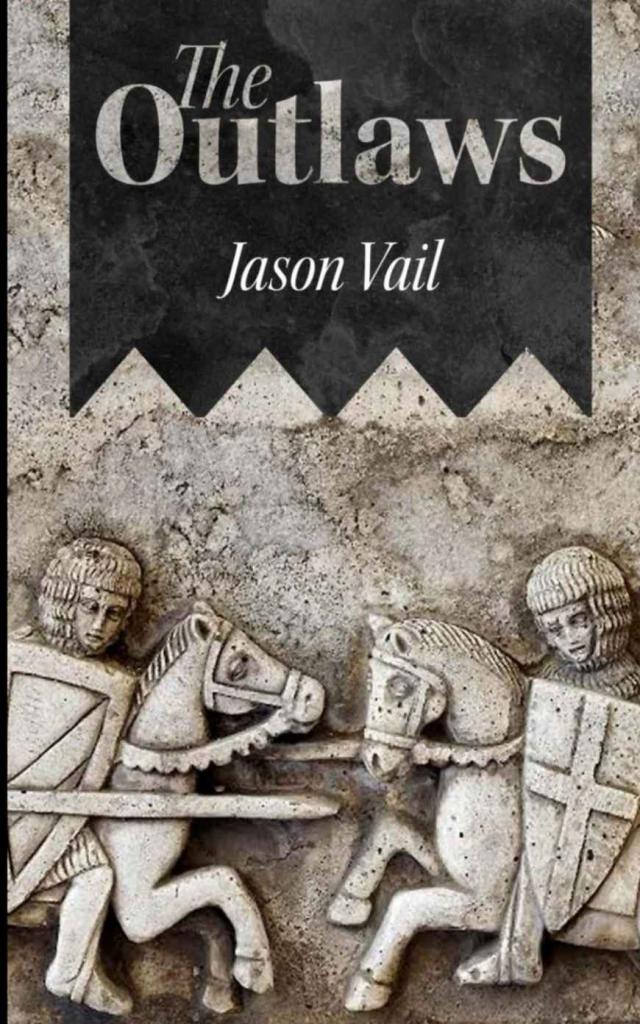
The Outlaws
Jason Vail
THE OUTLAWS
Copyright 2014, by Jason Vail
All rights reserved, including the right to reproduce this book or portions thereof in any form.
A Hawk Publishing book.
Cover illustration copyright Danielsbphoto/dreamstime.com.
Cover design and maps by Ashley Barber
ISBN-13: 978-1503051379
ISBN-10: 1503051374
Hawk Publishing
Tallahassee, FL 32312
Also by Jason Vail
Stephen Attebrook Mysteries
The Wayward Apprentice
Baynard’s List
The Dreadful Penance
The Girl in the Ice
Lone Star Rising Series
Lone Star Rising: Voyage of the Wasp
Lone Star Rising: T.S. Wasp and the Heart of Texas
Martial Arts
Medieval and Renaissance Dagger Combat
The Outlaws
PART 1
1173-1175
CHAPTER 1
Shelburgh village, England
October 1173
Matilda Attebrook awoke from the nightmare naked in the yard.
She wasn’t aware at first that she was naked or that she was in the yard. She opened her eyes to find her arms locked around her knees, shivering from more than the cold air of the pre-dawn.
A child’s voice sounded behind her: “Ma, what’s the matter?”
Matilda’s head snapped around. Her oldest son Robert, a skinny boy of ten, stood in the doorway of the house, clutching a blanket around his shoulders. Only then did it register where she was.
She shot up straight and glanced toward the lane, which was almost invisible through fog and gloom, giving the yard and the house the aspect of being apart from the world. Tendrils of fog slithered along the ground. It was acceptable to be naked in bed; most people slept that way. It was another thing to roam the garden with your bottom showing.
“Mum?” Robert asked when he got no immediate answer.
“Nothing. It’s nothing.”
“You sure?”
“Thought I heard something. In the cabbage.”
Robert craned his head toward the garden where the late cabbage was hiding behind a palisade of tall grass and a little wicker fence, which was meant to keep out the pigs. There was little enough to eat that the notion of some creature, whether two- or four-legged, stealing the cabbage was a matter of serious concern. As man of the house while his father was away, its safety was his responsibility. “I don’t hear anything.”
“Neither do I,” she said, marching past him into the house. “Now.”
Matilda took her undershift and dress from the peg by the bed and put them on. It was too early to be up, but it was no use going back to bed. The twins, Alice and Agnes, watched her from the bed with eyes as round as the moon, while their brother Brian slept on beside them.
“Lie back down,” Matilda ordered the girls and they sank beneath the blanket.
Robert, meanwhile, was fumbling his way back across the house’s single room to his pallet. He barked his shin on an unseen bench and said, “Shit.”
“Mind your tongue,” Matilda snapped, although she felt some sympathy and wondered how she had made it with her eyes closed around the hearth, the single trestle table, the two benches and their few stools, which besides the bed and her loom were the only furniture they had.
“Sorry,” Robert said.
“It’s Sunday. You shouldn’t curse.”
“Right, Mum,” Robert said, perhaps hoping she might mistake the appearance of obedience for its substance. No doubt when he ran with that gang of rough housers from the village they cursed to their hearts’ content, as long as none of their elders could hear them.
“And not you,” she said. The pigs were rustling behind the board fence separating the bier from the rest of the house. The sow had heard the commotion and she was snuffling at the gate. There were acorns in the wood and she was anxious to be at them.
“Not me what?”
“Not you. Can’t have you laying about all day. Might as well let the pig out. Just make sure she doesn’t decide to have the garden for breakfast. And fetch some water.”
“Oh, Mum,” he said. “Just a little longer. The sun’s not up yet.”
“Get going.” She knew the injustice of the order. Sunday was a lay-in-bed-late day, but she didn’t want him watching her. She had to have some time yet. He was canny, that boy, and he might guess what she was feeling.
Robert threw on his shirt and renavigated around the household obstacles, bare feet crunching on the rushes. He paused near the doorway, silhouetted by silver fog, a stick caricature of a man, as if he was thinking of making one final plea for normalcy. But he seemed to think better of it. Taking the switch by the bier gate, he ushered the sow and her precious little brood out of the house, and plodded into the soup, which had begun to glow with the dawn. A shouted “Ho! Ho! Get on, you, get on,” told her some of the piglets had made a break for the cabbages. Then the back gate clapped shut and she knew the garden was safe for the morning.
Matilda sank onto a bench and rested her head in her hands. The despair was almost more than she could stand without crying out. It wasn’t right she should feel this way. There was no reason to. It was silly. Foolish. Weak. But she couldn’t help it. She always worried when Harold was away. Something bad could happen to him: an accident, a sudden illness, a bully with a knife at a tavern. Not that any of these things couldn’t occur in the village. They could. His absence just magnified the possibility. If anything happened to him, there was her weaving and what she could bring in working for others standing between the family and starvation. She learned what starving was like when she had been a slave in Wales and it wasn’t a pretty way to die.
Harold had been gone a week now, which was a very long time for him to be away. He made their living by doing odd jobs as a carpenter, but in reality at anything anyone would pay for. A man named Alecoc had hired him and others in the area to help put up a barn. It didn’t take a week for all those men to throw up a simple barn. He should be back by now.
She imagined him laying over somewhere drinking up all the money he had made. But other men might do that; not him.
“It’s nonsense,” she said to herself. “Just nonsense.”
Robert came back from the brook, lugging the pail. She could see him pause in the yard, his outline fudged by the fog. He put the pail down and rubbed his thighs. When he reached the doorway, she saw he had spilled a good deal of the water on his legs and feet, which were muddy from dirt in the yard. He put the pail down by the hearth.
“I told you, always wear your boots in this weather,” she said. “You’ll catch your death.”
“But they always get wet. “ou know how I hate wet shoes.”
Matilda fumbled in the dark by the plank where she laid out her pots and trenchers. She tossed him a rag. “Well, dry yourself with this. Can’t afford to have you sick. Your father doesn’t bring in enough as it is.”
Robert gave her a sharp look, as though he expected her to bring up the prospect of more work. She and Harold had argued over this very thing just before he left: that Robert was getting big enough to hire out rather than provide sporadic help as he did now. Harold had maintained he was too small yet; give him another year.
Robert finished drying and cleaning himself. He put down the rag and asked, “Shouldn’t we light the fire?”
Matilda raised her head with great effort to look at him. “I suppose so.”
She made to push away from the table and take care of the chore herself, but he beat her to it. He removed the clay cover from the embers on the hearth, which sat on an earthen bank held up by boards, and added dry leaves to get the fire started. Presently there was a little flame crackling. A driblet of smoke curled toward the hole in the roof and the room began to feel warmer inside.
“I’m hungry,” Robert said.
“You’re always hungry, mouse,” Matilda said.
“I am not a mouse anymore. I am a fox.” Robert smiled. It was like the dawn itself. He had his father’s face and dark blond hair with its strands of gold and that same sweet smile. She forgave so much for that smile, both in his father and him. More than she should. Robert spent too much time with that layabout uncle of his, Nicholas, shooting arrows, wrestling and practice fighting with sticks rather than working. Harold defended this play. “Small men need to know how to fight more than big men,” he said. Matilda did not approve of fighting. If she didn’t find some kind of craft for Robert, who displayed no talent for carpentry and even smaller interest, he could end up a soldier, which made her shudder. Most soldiers were just brigands drawing pay. Or he’d be a ditch digger or a hedge cutter, and poorer than they were now. What decent girl would want such a poor man? She was determined that none of this would happen.
“If you were a true fox, I would have to send you out to find your own breakfast,” she said.
His smiled broadened, and took on a trace of slyness. “I am a true fox and I will just hunt here.” Then said: “I can spell fox. F-O-X.”
Matilda was startled.
“And I can spell my name,” and he did so. “And I can write them too.” He got down on the floor, spread the rushes to expose the dirt beneath and made the letters with a finger.
They were just marks in the dirt to Matilda, who could not read. Her father had not thought girls needed to read, although he had seen that her brothers had been lettered. She said, “Who taught you that?”
“The vicar. Yesterday. While you were out ditching.”
“Hmm. I had no idea. And I thought you were supposed to be trimming hedges.” She nodded, pleased and thrilled. The vicar already had taught him all the letters and how to make them, but she had not realized Robert had gone beyond that. “And I suppose you expect a reward for this feat, Master Fox?”
“Breakfast will do.”
“Will it, then?” She could not resist the smile that tugged at her lips. Matilda felt less depressed at Harold’s absence. Robert often had this effect on her, as on other people. She opened the bread box. To her horror, a fat mouse stared up at her. Furious, she swatted at the mouse, which hopped out of the box with amazing speed, plopped onto the ground and scurried through a gap in the wattle wall of the house. “God’s blood,” she blurted, forgetting what she had said about not cursing, “how did he get in there?”
The mouse had chewed a sizable hole in the loaf. She tore off the part on which it had been dining and threw it into the bier, where the pig would find it later. She gave half the loaf to Robert, whose eyes widened with surprise and greed. He never got a half loaf all to himself. Then he glanced at Alice and Agnes, the four-year-olds, who were sitting up in bed, their yellow hair in tangled halos about their heads, blue eyes watching the half loaf in Robert’s hands. Reluctantly, Robert started to break off pieces for the twins.
“No, fox, it’s yours,” Matilda said. “Best go easy on it, though. It’s got to last you the day.”
“Why?” Robert asked.
“Because I’m sending you to Alecoc’s. I want you to check on your father.”
Robert looked relieved. A journey to Alecoc’s was not work. It was an adventure. “Now? I’ll miss church.”
Matilda nodded. “Yes.”
Robert smiled. He hated church and always fidgeted and made noise in the back with the other children which embarrassed Matilda when others called attention to it.
“And put your boots on and take your cloak,” Matilda said, as he started for the door. “It looks like it might rain today.”
“Right, Mum.”
Alecoc’s was an hour away on foot, across the river and through the forest in the land of the Mortimers.
Robert paused at the foot of the wooden bridge over the river. The toll-taker, who occupied a booth at the village side, was not on duty today, this being Sunday. Robert sat in the booth for a moment, pretending to be the toll-taker. It was an unsatisfactory occupation until two imaginary knights came up and asked for passage, which he refused no matter how much money they offered him. When they wanted to fight, he turned his walking stick into a sword, launching terrible blows from one guard and then another, and sent the imaginary knights scurrying on their way. A movement caught the corner of his eye. The hayward and his wife and four children had come out of their house down the road and the daughters were pointing at him and laughing. The hayward’s wife had a disapproving look on her face, but she always looked like that at everyone. Robert stuck his tongue out at her. Later in church, she was certain to tell his mother he had been disrespectful, but he didn’t care. He was on an adventure and he was not going to let anything spoil it. Besides, he would say he stuck his tongue out at the girls, not the wife.
When the hayward and his brood had gone up the road, Robert gathered a handful of stones from the river bank and, pausing at the middle of the bridge, cast one stone after another into the black current. Robert loved the river. It wasn’t much of a river; a boy could throw a stone across from one bank to the other with room to spare and almost everywhere you could wade across. In fact, one favorite pastime was for gangs of boys to have a battle by flinging stones at each other across it. The river was dark and mysterious, though, a wonder that so much water could come from somewhere high in Wales and run all the way to the sea. Robert wished he could go to the sea.
Robert heard horses approaching behind him just before he reached the footpath beyond the bridge. Their hooves boomed on the wooden planks of the bridge. There were two, ridden to Robert’s surprise by boys a couple of years older than he was. They were both carrying crossbows; must be going hunting. Robert recognized the boys as squires from the castle. One was the earl’s bastard son, Eustace, who had just returned in disgrace from the abbey school where he had been sent to become a priest and had somehow failed. Eustace had a big bruise on his cheek from where the earl had hit him two days ago. The other was a boy named Reginald le Bec. Eustace gave Robert a stony glance and then rode past. Reginald, however, cut at Robert with his whip. It happened so fast that Robert didn’t have time to duck. The blow landed on his shoulder and was so painful that he could not stifle a yelp. Reginald laughed as his horse carried him out of range. Eustace did not even turn around to see what had happened.
Robert found a stone and almost threw it at Reginald, who was still laughing as he and Eustace drew off. But, hefting the stone, Robert thought better of it. Those two boys could chase him down on their horses and when they caught him, they’d beat him up. He was too small yet to fight even one of them alone. So he stood at the edge of the road, fuming, hating being small and weak, his shoulder smarting. He pulled back his collar to check the damage. He had a nasty weal but was not cut.
When the riders had gone round the nearest bend, Robert found the footpath and turned in. The path skirted the river for half a hundred yards, and then some fields before it turned into the forest. The forest was dark despite the fact all the trees were bare, and as always, frightening. There were supposed to be wolves still in these woods and even bears. Wolves had never attacked anyone he knew, but once at the Leominster fair, he had heard about a girl near his age being killed and dragged away and eaten. Robert looked around, ready for the wolves. He wished now that he had brought his bow. He had been so excited about the prospect of the adventure that he had rushed away without it.
Although Robert was thinner than many of the boys his age, he was quick and he made good time. In a quarter hour, he had reached the fork in the path: left led north toward Knighton; right angled southeast to Alecoc’s.
Shortly after Robert started down the right fork, he saw the ravens. There must have been a dozen perched in the bare branches ahead, an unholy looking congregation. The sight of them made him shiver with anxiety. Robert had been well educated about forest spirits, and he thought this might be a gathering of them. People said they fed on souls as well as flesh. It was bad luck at best to walk under such a flock. To avoid them, he left the path and cut through the wood to the right, intending to circle around and pick up the path beyond them.
The wind changed, with a faint rattle of branches. Robert caught the sour, gut-curling scent of rotting meat.
Glancing back through a wicket of branches, he saw the feet.
Booted in brown leather, they lay in the path beneath the ravens.
The boots and feet were attached to patched, dull brown hose. The boots looked like any man’s boots, but the patches on the brown hose caused Robert’s heart to beat faster and his mouth to go dry.
He forgot about the ravens. They weren’t interested in him.
When he emerged onto the path, he saw the rest of the body. A fat raven sat on its chest, flapping away to a low branch at his appearance.
The dead man was his father.
His head had been almost cut off.
The ravens had been eating his eyes.
Robert sank to his hands and knees beside the body. He reached out to his father’s face with trembling hands. But he could not touch him. So he settled for straightening father’s collar, stiff and crinkly with black dried blood, as if somehow that might give father comfort. He crouched on his heels as the trembling grew into great waves of shudders. His mouth fell open. He wanted to scream, but he could not more than grunt; nor could he cry. He just rocked back and forth, clutching his knees, stomach clenched, mouth contorted.


