

The Private World of Georgette Heyer, page 1


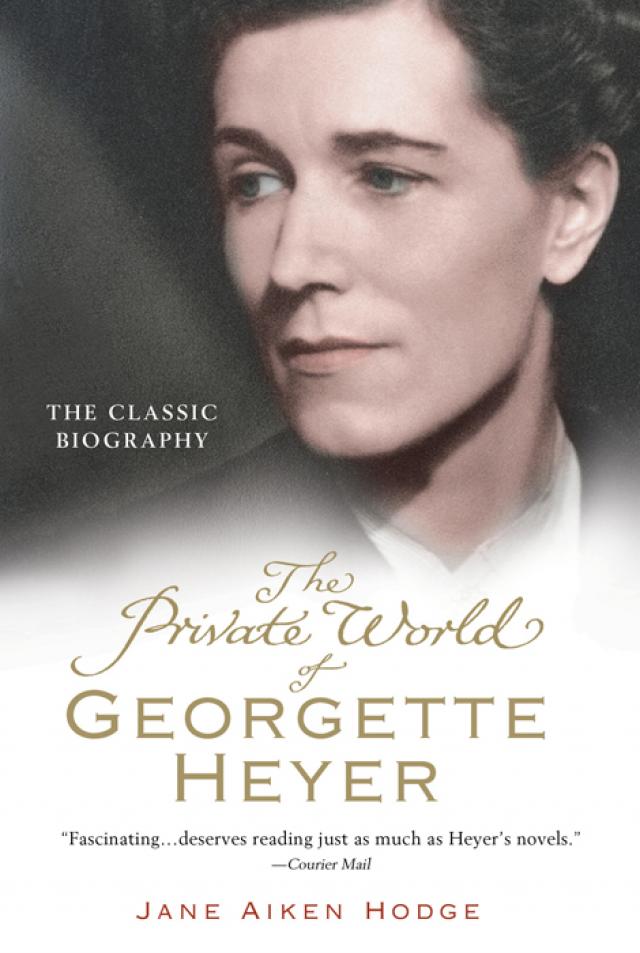
PRAISE FOR THE PRIVATE WORLD OF GEORGETTE HEYER
“One of the most beautiful books I know. Time and time again, on reading this book, I found myself breaking off to lift another dog-eared Heyer from the shelf and lose myself in the increased pleasure of a re-reading… A successful biography.”
—Washington Post Book World
“A fascinating biography of Georgette Heyer, one that deserves reading just as much as Heyer’s novels.”
—Courier Mail
ABOUT THE AUTHOR
Author of over twenty eighteenth-century historical novels including The Lost Garden, The Winding Stair, and The Adventurers, Jane Aiken Hodge worked as a journalist, reviewer and civil servant before her death in 2009. Born in the United States but raised in England, she read English at Oxford before returning to the United States to receive her master’s degree at Harvard, and worked for the British Government in Washington D.C. and for Time Magazine in New York. The daughter of a literary family, she was the sister of famous children’s author Joan Aiken. She was also a lifelong lover of Georgette Heyer’s Regency romances.
Books by Georgette Heyer
Romance
The Black Moth
These Old Shades
The Masqueraders
Beauvallet
Powder and Patch
Devil’s Cub
The Convenient Marriage
Regency Buck
The Talisman Ring
The Corinthian
Faro’s Daughter
Friday’s Child
The Reluctant Widow
The Foundling
Arabella
The Grand Sophy
The Quiet Gentleman
Cotillion
The Toll-Gate
Bath Tangle
Sprig Muslin
April Lady
Sylvester
Venetia
The Unknown Ajax
Pistols for Two
A Civil Contract
The Nonesuch
False Colours
Frederica
Black Sheep
Cousin Kate
Charity Girl
Lady of Quality
Historical Fiction
Simon the Coldheart
The Conqueror
An Infamous Army
Royal Escape
The Spanish Bride
My Lord John
Mystery
Footsteps in the Dark
Why Shoot a Butler?
The Unfinished Clue
Death in the Stocks
Behold, Here’s Poison
They Found Him Dead
A Blunt Instrument
No Wind of Blame
Envious Casca
Penhallow
Duplicate Death
Detection Unlimited
Copyright © 2011, 1984 by Jane Aiken Hodge
Cover and internal design © 2011 by Sourcebooks, Inc.
Cover images: Front cover courtesy of the Rougier family archives.
Back cover © The Bridgeman Art Library International
Sourcebooks and the colophon are registered trademarks of Sourcebooks, Inc.
All rights reserved. No part of this book may be reproduced in any form or by any electronic or mechanical means including information storage and retrieval systems—except in the case of brief quotations embodied in critical articles or reviews—without permission in writing from its publisher, Sourcebooks, Inc.
Published by Sourcebooks, Inc.
P.O. Box 4410, Naperville, Illinois 60567-4410
(630) 961-3900
FAX: (630) 961-2168
www.sourcebooks.com
Originally published in the United Kingdom in 1984 by The Bodley Head Ltd
Originally published in paperback in 1985 by Pan Books Ltd
Library of Congress Cataloging-in-Publication Data
Hodge, Jane Aiken.
The private world of Georgette Heyer / by Jane Aiken Hodge.
p. cm.
Originally published: London : Bodley Head, 1984.
1. Heyer, Georgette, 1902-1974. 2. Novelists, English—20th century—Biography. I. Title.
PR6015.E795Z83 2011
823’.912—dc22
[B]
2011015771
Contents
Front Cover
Title Page
Copyright
Acknowledgements
Foreword
Chapter 1
Chapter 2
Chapter 3
Chapter 4
Chapter 5
Chapter 6
Chapter 7
Chapter 8
Chapter 9
Chapter 10
Georgette Heyer’s Books
Acknowledgements
Back Cover
To Georgette Heyer
alias Mrs Ronald Rougier
ACKNOWLEDGEMENTS
I am deeply grateful to Richard and Susie Rougier, who made this book possible, and to Frank Heyer. I am also indebted to the following friends, relatives and associates of Georgette Heyer who made me free of their memories and lent me their letters from her: Mrs Isabella Banton, Mrs Enid Chasemore, Mrs Jane Chester, Mr Hale Crosse, Mrs E. G. Delaforce, Mr and Mrs A. S. Frere, Mr Elliot Graham, Canon and Mrs Heyman, Mrs Ruby Hill, Mrs Deborah Owen, Mr and Mrs Max Reinhardt, Mr and Mrs Donald Sinden, Mr John Smith, Mr and Mrs Dmitri Tornow, Colonel and Mrs John Weaver, Miss Joyce Weiner, Mrs Valerie Worth.
I also wish to thank for their help: Mrs Paddy Aiken, Mrs Claire Barwell. Mrs Thelma Banyon, Headmistress of The Study, Mr A. E. Bradley, Principal of Westminster College, Mrs A. S. Byatt, Miss Grace Cranston, Archivist of Heinemann, Dr J. A. Edwards, Archivist of the University of Reading Library, Mr Simon Lawrence, Mr Eric Major of Hodder & Stoughton, Mr Douglas Matthews, Librarian of the London Library, Mrs Maureen May, Mr Frank Miles, Archivist of King’s College School, Mrs Anne Oliver, Miss Julia Trevelyan Oman, Mrs A. A. Piper, Headmistress of Wimbledon High School, Mrs Pauline Prest of the Wimbledon Literary and Scientific Society, Miss Joy Preston, Miss Josephine Pullein-Thompson, Mr T. J. Rix of Longman, Mrs Jane Fane de Salis, Mr P. J. Shaw, Miss Peggy Sutherland, the Imperial War Museum and the National Army Museum.
I am grateful to Joanna Cannan’s family for permission to quote from No Walls of Jasper, and to The Bodley Head and William Heinemann for permission to quote from Georgette Heyer’s novels, and above all to Jill Black of Bodley Head for friendly and constructive editing, and for the pictures. I am also most grateful to Georgette Heyer’s devoted readers for their appreciative letters about the hardback of this book, and their constructive comments, which have been incorporated into the text.
FOREWORD
Georgette Heyer was an intensely private person. A best-seller all her life without the aid of publicity, she made no appearances, never gave an interview, and only answered fan letters herself if they made an interesting historical point. Having scored an instant success with The Black Moth at the age of nineteen under her own name, Georgette Heyer, she experimented with a pseudonym, Stella Martin, for her third book, published by Mills & Boon, then achieved a permanent alias when she married Ronald Rougier at twenty-three. From then on, Georgette Heyer wrote the best-sellers, while Mrs Ronald Rougier led the deeply private life. She never talked about her background and early years, giving only the barest facts of her life in eighteen lines of Who’s Who. After her death, A. S. Byatt, the critic and novelist, wrote an invaluable long memorial piece for the Sunday Times, based on interviews with her husband, her friend Carola Oman and her two good publisher friends, A. S. Frere of Heinemann and Max Reinhardt of The Bodley Head. This is the only source for much of the information about her early life, about which she herself never talked. I have been able to supplement it by talking to her surviving family and friends (her husband and Carola Oman are now both dead) and by reference to her letters and to the four early novels she later suppressed.
Her own invariable answer, when asked about her private life, was to refer the questioner back to her books. You will find me, she said, in my work. So should one now, almost ten years after her death, try to look behind the curtain of privacy in which she shrouded herself? My first instinct, when I started work on this book, was to concentrate entirely on the work, merely giving the barest facts of her life as a foreword. Then I began to talk to the people who knew her, and to read her letters. Everyone who knew her had loved or respected her, and they all seemed glad that a book should be written about her. But her own letters settled the question. She may have been a private person socially, almost a recluse, but on paper she was a compulsive communicator. And she wrote, her son says, just as she talked. Her letters to her publishers are full of sidelights on her own life and pungent comments on the world at large. They confirm, in short, her friends’ unanimous description of her as shy on the surface, but a formidable, positive person underneath, with strong views and a great sense of style.
It hardly sounds the description of a purveyor of romantic froth. But in fact, for those with eyes to see, the strong character is there in her books, even in the lightest and most frivolous of them, and an awareness of the kind of person she was adds a new dimension to one’s enjoyment of them, or, perhaps, helps to explain just why one does enjoy them. She may have been a compulsive writer, but she was also an immensely skilled and meticulous craftswoman. She did her best to conceal her high standards and stern moral code behind the mask of
Georgette Heyer in 1946. ‘It was thought to be a speaking likeness,’ she wrote nostalgically in 1964, ‘even my life’s companion approving of it and setting up a copy on his desk in Chambers.’
Naturally, it was the ravening fan public that made its voice most clearly heard during her lifetime, and its adulation served both to drive her further into herself and to put off readers who might have enjoyed her as they do Jane Austen or even Ivy Compton-Burnett, a favourite of hers. There is a terrible snobbery in the average intellectual reaction to her work. It is not everyone who has given her name to a type of novel, and it is unfortunate that that name should tend to provoke an uninformed, unjustified sneer. My aim in this book is to try to redress the balance by giving a feeling of her and of her work, as far as possible through her own words in the extensive correspondence which her publishers have kindly made available to me and her letters to friends. Some of her friends, though happy to talk about Georgette Heyer, have felt that she would not have wished her letters shown or quoted, and this is a feeling that must be respected. Her letters to her publishers, on the other hand, are part of the professional world she enjoyed, and unless otherwise indicated all the quotations in this book are from them.
Unfortunately, hardly any letters survive from before the 1940s, when she herself was in her forties and had been a best-seller for years. By this time she was taking a sadly deprecatory line about her own work. Speaking of Friday’s Child in 1943 she says: ‘Spread the glad tidings that it will not disappoint Miss Heyer’s many admirers. Judging from the letters I’ve received from obviously feeble-minded persons who do so wish I could write another These Old Shades, it ought to sell like hot cakes. I think myself I ought to be shot for writing such nonsense, but it’s unquestionably good escapist literature, and I think I should rather like it if I were sitting in an air-raid shelter, or recovering from flu. Its period detail is good; my husband says it’s witty – and without going to these lengths, I will say that it is very good fun.’
The statement sums up the problem she had with her readers. The dons and lawyers mostly kept quiet. The more vociferous of the fans tended to like the wrong books for the wrong reasons. They kept asking for swashbuckling romance when she was writing neat romantic comedy in the vein of Congreve and Sheridan. The reviewers, too, failed to appreciate the style and craftsmanship of her work as it developed into what would be known as ‘the Georgette Heyer.’ It is no wonder that she turned against publicity of any kind.
A page from one of Georgette Heyer’s Regency notebooks. She knew every detail of the Great North Road, but no heroine of hers ever actually got to Gretna Green.
As well as the letters, Georgette Heyer left the unfinished typescript of about half of what she had planned as a serious mediaeval book, since published as My Lord John; a remarkable research library of some thousand volumes (now unfortunately dispersed); and a small but highly significant collection of papers, to which her son has kindly given me access. There was no attic full of carefully hoarded manuscripts and first drafts. A flat-dweller since 1939, she found the proliferating copies of her published books problem enough without indulging in the sentiment of keeping old papers, however fascinating they might have proved to posterity. She saved a few reviews, and one fan letter. It was from a woman who had kept herself and her cell-mates sane through twelve years in a Romanian political prison by telling the story of Friday’s Child over and over again.
There was an impressive collection of her own research material. About three-quarters of this was the detailed and meticulous work for what was to become My Lord John. The rest, even more immediately fascinating, consists of the files devoted to research for her eighteenth-century and Regency novels. There is also a group of short stories that have never been published except in magazine form; two articles published in Punch and one from the Sphere, and five articles that have never been published at all. The stories are typical Heyers, and it is surprising that they have not been published as a companion volume to Pistols for Two, but Georgette Heyer never thought much of her short stories, dismissing them as mere potboilers. The articles – critical, personal and political – are an interesting experiment that apparently did not come off. We should probably be grateful. If Punch had gone on publishing her in 1954 we might have gained an essayist and lost some of her best work.
She might have turned ‘respectable.’ After its heyday in the nineteenth century, the historical novel had fallen into disrepute in the early years of the twentieth, and this was particularly true when Georgette Heyer started to write. She herself was obviously influenced by popularizers like Baroness Orczy and Jeffery Farnol, but they had helped to give the genre a vulgar name. Her planned book about John, Duke of Bedford, was to be respectable: a very early example of the more serious kind of historical novel that would be developed by people like Zoë Oldenbourg and Mary Renault.
Her books may not have received critical acclaim, but they sold. When she died, at seventy-one, in 1974, she had fifty-one titles in print in hard covers or paperback and had been translated into at least ten languages and pirated in others. She was that rare thing, a steady best-seller. Hyped single titles come and go. Even in the current climate of sex and violence, her books are still solidly on the shelves. In fact, she now has more titles in print than she did when she died, since My Lord John has been published and Simon the Coldheart, an early historical novel, reprinted. Her name is a household word, used in The Times crossword puzzle in the Thirties and in the New York Times one in 1982. She is a literary phenomenon that demands investigation.
Axford and Paragon Buildings, Bath. Heyer heroines were apt to be depressed in gossip-ridden Bath. Kitten, in Friday’s Child, missed her husband, and Lady Serena, in Bath Tangle, missed her hunting and her father.
I have indulged myself, for the purposes of this book, in reading her entire output in chronological order and it has proved a rewarding experience as well as a delightful one. There are, to begin with, four early novels which she later suppressed. Instead of the Thorn, Helen, Pastel and Barren Corn were all written in her late teens and early twenties and are about the experiences of young women growing up in the complex social scene of the years after the First World War. Inevitably they and the detective stories she wrote mainly in her thirties throw a certain amount of light on the early years of her own life about which she would never talk. Her surviving brother, Frank Heyer, has confirmed that there is a considerable autobiographical element in the novels, particularly in Helen.
What she did not choose to write about is almost as interesting as what she did. Like Jane Austen, she knew her own limitations to a nicety. She spent the early years of her married life under primitive conditions in the wilds, first in Tanganyika, then in Macedonia. She was the only white woman for miles in Tanganyika, and nearly died in a dentist’s chair in Kratovo. But she recognized this for experience she could not use. No heroine of hers would ever sit in a grass hut writing a novel.
She would write only of what she knew, or could find out about. The meticulous research shows how hard she worked for the background of her eighteenth-century and Regency novels, as well as for the more serious historical ones. Aside from a few excursions to France, where she had been as a child, her early books are set largely in London and the Sussex country she knew so well. She then widened her field gradually as she came to know other parts of England. Her son went from Marlborough to Cambridge and his mother’s novels follow him. And a whole new burst of country opened up for her when she and her husband started going to Scotland for his golf and toured the north of England researching the landscape and its castles for her long-projected mediaeval book. The Quiet Gentleman, The Toll-Gate and Venetia all have north-country backgrounds. Interestingly enough, though she and her husband spent many summers at Gullane in Scotland, and she loved the Scots, she never set a book in Scotland. Perhaps she looked on this time as pure holiday, or perhaps she sensibly blenched at Scottish dialect. She used Irishmen in The Black Moth and Faro’s Daughter, and allowed herself an orgy of north-country dialect in The Unknown Ajax, but mostly stuck firmly to her own brand of upper- and lower-class Regency speech.





