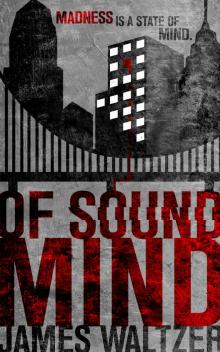
Of Sound Mind, page 11


When his parents presented him with a Walkman, for Richard it was penicillin, the Salk vaccine, and Prozac all in one. He could go anywhere, anytime, snuff out much of the unwanted sound track in his vicinity and substitute with his favored jazz sounds or classical strains . . . and be socially acceptable. It was a miracle invention, the Walkman, soon supplanted by the Discman, and then the versatile, far less obtrusive iPod. Funny, these most commercial of products becoming godsends for Richard Keene. They gave him the comfort of conformity.
But they have been of no help in the landscape of his dreams, which have a language and sound track all their own and no manmade technology to parry them. The dreams come, even now, like streamers hurled by the wind, some rippling past at high speed, others clinging like crepe and winding about the neck, intent on strangling. Not every night, but often, and always the same feeling if not the same setting: a little boy trapped in sheets and blankets, or drowning just under the surface of the water, or stuck to the tracks and facing the headlong rush of a train, or enveloped by a man in a powder-blue shirt with long sleeves creased and cuffs stiff as slate, the walls closing in.
A little boy with no release. The dreamer trapped as surely as his younger self.
He had an undistinguished record through high school and two years of community college—he had trouble concentrating, paying attention in class. He liked music because it soothed him. He took piano and guitar lessons but wasn’t talented enough to pursue a musical career, and so he drifted from job to job, saving a few dollars while continuing to live at home, by that time a nicer home in the suburbs, one with a more spacious bedroom and no bucking broncos on the walls. He tutored children at the neighborhood Y, made tuna fish hoagies at a deli in a strip mall, forced himself to make calls for a telemarketing firm. When Richard trained with an insurance company to be an auto claims adjustor, the sight of a wreck unnerved him; even a battered fender was disturbing. They moved him to the billing department, and there he labored in white-shirted anonymity among the computer-generated invoices, becoming adept at on-screen navigation and mindless processing. He tried to strike a truce with life and with the past by earning wages, handling chores at home, avoiding crowds and noise and unpleasant circumstances. But the past would not be filed away. It returned with increased ferocity, like a hurricane that has idled and gathered strength. Sounds of horror, a little boy immured beneath blankets, the powder-blue long sleeves in his face, the questions jabbing him like little knives, circling him, returning to the same place, that same question of questions. Was he ever there at night? Was he there that night? Wasn’t he, in fact, there that night, this strange boy who insists that he was in bed and underneath the blankets in his own bedroom?
There was no leashing the past. Still, he tried to slip by it and stay a step ahead. Survival tactics. But then one night the full-length mirror hanging on his bedroom door drew him back as if by magnetism to the awful, reflected reality he had avoided for years. And he looked himself up and down and stared at his face, his brown eyes darker than he remembered, the black pupils swelling like oil slicks. The dormant dread flared: he was an unhinged soul. Who am I, what am I, why this face and form, what if there were no people, no world, no universe, nothing? And the edges of his vision blurred red, and he thought his forehead was vibrating, and a stranger stared back at him from the mirror.
Marty and Evelyn rushed into his room when they heard the screaming. Richard heard nothing. When his parents thrust the bedroom door open, banging the mirror into his nose, he backpedaled to his bed and got under the covers. There he lay awake all night, fully clothed.
His next bedroom was one without mirrors.
The idea of being an audiometric technician had hit him the day he came home from the treatment center, and he was proud and rather relieved that he was thinking in such pragmatic terms. He knew that his special auditory capability was no real asset in this regard—technology did all the work—but the psychological appeal for him was to confront the demon on its home field, a kind of auditory proving ground. And he could offer empathy and counsel to those suffering auditory discomfort, be it sensitivity, deficit, distortion, or otherwise. So he logged the twenty hours necessary for certification and got the job at Rosen & Wallingford. More than a year later, he finally mustered the energy and courage—at the psychologist’s urging, and with his parents’ financial assistance—to leave home and get his own place, placing him in the big city and much closer to his job.
And now that job is gone.
Wendy calls him at one o’clock. Two weeks’ severance is already in the mail.
But when Richard takes the call, he is not thinking about his job at Rosen & Wallingford at all. His thoughts are on the case.
Now he can concentrate on the case. Full time.
Eight days since the murder. No doubt in his mind there was, in fact, a murder. But what he regards as evidence so far would satisfy only him. He must now move to the second stage and identify the pieces of the mosaic. For the first time, he ponders motive. A lovers’ quarrel turned violent then deadly, or something more sinister, something planned?
He feels certain that it was planned, premeditated. That it is no coincidence the sounds were masked by the movie scene, but the result of meticulous timing. No, he will not be thrown off the trail—not this time. The matter of motive isn’t his concern, really; he’s not the prosecutor. But he is curious, naturally, and suggesting a plausible motive might help prod the police. For he will have to enlist the police eventually; he knows that.
He wonders if there’s a financial motive. Braun and the transaction at the bank—was it legit?
What became of the body?
An intriguing question. What do you do with a dead body in a high-rise, when you must conceal its disposal?
Medical residents have resources.
He needs more from Lori. He’s relying on her—she’s his confederate. He hopes she may be something more than that. When she told him she didn’t have a boyfriend, she seemed to be opening a door. They looked at each other in silence for a moment. Then back to business.
Business has brought them together. Right now, Richard has some other business: a 4:00 p.m. appointment for another go at an MRI, this one at a site closer to home and, as ordered, in an open machine. His knee remains sore, and it sometimes buckles at high speeds on the treadmill. Something’s wrong somewhere.
You lose your job, but the world doesn’t stand still, he reminds himself. No reason to sit home and mope. To the contrary, losing the job will be a godsend. Perfect timing.
As he walks to Metropolitan Hospital on Ninth Street, Richard wonders if his path will cross Braun’s. This is Braun’s turf after all; Lori told him that.
It’s a big hospital; chances are slim. Besides, Braun has nothing on him—it’s the other way around.
But maybe Braun peered through the peephole and saw him at the door that night—not just later at the elevator. That possibility gnaws at Richard. During this short trip to the hospital, he glances behind him several times to make sure that Braun is not following . . . and to make sure that no one else is following.
He checks in at Diagnostics, then sits in the waiting room with a dozen other patients and a batch of dog-eared magazines. After twenty minutes spent reading two paragraphs of an old Newsweek article about unmanned space flights and eavesdropping on snatches of conversation throughout the room, he hears his name called. A plump, pleasant nurse leads him to the interior, mystical chambers. He follows her into the scan room with its MRI apparatus, which reminds him of cold storage, cryogenics but without the frozen steam. Then he thinks of mailing tubes dropped down the postal chute at the building that housed his old job at the insurance company, the same kind of tubes you send winging from your car window to the drive-in teller at the bank, suburban style. Evelyn used to send him on such errands.
This chamber doesn’t look any bigger than the last. He takes it calmly.
“I had some trouble the last time I went for an MRI,” he says.
“Really?”
“Yes.”
The nurse looks at him and tries to move from pleasant to compassionate, but makes it only halfway. “You get uncomfortable?”
“Yes, very. This looks like the same kind of unit I had at Logan. I was supposed to have the open type this time.”
“We’re getting one in very soon,” she says, “but it hasn’t arrived yet; I’m sorry. I know we’re getting more requests for that these days. But give this one a try. We can do some things so that you don’t feel like a sardine.”
Nice imagery. Richard casts a wary eye at the tube.
“We have these special glasses that enable you to see behind you and into the room as you’re lying down so you don’t feel like you’re trapped in there, kind of like an optical illusion,” she says, handing him a pair. “And we pump in soothing music to relax you. Plus, I’ll give you a buzzer to hold in your hand. If at any time you feel panicked, just squeeze it and we’ll hear it in the control room, where the technician will be receiving your scan on the computer. That’s right over there.” She points to a glass-enclosed booth, where a young, sympathetic-looking woman waves from behind a computer screen. “How’s that sound?”
So the tables are turned: He’s the one under observation, rather than the detached technician at the controls. Turnabout is fair play. Richard figures he has to try. “Okay, I guess.”
“Oh, you’ll be fine; you’ll see.”
But as soon as he climbs in and lies on his back, he starts to sweat and shuts his eyes. “Try the glasses,” the nurse says, and he fits them on. They have no optical lens but twin mirrors reflecting the room behind him, wavy, mildly distorted. She gives him a headset to place over his skull and onto his ears, then clamps some sort of coil around his knee. “That landmarks the area we want to focus on,” he hears her say through the headset, surf-like sounds already filtering in. He goes with it, tries to visualize the suggested scene, the seashore with a big, blue, restful sky festooned with wisps of cloud, a broad beach stirred by ocean breezes, and the ocean itself stretching in great, sunlit ribbons toward the endless horizon.
She slaps the plastic buzzer in his hand—“Give me a ring if you need to”—and she’s gone. He doesn’t like the mirrored glasses, so he closes his eyes again and he’s at Playtown Park in the Philly suburbs, and Cindy is next to him in the two-seat compartment of the kids’ Ferris wheel as it loops skyward in a lazy arc, the open compartments dangling, the ground retreating beneath them. Evelyn and Marty watch from below, and Cindy’s mother is there, but not Herb Dempsey; he’s nowhere in sight. Cindy and Richard sit side by side, and when they reach the apex of the wheel, the motion torques their bodies so that their arms press against one another, and they look at each other and smile. He can feel her smooth skin. It is a magic moment, but now it’s gone in a blink because Richard can’t hold onto it, can’t keep his eyes shut as he slides into the doom of the narrow tube.
He looks above the glasses, and the metal enclosure is right on him, as if it would crush down through his nose. The apparatus hums and spits ominous knocking noises like a sick car motor, the magnetic fields dancing, and Richard hears them cut right through the tepid white noise in his headset. Now additional sounds, the cycle of murder sounds, join them like an orchestral duo, and he can hear it all distinctly, a world-class conductor who hears every note in the recesses of the stage. He has to urinate. He rolls his shoulders, and the glasses slip across the bridge of his nose. He realizes that, once again, he is not going to make it despite all the accessories. He must get out. He thumbs the buzzer. Hears nothing, figures it doesn’t make noise but triggers an emergency light or shows up on the computer screen in the control booth. But there is no response. He presses again, hard, and waits for rescue, time suspended.
He pounds a fist against the side and roof of the cylinder’s cold metal, short incessant blows, for that is all the space allows. He pounds as hard and fast as he can, bloodying his knuckles within seconds. He shouts in a voice not quite his own, and the shouting becomes screaming, the effort spraying mucus and saliva onto the metal as if a sudden rain has fallen. He tears off the mirrored glasses and the headset still releasing futile white noise.
Finally, the nurse is there, fetching the tube from its tunnel.
“Oh my God,” she says. “Oh my God, I’m so sorry. What happened to the buzzer? Did you press the buzzer?”
As if oxygen has just now reached his brain, Richard bolts up like a reflexed cadaver and spurts out of the contraption. “You’re bleeding,” the nurse tells him, and he looks down at his bloody hand, aware of its condition for the first time.
ELEVEN
The hell with it, Richard thinks as he walks down Locust Street, his right hand bandaged. If they can’t figure out what’s wrong with the knee without a damn MRI, then he’ll just live with it; that’s all. What did they do before MRIs?
His iPod taps into iTunes Radio to play Motown, songs that impress him with their energy and musicality; he understands why this music had such an impact. A passing man wears enough cologne to counteract the fumes emanating from a garbage truck loading up in the alley at midblock between Eleventh and Twelfth. “Nowhere to run, nowhere to hide,” sings Martha Reeves and the Vandellas to a driving beat that quickens the walk.
At the 42s, Richard enters the building’s adjacent nine-story parking garage. His ’98 Toyota is parked in space five on level G, he remembers, secure in the knowledge that he has the vital information written down on a scrap of paper in his wallet, a necessary step since the disabled car has sat there for two weeks already, and locating a parked automobile when you have forgotten its precise location can be a maddening experience in a facility like this, replete with pillars and transverse ramps and levels that replicate each other right down to the puddles.
He approaches the shed where Jay presides over incoming and outgoing traffic. Richard likes the ever-smiling Indonesian, wiry with warm brown eyes and an omnipresent blue baseball cap. In fact, he likes him more than anyone else he has met in the city. Jay’s a smart guy. He’s about halfway home with the English language and is taking a course to improve his skills. He is determined to go to college. Richard admires that.
Since Richard doesn’t use his car that often—and hasn’t at all in the last two weeks—he doesn’t see a great deal of Jay, but they’ve developed a rapport based on just a few meetings. For one thing, they know each other’s name. Richard is among the few tenants who address Jay by his first name, and they speak about more than just the monthly parking fee.
“What happened to hand?” Jay sees the bandage wrapped around Richard’s knuckles, as if the right hand belongs to a boxer getting ready to lace up the gloves.
Richard glances at his hand. “Ah, little accident. Put it through a window—didn’t even see it. I should get my eyesight checked, huh?”
Jay looks concerned. “Everything okay?”
“Thanks, everything’s fine. Jay . . . let me ask you something; you might be able to help me.”
Jay nods and his eyes tell that he’d be happy to help Richard, and he trusts that, if he did, Richard would not put him at risk.
“There’s a woman who lives here by the name of Eleanor Carson—apartment 2307,” Richard continues. “Can you tell me if she’s a monthly?” He points to the smooth, copper-colored cement at his feet, meaning to indicate the garage itself.
Jay broadens his smile. “Mr. Richard,” he says. “Is she pretty?” He reaches out and brushes Richard’s sleeve in a friendly way.
Richard returns the smile but turns serious again. “I don’t know; I’ve never seen her. At least I don’t think I have.”
Jay looks puzzled by Richard’s inquiry. He pays attention to rules and regulations, but he’s inclined to help his friend. Sensing uneasiness, Richard gives Jay an earnest “It’s important,” and Jay grabs a PDA from a shelf in the shed. “How spell?”
Richard spells both the first and last names, and Jay punches in the letters.
“Here she is. Eleanor Carson. Nissan Altima. You need license plate?”
Richard smiles, wishes for a moment he were a state trooper so he could run the plate, but what would that get him anyway? He already knows where she lives. Lived.
“No, thanks, not now . . . I have one more for you.”
Jay has tapped out a four-digit number on the PDA. “Her car’s still here.”
“Eleanor’s?”
“Eleanor Carson.” Jay points at the little screen. “It tells me who’s here and who’s not.”
“Very efficient,” says Richard, recalling that the magnetic strip on his seldom-used key card raises the gate both ways. “How about Davis Braun, Jay? Does he have a car here? B, R, A, U, N.”
“I know that guy,” says Jay. “Nice guy. He went out this morning. Not back yet.” He pecks at the PDA.
“A, C, U, R, A.”
“Acura.”
“Yeah, Acura.”
“That’s Mr. Braun’s car, huh?”
“Yes, that’s his.”
“Thanks, Jay.”
“You’re welcome,” Jay answers, and his grin shows pride in his work and once again suggests that he trusts Richard. Still, he asks, “Why you need?”
“They’re neighbors of mine, and I haven’t seen either in a while,” Richard explains. “I was getting worried. Glad you saw Davis today.” He gives Jay an appreciative tap on the shoulder. “Don’t tell him I was asking; he might think I’m being nosy or something.”