

The Arriviste, page 27


Frances trotted toward another set of shrubs and disappeared beneath a buckeye canopy. I trailed her, keeping to the garden path, hands in my pockets, Bud at my side. He didn’t have his hands in his pockets. One wagged his new walking stick, the other hewed the wind with gesture: he was making his stand, exuberantly, but also with a show of disinterest, as if a principle were at stake instead of his livelihood.
And I? I was just walking my dog, checking for stars behind the scudding clouds.
“It is unfortunate,” I agreed.
“These are growing pains. We’ve got to take the long view.”
Frances emerged from the bush, shook herself, and trotted back to the front door.
I tried to walk back up the path, but now it was his turn to block my way. “How much are we talking about here—these are not great sums! And for two, three weeks tops. It can’t hurt you.”
A pair of chimney swifts swooped and fluttered around the turret on the third floor. As they darted past my office, I caught a glimpse, fast as their flight, of a figure in the window behind them, oblique to the glass, veiled by the curtain, identifiable as myself by the rough edges of his front teeth and the tiny screws at the corners of his eyeglass frames. I blinked and he was gone.
I stepped around Bud onto the lawn. “What would you know about that?”
He stopped, and so did I. He grabbed my arm and knit his brow, or so it seemed from a series of smudges in the darkness. Maybe my eyeglasses needed a wipe. “Look, it wasn’t . . . Shewasn’t—”
“You misunderstand me.” I freed myself from his grip and marched on, rejoining the path.
He hurried alongside me. “Well, you might feel this way now. I’ll check back with you tomorrow.”
“I wouldn’t bother.”
“For Chrissake, Neil, you know how these things go! If Vogel moves on me, the banks will get nervous and try to grab what they can too. There’ll be a feeding frenzy. They might even come after you.”
“They wouldn’t get far.”
I stopped and faced him near the top of the path, in the delta of the porch light spilling down the front steps. A dimmer light from an upstairs window turned his shirt buttons a pale green.
He cleared his throat but before he could speak I cut him off. “There’s nothing more I can do for you, Bud.”straightforward. The balance of the mortgage wouldn’t amount to much—I’d pay it off in a few strokes of the pen, tear down the house, remove the hedge, and plant an alley of sycamores from the head of his front path to the chimney in back. “If that,” I mumbled, and tried to blot the image of my renovated landscape out.
Frances scratched the door and I inched toward it myself. “Fine, Neil, have it your way. But do me one favor, will you? It won’t cost you a dime. Don’t say I couldn’t read the writing on the wall. I read it all right.”
“Hmm?”
“You don’t know what I’m talking about, do you?”
“No.” The admission seemed to prove his point. He snickered, and his shivering might have been as much from excitement as from cold.
Then I remembered. “On your wall, you mean? At your last party?”
“That’s right.”
“They were shadows.”
“Exactly. And all you had to do was pass your hand over them to make the words say what you wanted them to. When you became my partner, I thought that’s what you’d do.”
“You’re not making sense, Bud.”
“I wasn’t wrong about the writing. I was wrong about the partner.”
I was about to go in when a glimmer from a spur halfway down the length of his stick filled me with menace. He was still handling that stick, twisting and knocking and appraising it. I was about to turn my back to him but thought again.
He saw it right away. “What ever gave me the idea that he was my friend?” he asked in a negligent undertone. “What was it?” he repeated—maybe to me this time, though I didn’t have an answer—and, with Frances scratching at the door again, gave the stick a short wave. “If it had been you holding this, I’d have been a fool to turn my back.” He lifted the stick and threw it downhill; it seemed to fly for a while before crashing in the apple trees. “I’d have done it, though.”
Would he have been a fool? I might have liked to tell him he wouldn’t have been. But I didn’t have it in me then. And anyway, I wouldn’t have had the chance. I was looking toward the orchard, wondering about the damage from the stick he’d thrown. When I turned back he was already walking away fast, as at the beginning of a larger transit.
When was it that I thought I saw him again—three years later, or four? It must have been about a year before I left Dunsinane for my house here in Key West, so less than two before the onset of the emphysema that, though it makes for strangled days and long nights, can’t keep me from enjoying a good smoke every so often. The specific date eludes me. It was a bright fall day—I’m sure of that much—bright and warm, and I was by myself. Mickey had prevailed on me to go down to Merrick Bay, on the South Shore, to look into a new process for seeding oyster beds in contaminated waters.
He saw an opportunity in those waters. What I saw, peering down from the jetty, was slime. The dredge and netting were an algae-colored green, the ropes gray. The oysterman, when I passed on offers to sample his product, turned a shade of red. It was bad form of me to refuse, but I wasn’t in an obliging mood. I’d learned that a developer—P. T. Barnum’s grandson, as it happens—had been granted a permit to parcel the estate that lay between me and the shore into half-acre residential lots. He would grace the development with the family name. If the bottleneck on the parkway I’d taken irritated me less than usual, this was because the looks I cast at the landscape had the sweetness of parting glances.
Sullen at my refusal, the oysterman had left me on my own. I had no idea what to look for in an oyster bed and was on my way in a quarter of an hour. I didn’t feel like driving back right away, not on an afternoon like that. I put down the top—I was in a Mercedes coupe by then; the Giulietta’s fickleness had worn me out—and followed the road signs to Jones Beach. I had never been there. The complex of parking lots, water towers, way stations, embankments, walks, outbuildings, and drinking fountains and the thought of the stocks of concrete and asphalt that had gone into them and of the piles of limestone and sand beneath them astonished me.
I had the whole expanse more or less to myself and walked until my wonder at the scale of the building was lost in the grating of stones in the surf, in the shimmer and salt. Then it was time to think of turning back.
But I couldn’t turn around just anywhere. On the beach I need a milestone. I set my sights on a tide pool winking on the sand.
I marched toward it, on and on. It receded and disappeared. Even then I kept after it, till it dawned on me in a maze of reflections—from flagpoles, trash cans, loudspeakers, spigots, seaweed, stones on a breakwater—that the pool had been a mirage.
Another objective loomed up on the spot, one that, though I couldn’t exactly make it out, was too big to be an illusion: a biplane. What it was doing there I never found out. Some distance shy of it at the edge of the water, a man with binoculars strapped around his neck and a gut hanging over his bathing trunks stopped me. “Hey, mister,” he said. “Are you a strong swimmer?”
“Depends what I’ve had for lunch,” I replied with sunny-day congeniality. “Why?”
“That guy out there. He’s in trouble. I’d try to help him myself if I could.”
The swimmer was out beyond the breakwater. But he wasn’t all that far out and didn’t seem to be panicking. “What makes you think he’s in trouble?”
“He’s stuck. He’s been swimming like that for ages, but he keeps getting pulled farther out.” He glanced at his binoculars. “Brand new. He’s lucky I was messing around with them and noticed him.”
“Mind if I take a look?”
He lifted the strap off his neck and handed me the binoculars. “My wife ran up to the phones and called for help. Should of been here by now.”
The crawl in which the swimmer’s hands thrashed the water and his elbows barely broke its surface and his legs dragged him down revealed his exhaustion. But from the pace of the flow going past him, you’d have thought he was carving the waters—if, that is, you hadn’t seen the like of it. “I’m not going out into a riptide like that,” I said.
I lowered the binoculars and, when I looked through them again, thought I could make out the lines of the eddy. It was narrow. Forty or fifty feet to either side of the swimmer, the whitecaps rolled in; but where he swam the surface was calmer. By swimming across the tide, parallel to the shore, he might have been able to free himself. Instead he thrashed away, four strokes and a breath, four strokes and a breath.
He lifted his head out of the water between strokes to peek shoreward. I blinked. Was that Bud? The resemblance wasn’t so strong. The swimmer’s features were less firm, deeper set, puffier. But then, why did I think of it? What had I recognized? It wasn’t impossible—Bud had to have gone somewhere. The change might be an effect of the soak and of the years. I kept the lenses trained on him, watched his head bob on the water, waited for him to take another look.
“If you don’t mind,” the man beside me said, tapping the side of the binoculars.
“Just another minute.” The swimmer was losing more ground. He was bound to look up again, to wave or shout.
I waited, but he kept paddling. When the man’s wife joined us and asked to look through the binoculars, I gave them to her. Stocky and gavel-kneed like her husband, she’d raised the binoculars to her eyes when he snatched them from her.
“For Pete’s sake,” she said, “give me a chance.”
“Doesn’t look good,” he said. “Doesn’t look good at all.” The swimmer was a vanishing speck.
“What’s keeping the rescue boat?” his wife asked.
We heard a churning on the water and saw the launch scudding toward the swimmer, its bow high.
“Lucky guy,” said the man beside me. The boat circled, the motor droning at idle.
“He nearly drowned,” his wife said. “You call that luck?”
They hoisted the swimmer up and in. I pointed at the binoculars. “Would you mind letting me take another look?” I asked. “I think it might be someone I used to know.”
“That’d be some coincidence,” the man said. “All right, but be quick about it.”
It took me a moment to sight the boat in the lenses. By then the pilot had started to swing it around, and the swimmer, hunched in the stern with a towel draped over him, faced away from me. The skin on his neck and ear was lobster-colored.
“Seen enough?” the man asked me. The prow cut a long arc through the swell.
I held on to the binoculars. At the end of the turn, the swimmer looked over his shoulder at the shore, straight into my sights. His hair was thin, his eyes beady, his mouth turned down at the corners without a hint of gratitude, let alone the elation that Bud would have felt to be still kicking. It wasn’t Bud.
But walking back up the beach through an azure broken only by a cloud whose fish shape, imitating the form of the land below, suggested a parallel life elsewhere, I was less sure that I had seen enough. It wasn’t Bud, but it might have been.
acknowledgments
This book could not have been written without help from Nick and Maura Balaban, Marilyn Berger, Jeremy Berlin, Andy Cohn, Frederick Crews, Shelagh Eldon, Jeffrey Fleisher, Don Hewitt, Brigid Hughes, Diane Johnson, Ferrell Mackey, Sara Michas-Martin, the Sewanee Writers’ Conference, Simona Sawhney, Frank Steinfield, Christopher Tilghman, the Virginia Center for the Creative Arts, David Wallenstein, Joanne Wallenstein, Stephen Wallenstein, and Ted Weissberg. It would not have been begun or persevered in or completed without Ginger Strand’s encouragement and savoir-faire. My debt to the extraordinary reader and editor Kathleen White for her ingenuity in shaping early drafts is greater still. Jeff Hantman, Alan King, Bud and Patricia Miller, Howard Pashman, Mike Pressman, Lou Wechsler, Fred Wilpon, and Howell Woltz replied generously to all the questions I could think to ask. My dog Orlando lay at my feet through much of the writing and led me on daily walks through woods where the characters’ moods and motives were conceived. Would that I could walk with her still. The commitment and acumen that Ben Barnhart brought to refining the manuscript from the moment he took it on are in themselves an inspiration to produce another. Publicist is supposed to be a results-oriented job, but the fun I’ve had dealing with Ethan Rutherford trumps numerical consideration. To the extent that this novel may be said to be about failed partnerships, the experience of writing it ran counter to the theme: The Arriviste’s existence rests on acts of kindness for which I can hardly be grateful enough.
James Wallenstein’s work has appeared in GQ, The Believer, Antioch Review, Boston Review, Hudson Review, Jacket Magazine, and elsewhere. He lives in New York. The Arriviste is his first novel.
More Fiction from Milkweed Editions
To order books or for more information,
contact Milkweed at (800) 520-6455
or visit our Web site (www.milkweed.org).
Visigoth
Gary Amdahl
Extra Indians
Eric Gansworth
Orion You Came and You Took All My Marbles
Kira Henehan
Pu-239, and Other Russian Fantasies
Ken Kalfus
Thirst
Ken Kalfus
Milkweed Editions
Founded as a nonprofit organization in 1980, Milkweed Editions is an independent publisher. Our mission is to identify, nurture, and publish transformative literature, and build an engaged community around it.
Join Us
In addition to revenue generated by the sales of books we publish, Milkweed Editions depends on the generosity of institutions and individuals like you. In an increasingly consolidated and bottom-line-driven publishing world, your support allows us to select and publish books on the basis of their literary quality and transformative potential. Please visit our Web site (www.milkweed.org) or contact us at (800) 520-6455 to learn more.
Milkweed Editions, a nonprofit publisher, gratefully acknowledges sustaining support from Amazon.com; Emilie and Henry Buchwald; the Bush Foundation; the Patrick and Aimee Butler Foundation; Timothy and Tara Clark; the Dougherty Family Foundation; Friesens; the General Mills Foundation; John and Joanne Gordon; Ellen Grace; William and Jeanne Grandy; the Jerome Foundation; the Lerner Foundation; Sanders and Tasha Marvin; the McKnight Foundation; Mid-Continent Engineering; the Minnesota State Arts Board, through an appropriation by the Minnesota State Legislature and a grant from the National Endowment for the Arts; Kelly Morrison and John Willoughby; the National Endowment for the Arts; the Navarre Corporation; Ann and Doug Ness; Jörg and Angie Pierach; the Carl and Eloise Pohlad Family Foundation; the RBC Foundation USA; the Target Foundation; the Travelers Foundation; Moira and John Turner; and Edward and Jenny Wahl.
Interior design by Ann Sudmeier
Typeset in Dante MT Pro
by BookMobile Design and Publishing Services, Minneapolis
Printed on acid-free 100% post consumer waste paper
by Friesens Corporation
The characters and events in this book are fictitious. Any similarity to real persons, living or dead, is coincidental and not intended by the author.
© 2011, Text by James Wallenstein
All rights reserved. Except for brief quotations in critical articles or reviews, no part of this book may be reproduced in any manner without prior written permission from the publisher: Milkweed Editions, 1011 Washington Avenue South, Suite 300, Minneapolis, Minnesota 55415.
(800) 520-6455
www.milkweed.org
Published 2011 by Milkweed Editions
Please turn to the back of this book for a list of the sustaining funders of Milkweed Editions.
Library of Congress Cataloging-in-Publication Data
Wallenstein, James, 1963–
p. cm.
eISBN : 978-1-571-31835-0
1. Investment bankers—Fiction. 2. Avarice—Fiction. I. Title.
PS3623.A445A89 2011
813’.6—dc22
2010046012
This book is printed on acid-free paper.
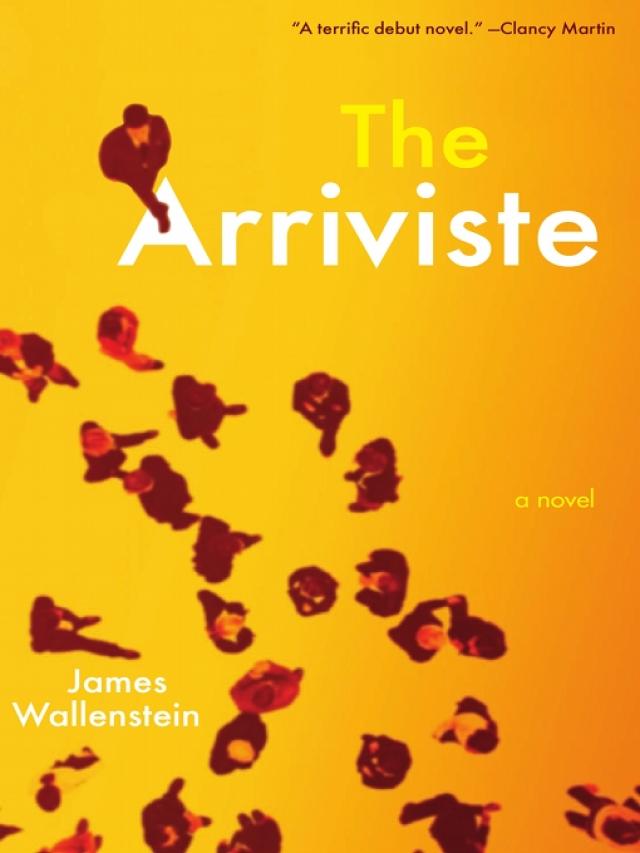
James Wallenstein, The Arriviste





