

Underjungle, page 1


MORE PRAISE FOR UNDERJUNGLE
“What can I say about Underjungle but Oh my God. So, so gorgeously strange, told by a sea creature, and set completely underwater, Underjungle (even the title is fantastic) is about all the big issues—love, loss, family, war—but it’s also about how all the oceans, like all of us, are connected—and the dangers when we forget that, and it’s written in prose as startlingly beautiful as the discovery of a real pearl shimmering in an oyster. A love letter to our oceans, Underjungle glints with humor and heart, and it’s totally unlike anything you’ve ever read before.”
—Caroline Leavitt, author of With or Without You
“Underjungle isn’t just a novel. It’s a symphonic meditation on existence, heartache, and underwater worlds beyond our imaginings. In prose both witty and elegiac, Sturz’s finned narrator plunges readers into the ocean’s depths, evoking such vivid tastes, textures, and scents that they may find themselves reluctant to come up for air.”
—Jennifer Steil, author of Exile Music and The Ambassador’s Wife
“James Sturz has written a strange and beautiful book that defies the usual categories. It’s a love story, a war story, and undersea epic and a meditation on the human hand. By the time you finish it you will know a lot more about what is happening in the sea around us—which may be the most important story of our time.”
—John Benditt, author of The Boatmaker
“This love song to the unseen life of the ocean is a thing of passion, beauty, and shimmering fish. Deep inside James Sturz’s singular and engaging story, there’s a message for us who dwell on land: Not just to take care of the ocean, but of one another as well.”
—Daphne Merkin, author of 22 Minutes of Unconditional Love
“Underjungle is a wondrously beautiful tale told in language that made me feel I was breathing the atmosphere of an exotic and miraculous planet. Of course, I was. But the most amazing thing is that, the whole time, I was breathing underwater.”
—Carl Safina, author of Song for the Blue Ocean and Beyond Words
“Reality, it has been said, is the aggregate of all perceptions, not just our human ones. The wondrously original Underjungle affords the reader rich access to just such perceptions, to a vivid inhuman world. And yet I marveled at the deep sensation of feeling more human for having read it, and have relished, long after the last page, the rock of the waves in my bones.”
—Chris Dombrowski, author of The River You Touch
“A beautifully written, unique novel that contemplates many of life’s big questions as it intrigues and entertains. A delightful read set deep in the ocean, in a part of our planet we’re just beginning to understand.”
—Bernie Chowdhury, author of The Last Dive
“James Sturz creates a world so colorful, imaginative, and diverse that it could only exist within the waters of Planet Ocean. It brings us into intimate contact with a wildly strange, incredible, and yet familiar imagining of aquatic life—and it takes us on a fascinating poetic journey that’s a joy to read and will make you love the ocean even more. Underjungle is a script for weaving dreams.”
—Paul Watson, founder of the Sea Shepherd Conservation Society and the Captain Paul Watson Foundation
“As a reader, I love to have my mind blown. James Sturz does this in his singular Underjungle, an entire novel told from the point of view of fish. Fish! And unknown sea creatures! With great authority, Sturz is able to capture it all: love, loss, heartbreak, danger. I unwittingly learned so much about ocean life, another world, similar but also different than our own.”
—Marcy Dermansky, author of Hurricane Girl
“Not many of us would have the audacity to write a novel where the only human character is a corpse decomposing on the ocean floor, but in Underjungle James Sturz has met this challenge in dazzling fashion. To get a more intimate view of the world under the waves, you’d have to become fish food yourself, so instead I recommend this profound and unclassifiable novel, a mind-expanding Aeneid of the seas.”
—Ned Beauman, author of Venomous Lumpsucker
“James Sturz is the Jacques Cousteau of storytelling. In Underjungle, he has crafted a magical, mystical, almost mythological narrative unlike anything else I know, an undersea morality tale for our hurt kind struggling through this postlapsarian mess we made.”
—William Giraldi, author of Hold the Dark and Busy Monsters
“An artistic romp in the underwater world, showing us that humanity barely scratches the surface of understanding our water planet. What a fascinating read!”
—Jill Heinerth, author of Into the Planet: My Life as a Cave Diver
“It’s OK to eat fish/ ‘cause they don’t have any feelings,’ warbled Kurt Cobain, verbalizing the disconnection many humans have from sea creatures and their vast ocean home. But fish and other critters in Underjungle definitely have feelings—and opinions!—on love, life, tribal affiliations, and the perplexing visitation from an alien being. James Sturz’s narrator is a charismatic, poetic, sometimes snarky guide to exploring the ocean and its denizens in a wholly original way.”
—Erica Gies, author of Water Always Wins
“In this strange and engaging dystopian novel, Sturz poses more questions than answers. Life beneath the sea may strike most of us as peaceful and serene, but Underjungle’s invented underwater realm is surprisingly violent—an echo of the world above?”
—Virginia Morell, author of Animal Wise and Becoming a Marine Biologist
“Underjungle is unlike anything I’ve ever read: a feverish tale told feverishly by one of the sea’s inhabitants. It’s a story that will devour you as you devour it, a terrifying tale of war and peace beneath the waves and a paean to the natural underwater beauty that exists without our noticing. It will break your heart, even as it implicates you, lashing you against the coral and feeding you to the sharks. I’m in awe of James Sturz’s ravishing, sun-lit, ink-black book full of mesmerizing characters who come to life on the page and resonate with you long after you’ve read the last word. You’re going to love this book and its astonishing conclusion.”
—David Samuel Levinson, author of Tell Me How This Ends Well
“An otherworldly romance full of poetry and wisdom. I love this novel—a strange, beautiful, and wholly original book. To read James Sturz’s Underjungle is to be enchanted.”
—Iris Smyles, author of Droll Tales
AN UNNAMED PRESS BOOK
Copyright © 2023 by James Sturz
All rights reserved, including the right to reproduce this book or portions thereof in any form whatsoever. Permissions inquiries may be directed to info@unnamedpress.com
Published in North America by the Unnamed Press.
www.unnamedpress.com
Unnamed Press, and the colophon, are registered trademarks of Unnamed Media LLC.
Hardcover ISBN: 978-1-951213-75-6
Ebook ISBN: 978-1-951213-93-0
LCCN: 2023935194
This book is a work of fiction. Names, characters, places and incidents are wholly fictional or are used fictitiously. Any resemblance to actual events or persons, living or dead, is entirely coincidental.
Cover design and typeset by Jaya Nicely
Manufactured in the United States of America by Sheridan
Distributed by Publishers Group West
First Edition
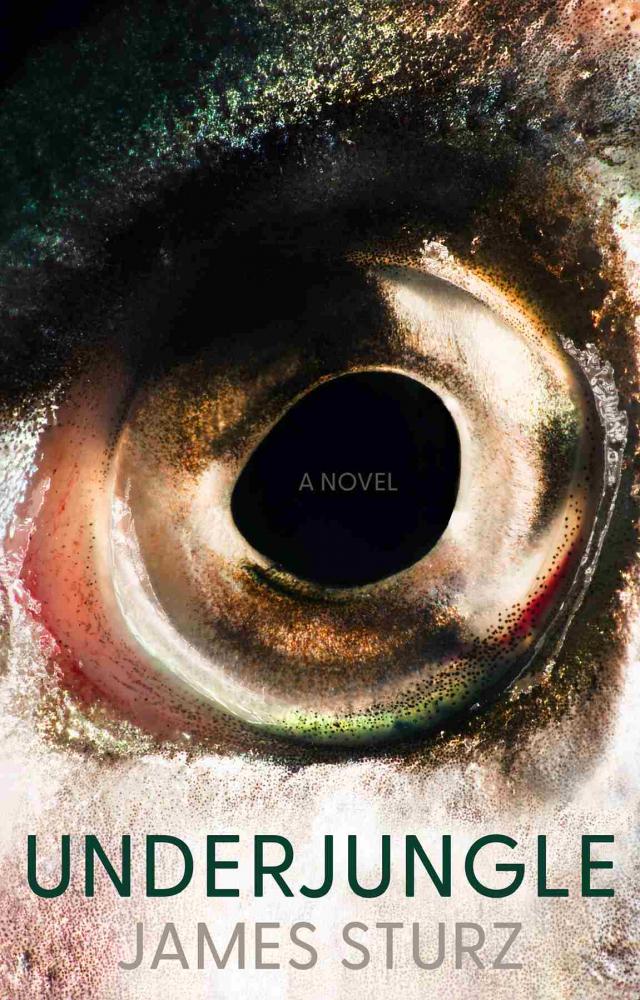
UNDERJUNGLE
A NOVEL
JAMES STURZ
For Paula
All the little fish of her laughter fled
before the shark of her awakening rage.
—Yehuda Amichai
1
I fell for you from far away. You had skin like waves. I know it wasn’t the pull of the moon. You smelled like fresh water, pureness, and trouble amid the pulverized sand and shells. I already knew what you looked like and how you moved.
I was a puddle in the ocean. I wanted to turn you into jelly.
There has never been a world like ours: a place that was perfect even before I knew you were in it. Our world is canyons and ledges and phosphorescent trickles, and mountains and swirls and sponges. It is plankton thick enough for farmers to herd and fissures that flash-boil lobsters into feasts. It is polyps and oysters and undulating pelvic fins. It is our origin and the future. Amid the bleats and yowls, the sea fills quickly with ballads about satisfying every kind of hunger, not all of them requiring food.
I was flailing fins, a somersault of nerves. Hints of you washed across me, and I opened my mouth. There were bubbles in my stomach. I kept reminding myself to breathe.
I’ve always said this is a peaceful world. There is no stillness. No possibility of getting caught in a morass. What choice is there but to let the current take you? We urge our young to go with the flow. Within the surge and saturation, the hold of water is all around us. To know someone is to engulf them.
Eventually, the tide will bring you back.
This is the only place I know, but it is one of vastness. Of roiling sands and squeals and moans, of thick seaweed forests, abyssal plains and hills and lava pillars coated with volcanic glass. But it is also a cradle. This womb is everywhere. It is a place you never have to leave.
Deep below the surface, our world is cold, dark, and content. Colors are fickle. Red disappears first as you descend, followed by the yellow of the sun. The hundred shades of blue last the longest, but eventually there is only black—and the candied ooze of the ocean floor. Where the pressure is constant, it clings to you as an embrace. We are most comfortable there, in our sheath. But
The world is flitters and ripples and secret vibrations. It is languorous undulations and scarlet bellies. When I first sensed you across the ocean, I knew I wanted to make you spill your eggs, so that my gentle army of warriors would attack them.
We are creatures of love, of amorous frenzy. Our tongue-like bodies turn each other into Antarctic slush. Our males flaunt and wiggle their fins in the most ardent ways, then press themselves ferociously against their mates. But when you bear a thousand eggs, you know it’s because nearly all of them will die. The sadness of love is unshakable for us. Only the sea cucumbers—so soft and round, and then swelling and stiffening as you knead them, before finally spurting from one end in delirious spasms—exist in a world of sweet, euphoric ignorance.
When our children grow, we urge them to stick together. We make sure they understand their brothers and sisters are not their dinner. It is violence to kill another creature, but it is a necessary violence. The choice not to kill is surely the one to die. When our young decide this (as they sometimes do), it is hard to mourn, since it is a great dishonor to the parents, who expended the time and effort needed to raise them. You can only hope the child grew sufficiently fat and muscled before making the decision to become another animal’s food.
But there are different kinds of killing. To watch a cookiecutter shark carve a hole into a wahoo’s flank so that it can immediately start feasting on its squishy innards is to witness a peculiar form of ghastliness. But many sharks eat their brothers and sisters before they are born, so what do you expect? I’d rather not think about tilapia in the ocean’s farthest reaches, where the water turns brackish, whose females brood their young in their mouths, while bachelor males suck them out and swallow them in a single decimating kiss. And yet those barbarians still leave the female’s tongue attached, so the mothers can wail about their losses.
When an animal bleeds from its mouth, you know its tongue and gums and cheeks will soon become a feast for many, so perhaps it is more discreet to enter through its side, although I would not like to experience this myself.
We urge our young to make friends with animals of sufficient size. Make friends with animals with tentacles, but do not always trust them. Make friends with ones without tentacles, but don’t expect them to be of much use. Make friends with ones with rotating eyes, because they will always be able to look themselves in the face. But mostly we tell our young never to worry about getting lost, for they’ll always be guided by the smell and taste of the water and the irresistible pull of the electromagnetic field. They’ll be drawn back home. As I was to you.
Sodium chloride. Magnesium chloride. Agitation. Magnesium sulfate. Calcium sulfate. Potassium sulfate. Fear. Exuberance. Boron. Sadness. Copper. Zinc sulfide. Gold. Each of them maps an unmistakable trail.
You can smell your prey and feel its vibrations in the water. The same is true for someone you desire.
Sometimes a partner will say, “I need space.” But we live in unlimited space. How can’t you already have all the space you need? If you do need more, where are you supposed to go?
Our movements look brooding, but even we are surprised by our speed. It doesn’t take long to cross the universe, to seek out warmer waters for a few days and make a meal of the local tropicalia. If those fish don’t want to be eaten, why are they so brightly colored, in all those bite-me hues? Life can’t all be about preening and flaunting in the hope for a little sex. The flounders know about humility. Many toadfish are open to earnest conversation. Sometimes there is sense to burying yourself in the sand. And yet when I saw you swimming with that school of anchovies around your neck, I was hypnotized. You never said how long it took to train them. I know you wanted to bring them back from the Coral Sea, but they fled our colder waters. At least you still had your oyster shells. You’d balance them across your chest.
“Camouflage,” you’d say.
We undulate and flitter about. There are coquettish things some females do with their pelvic fins. To see our younger ones practicing this in groups is at once amusing and upsetting. When the humpbacks start to sing—not those lower moans and thrums, but the deepwater booming, whistling, and yelping—their chants are thrilling and infectious, bouncing through the currents and coursing through the dark. When you hear their songs, how can’t you feel your body shake? How do you resist jiggling your booty like a sea lamprey sucking at a salmon’s skin?
Their songs vibrate the twilight zone with eddying bursts of light.
We are acrobatic and lithe and quick to alter course with the minutest flick of a single fin. Only my childhood guardian, Gola,* is the exception. With the grievous wound to his swim bladder, he keeps rising and sinking uncontrollably. We’ve all seen him shoot up awkwardly in the middle of a conversation.
“My injury,” he says, “makes me ridiculous. Everyone says I have trouble staying on point.”
Only fragments of soft coral float up. Intelligent life is better known for attempts at depth.
Once a month, we visit the tomb, our prayer house in the canyon. Encrusted with urchins and mottled with calcium carbonate, magnesium hydroxide, and iron-manganese oxide, it is a magnificent figure. We’ve all heard the whales gulp and drone as they pass. Ribs rise in aching columns from the floor, like ancient hydrothermal vents. Its vertebrae are shattered chunks. The massive caudal fin sits a quarter league away. No one admits to having played hide-and-seek in the body as a child, but it is what we all remember and it is what we think. Some claim this place isn’t truly sacred. There are places where the water is too cold and deep. They say, That is God. That is the afterlife. That is heaven. But to see the remnants of this beast—this thing that turns blue whales into blennies—is to remember that other creatures have come before us from faraway places, and that our infinite realm must have even more infinity along its edges.
Existence extends through space, as it does through time.
We are a sea in a solar system of seas.
What do we know of life? The alchemy of the ocean provides our essence. We take its oxygen and calcium, its plankton and its meat, and we turn it into frenetic, multiplying life. We take its roiling energy, too. We know that all creatures need food and water and a place to live. But what about empathy and love? We have grown too advanced and complicated to prosper without a purpose.
Can love be a purpose?
Or is it what we substitute for the absence of one?
Some say God is the jellyfish, the very essence of water jolted alive, but personally I think that idea is stupid.
God is the absence of everything else. A purpose.
When I was younger, one of a thousand before I became one of six, I marveled at the clearer water, at how it shimmered along its upper reaches, sparkling beneath the last glimmering rays of sun, and then how it darkened as it deepened—colors filtering out one by one, even as the particles and protozoa multiplied and the water became thick.
When food floats down to the ocean’s floor, the life processes there are so slowed that it takes nearly forever for the food to rot. We think of it as manna. We are grateful for it, but it is expected. There is always something sinking down—onto a ledge or crag, or into your mouth. Some say the heaps of dead creatures across the substrate must be a sign of God—proof of his existence, an indication of his love. It’s food you don’t have to kill for, that arrives as benefaction. Isn’t that the sign of a blessed life?
But seeing a hundred of our kind gorging on the ocean floor, tearing bodies apart with their teeth, does not fill me with a good kind of belief.
We live. We die. Some of us love.
Everything else is distraction.
We number in the millions, or the billions. There is no way to count. Like particles of water, none of us stays in the same place very long. Sometimes we’ll sweep along the continental slopes or above the mid-ocean ridges, seamounts, and abyssal hills, stealing through the twilight and midnight zones, invisible to anyone who relies on their eyes to see. But mostly we remain at four and five hundred fathoms, where the intelligent animals all know who and what we are. Even the sea cucumber, who breathes through its anus, clad in that frolicsome ring of teeth.


