

The Shadow, page 1


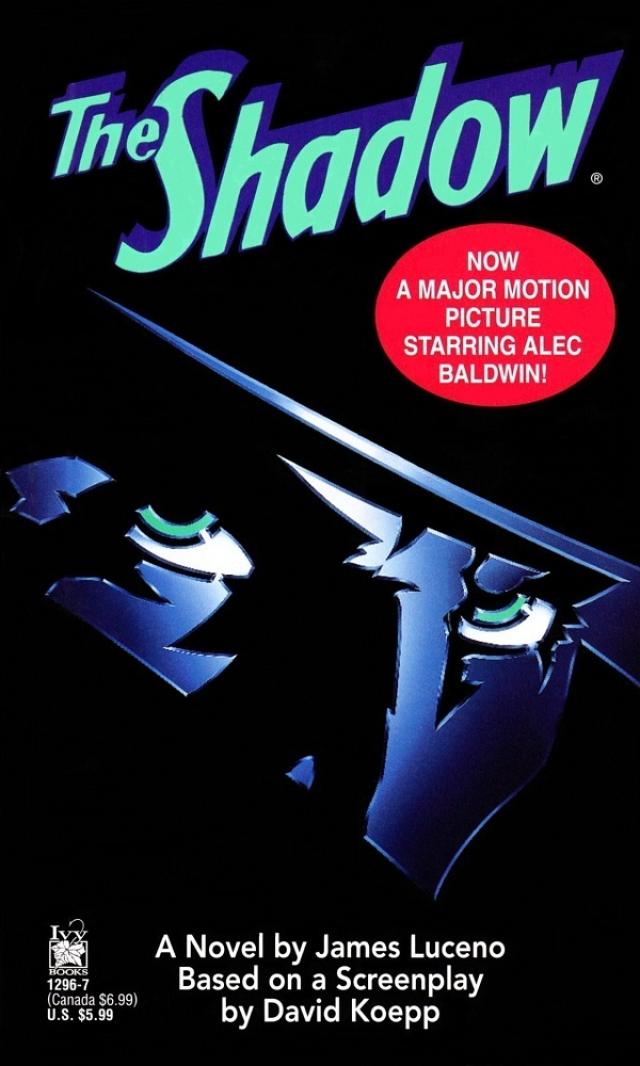
Who knows what evil lurks
in the hearts of men . . . ?
Perhaps only a man on intimate terms with evil himself. Such a man is Lamont Cranston, cold-blooded czar of a criminal empire—until a powerful Far Eastern mystic makes the ganglord his prisoner, and his disciiple in the occult arts that will change his life forever.
Armed with the uncanny powers of cloak himself in darkness and control the minds of others, Lamont Cranston makes the crime-scourged streets of 1930's New York the battleground in a war against the dark forces he once embraced. The battle will unite Cranston with his extraordinary soul mate, Margo Lane. And it will pit him against the unspeakable Shiwan Khan—a brilliant madman fiulled with his ancient ancestor's lust for conquest, and appetite for annihilation . . .
LOOK INTO THE SHADOW . . .
Long before Batman, Superman, and other crime-fighting superheroes, The Shadow materialized in 1930 as an eerie radio announcer on “Street and Smith’s Detective Story Hour.” Though The Shadow introduced stories about conventional detectives, in the end it was this mysterious, bodiless voice that stole the show. Listeners became riveted. And soon, The Shadow appeared in his own magazine.
To meet an ever-growing public demand, Walter B. Gibson, a magician turned writer, was hired to write the first Shadow novel in 1931—eventually authoring two hundred eighty-three Shadow novels under the pseudonym “Maxwell Grant.”
In 1937 The Shadow was immortalized by Orson Welles, in the part of Lamont Cranston/The Shadow, in his own radio series. The radio show, which aired until 1954, and the seventy-five million copies of The Shadow magazine, novels, and comic books have thrilled countless Shadow fans around the world.
And now, The Shadow casts himself on the silver screen . . .
By James Luceno
Published by Del Rey Books:
THE YOUNG INDIANA JONES CHRONICLES, BOOK ONE: The Mata Hari Affair
A FEARFUL SYMMETRY
ILLEGAL ALIEN
THE BIG EMPTY
Published by Ivy Books:
RIO PASIÓN
RAINCHASER
ROCK BOTTOM
Ivy Books
Published by Ballantine Books
Text and cover art © 1994 Universal City Studios, Inc., and Bergman/Baer Productions
The Shadow © Advance Magazine Publishers Inc. The Shadow and associated symbols and word marks are trademarks of Advance Magazine Publishers Inc. Used under license.
All rights reserved under International and Pan-American Copyright Conventions. Published in the United States by Ballantine Books, a division of Random House, Inc., New York, and simultaneously in Canada by Random House of Canada Limited, Toronto.
Library of Congress Catalog Card Number: 94-96088
ISBN: 0-8041-1296-7
Manufactured in the United States of America
First Edition: July 1994
10 9 8 7 6 5 4 3 2 1
CONTENTS
THE SHADOW
ACKNOWLEDGEMENTS
1: A Long Way From Shangri-La
2: Temple Of The Cobras
3: The Shadow Strikes!
4: The Shadow Masked
5: The Shadow Revealed
6: Exhibition Of Evil
7: Strange Bedfellows
8: Agents Of Influence
9: A Subterranean Summit
10: A Deadly Contest
11: Steak Knives And Crossbows
12: Sciaphobia: Fear Of Shadows
13: Chinatown Chinatown
14: Chasing The Dragon
15: Mind Games
16: Survival Lessons
17: Messages Sent On The Wind
18: The Gathering Storm
19: The Powers Of The Unseen
20: Reawakenings
21: Rolling Thunder
22: Inmates
ABOUT THE AUTHOR
For Jim Steranko—artist, author,
acrobat, magician, raconteur—for
keeping me on track.
And for the late Walter Gibson
(aka Maxwell Grant), author extraordinaire,
who could turn out a Shadow novel
of this size in five days, on a
Smith-Corona portable.
ACKNOWLEDGEMENTS
Most of these words belong to David Koepp, though I’ve also borrowed a phrase here and there from some of the almost three hundred Shadow novels written by Walter Gibson throughout the thirties and forties. I’ve tried to be faithful to both visions.
First and foremost, thanks to my editor, Susan Randol. We were both under the gun, and we made it happen.
And a tip of the slouch hat to those at Bregman/Baer Productions and Universal Studios, who helped me get a sense of what the movie will look like, including Dee Dee, Myron, and David, for showing me the gowns and suits; John Zemansky, for letting me heft the magnums; and Joe Nemec, for the notes and drawings, and for the tour of Shadow locations on the back lot.
None of it could have happened without the help of Leona Nevler, of Ivy Books; John Polwrek, of Universal Studios; and Charles O. Glenn, of Bregman/Baer Productions, who opened many a door. And special thanks to Lee Herschman, who went way out of her way.
I am also indebted to Michael Riccardelli, for providing me with Shadow comics galore; to Guy Guden, whose Who Knows What Evil has recently been published by Graven Images; and to Brian Daley, Karen-Ann, Carmen, Carlos, and Jake, for their unfailing support.
1
A Long Way from
Shangri-La
In the fertile river valleys and terraced hillsides that lie in the shadow of Mount Kailasa in western Tibet, the dry season ends in April. By then the wrinkled landscape has taken on a thirsty look, and clearing for spring planting has already commenced. For weeks, axes and machetes have been brought to bear on the thick forest growth above the shrunken rivers, and hundreds of felled trees, dry as kindling, lie about like outsize match sticks. On one auspicious morning, a small army of torch-wielding young men will scurry down the hillsides, setting fire to the trees, leaving in their wake an avalanche of flames that will climb hundreds of feet into the air. Within hours, smoke covers the land, hanging in the valleys like mist and obscuring the sun. But when the smoke clears, the burned fields are blanketed with a fine layer of nurturing ash that has secured the soil’s moisture deep within the fire-hardened ground.
Most villages will plant rice or scatter the seeds of other grains, like millet or gingke. But a few will court a far more lucrative cash crop: papaver somnifera, the delicate opium poppy, which withers and dies in strongly acidic soil and thrives where the substratum is porous and malleable, such as it is in the vicinity of Kailasa, known in Tibet as Kang Rimpoche, “the great ice jewel.”
The hillside palace of the drug lord who reigned over Kailasa gave ample evidence of the benefit that came from opting for the opium poppy. What with its lofty ramparts, precipitous stone walls, and low-pitched roofs of tile and native slate, it soared more than sprawled, dominating the valley whose terraces of white, red, and purple flowers had paid several times over for the embellishments that had come to it: hardwood furniture fashioned in Europe and Japan; carpets from Morocco and Turkestan; fine porcelains from China; silk brocades from southeast Asia; even a gasoline-powered generator transported by airplane from the United States.
Just now those terraces were dotted with harvesters conscripted from several of the local villages. Most wore the sashed tunics or simple blouses and trousers typical of the highland peasantry. The skin of their high-cheekboned faces had a leathery look, and their callused hands held the dull knives used for scraping the gummy black sap from the incised bulbs of the poppy plants. The women wore heavy coral and turquoise necklaces, from which dangled small amulet boxes known as kaus. The men kept their hair trimmed short in front and long and braided behind.
Armed with antique breech-loading muskets or with Lee-Enfield rifles that had found their way to Asia from the trenched and shell-cratered post-war landscape of Europe, mounted guards in yak-hide coats and turbanlike headclothes moved menacingly among the workers.
Incongruously, a car horn blared in the heat-shimmered air, and one of the horses reared as a Packard convertible motored into view around a bend in the deeply rutted dirt road that wound up the valley toward the palace. The guard reined in his startled beast and gazed at the late-model automobile with expectant curiosity. Some of the workers stopped to look as well, but any whispered exchanges were immediately silenced. The guard recognized the driver and the figure seated in the rear of the auto, but the man in the passenger seat was unfamiliar. Even so, the man’s quilted, cranberry-colored coat and spiked, bronze helmet marked him as a local warload—perhaps from the region of Lake Manasarovar or Parang—and a competitor in the opium trade.
The Packard continued on, its straight-eight power plant sputtering some as the auto gained altitude on the jarring road. The auto crossed a narrow saddle and skidded to a halt in front of the castellated palace, whose principal entrance was flanked by rough-hewn stone sculptures of Fu-dogs, seated forbiddingly on their haunches atop low pedestals.
The driver was a burly Tibetan with a shaved head, flaring eyebrows, and a Fu-Manchu mustache and beard. First out of the Packard, he walked around to the passenger side and threw open the door. “Out,” he commanded his helmeted passenger, reaching inside to take hold of him.
“Take your hands from me,” Li Peng protested. “Outcast! You dare to touch me?” He was a short but solidly built Chinese, whose left eye had already sustained damage from obv
Li Peng succeeded in shrugging off the larger man and had a fist cocked when the Tibetan in the rear seat—a long-haired man with a high forehead—drew a foot-long knife from the waistband of his trousers and pressed it to Li Peng’s throat.
Momentarily subdued, Li Peng allowed himself to be led away from the car toward the palace’s towering front doors, which were painted a garish red-orange and decorated with large bronze strap hinges and knockers.
The doors opened on a stone corridor with a vaulted ceiling. Pressed between the two Tibetans, Li Peng was hauled along at a brisk pace, past dank stairways and fixed-pane windows, then steered to the right into a shorter corridor that ended in an arrowhead arch, filled with lattice-work double doors. The fright Li Peng had experienced on first being abducted had returned, and he began to tremble slightly in the tight grip of his captors.
The room beyond the lattice doors was crowded with ornate furniture, large pillows and sheepskins, inlaid tables, and the low pallets favored by opium smokers. A worn Persian rug, askew to the entry, warmed a portion of the cobblestone floor, and the light from a roaring fire, a lattice-covered skylight, and several table lamps and chandeliers cast a checkerboard of shadows on the walls.
Perhaps a dozen Asian and Western women lounged in studied abandon on the room’s slightly elevated upper tier, their faces rouged and their raven hair bunned and braided. Silver and ivory cigarette holders dangled from their slender manicured hands. They wore tattered, tight-fitting Mandarin gowns, beaded flapper dresses, sheer robes, and lingerie. The presence of their stout madam attested to the fact that they were on loan from the brothels of Shanghai or Hong Kong. Interspersed among them reclined Chinese men in silk pajamas and skullcaps, nodded out with their opium pipes, along with a few mysterious-looking Westerners in black suits, who were being ministered to by servants bearing trays of food and wine. The room reeked of cheap perfume, cypress smoke, and the sweet smell of fired opium.
Though much of him was in shadow, the man who had ordered Li Peng snatched from his home on the western shore of Lake Manasarovar was seated at a gilded table on the far side of the room. Sunlight pouring in from a bank of windows behind him made it impossible to see Ying Ko’s face. Only his hands were visible: the right, feeding scraps of meat to a bearish, short-haired chow; the left, holding a cigarette. Two armed guards wearing long coats and ear-flapped caps flanked him, and Wu, his chief adviser, was bent over the table, displaying the contents of a large, leather-bound ledger. Three attendants hurried away from the table as the two Tibetans dragged Li Peng forward; otherwise, no one seemed to be paying Li Peng the slightest attention.
The whores’ madam started the phonograph, and the strains of big band music began to waver from the machine. The bald Tibetan kowtowed his way out of the room, closing the curved-top doors behind him. Still in the grip of his knife-wielding abductor, Li Peng stood silently in the center of the room, waiting.
Wu closed the ledger, bowed slightly to his employer, and stepped around the table to approach Li Peng, the yard-long book held close to his chest.
“Ying Ko asks too much,” Li Peng whispered harshly when Wu was within earshot. “My poppy friends are a glass of water in a rainstorm compared to his. His lips are always moistened with tea or butter, while the rest of us go thirsty.”
The hand that had been feeding the dog now held a poppy capsule, which it rolled in a steeplechase over charcoal-smudged knuckles. Ying Ko’s fingernails were an inch long and lacquered a dark burgundy. A veil of cigarette smoke drifted lazily in front of him.
Wu compressed his lips. He was an old man, whose sight required the help of round, wire-rim glasses, and whose hairless face bore a mole near the right nostril. He wore a black p’u-fu robe with vibrant mandalas embroidered on the front and back, and a round fur cap, whose crown was enlivened by a peacock-feather tassel.
“You and your brothers murdered three of our men,” Wu said, as if to remind Li Peng. “We can’t let that go unaccounted, can we?”
The captive’s whisper grew insistent, and he nodded toward Ying Ko. “He would have done the same if anyone had tried to demand an unfair percentage of the opium trade.” Li Peng used the Chinese term, a-fou-yong—a rendering of the Arabic ofium. “He already controls all the fields below Kang Rimpoche, from the mountain to the lake, and most of the land beyond. The opium trade with Shanghai, Tientsin, Marseilles, and Buenos Aires—it’s all his. And as a philing—an outlander—he has direct access to both the Corsican crime syndicate and American mafiosi. Everyone knows of his barbaric raid against the tribal chiefs of Barga. Even the Potola in Lhasa isn’t sacred to him.”
Without warning, he threw off the hand of the guard and took a bold step in Ying Ko’s direction. “Send three more and I’ll kill them, as well,” he warned the shadowed figure.
Ying Ko’s filthy hands came to a sudden stop in the room’s eldritch light. The poppy capsule was seized in his right hand, and when he opened it nothing was there.
Li Peng martialed his courage. “I’m entitled to my piece,” he said, aiming a shaking forefinger at the drug lord. “Kill me if you must, but I promise, my brothers will come for you.”
Except for the snap of the fire and the inconstant swirl of the brassy music, the room fell quiet. But at last, and with deadly intent, Ying Ko spoke:
“And I promise you . . . that I will bury them beside you.”
In need of a shave and framed by disheveled black hair that fell dully to the tops of broad shoulders, the face that leaned forward into the light had the pale and haggard look of opium addiction. But Ying Ko had a Western face, not more than thirty years in the making, at once captivating and frightening to behold.
Ying Ko directed a casual gesture to his long-haired henchman, and Li Peng immediately felt a hand vice itself on the back of his neck. In the same instant, a glint of firelight off the double-edged blade of the henchman’s knife caught his swollen left eye. With the practiced elegance of a trained fighter, Li Peng sent an elbow backward into the Tibetan’s solar plexus, even as his right hand was reaching out for the knife. Attempting to come around Li Peng’s left side, the guard stepped directly into his captive’s backhand and was spun ninety degrees, falling face first to the floor. At the same time, Li Peng—the long knife firmly in hand now—reached out for Wu.
The struggle had lasted only a moment, but Li Peng suddenly had the knife to Wu’s throat and was using him as a shield. Revolvers had flashed into view from the waist sashes of Ying Ko’s flankers, but neither gunman was positioned for a clear shot. Li Peng could see the prostitutes only peripherally, but their murmurings told him he had their attention.
“I wish only to leave,” he announced, his voice raspy with apprehension. “Let me leave.”
For emphasis, he pressed the blade to Wu’s throat. The old man’s palsied hands were clamped on Li Peng’s knife hand, though his elbows continued to support the ledger. Throughout, Wu had found amusement in Li Peng’s threats—smiling and bobbing his eyebrows—but no longer; Li Peng could hear and feel Wu’s labored breathing.
Ying Ko himself had come to his feet. A wool blanket that had covered his lap fell to the floor as he edged around the table and advanced on the stairs. Muscular and over six feet tall, he was barefoot and dressed in a richly embroidered black silk tunic and trousers. His assassins kept their weapons raised but remained where they were. The guard was still facedown on the floor, more, Li Peng surmised, out of humiliation than the force of his backhand.
“I’ll cut Wu’s throat,” he warned. “He’s your friend, Ying Ko, your right hand. Even you wouldn’t chance seeing him killed.”


