

Fantastic Four, page 1


Contents
Cover
Novels of the Marvel Universe by Titan Books & Also Available from Titan Books
Title Page
Leave us a Review
Copyright
Dedication
In the Beginning…
13.7 Billion Years Later
Not on Earth, Not in Another Dimension, But…
Seventy-Two Hours Later
Meanwhile, On that Third Planet from the Sun…
Back In the Very Dim and Distant Past
Back to the Baxter Building
Galactus
Clobberin’ Time!
A Long Time Ago…
The Silver Surfer
Elsewhere
A Few Days Later…
About the Author
Also Available from Titan Books
Novels of the Marvel Universe by Titan Books
Ant-Man: Natural Enemy by Jason Starr
Avengers: Everybody Wants to Rule the World by Dan Abnett
Avengers: Infinity by James A. Moore
Black Panther: Panther’s Rage by Sheree Renée Thomas
Black Panther: Tales of Wakanda by Jesse J. Holland
Black Panther: Who is the Black Panther? by Jesse J. Holland
Captain America: Dark Designs by Stefan Petrucha
Captain Marvel: Liberation Run by Tess Sharpe
Captain Marvel: Shadow Code by Gilly Segal
Civil War by Stuart Moore
Deadpool: Paws by Stefan Petrucha
Doctor Strange: Dimension War by James Lovegrove
Guardians of the Galaxy: Annihilation by Brendan Deneen
Loki: Journey into Mystery by Katherine Locke
Morbius: The Living Vampire – Blood Ties by Brendan Deneen
Secret Invasion by Paul Cornell
Spider-Man: Forever Young by Stefan Petrucha
Spider-Man: Kraven’s Last Hunt by Neil Kleid
Spider-Man: The Darkest Hours Omnibus by Jim Butcher, Keith R.A. DeCandido, and Christopher L. Bennett
Spider-Man: The Venom Factor Omnibus by Diane Duane
Thanos: Death Sentence by Stuart Moore
Venom: Lethal Protector by James R. Tuck
Wolverine: Weapon X Omnibus by Marc Cerasini, David Alan Mack, and Hugh Matthews
X-Men: Days of Future Past by Alex Irvine
X-Men: The Dark Phoenix Saga by Stuart Moore
X-Men: The Mutant Empire Omnibus by Christopher Golden
X-Men & The Avengers: The Gamma Quest Omnibus by Greg Cox
Also from Titan and Titan Books
Marvel Contest of Champions: The Art of the Battlerealm by Paul Davies
Marvel’s Guardians of the Galaxy: No Guts, No Glory by M.K. England
Marvel’s Midnight Suns: Infernal Rising by S.D. Perry
Marvel’s Spider-Man: The Art of the Game by Paul Davies
Obsessed with Marvel by Peter Sanderson and Marc Sumerak
Spider-Man: Into the Spider-Verse – The Art of the Movie by Ramin Zahed
Spider-Man: Hostile Takeover by David Liss
Spider-Man: Miles Morales – Wings of Fury by Brittney Morris
The Art of Iron Man (10th Anniversary Edition) by John Rhett Thomas
The Marvel Vault by Matthew K. Manning, Peter Sanderson, and Roy Thomas
Ant-Man and the Wasp: The Official Movie Special
Avengers: Endgame – The Official Movie Special
Avengers: Infinity War – The Official Movie Special
Black Panther: The Official Movie Companion
Black Panther: The Official Movie Special
Captain Marvel: The Official Movie Special
Marvel Studios: The First 10 Years
Marvel’s Avengers – Script to Page
Marvel’s Black Panther – Script to Page
Marvel’s Black Widow: The Official Movie
Special Marvel’s Spider-Man – Script to Page
Spider-Man: Far From Home: The Official Movie Special
Spider-Man: Into the Spider-Verse: Movie Special
Thor: Ragnarok: The Official Movie Special
An original novel by
JAMES LOVEGROVE
TITAN BOOKS
LEAVE US A REVIEW
We hope you enjoy this book – if you did we would really appreciate it if you can write a short review. Your ratings really make a difference for the authors, helping the books you love reach more people.
You can rate this book, or leave a short review here:
Amazon.com,
Amazon.uk,
Goodreads,
Barnes & Noble,
Waterstones,
or your preferred retailer.
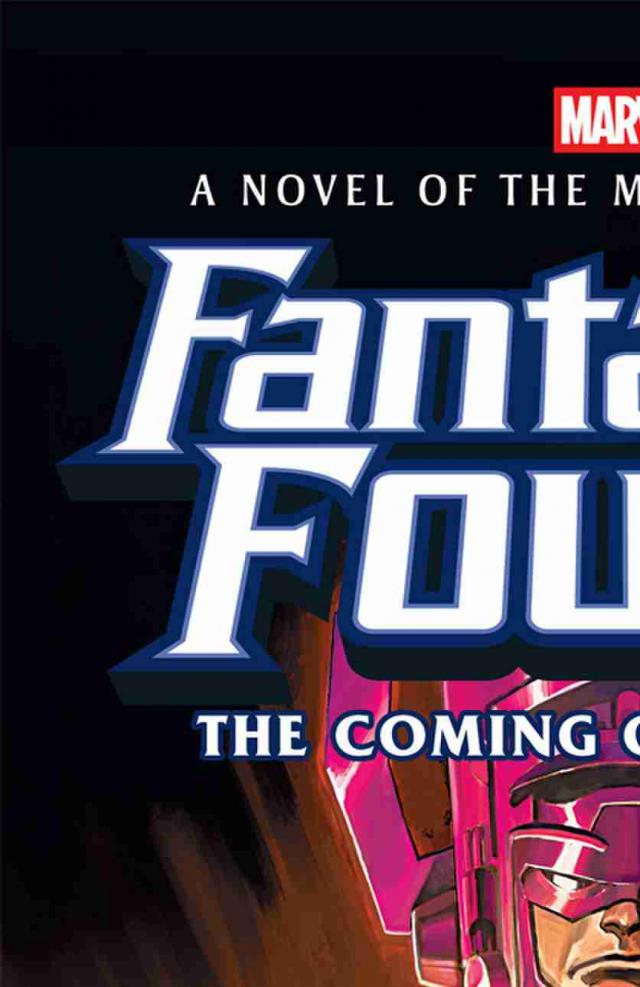
FANTASTIC FOUR: THE COMING OF GALACTUS
Print edition ISBN: 9781803369044
E-book edition ISBN: 9781803369037
Published by Titan Books
A division of Titan Publishing Group Ltd
144 Southwark Street, London SE1 0UP
www.titanbooks.com
First edition: June 2025
10 9 8 7 6 5 4 3 2 1
This is a work of fiction. All of the characters, organizations, and events portrayed in this novel are either products of the author’s imagination or are used fictitiously. Any resemblance to actual persons, living or dead (except for satirical purposes), is entirely coincidental.
© 2025 MARVEL
MARVEL PUBLISHING
Jeff Youngquist, VP Production and Special Projects
Sarah Singer, Editor, Special Projects
Jeremy West, Manager, Licensed Publishing
Sven Larsen, VP, Licensed Publishing
David Gabriel, VP, Print and Digital Publishing
C.B. Cebulski, Editor in Chief
Cover art by Jack Kirby. Paints by Dean White.
No part of this publication may be reproduced, stored in a retrieval system, or transmitted, in any form or by any means without the prior written permission of the publisher, nor be otherwise circulated in any form of binding or cover other than that in which it is published and without a similar condition being imposed on the subsequent purchaser.
A CIP catalogue record for this title is available from the British Library.
EU RP (for authorities only)
eucomply OÜ, Pärnu mnt. 139b-14, 11317 Tallinn, Estonia
hello@eucompliancepartner.com, +3375690241
This one’s for
Paul Wilson
Silver Surfer super fan
In the Beginning…
…IT WAS the end of everything.
The universe was dying.
Its multibillion-year lifespan was coming to a close. As all things in nature must decay, the whole of creation was decaying. A rot had begun to spread from the center outwards, moving from solar system to solar system, world to world, bringing oblivion wherever it touched.
It was a plague of dark radiation which altered the very building blocks of existence. It broke the bonds within molecules. It dissolved atoms. It unentwined DNA strands. It dispersed matter into nothingness.
The dark radiation fed on destruction, and with every planet it reached and every species it extinguished, it grew stronger and proliferated faster.
It was an inexorable spaceborne cancer, and nothing could stop it.
* * *
THERE WAS a world at the universe’s edge, and its name was Taa.
Taa was a veritable paradise, the most advanced civilization in existence. It was a place of scientific marvels, social harmony and everlasting peace. Its denizens spent their long lives pursuing the arts and the acquisition of knowledge.
In the tall, shining towers of their cities, Taa-ans devoted themselves to contemplation and recreation. In their civic spaces they raised vast statues in tribute to the noted forebears who had helped make Taa the beacon of progress and reason it had become. They toiled enthusiastically in fabulous laboratories and gazed at the night skies from ultra-sophisticated observatories.
They traveled across their world in transparent thought-spheres to further their studies. The thought-spheres could hover amid the lava spewed from the mouth of a volcano, and endure the pressures of the deepest ocean depths, with no danger or discomfort whatsoever to their passengers.
In the entire universe, there was nowhere else quite like Taa. It was the civilization other civilizations aspired to be.
And one of its foremost inhabitants, and perhaps its greatest mind, was the man called Galan.
* * *
FOR MONTHS, Galan had been absent from Taa. He had taken himself off into the farthest reaches of space aboard a quantum-drive starship capable of subspace travel. He had journeyed far and wide, making surveys, taking readings, gathering data.
He wished either to confirm or to disprove certain observations he had made from the surface of his homeworld.
His researches led him to one dire, inescapable conclusion.
When he returned to Taa, he broke the news to his race.
The universe was doomed.
At first, Galan—an impressive figure in his gleaming metallic-blue armor-like outerwear, with a high forehead and strips of close-cropped hair—had difficulty finding words to express himself. He was addressing a room full of his scientific peers, with the event being broadcast planetwide to the transceiver units implanted in the brain of every Taa-an at birth.
When great Galan made an announcement, all listened. When he had information to share, all paid attention.
“I can scarcely speak,” he said at last. â
There was rumbling consternation among the assembled scientists, and likewise across the whole of Taa.
“Our world,” Galan continued, “is one of the last still in existence. A terrible radioactive plague is sweeping towards us, here at the fringes of the known cosmos. I have watched as countless races have fallen before the contagion. I have seen billions upon billions of lives snuffed out, planets reduced to dust, suns become little more than clouds of cinders. It is hopeless. There is no avoiding this plague, and no remedy for it that I know of.”
“Can it truly not be defeated, Galan?” a member of his audience cried out. “There must be a cure, and surely we Taa-ans, with our knowledge and our technology, stand a better chance than anybody of finding one.”
“I have applied my mind to the question,” Galan replied. “My thoughts during my return journey were occupied by little else. I programmed my starship’s computer to run a septillion scenarios. It calculated and recalculated, and every time the answer was the same, confirming my suppositions. Nothing can escape the plague. The dark radiation defies being repelled. There is no countermeasure, no antidote. Perhaps, if we had decades, we might collectively be able to devise such a thing. But we do not have decades. The plague’s progress is accelerating, and it is nearing Taa.”
“How soon?” asked another audience member. “How long do we have before it is upon us?”
Galan’s already grim visage became ever more somber. “Days, my friends. We have only days left.”
There was, then, an outpouring of grief and horror from the entire population. Whether through speech, or via their transceiver units, person communicated with person, sharing their shock, their sorrow, their dismay, their anguish. It was some while before all these voices quietened and Galan was able to sum up the situation.
“What must we do, my friends?” he asked rhetorically. “I can think of only one thing. It is all we can do. We must prepare for the inevitable. We must simply await the end of all that is.”
He looked down for a moment, then raised his noble head. His eyes glistened. His jaw was set.
“Our race must die with dignity,” Galan said, “in a manner befitting Taa.”
* * *
AND YET, Galan thought later, it was not fitting that all must perish.
Evening had come, and Taa’s threefold suns were setting, creating that remarkable interplay of deepening colors and multiple crisscrossing shadows which made its dusks so incomparably beautiful.
Galan stood on the balcony of his apartment, at the summit of a forty-story tower, beholding the dying embers of the day with the heaviest of hearts. He had carried the knowledge of the universe’s impending demise all by himself during his time in space, and had thought that revealing it to everyone else on Taa would relieve him of the burden.
But, in fact, he now felt the weight of it even more.
It seemed extraordinary that Taa should die. All that erudition, all that genius, everything Taa-ans had accomplished over countless generations—shortly to be snuffed out, as though it had never been.
Inconceivable.
There had to be a way, surely, for the glory and grandeur that were Taa to live on.
Galan brooded on the matter, even as Elder Child, Taa’s largest sun, sank below the horizon. Its two siblings, Middle Child and Youngest, followed in swift succession, and night fell.
The sky bristled brilliantly with stars. But there seemed to be fewer than usual, and as Galan watched, he could have sworn he saw one or two of them wink out of existence.
A plan, born of hope and desperation, began forming in his brain.
* * *
IN THE days that followed, Galan roved back and forth across Taa in a thought-sphere. He guided the vehicle with his mind, visiting several specific locations: the homes of Taa’s preeminent chemists, physicists and biologists.
He could have contacted these scientists by transceiver, but he elected to visit them in person instead. So much more could be achieved through a one-to-one conversation than remotely.
His proposal to each was this. They would assemble every scrap of knowledge on Taa and commit it to databanks. Then, together, they would depart the planet in Galan’s starship with those databanks on board and head for the very source of the dark radiation, at the universe’s heart.
To call this mission hazardous was an understatement. It was suicide.
And yet there was a chance—a very remote chance—that where the radiation originated from, there they might be able to fathom its nature best, and thus perhaps find a way to combat it. The starship’s computer, loaded with the accumulated brainpower of an entire race, would be put to work, to aid them in coming up with a solution.
The dark radiation, Galan reasoned, did not just appear out of nowhere. It had emerged from something, and in that something might lie the key to salvation.
From each scientist he garnered agreement, and a date was set for them to assemble at Galan’s home and launch into space.
During those days, as Galan mustered his scientific allies, the effects of the dark radiation began to be felt on Taa. Journeying across the continents, Galan saw death laying its dark hand, now here, now there, arbitrarily, capriciously, as though this was all just some childish game to it.
Cities were slowly becoming necropolises as the sinister, invisible plague crept over them. People collapsed and died in the streets. Thought-spheres crashed to earth as their occupants were suddenly struck down. Towers cracked and fell. Forests and jungles turned brown, then black. Seas dried and became turgid swamps. Great ocean beasts floundered in the shallows, gasping their last. Mountains literally crumbled.
Galan hardened his heart to these apocalyptic scenes. He focused on his mission. He could not afford to give in to despair. With him and his colleagues rested Taa’s one slim hope of survival.
* * *
AT LAST the day came.
The scientists gathered at Galan’s residence. Several of them did not make it; death had claimed them in the interim.
The handful who did boarded Galan’s starship, and they lifted off and rose into the sky, escaping the moldering, death-riddled shell that was once Taa. They felt some guilt at abandoning their fellow Taa-ans, their friends and their loved ones; but more than that, they felt dread and trepidation. Ahead of them lay an uncertain destiny. The only thing they knew with any surety was that they were more than likely going to die.
They flew through the darkness of a hollowed-out universe, on a course for its very center. Galan had erected an antimatter field around his starship which he hoped would mitigate the dark radiation’s effects. Eventually the field would succumb to the plague and become useless, but it ought to protect the vessel long enough for them to reach their destination.
The fearful voyage soon neared its end. The starship’s long-range sensors detected an extraordinary phenomenon ahead: what appeared to be a seething, blazing cauldron of sheer cosmic energy, vast as a sun. Galan and his colleagues analyzed it and came to an inescapable conclusion.
The pulsating energy mass was the source of the dark radiation. As Galan had theorized, the plague had to have come from somewhere, and this was it.
But not only that.
The energy was sentient.
The starship decelerated on its approach to the energy mass. Its protective antimatter field was by now just the thinnest of skins, barely keeping the dark radiation at bay. The vessel’s life could be measured in hours.
Nonetheless, the Taa-an scientists, led by Galan, set about studying the phenomenon, trying to comprehend what it was made of, why it lived, and how its malign influence on the universe might be counteracted.
It was an urgent race against time, the greatest intellects of the greatest ever civilization applying themselves to penetrating what was perhaps the ultimate mystery—and in doing so, saving themselves and everything that was.
They failed.
The antimatter field gave out. No longer were they shielded from the plague.





