

Slaughter Time (A Breed Western #15), page 1


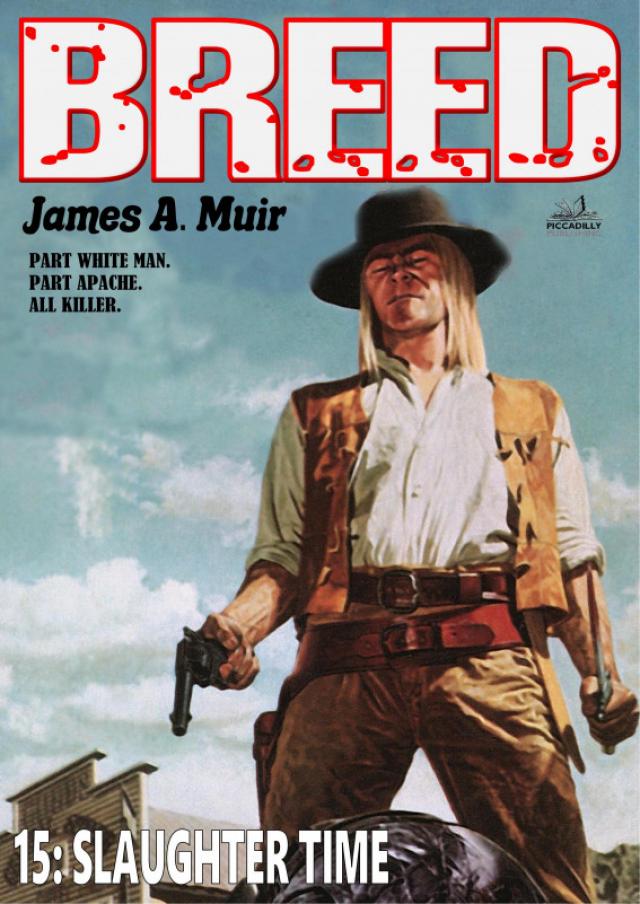
Table of Contents
Chapter One
Chapter Two
Chapter Three
Chapter Four
Chapter Five
Chapter Six
Chapter Seven
Chapter Eight
Chapter Nine
Chapter Ten
Chapter Eleven
Chapter Twelve
About the Author
The Breed Series
More from Piccadilly Publishing
For two friends on the other side of the fence:
Reg and Nina
Chapter One
THE MAN RODE hunched over in his saddle, letting the pony choose its own pace. The reins were gripped loosely in his left hand, the right clutching at the horn to hold him in place. A welter of bruises decorated his face, placed so closely together that his features were camouflaged by the interlinking of blackening purple marks. One eye was swollen shut, the other red and puffy above an ugly cut that was thick with congealed blood. More fluid dribblings came from his flattened nostrils and from the cuts where his lips had been mashed back against his teeth. Sweat darkened the armpits and back and chest of his faded linen shirt, and his shoulder-length mane of blond hair hung limp about his collar. Each slow step of the big gray animal he rode brought his teeth together in clenching admission of the pain that wracked his body, producing a fine beading of perspiration across his broad forehead.
He followed the trail slanting up through the trees until it debouched into a canyon that was carpeted with sparse grass, the walls high and white in the afternoon sun, the reflected glare causing him to wince as his good eye watered and dropped salty tears into the cut on his cheek. He followed the canyon down to where a narrow cut bled through to a wider spread of land, then turned north and west. The trail got rocky here, the grass giving way to bare stone that rang loudly under the shod hooves of the gray horse. After a while the trail curved round to follow the path of the descending sun, heading due west through a landscape of jumbled rock that glistened in a myriad eye-watering colors that shimmered and shifted in the radiant light. When he reached a place where a great, sheer wall of white stone lifted up like a curtain dropped from the sky, he turned into a gulley that might once have held a river inside its bare confines, but was now just hard, dry sand. Mesquite and cholla dotted the arid ground, the gray and green of the living plants contrasting dully with the iridescent coloring of the rock. He followed the gulley on to where it turned north, then swung west again into a ravine of dark blue stone.
At the end of the ravine there was a low wall of washed-out shale, pale red against the blue. He climbed it slowly and came over the rim into a shallow canyon that was almost hidden behind a stand of wind oak. The walls of the canyon were no more than fifty feet high. Caves dotted the upper level like the eye sockets of sun-bleached skulls, but along the lower levels there were the remnants of buildings: adobe frontages that jutted out from the cliffs, like boxes stacked one atop the other. Thirty feet up from the ground, the empty adobes were linked by ancient ladders, their wood still good, despite their age. At the bottom, stone steps led to the first terraces, the entrances still guarded by weathered fences and piles of wind-washed boulders.
Mesquite and juniper filled up the interior of the canyon, intercut with wind oak. There was a stream running down the center, emerging from a small, dark hole in the western face of the rock and disappearing inside a second small, dark hole that was slightly to the south of the eastern side.
The man halted his pony beside the stream and eased his body down from the saddle. The movement caused him fresh pain, and he groaned as he set his moccasined feet on the warm earth and staggered towards the water.
He went down on his knees, more from weakness than voluntary action, and pitched the flat-crowned Sonoran stetson from his head. Then he sunk his face in the water, holding it there as the cool, fast-flowing current washed over the bruises; washed the blood away. He eased his face slowly clear of the stream, panting like a dog, down on all fours like a dog.
But hating like a man.
Hating like warrior of the Chiricahua.
He stood up. Slowly. Painfully. And went over to the gray stallion, hauling the animal away from the stream before it could bloat its belly on excess water. He tethered the horse and slipped the saddle loose, dropping it along with the blanket dose to the rock wall. Then he fixed a hobble about the forelegs and eased the harness clear of the proud gray head. After that he stripped off his own garments – the shirt, a pair of close-fitting buckskin pants, and the high moccasins favored by the Apache peoples – and climbed into the stream.
He lay in the cool water for a long time, feeling the liquid ease the pain with its numbing cold before he climbed out and lay naked in the sun.
His name was Azul.
Or Matthew Gunn.
Or Breed.
It depended on who knew him, and from where they came; even on how they thought of him.
He was the product of a marriage between the Santa Fe trader, Kieron Gunn, and a woman of the Chiricahua Apache, Rainbow Hair. He had been raised as an Apache, yet taught the ways of the white men – the pinda-lick-oyi – by his father. In the great cathedral in Santa Fe, he had been christened Matthew Gunn, after his father; in the rancheria of his mother’s people, he was called Azul, for his blue eyes. He was a man born of two races. A man tom between the disparate needs of red and white, belonging fully to neither, understanding both. And often hated for the mixture of blood coursing his veins.
Down along the Border men had given him a new name: Breed.
Some said it spelled death.
Slowly, wary of the bruises that covered, as well as his face, his ribs and belly and back, he climbed to his feet. He pulled on his clothes. Then fastened a gun belt about his waist. It held a Colt’s Frontier model in .45 caliber and a leather sheath containing a wide-bladed Bowie knife. Into the side of his right moccasin he slid the needle-sharp, slender blade of a throwing knife. Then he slid a Winchester rifle in .44-40 caliber from the sheath belted to his saddle and moved off down the canyon; slowly.
He had seen jackrabbits down amongst the foliage at the western end.
He sat against the rock, tearing meat from the roasted carcass of the rabbit. The juices ran hot and stinging against his lips, and the movement of his jaws sent flashes of pain up through his cheeks, into his nose and eyes.
But the food tasted good: it was giving him strength, filling his belly with honest meat and rich, red blood. He looked at the fire, then up at the moon that was shifting imperceptibly across the sky, like a pale and wailing face mourning his hurt.
Soon, he thought. When this eye opens again and I can move faster. Ten days, maybe. Then I go back.
He tore the last of the meat from the rabbit and sucked the thin marrow from the bones. He tossed the remnants into the fire and walked slowly over to the stream. Rinsed out his mouth and washed his face. Then went back and banked the fire up before curling into his blanket and sinking into sleep.
Soon, was his last thought: definite; implacable. Relentless as the encroaching approach of death.
His battered lips curved in an ugly smile as he repeated the single word:
Soon.
Chapter Two
MATTOCK WAS PRETTY big for a West Texas town.
Backed up against the eastern edge of the Guadalupes, right on the New Mexico line, it got sheltered from the weather by the overhang of the mountains and also got the water from the hills. It was located close enough to the Goodnight-Loving cattle trail that it picked up a fair number of drovers heading northwards out of the high-price cattle country to the south, and found plenty of business from its own ranchers. There was a big corral on the east side, with smaller stock pens around, all fed by a windmill that pumped water up out of the dusty ground into a series of cache tanks. There was a Cattleman’s Association office right by the pens, and another – larger – one, inside the town. There was a bank and a stage depot; a saddlery, a stable, a gunsmith’s; a dry-goods store and a hardware store; a general store and a saloon; one hotel; one eating house; a marshal’s office with a three cell jail built of brick out back, and a whorehouse.
Mattock was pretty big.
And Jonas Masters was the biggest man in town.
The biggest man in the territory.
Not just in size, though his shoulders were close on twice as wide as most men’s, and if he had been able to stand upright he would have topped close to seven feet. His hair was white, very thick, falling down into a beard and mustache that gave his weathered face a patriarchal look, like some prophet out of the Old Testament. His chest and arms and hips were equally wide, in proportion to his height. Only his legs failed to fit the giant image: they were thin, withered inside the black pants he wore, hidden beneath the blanket that covered his wheelchair.
Jonas Masters had commanded a squadron of Texas Volunteers during the War Between The States. He had fought hard and long – and bloodily – from the very outset. Then, at Chandler’s Ford, a Minié bullet had hit him in the back, lodging against his spine. For a month he had fought to live, and when the doctors pulled him through, it had been without the use of his legs.
There was no feeling there. Nothing but the dead weight of the two limbs that dangled like rotting stumps from the base of his body. Over the years since the War, they had withered even more, so that now he was not even able to walk on crutches, but confined to the
Luke was twenty-five years old, with his father’s build and his mother’s looks. He was tall and wide and handsome. Perhaps too handsome, for he had sparked up at least three local girls and come running to his father for money without marrying any of them. He preferred to spend his time in the saloon or the cat house: too much time for Jonas’ liking; with not enough spent on the ranch. But Jonas went on funding the boy-he still thought of his grown son as a boy – and settled his debts and his problems with the same autocratic command that had made him the richest man in the territory. A man who ruled from the throne of his wheelchair, commanding the storekeepers and whores of Mattock like some feudal lord.
Until now.
Until that goddam half-breed showed up.
Jonas Masters watched the five stud bulls he had shipped in, milling around their individual pens and felt a sudden chill grip his legs. He knew he was imagining it: he couldn’t feel anything below his hips. But, by God! they felt cold still.
Breed rode into Mattock with a chilly north wind trailing his back.
There was no reason for going there other than the fact that he wanted to spend time away from the Mogollons and let the trouble up there die downi. Mattock was as good a place as any to pick, and far enough distant so that he should be safe.
Just like any other traveling man, he booked into the Mattock Palace Hotel. The sign out front said it was the biggest and best from El Paso to Odessa, and his room was comfortable enough. It had a wide bed and a wardrobe; a washstand with a jug of fresh water in the enamel bowl; and what looked like a carpet on the floor. The window opened onto Main Street, and the only problem had been the desk clerk who studied his face as he signed the register.
He had signed as Matthew Gunn, and when he spoke English to the clerk, the man had sighed and said, ‘Fine. That’s all right.’
‘Why?’ Breed had asked. ‘What difference does it make?’
‘A lot,’ the clerk had answered, blotting the register. ‘Injuns ain’t exactly welcome here. Nor them related to injuns. On account of Mr. Masters’ troubles.’
‘I never heard of him,’ Breed had said. ‘What troubles?’
‘His wife got took by the Comanch’. They took her an’ took her.’ The clerk had shrugged, embarrassed. ‘Know what I mean? She died. Since then, Mr. Masters an’ his boy ain’t been overly fond of injuns. So, seein’ as how he more or less runs this town, I hafta to be careful.’
The same day Breed had found out how careful.
He had take a bath and eaten a meal. Checked his horse into the stable, and then gone to the hardware store to buy fresh shells.
The store had a big sign outside, a solid section of wood that was suspended from four metal chains over the sidewalk. It carried a legend scored into the wood with hot irons and black paint. It read: Caleb Black’s Hardware Emporium. Underneath those words there was a faint etching in white that said: No Indians or Nigras.
The store had been empty when he walked in. Forks and hoes and rakes and shovels were stacked against one wall. Heavier equipment was canted either side of a trestle occupying the center of the room. To the left there was a glass-fronted counter with guns set out on green cloth. As he went in, a bell had rung from its stanchion over the door and a girl with long blonde hair and dark gray eyes had come out from the back. She was wearing a pale blue dress that looked a little too small, as though she had worn it a long time, enough for her figure to fill faster than the dress could accommodate.
She had smiled at him.
‘Can I help you?’
He had bought six boxes of cartridges, the .45 to .44-40 that fitted both the Colt and the Winchester, and was handing over his money when the man walked in.
He was tall, close on three inches higher than Breed. Wearing a dark blue shirt that looked like it had been washed and ironed that same day. Stovepipe chaps covered his legs, buttoned up with fancy silver conchos that matched the chasings on his gun belt. He carried a Colt’s Peacemaker in the holster and a broad-rimmed, silver-banded stetson in his left hand.
When he saw the girl smiling at Breed, his face froze. It might have been a handsome face, once; a few years back. Now it was fleshed out, getting jowly around the chin and soft on the cheeks. The eyes were black and angry, carrying more life than the small roll of fat that sat over the gun belt.
‘Sarah!’ It sounded like a command. ‘What the hell you think you’re doing?’
‘Serving a customer, Luke,’ the girl had said. ‘What else?’
Her smile switched off as she said it, then came back on as she looked at Breed.
It was the first time he met Luke Masters.
‘I don’t like it.’ The big man stood a few feet clear of Breed. ‘He’s got an injun look to him.’
‘You don’t own all of Mattock,’ the girl had said. ‘I can serve anyone I like.’
‘Like?’ Masters had grunted. ‘How can anyone like a goddam half-breed injun?’
He fastened his right fist over the butt of his Colt as he said it, then looked again at Breed.
‘Word of warning, injun. Pay for what you want, then get out. Today.’
Breed had looked back into the angry eyes and said, ‘When I’m ready. Not before.’
The man’s face had curved in a tight, unpleasant smile. ‘I’m Luke Masters, feller.’
Breed had said nothing, just scooped the boxes of shells into the gunny sack the girl handed him.
‘You hear me, feller?’ There was a tight edge of anger in Masters’ voice. Like he wasn’t used to being ignored. ‘I said I’m Luke Masters.’
‘Nice name,’ Breed had grunted. ‘That why you keep repeating it?’
Masters’ face had gone pale under the tan, his eyes narrowing as his chin jutted forwards in an expression oddly close to a pout.
‘Luke,’ the girl had said warningly, ‘don’t make trouble. Please?’
‘Ain’t me, Sarah.’ Masters came up to the counter, positioning himself on Breed’s left. ‘It’s him. Hell! He reeks of injun. Got the sign on him like the red stripes on a barber pole.’
Breed had turned then, the gunny sack swinging loosely in his left hand, his right close to the Colt on his waist.
‘So?’ His voice was flat; impassive. Only his eyes betrayed the mounting irritation: they were cold and clear, like a winter sky.
‘So we got rules here in Mattock,’ grated Luke. ‘No injuns. That includes ’breeds.’
‘Luke!’ Sarah had intervened again. ‘He just wants to buy shells. He’s got money. Leave him be.’
‘Where’d he get it?’ Luke had sneered. ‘Off some murdered white man? Never did know of a ’breed could earn an honest dollar.’
‘I earned it,’ Breed had said slowly, the explanation prompted by the pleading look in the girl’s gray eyes. ‘Honestly.’
‘Yeah?’ Luke’s lip had curled in an expression of contemptuous disbelief, but when he saw Breed’s face his hand had come clear of the pistol. ‘Maybe. Makes no difference … we still got rules.’
‘Who makes them?’ Breed had challenged. ‘You?’
‘Goddam right! ’ Luke had squared his shoulders then, as though trying to find authority in his size. ‘You ever hear o’ the Box M?’ Without waiting for an answer, he had continued, ‘Me and my Pa own it. Like we own most o’ this town. So, yeah: we do make the rules.’
‘I got a rule of my own,’ Breed had said; slowly, his accent guttural as the anger mounted. ‘I don’t let people push me around.’
The paleness had left Masters’ face then, replaced by a suffusion of red. His dark eyes had got very big, bulging in anger and disbelief. Breed had ignored him, touching his hat brim to the girl as he turned and walked casually to the door. It swung open with a faint creak of the hinges that was very loud in the sudden silence. He was part-way through before Luke Masters found his voice again, and when it came, it was harsh with rage.





