

Princess Nai and Other Stories, page 1


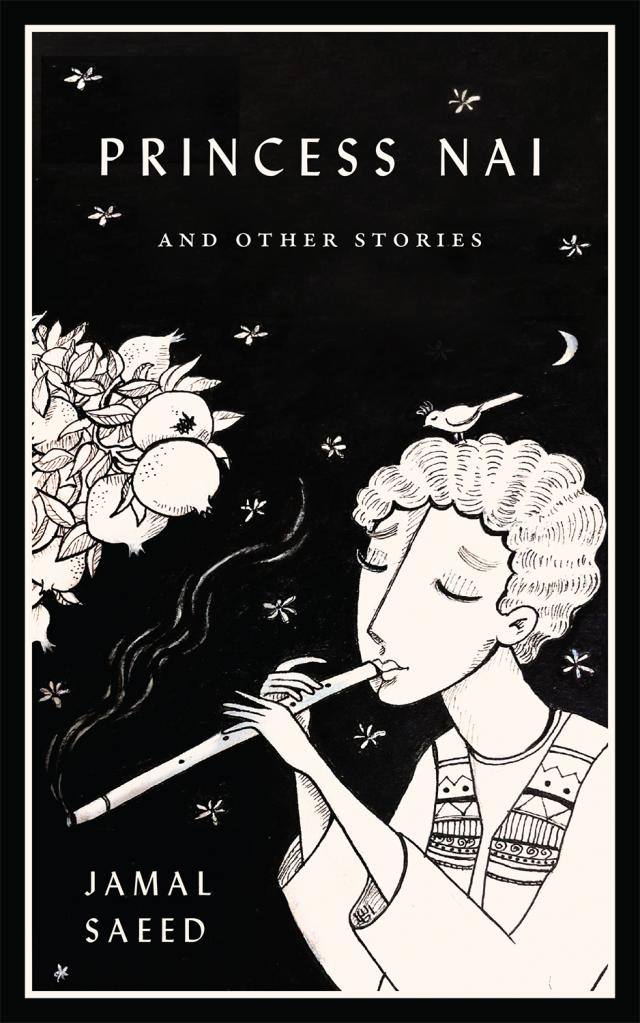
Princess Nai and Other Stories
Jamal Saeed
Contents
Dedication
Princess Nai, The Flute Princess
The Scent of Pine Trees
Sunstruck
That Night
The Climbing Rose
A Lonely Young Man on a Rocky Shore
Fattoush
An Olive Tree
A Shipwreck
The Two Nasties
The First Kiss
The Ring
Beans, Beans, Beans
The Document
My Grandmother Fatima’s Cough
Acknowledgments
About the Author
Copyright
Dedication
vTo Catherine Cobham and my other three sisters:
Asmahan, Khadijah and Roza Saeed
Princess Nai, The Flute Princess
1My grandfather used to laugh — a lot.
“Grandpa, Grandpa,” I said, running up to him in front of our house. “I just saw a goldfimsh!”
“What’s a goldfimsh?” he asked.
“The bird I see when I walk along the farm path with my mother.”
“You mean a goldfinch!” Grandfather said. He laughed and gave me a hug. He always laughed when I said things like that.
* * *
I soon lost the ability to talk about the goldfinch in this innocent way. I finished high school and came to Damascus like many other villagers.
A few months later, as I was returning to my apartment in Damascus after dark, I followed my usual routine: put my key in the lock, turned it and switched on the light. Then I saw six 2men I had never seen before, positioned all around the room and pointing guns at me — five Kalashnikovs and one pistol.
“Who are you? How did you get in here?” I asked. I wondered for a split second if they were thieves before realizing the truth. Seeing handcuffs on their belts, I knew these were Mukhābarāt, the government’s secret police, and since they had scattered my books and clothes all over the floor, I presumed they must have found the pamphlets hidden in my mattress, the ones that condemned the killing of a political prisoner under torture.
“Shut up!” shouted the man holding the pistol. “Get your hands up and face the wall!”
As I turned I noticed that the soft thing I had stepped on was a sky-blue shirt. It was the last gift I received from Laila before leaving my village, and before she broke up with me. As I raised my hands over my head, the thought came to me that Laila, always fastidious, would be angry with me for stepping on this fine piece of cloth. When one of the men pushed me against the wall, I moved my foot off the shirt. Surely Laila would forgive me if she knew that I’d been forced by the police to tread on her gift.
Other men grabbed my arms, twisted them behind my back and put handcuffs on me. My head was at an angle, one cheek forced against the cracked plaster. From this awkward position I could see the pamphlets I had hidden were now on the table. They were to have been distributed that night.
I imagined I was wearing Laila’s sky-blue shirt and that a gun went off. I pictured my blood flowing, the red staining the blue of the last present I would ever receive. I looked down at the floor where I would fall among my scattered 3things. That’s when I saw her lying on the floor, broken and crushed, the holes in her body bent into arcs. The princess. The sight roused me from my fantasies. I was incredibly sad. A boot had smashed her mouth and torn the lips that had so often touched mine. I could feel the heel of the boot as if it were against my own lips.
As the six men pulled me out of my apartment, I looked back for one last view of the princess lying discarded among the rest of my life’s detritus. I never set foot in that place again.
* * *
One autumn evening far in the past, so long ago that it seems as if it happened in another lifetime or to another person, I was walking behind my mother on a narrow country path through our neighbor’s farm. I shouted, “Mum, look at that bird! Such a sweet bird. The color on its wings is like the sun.”
“It’s just a goldfinch,” my mother answered. She was not impressed. But knowing the name of the bird was not enough for me. Why didn’t Mum say anything about his beautiful feathers? And couldn’t she see the astonishment on my face or understand the love I felt for the tiny creature?
The bird perched on a hawthorn tree at the side of the field, right by the edge of a river and some woods. I ran towards the bird, expecting my admiration and amazement to be reciprocated, but he flew away before I could reach him.
“Why doesn’t the bird trust my love, Mum? Why did he fly away?”
“Stop your silly chatter!” my mother ordered. “I have a lot on my mind.”
4But it wasn’t silly chatter to me. I watched as the goldfinch flew into a clump of reeds at the edge of the river. It alighted on the top of the tallest reed and its weight made the delicate plant bow its head, while the rest of the reeds waved their tasseled hats in welcome. I smiled and took a step forward, and that’s when I felt someone grip my bony shoulder. Next came a sharp smack on my bottom.
“Don’t go near the reeds,” my mother hissed in my ear. “They’re full of snakes. A snake bite could kill you!”
Later when I saw my grandfather, I told him about the goldfinch and how he landed on the head of the princess of the reeds.
“The goldfinch chose the princess. He chose the princess, right?” I asked.
My grandfather laughed. “Yes, of course. She is the princess of all the reeds for sure.”
* * *
The next day I found myself standing near the clump of reeds again. Their waving green tassels formed a carpet of green, undulating like waves on the ocean. I heard my mother’s words again: Don’t go near the reeds. They’re full of snakes. A snake bite could kill you . . . kill you! But the obsession with finding my reed princess was pounding through my veins, and this clump of reeds was where the sweet bird had landed. He had to still be there. And the fact that the place was forbidden made it irresistible, full of secrets I had to know.
So, on that faraway autumn afternoon, defying my mother’s warnings, I walked through the reeds. I had to meet the princess, 5as well as profess my love to the goldfinch. But he had ignored me. When I found him, well, I would ignore him too. But I didn’t have the chance. The goldfinch wasn’t there among the reeds.
“Where are you?” I shouted. “I want to ignore you.”
Maybe he was flying above me, and so, up to my knees in water, I searched the sky. A flock of sparrows fluttered there, but they seemed insignificant and worthless. I was looking for that beauty of gold and black and red.
After a while I gave up on finding the bird. In truth I became desperate. But the princess was still there, somewhere in the crowd. The green carpet of reeds looked more beautiful from a distance, but from inside it was clear the clump was made up of single plants, each one the same as the other. I had only one aim: to discover which reed was the princess. This was my mission, but it was not easy to distinguish the princess from the other reeds. I tried to pick up signs that might help in my quest. I watched how the leaves moved and listened carefully to the sound of them rustling; I heard the birds talking in their own language, and at some point all the voices transformed into a single voice inside me, which convinced me that the reed at my right hand was the princess. I felt happy to have recognized her and decided to take her away with me.
“Now I know who you are,” I told the princess, taking hold of her slim body. I reached into my pocket and pulled out a knife I had taken from my mother’s kitchen that morning. The sparrows flew away, and I pushed back the princess’s attendants with my elbows and cut through her stem. I nicked my hand with the knife, causing it to bleed a little. My blood dried on the princess’s body. I left the forest happy, dragging 6the long reed behind me, riding it like a green-tailed horse, stirring up dust as I walked.
At home my mother hit me because she had been searching for her knife all morning. She hit me again because I had cut my hand. And a third time for disobeying her and going into the reeds.
“Why are you hitting him?” demanded my grandfather, who was smoking in the corner of our house. My mother tried to explain, but he dismissed her with a flick of his wrist. She left the house angrier than ever.
“So?” Grandfather asked, and I told him I had brought the princess of the reeds home with me, explaining how sparrows and other reeds had pointed her out to me.
“You understand their languages?” he inquired, his eyes wide. I nodded enthusiastically. Grandfather laughed harder than ever.
“But where did the goldfinch go?” I asked.
“Don’t worry, he’ll be back,” he said, eyeing the long reed.
“When?”
“Patience! In a little while. You’ll see. In the meantime, when the reed dries and becomes stiff . . . I mean when the princess dries . . . I’ll make a shabbabeh, a reed pipe, and you’ll play wonderful music on it.”
A little later grandfather took the reed princess away from me as I was using her as my horse outside in the dust. He took her to our mud-brick house and hung her upside down.
“We must let her dry straight,” he said.
* * *
7Some weeks later I watched as grandfathe
“I think I can get two from her,” he said to the air, and he took his whittling knife and cut out a large section from the middle of the reed. Then he cut it into two sections, one shorter than the other. He took the shorter one and blew into its hollow shaft. It made a flat, dead sound.
“That’ll do.”
And then he took his knife and quickly carved a rounded notch at one end.
“This is where you will blow,” he said.
Next he placed his fingers along the shaft and marked the spots with his knife, five on the front and one on the back. He took one of the two skewers out of the fire. It glowed hot, and I held the cool end with a rag. Grandfather burned holes into the shaft where he had marked the spots and placed the iron back into the fire. He was done.
“Here you go, Grandson, your shabbabeh,” he said, and handed me a flute like the ones other boys in the village played. I put my fingers on the holes and blew into the reed, and a shrill squeal tore through the air.
“I’ll show you how to play it later. But now I will make a Nai, a bigger flute.” He picked up the longer section of the reed princess.
8Now the look on Grandfather’s face changed. He seemed to be saying a strange silent prayer while he stared at the princess’s body, moving it tenderly around in his hands, touching it with one finger here and another there, again marking her with a nick of his knife. These cuts seemed to be farther apart than on the first flute. As he worked his hand quivered and twitched while his eyes seemed to peer into the princess’s soul. And all the while as he touched her, she lay in his hands obedient and quiet. He took the other skewer from the fire, and I noticed how the tip was now pulsating with an even redder and hotter glow.
Hiss cried the princess, as the first hole burned through her reed body, causing smoke to rise into the air. I watched how the red of the poker danced in my grandfather’s eyes as he worked.
Hiss, hiss, hiss, she sighed, as more holes were burned into her. Grandfather then took his carving knife and made the curved notch, her mouth, through which she would receive the breath of life. He was almost finished.
It was the end of the day and time for my grandfather’s glass of wine. He poured some of his wine into the princess’s mouth and then drank the rest himself. His hands were visibly trembling now. I was overcome by an inexplicable feeling of reverence. And then my mother’s father raised the princess to his lips and softly blew into her mouth. She sang her first note, and as my grandfather’s gnarled fingers danced over the holes on her body she began to sing. The sound was mesmerizing. I felt myself floating on a wave, like the sea of green tassels above the reeds.
9Suddenly I was brought down to earth by a dark anger. I looked at the long slender body of Princess Nai in my grandfather’s hands and the short child’s flute in mine.
“You’ve made Princess Nai for yourself and left me this child!” I shouted, throwing the shabbabeh to the ground. “I want the princess!” I shouted even louder. “She’s mine! You’ve cheated me, Grandfather!”
My grandfather looked at me in astonishment. And then, just like that, he held Princess Nai out to me. I took her and looked down at her then up into my grandfather’s eyes. I felt confused. He laughed.
“Okay, then, she’s yours,” he said. “Play.”
I held the princess, but my fingers were not able to reach all her holes no matter how much I tried to stretch them.
“The holes are too far apart,” I complained.
“They’ll be fine as you get older,” he said, laughing again.
“When will that be?”
“Soon. Don’t be in a hurry.”
* * *
The “soon” my grandfather talked about came to pass. I grew up. My fingers could cover the holes of the flute, but I still couldn’t make my princess sing like my grandfather. But every time he offered to show me, the dark anger returned. And so my progress with the princess was slow. But I continued to try and, when I did, Princess Nai protested in pain. That’s when my mother would cover her ears and threaten to smash the princess over my head. I still 10didn’t know how to let my soul whisper in the princess’s mouth and make her sing sweetly.
* * *
It wasn’t long after that when Laila began to avoid looking into my eyes.
“I think . . . we . . . I mean to say . . . I believe . . . it would be better . . . if we broke up.”
“What? Why?” I was trembling, too shocked to voice the question in my heart: All I can think about is my love for you. How can you think about breaking up?
At the time I did not understand Laila was a separate being from me. She owned her body and soul, so she had the right to use them as she wished. Laila left me, and I panicked like an animal that knew it was about to be slaughtered. The world seemed incomprehensible. I ran into the house and grabbed the princess from the drawer where I kept her and rushed into the street, heading for the oak woods on the edge of the town. There was the same river running through the forest where I first found the princess, and I stood on its bank, my soul in pain. I joined the river’s babbling cry and shouted into the air, “Laila, Laila, lama sabachthani? Why hast thou forsaken me?” There was no answer except for the sound of the rolling river.
I sat on a rock and put Princess Nai’s mouth close to mine. I blew into her and finally a song poured from her that captured the pain of an innocent teenager. I closed my eyes and heard how the beautiful lyrical sound spread through the whole of the forest. It was so pure I could feel many gods sitting down around me to listen. As I continued to play, I saw 11them in my mind. Some watched my fingers tremble over the princess while others enjoyed wine from skins brought from the distant heavens. Still others floated languidly in the river, their eyes closed as they lived the emotions I was sending out into the air. The eldest and wisest of the gods came over to me and put a hand on my shoulder. I felt his tears fall on my face.
“What a gentle heart you have, my son. Pain is harder when it’s borne alone.”
As I continued to play, I saw the rocks, oaks, rivers and reeds disappear. All that was left was the wise one’s face, his long, sacred beard wet with his compassionate tears. I began to cry. My sobs filled the air where the music had been. When I opened my eyes and wiped the tears away, I looked for the gods, but they were invisible to me and to everybody else. They had come streaming out of Princess Nai to find their way into the air and lived only in my memory.
Not long after the princess had trained me to deal with her, she raised her mouth to mine one summer evening and began to sing. I saw my mother approach and was about to stop, but the look in her eyes told me she was no longer going to threaten to smash the princess over my head. And so Princess Nai and I began to sing for my mother, about an evening when we walked together, about a sweet goldfinch and a hawthorn tree near a country river. About the boy I was and the man I was becoming. Although she didn’t understand the words hidden in the music, they spoke of things my mother knew, like a familiar secret. When I lowered the princess from my mouth, my mother looked at me with an expression I hadn’t seen for a long time.
12“Play more,” she said, “your music touches me.” And she placed a hand on her heart.
* * *
I did not become a famous musician.
No journalist interviewed me, so I could tell them I did not like to play from notes on paper. The lines on these pages were like prison bars to me. Nor did I tell anyone that the flute is much purer than all the stringed instruments, because the flute lets you pour your soul into her directly, while stringed instruments need an intermediary — fingertips, a bow or a pick. Because of this, to my mind, something of the soul is lost.


