

Aqueous, page 1


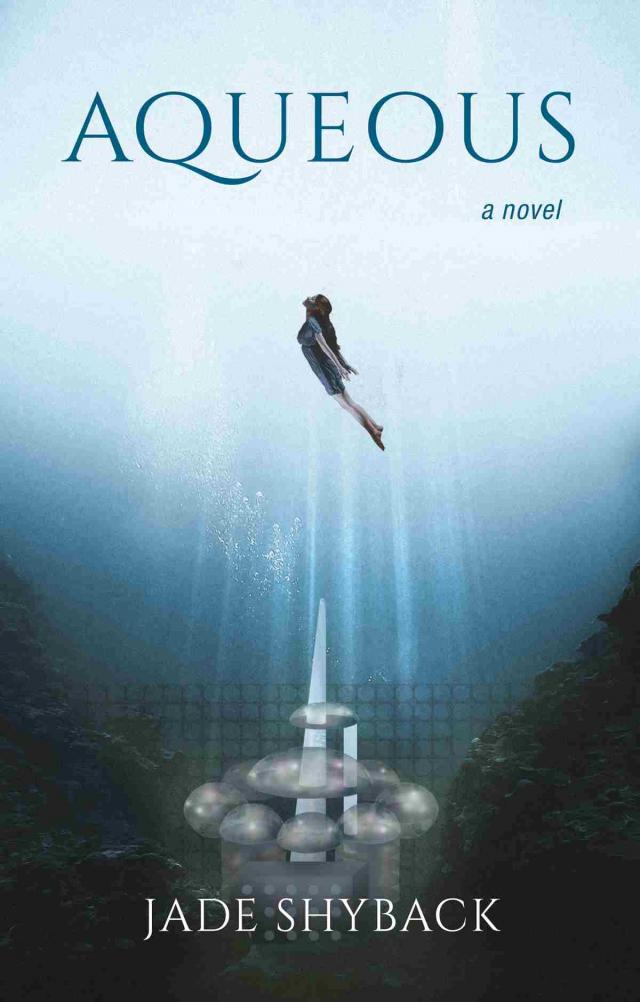
Aqueous
Copyright © 2023 by Jade Shyback
All Rights Reserved
No part of this book may be used or reproduced in any manner whatsoever without the prior written permission of both the publisher and the copyright owner.
Book design by Mark E. Cull
Library of Congress Cataloging-in-Publication Data
Names: Shyback, Jade, 1973– author.
Title: Aqueous: a novel / Jade Shyback.
Description: First edition. | Pasadena, CA: Xeno, 2023.
Identifiers: LCCN 2022019365 (print) | LCCN 2022019366 (ebook) | ISBN 9781939096098 (paperback) | ISBN 9781939096104 (ebook)
Subjects: CYAC: Undersea colonies—Fiction. | Survival—Fiction. | Environmental degradation—Fiction. | Science fiction. | LCGFT: Science fiction. | Bildungsromans. | Novels.
Classification: LCC PZ7.1.S51873 Aq 2023 (print) | LCC PZ7.1.S51873 (ebook) | DDC [Fic]—dc23
LC record available at https://lccn.loc.gov/2022019365
LC ebook record available at https://lccn.loc.gov/2022019366
The National Endowment for the Arts, the Los Angeles County Arts Commission, the Ahmanson Foundation, the Dwight Stuart Youth Fund, the Max Factor Family Foundation, the Pasadena Tournament of Roses Foundation, the Pasadena Arts & Culture Commission and the City of Pasadena Cultural Affairs Division, the City of Los Angeles Department of Cultural Affairs, the Audrey & Sydney Irmas Charitable Foundation, the Kinder Morgan Foundation, the Meta & George Rosenberg Foundation, the Albert and Elaine Borchard Foundation, the Adams Family Foundation, the Riordan Foundation, Amazon Literary Partnership, the Sam Francis Foundation, and the Mara W. Breech Foundation partially support Red Hen Press.
First Edition
Published by Xeno Books
An imprint of Red Hen Press
Pasadena, CA
www.redhen.org
This is a work of fiction. The names of characters, animals, businesses, places, events, inventions, and incidents in this book are the product of the author’s imagination and used in a fictitious manner. Any resemblance to actual persons (living or dead), actual animals, actual businesses, actual places, actual events, actual inventions, or actual incidents is purely coincidental.
For Nat Sapach, who told me I was good at this.
And for me, who believed him.
CONTENTS
CHAPTER ONE
CHAPTER TWO
CHAPTER THREE
CHAPTER FOUR
CHAPTER FIVE
CHAPTER SIX
CHAPTER SEVEN
CHAPTER EIGHT
CHAPTER NINE
CHAPTER TEN
CHAPTER ELEVEN
CHAPTER TWELVE
CHAPTER THIRTEEN
CHAPTER FOURTEEN
CHAPTER FIFTEEN
CHAPTER SIXTEEN
CHAPTER SEVENTEEN
CHAPTER EIGHTEEN
CHAPTER NINETEEN
CHAPTER TWENTY
CHAPTER TWENTY-ONE
CHAPTER TWENTY-TWO
CHAPTER TWENTY-THREE
CHAPTER TWENTY-FOUR
CHAPTER TWENTY-FIVE
CHAPTER TWENTY-SIX
CHAPTER TWENTY-SEVEN
CHAPTER TWENTY-EIGHT
ACKNOWLEDGMENTS
ABOUT THE AUTHOR
CHAPTER ONE
I missed the sun. I missed its warmth on a breeze that tickled my skin, and the blinding effect of its stare. I dreamt of running beneath it, breathless, chased by the laughter of sun-kissed siblings. Bleached locks and tan skin were the fleeting recollections of my terrestrial childhood lost, but the ocean created amazement too. It orchestrated new memories that I was thankful for, and the view from my pod was unarguably magnificent—a vast seafloor aglow with life. A place where fantastic creatures floated by, winding their way through the waving gardens our botanists had engineered. New species discovered us as we discovered them, curiously approaching the glass to observe humankind, or what was left of it.
I was a lucky one, one of the few who remained, and I was trained to understand that there was no benefit in longing for a time that had perished in the sun. Besides, my subterranean plant taxonomy catalogue wasn’t going to log itself. It was time to snap out of the past and into to the present, so I pivoted my chair away from the glass, back toward my desk.
I’ve lived most of my life two and a half kilometers below sea level in subterranean merstation number three, also known as Aqueous— an underwater utopia created during an ecological coup to save the human race. The mini-pod that I occupy is standard-issue for a trainee my age, and acts as my floating, spherical bedroom underneath the sea. Made of syntactic foam and borosilicate glass, it has translucency for privacy and transparency for optimal environmental observation. Tethered above a common corridor and uniquely designed, mini-pods seal with a bottom airlock so that in the event of an emergency, not that we have ever had one, they could automatically detach, allowing the pod and its inhabitant to drift upward and become, in theory, a one-way ticket to the surface, not that anyone would want to go there.
The shell of each mini-pod contains identical furnishings. My pod, MP124, has the all-important learning nook complete with desk, chair, keypad, and monitor. There are two bookshelves located above the desk that, for the most part, are never used because the educational manuscripts and essays studied by trainees are stored on the shared drive. I keep, however, a small yellowed satchel of beads on the lower shelf. It’s the only item that I own.
My berth, positioned above the nook, is a starry planetarium of twinkling station lights. It’s an observatory of departments towering high above my pod where the corridors and gathering spaces of Aqueous stand at attention, illuminating the surrounding water. As a comforting nightlight, it’s breathtaking, and I mean that quite literally. Outside of the glass, I would not be able to breathe.
My clothes hang aligned, hooked to the side of the nook. The few outfits I have are standard-issue based on rank and will be surrendered when my rank changes. Currently, I am ranked Y10 and have been allocated Standard-Issue Dress (SID) to reflect this. Like all Y10s, I have daytime SIDs, athletic SIDs, dinner SIDs, formal SIDs, casual SIDs, and sleeping SIDs. The residents of Aqueous are valued equally, making uniformity paramount.
Behind the nook is the lav, containing only the essentials: a sink, a washlet, a shower, and the tiniest mirror imaginable because while cleanliness is necessary, vanity is not. I am given one small towel per week, never any paper, and the all-in-one cleanser is restocked sparingly. To make matters worse, minimal water consumption is expected. Showers are not only timed, they’re infrequent. Washing thoroughly, quickly, is imperative because beneath the floor of each pod is an elimination chamber designed to recycle all waste. Reusing the water too soon increases the likelihood of becoming very, very sick.
In stark contrast to the ocean beyond, everything in a mini-pod is bright white. I was taught that this, in conjunction with applied photonics, counteracted the negative psychological effects of life in the dark, but our superiors liked to jest that the all-bright-white eliminated the mess associated with teenage bedrooms. It was difficult to imagine mess in the absence of possessions.
I was staring absentmindedly at my taxonomy catalogue.
Ugh.
I pivoted back to the glass once again, abandoning my log to return to the magic of the undersea. The minimalistic design of my mini-pod did not extend beyond the glass. The waters of Monterey Canyon provided a spectacle of habitats to delight any young observer. From cavernous walls, to rocky outcroppings, and sandy sea-floor, it was an aquatic playground of magnificent proportion. Pink, pompom anemones waved at comb jellies as fangtooth fish swam by. Tiny flapjack octopi propelled themselves through the saline as the ominous anglerfish searched for its next snack. It was a seafloor performance of endless entertainment until it was interrupted by my AI Assistant.
“ATTENTION. ATTENTION. Empyreal Blaise has identified at your airlock,” it alerted.
I quickly tapped the release, allowing an elegant woman to ascend. Irrefutably the most beautiful resident on Aqueous, I never tired of her pleasant face. Wide-eyed with high cheekbones and a long golden mane, she was effortlessly regal and every inch the admiral’s wife. Her hair was routinely knotted at the nape of her neck, emphasizing her height, and her lean frame allowed her SIDs to drape favorably over a heart true and pure. She was heaven personified. Intelligent and poised, her counsel was sought by many, making her an unofficial ambassador of the station, and a wave of calm washed over me as her expression relaxed into a loving smile.
“Oh Marisol, you have the look of a lost little lamb. Are you still hard at work?” she asked, floating toward me with outstretched arms to gather me into her familiar embrace.
A lamb . . . What did a lamb look like again?
There were too many marine species to catalogue to consider the characteristics of a lamb. I disentangled myself from her long limbs.
“I’m stressed. I have no idea how I am going to get everything done before graduation. I’ve got to finish my taxonomy report, curate bacteria samples, review my labs on carbon cycling, finish the assigned code review, and log a few more hours of simulated dives. My thesis is nowhere near completion and grad is a week away, followed immediately by the anniversary.”
“But you’ll have a chance to relax at your party.”
“I appreciate that you want to celebrate my birthday, but could we postpone it? Or better yet, skip it altogether? I have no time for a frivolous party.”
“There’s a
She glanced around the room.
“You’ll have your new pod and assignment soon. I’m so proud of you, Marisol. You’ve accomplished so much in ten short years, but many of those same accomplishments will be celebrated collectively by the Y10s at graduation, and I want to showcase you. Just you. You deserve the spotlight before we celebrate scholastic achievements with your peers, followed by station successes with all of the residents during the anniversary. I know you’ll enjoy it, and I’ll be sure to schedule it after the trials, once the pressure is off. You’ll have time to get everything done, so don’t fret.”
Despite my heightened anxiety, I was relieved to talk of celebrations, not assignments. She was masterful at making me feel better and had always been my biggest supporter. My savior, in fact. I wouldn’t disappoint her by admitting that my nightmares were back, or that my thoughts often drifted to the past. To do so would dilute her role in my upbringing, diminishing the joy she associated with my unavoidable milestone birthday.
“Come on. Let’s get out of here. You need a break.”
“I can’t spare the time,” I argued in futility.
“I know best, and I won’t take no for an answer. Besides, you’re not allowed to refuse your mother.”
She extended a long, dainty finger to gently tap me on the nose before turning to glide toward the airlock. She expected me to follow, but I stood motionless behind her. Unknowingly, she had tapped into something painful. Something that had lingered for ten long years. No matter how much I appreciated her, or how much I loved and admired her, she wasn’t my mother. We had left my mother under the warmth of the sun.
CHAPTER TWO
It was dawn, but we were not high enough.
“You must climb, Sunniva. We cannot stop. Not yet,” said my mother.
It was hot and we were dirty. More dirty than usual. Our hands had torn and bruised black from crawling along the jagged hillside, but we needed to traverse the barren slope before the sun rose. The large rocks and caves of the mountains above would shadow us from the midday sun.
We had heard of a fortified, alpine village that was rumored to have rations. It was possibly the last food source in the area, making it well worth the climb, but we were not alone, and there would not be enough. Dozens of displaced families were making the same desperate ascent. Hopeless, defeated, empty, and silent, we snaked upward, together, to plead with those at the top.
The end of the world had arrived too quickly, and as many had predicted, rising temperatures melted the ice caps, flooding coastal cities. As the sun relentlessly cranked up the heat, we witnessed the largest global human migration ever recorded. People moved inland, placing a tremendous strain on food supplies.
What didn’t flood, burned, and viable farmland diminished. Crops turned to dust, fresh water dried up, and food supplies dwindled. Then our power grids overheated and failed, and without sufficient renewable technologies we lost air conditioners, lights, gas stations, internet, plumbing, and telephones.
No electricity meant no refrigeration, so what little food could be grown, spoiled. Farmer’s herds perished, as did wild animals and birds, making ground insects and roots a primary source of nutrition for those still alive.
We had angered the sun so greatly that it ceased being our regulator, our rejuvenator, and retaliated against our greed by scorching Earth in blistering reprehension for our disobedience and abuse. Stripping our biome to expose our fragility, the sun doled out a punishment so severe that most people died, and those left suffered perpetually burnt skin, cracked lips, and hunger as the indelible reminders of its wrath. Our only hope existed in the lower temperatures of higher altitudes, so we climbed.
As temperatures climbed, so did the topography of our planet. Alpine areas, formerly too cold to sustain vegetation, greened. The hippies in these areas, living off-the-grid, were initially the least affected. Ecologically minded, outdoor enthusiasts, they had purchased inexpensive properties, installing photovoltaic modules, cisterns, and wind turbines to power their modest retreats, but as prices skyrocketed for sustainable homes, many were convinced to sell. Enticed by fat offers from the wealthy and powerful, alpine homesteads changed hands quickly to the detriment of sellers, who were late to grasp the ephemerality of currency. Soon there was nothing left to buy and nowhere safe to go. Then the walls went up, fortifying alpine compounds where the rich could survive.
My mother had not been rich, but she had outshined, outlasted them all. She had been a housekeeper until there were none left to keep, and now her heat soaked hair lay tangled around her glistening face. It was the beauty of the vagabond life I knew. Her beauty, and I loved it. Her thick matted locks would fall to her shoulders when there was nothing to tie them back. They framed her face like a picture, and I liked to twirl them between my fingers while her inquisitive eyes inspected me.
In dire times we still found joy. She enjoyed playing tricks, like convincing me that my foot size had doubled and I would have no shoes, before revealing an extraordinary pair that she had recovered during our pilgrimage. She would laugh wholeheartedly at my surprise, throwing her head back in delight to let the notes of her happiness ring true. She was small, but resourceful, and her strength had endured, even under a merciless sun.
It is remarkable what the human body can endure when given no alternative. My mother would not surrender. She would adapt. She moved us at night to conserve energy because daytime temperatures were too hot. We scavenged for dwindling nourishment along the way, and though we were running out of resources, I was not aware. Her focus had shifted to keeping me content until it was no longer possible.
I was exhausted and had stopped climbing again.
“Look here, Sunniva. You are a lucky one. I have found some magic story beads for you.”
Her eyes twinkled with excitement.
“What are they, Mommy?”
I stared down at the crisp pine needles in the palm of her hand.
“Each of these beads will grant you one fantastic story, full of bountiful treasure and gigantic beasts, but as a princess you will have to be brave.”
I grabbed every bead as fast as I could and looked up into her wise, hazel eyes.
“I am brave.”
“Yes, Sunniva, I think that you are, but have you ever seen a dragon?”
“No, Mommy. Have you?”
She looked from side to side, slowly, deliberately, in a manner not to be overheard, despite a lack of listeners, before whispering, “Give me one bead and I will tell you all about the king and queen who captured it.”
I passed her the best pine needle that I had, careful not to drop a single one, for I would need them during our adventures ahead. That’s when I would prove to her how brave I could be.
She accepted the bead and resumed moving slowly up the hillside, and I, clutching my precious beads tightly in my small battered hand, eagerly followed.
I was an accident. Conceived beyond the failure of existence, long after couples knew their offspring would perish, I was remarkably celebrated as a gift from the sun. I was Sunniva, the youngest and only daughter of my parent’s three children, and I was spoiled. Not in the conventional way, with expensive toys and sweets, but with my father and two brothers vying to be my favorite. They kept me blissfully unaware of the peril we faced.
My father, Senan, was a mechanic. He could fix anything, but he was especially good at making dolls. I had a village of stick people, fastened with wire and clothed in trash and dry grasses. We named them together and created an adventure for each one. It was unusual behavior for a rugged, burly man, but he had a soft side he reserved for his girls: his daughter and his wife. He taught his sons to care for me as though I were porcelain, in the same manner he cared for my mother. Theirs was a love story that could not be clouded by smoke-filled air, and together they would curate our remaining days with imaginary adventure.


