

The Dyson File, page 1


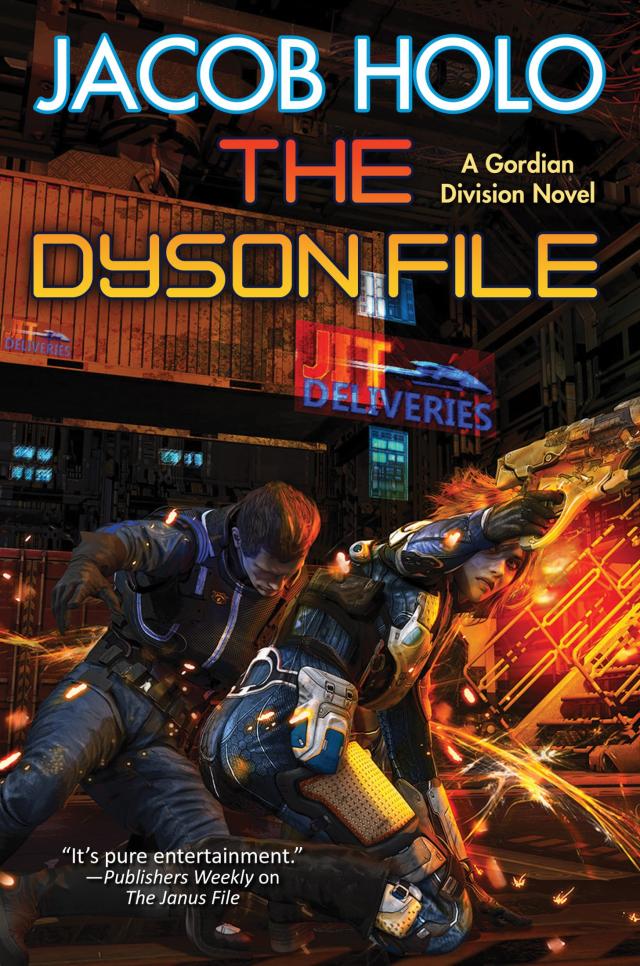
Table of Contents
DEDICATION
PROLOGUE
CHAPTER ONE
CHAPTER TWO
CHAPTER THREE
CHAPTER FOUR
CHAPTER FIVE
CHAPTER SIX
CHAPTER SEVEN
CHAPTER EIGHT
CHAPTER NINE
CHAPTER TEN
CHAPTER ELEVEN
CHAPTER TWELVE
CHAPTER THIRTEEN
CHAPTER FOURTEEN
CHAPTER FIFTEEN
CHAPTER SIXTEEN
CHAPTER SEVENTEEN
CHAPTER EIGHTEEN
CHAPTER NINETEEN
CHAPTER TWENTY
CHAPTER TWENTY-ONE
CHAPTER TWENTY-TWO
CHAPTER TWENTY-THREE
CHAPTER TWENTY-FOUR
CHAPTER TWENTY-FIVE
CHAPTER TWENTY-SIX
CHAPTER TWENTY-SEVEN
EPILOGUE
THE DYSON FILE
A Gordian Division Novel
JACOB HOLO
Baen
The Dyson File
Jacob Holo
NEW GORDIAN DIVISION NOVEL:
When a top engineer on Saturn commits suicide, Detective Isaac Cho and Special Agent Susan Cantrell are called in to review the case. But what seems like an open-and-shut case spirals into the strange. And if Cho and Cantrell don't solve the mystery soon, they may be the next ones to wind up dead.
The Atlas Corporation was all set to tear apart the planet Mercury—converting its resources into a swarm of solar-collecting megastructures—when Esteban Velasco, lead Atlas engineer, is found dead from a self-inflicted gunshot wound to the head.
Detective Isaac Cho and Special Agent Susan Cantrell, both eager to return to active duty despite close calls on their last case, are sent in to assess the situation. Their superiors expect a simple declaration of suicide, but Velasco’s death proves anything but typical.
The detectives soon find themselves embroiled in a mystery far more complex—and strange—than anyone expected, leading them to a church for Mercury-loving weirdos, a “nudist” colony open to Saturn’s unbreathable atmosphere, an exclusive park for hunting dinosaurs, and a ghost town where forgotten machines wage war over condo floorplans.
What was meant to be an easy return to duty for the detectives takes a sudden dark turn when ruthless mind-hackers ambush and nearly kill them, making one fact crystal clear:
If they don’t solve this case soon, it’ll be their corpses that turn up next.
BAEN BOOKS by
JACOB HOLO
The Gordian Protocol (with David Weber)
The Valkyrie Protocol (with David Weber)
The Janus File (with David Weber)
The Weltall File (with David Weber)
The Dyson File
The Dyson File
This is a work of fiction. All the characters and events portrayed in this book are fictional, and any resemblance to real people or incidents is purely coincidental.
Copyright © 2023 by Jacob Holo
All rights reserved, including the right to reproduce this book or portions thereof in any form.
A Baen Books Original
Baen Publishing Enterprises
P.O. Box 1403
Riverdale, NY 10471
www.baen.com
ISBN: 978-1-9821-9301-0
eISBN: 978-1-62579-938-8
Cover art by Kurt Miller
First printing, November 2023
Distributed by Simon & Schuster
1230 Avenue of the Americas
New York, NY 10020
Library of Congress Cataloging-in-Publication Data
Names: Holo, Jacob, author.
Title: The Dyson file / Jacob Holo.
Description: Riverdale, NY : Baen Publishing Enterprises, 2023. | Series:
The Gordian division ; 5
Identifiers: LCCN 2023029026 (print) | LCCN 2023029027 (ebook) | ISBN
9781982193010 (trade paperback) | ISBN 9781625799388 (ebook)
Subjects: LCGFT: Science fiction. | Detective and mystery fiction. |
Novels.
Classification: LCC PS3608.O49435648 D97 2023(print) | LCC
PS3608.O49435648(ebook) | DDC 813/.6—dc23/eng/20230626
LC record available at https://lccn.loc.gov/2023029026
LC ebook record available at https://lccn.loc.gov/2023029027
Printed in the United States of America
Electronic version by Baen Books
www.baen.com
10 9 8 7 6 5 4 3 2 1
To David.
For taking this shy engineer under his wing.
PROLOGUE
“A dark and stormy night,” the man uttered with a deep frown. “How appropriate.”
He gazed through outward-slanted windows to the black, roiling thunderheads. Ferocious streaks of lightning revealed the caramel hues of ammonia ice clouds, and a dusting of ammonia snow melted off the window’s vacuum-insulated outer layer.
Technically, it wasn’t night at all. Not according to his wetware’s internal clock, but that was because Saturn’s ten-hour-and-forty-two-minute days were ill-suited to the biorhythms of organic citizens, leading most places in and around the gas giant to follow an Earth-centric calendar.
The man harrumphed, took a sip from his wine glass, and continued to gaze out the window with heavily lidded eyes. The skin of his round face was pale and slightly moist, his salt-and-pepper hair oily and uncombed. He wore a dark green suit—mostly because he had to for the party—though the garment’s precise tailoring seemed to hang off his slouched shoulders in a slovenly manner, as if both he and the suit didn’t want to be there.
His dynamic scarf hung around his neck like a thick piece of limp linguini, its surface animated with a looping pattern of abstract shapes in muted colors.
He raised the wine glass to his lips once more.
His name was Esteban Velasco, Senior Macrotech Engineer for the Atlas Corporation, and though he stood on the cusp of his greatest achievement, his brooding demeanor and unkempt appearance hinted at the dark thoughts within his mind.
A distant bluish light drew his eyes, partially obscured by the ammonia clouds. The source of the light was a tall floating megastructure called Janus-Epimetheus, named in honor of the two moons demolished during its construction. The locals called it the “Shark Fin,” for it did indeed resemble a brilliantly white downturned fin, though one that measured over one hundred kilometers tall and flared at the top into an expansive oval plateau two hundred kilometers across and fifty wide.
Velasco couldn’t make out much beyond a distant silhouette haloed by a faint aura created by the lights from external buildings and short-ranged craft, all obscured behind the churning storm clouds. The powerful glow from its banks of nine massive engines—aligned in compact triplets vertically along the megastructure’s trailing edge—grew brighter as it made what was probably a minor course correction through the comparatively gentle winds of Saturn’s fortieth northern parallel.
The senior engineer stood on the bottom floor of the Atlas mobile headquarters as it floated through the storm, trailing Janus-Epimetheus on its endless journey around Saturn. The building resembled a miniscule silver top drifting behind the giant, downturned fin.
Velasco raised the wine glass to his lips once more, but then paused and stared into the golden, bubbly fluid. His wetware interfaced with the glass, and an infographic for the beverage appeared in his virtual vision beside it. He skimmed over the summary.
It was an expensive wine. Not synthesized within the miniaturized chemical factory of a food printer, but produced the old-fashioned way, starting with grapes grown in a vineyard. A Saturnite vineyard, in this case. The infographic said the drink had been imported from Old Frontier, a large agricultural city located about two-thirds of the way down the Shark Fin.
“Boaz broke out the good stuff tonight,” Velasco muttered to himself. “A shame.”
He relaxed his hand, and the glass slipped from his fingers. At this altitude, Saturn’s mass produced a natural 1.065 gravities, and the glass fell to the floor much as it would have if he’d let go on Earth. It bounced once and rolled until it stopped against the outward slant of the window, leaving an expensive streak on the self-cleaning carpet.
“What the hell, butterfingers?” sniggered a man behind Velasco. “Can’t handle a few drinks?”
Velasco let out a weary sigh.
“This is all I need right now,” he grumbled under his breath.
“You say something? I’m sorry, but I’m having trouble understanding you over your booze slur.”
Velasco turned around—slowly and with great lack of enthusiasm—to face Leon Traczyk, another macrotech engineer, though not as senior as himself.
The two formed a stark contrast. Traczyk stood half a head taller than Velasco, with impeccable posture, chin held high as he looked down his nose at the other man. His tawny mane was slicked back, without a hair out of place, and his beard was neatly trimmed and combed. He wore a crimson business suit with a diamond pattern alternating between lighter and darker shades, accentuated by a large ruby at his throat.
The suit didn’t look very fashionable to Velasco, but knowing Traczyk, the pattern was probably based on some new Lunarian or Jovian fashion trend. Behind him, the party was in full swing. Around seventy people from Atlas’ senior staff mingled in the wide half-moon space at the bottom of the mobile headquarters. Catering drones weaved through the crowd, offering drinks
“Leon,” Velasco grunted to his coworker.
“Esteban,” Traczyk replied with a smirk.
“Don’t you have anyone else to pester?”
“‘Pester’? Don’t be absurd. Can’t I stop by simply to say hello?” He raised his wine with a twinkle in his eyes. “I’d offer you another glass, but it seems you’ve already had enough.”
Velasco didn’t say anything. He simply stared at the other man, his face sullen and his eyes dark with secret intent. Traczyk, while annoying and overly ambitious in a boardroom-backstabbing sort of way, had been reduced to the equivalent of white noise in his frayed mind.
Traczyk snapped his fingers in front of Velasco’s face. The senior engineer wasn’t sure how much time had passed.
“Something wrong with you?” Traczyk asked, then smiled. “Perhaps you should seriously consider retirement. Or at least a sabbatical.”
Velasco locked eyes with the younger man. “Why don’t you say what’s really on your mind?”
“Where’s this coming from?” Traczyk shifted uneasily from one foot to the other, perhaps taken aback by his colleague’s sudden directness.
“Go on and say it,” Velasco taunted. “Unless you’re afraid to.”
“Afraid?” Traczyk’s face reddened and his voice grew softer, yet more forceful at the same time. “Listen here.” He jabbed Velasco’s chest with a finger. “Everyone here might think we won the contract because of you, but I know the truth. I was in the trenches each night trying to hold your sorry excuse for a design together. The boss is about to get up on that stage, and I’m sure he’s going to shower you with praise. Praise everyone else thinks you’ve earned, but the truth is you didn’t earn shit. You know it, and I know it. I carried your worthless, deadbeat carcass across the finish line. I did! That should be me he’s about to recognize. Not a has-been like you!”
Velasco let Traczyk’s scorn pour off him like the pointless bleating it was.
“Well, I wouldn’t worry too much,” he replied evenly. “I have a feeling you’re about to get exactly what you’ve wanted all this time.”
“What the hell is that supposed to mean?”
“You’ll see.”
Traczyk frowned as Velasco slid past him. He weaved through the crowd, heading in the general direction of the room’s center.
Julian Boaz, Atlas CEO, stood on the dais and surveyed the crowd. He was a big, bald, broad-shouldered man that exuded an air of approachability despite his physical stature and position within the company. He surveyed the crowd with warm eyes and an affable smile, though Velasco knew those features masked his real personality. Boaz could put on whatever friendly airs he wanted, but he knew—and had been on the receiving end—of the man’s ruthless nature. All Boaz wanted was to see Atlas on top, and he didn’t care who got caught in the grinding treads of their progress, be it their competitors or the company’s own engineers, programmers, and physicists.
“Ladies and gentlemen!” Boaz began. “Your attention please!”
The room grew quiet, and all eyes focused on the CEO.
Boaz held out a cupped hand, and an abstract document materialized over it.
“I have here the letter from the Senate’s Megastructure Subcommittee. I won’t bore you by reading through all the legalese, but suffice it to say, Atlas has been awarded the Dyson Realization Project. We did it, people! We’re the ones who’ll go down in history as the builders of the very first Dyson swarm!”
A cheer rose from the crowd.
“I know this project has had its ups and downs. I was so proud of all of you when our bid was selected as one of the two finalists”—he paused for dramatic effect—“alongside SourceCode.”
Someone in the crowd booed, and Boaz chuckled on stage.
“Now, now. Let’s all keep it classy. Our competitors have had a very bad day.”
The crowd laughed in agreement.
“And, in a way, what they’re going through now isn’t all that different from what we faced earlier this year. I know I shared everyone’s shock and disappointment when our first major replication trial was sabotaged.”
Sure, you did, Velasco thought. Which was why you called me to your office afterward and screamed in my face for an hour straight. I still remember the flecks of spittle hitting my eyes.
“But all of that is behind us now,” Boaz continued. “Our design—and design team—came out on top. In fact”—he wore a sly grin and held up a finger—“I’ve got something of a treat for everyone. A . . . friend, shall we say, on the subcommittee passed us a video from SourceCode’s botched trial. Who’d like to see it?”
The crowd cheered and laughed.
Velasco felt a hand on his shoulder.
“Hey, Esteban?” asked a soft, concerned voice, the sound cutting through the cheers by using his virtual hearing.
Velasco turned to find Horace Pangu, a senior consultant on the project, standing next to him. The slender man possessed a narrow face with sunken cheeks and sharp, dark eyes that nonetheless exuded a sense of warmth and genuine concern. He wore a subdued dark blue suit with a slowly changing starscape on his scarf.
“You okay?” Pangu asked, giving Velasco’s shoulder a friendly squeeze.
“I’m fine,” Velasco lied.
“You sure? You look like you’ve seen a ghost.”
Velasco winced at the word “ghost” before he could catch himself. He tried to pass the gesture off as a shrug.
“Something wrong?” Pangu asked.
“It’s nothing. Just a lot on my mind.”
“Want to talk about it? We can slip away while Boaz isn’t looking.”
“No, thanks. Maybe later.”
“Okay, but you know my door is always open.”
“Thanks, Wiz.” Velasco gave the man a thin smile. “I know it is.”
“Get a load of what happens next!” Boaz crowed as the video played at high speed in a virtual window behind the dais.
Velasco had missed the start of the video, but he knew how the trial would play out. SourceCode’s design utilized microbot swarms to reassemble raw material into components for the Dyson project. One of their swarm seeds had been fired at a test asteroid from a SourceCode construction cruiser, which also played host to the megastructure subcommittee and members of the press.
The initial deconstruction and replication phase had gone well enough, with the swarm reaching ten times its initial size before the first errors occurred. It should have stopped at that population level and switched from replication to construction, but instead the swarm continued to self-replicate. SourceCode engineers had attempted to halt the rampant replication, but unidentified errors prevented the shutdown command from being accepted, and the swarm continued expanding at an exponential rate until the entire asteroid had been converted into self-replicating microbots.
And then the situation grew worse. The swarm began ejecting spores at nearby objects, which included the SourceCode cruiser and the government guests inside. Microbots began to eat through the ship’s outer hull, forcing the subcommittee to call for aid. It had taken a concerted effort from six Consolidated System Police cruisers to rescue the crew and contain the outbreak.
No one had been hurt in the accident, but in the following days the subcommittee passed a motion to disqualify SourceCode, resulting in the contract being awarded to Atlas by default, despite their own mishap earlier that year.
Velasco watched the video play out almost absently, as if he were experiencing events from outside his own body. It didn’t seem real to him, and yet paradoxically it felt more real than his own flesh and blood. His mind didn’t second-guess what the video showed, didn’t question how SourceCode had failed so spectacularly. Instead, it accepted the images as the pure, unfiltered truth they were.
Because he knew the swarm had done exactly what it had been configured to do.
“Wow!” Boaz put a splayed hand to his chest. “What a disaster! I thought replication was in SourceCode’s wheelhouse, but this makes it look like they’re experts at replicating failure!”


