

The Poet is a Radio, page 1


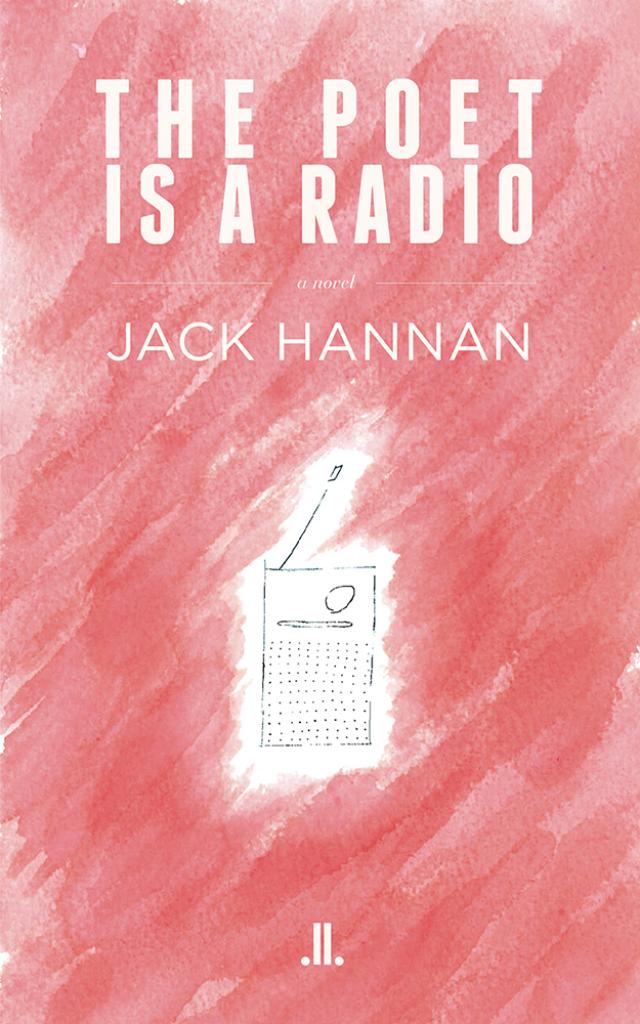
THE POET IS
A RADIO
A Novel
JACK HANNAN
.ll.
Copyright 2016 © Jack Hannan
All rights reserved. No part of this book may be reproduced, for any reason or by any means without permission in writing from the publisher.
This is a work of fiction. Names, characters, places, and incidents are either the product of the author’s imagination or are used fictitiously, and any resemblance to actual persons, living or dead, businesses, companies, events, or locales is entirely coincidental.
Prepared for the press by Katia Grubisic
Cover design: Debbie Geltner
Cover image: Molly Shea-Hannan
Author photo: Elizabeth Grace
Book design: WildElement.ca
Library and Archives Canada Cataloguing in Publication
Hannan, Jack, author
The poet is a radio / Jack Hannan.
Issued in print and electronic formats.
ISBN 978-1-927535-98-1 (paperback).--ISBN 978-1-927535-99-8 (epub).--
ISBN 978-1-988130-00-2 (mobi).--ISBN 978-1-988130-01-9 (pdf)
I. Title.
PS8565.A585P63 2016 C813’.54 C2015-908476-8
C2015-908477-6
Printed and bound in Canada.
The publisher gratefully acknowledges the support of the Canada Council for the Arts and of SODEC.
.ll.
Linda Leith Publishing Inc.
P.O. Box 322, Victoria Station,
Westmount Quebec H3Z 2V8 Canada
www.lindaleith.com
To Jesse, Katrina, Kai, Quinn, Deborah, and Molly
ONE
Where are you at two in the morning?
On Li Bai’s first birthday in Canada, he walked across a parking lot and found a grey duffle bag that contained almost two hundred thousand dollars in old twenty- and fifty-dollar bills, neatly bundled with thick blue elastic bands. He picked it up and carried it home, but he should not have done that. If it’s not yours, don’t touch it. Right, old man?
Li Bai is an old man. He is an old instrument of the hand that whirls the water in the pool. He’s an old Chinese man living in a corner of one big room in a warehouse in what was, a long time ago, the thriving commercial part of the city. Where the big money used to be. Now those businesses that need space, burdened with product that they need to put somewhere, are in the suburbs across the river, in low cement buildings right on the highway, close to the airport. The ones that aren’t holding all that inventory are up the hill, working with spreadsheets and cellphones in towers. Merchandise has become second world. “Own nothing,” Tom Peters said years ago. He was quoting Forrest Gump, “ rent your shoes.”
Now these old buildings down here are small—four, five, or six floors of cheap red brick storage boxes a few blocks from the river, renovated, even the river is being renovated, we are building new square pegs a couple of blocks from the edge of Chinatown. Li Bai lives down near the harbour and he walks uphill to go anywhere except all the way down to the Mirabeau Bridge, which is small and shakes. He stands on solid ground near the edge of the bridge. This is simple, pilgrim.
Li Bai owns two pairs of pants and two pairs of shoes. He is marginal, but I don’t want to make him seem strange. He’s just an old man who flew in from Paris a little less than a year ago. He’d been living in a rooming house in Köln before that, working in a restaurant on Jarrettstrasse, bringing bowls of won ton soup to the tourists. He is a traveller, a man who likes to sleep with a map of the world on the wall over his bed. He is an old man, he’s a cello, he has resonance. He has other interests. He washes his clothes in a large steel sink.
He lives alone, but he was not always alone. He has been married, with love and work and settled homes, clothes drying on a line outside. Four times, before finally embarking for the rest of the world, leaving China behind. His first wife was a girl from Zhanggan village who still cut her bangs straight and short across her brow, and she was so shy she never laughed. Meng Haoran.
His last wife was a woman named Song Zhiti, and he would walk across the Five Mountains five times just to be by her side in the moonlight. After they’d married he walked back across the Five Mountains a few too many times to meet his friend He Zhizhang at the Jingman Ferry, drinking wine from pots like it was water, ten thousand miles from home. “Zhiti, you are always with me” he said, the prodigal husband. He told her he looked into the river and saw her face in his own reflection, Hai sui yup meen ngoh geen doh nei gor yeung.
Hui say la! she answered in her anger. Nei gan tsik hai yut gor mo yung sui gwai.
He stood without expression, without wavering. Li Bai looked into her eyes and waited. Finally Song Zhiti, equally unwavering, shook her head and said very plainly lei mm hai yat gor holam yun. You are not a good man.
Ceremonial robes drying on the line. The disappointment on her face has never left him. When Li Bai was a young man, he studied fencing and for some years he was quite famous across Eastern China as an elite swordsman. He fought often in tournaments and won awards, ribbons to pin over his semi-pure heart. He also fought three times in real anger, with the other side of his heart, but only once in self-defence. He still owns two long and elegant swords, jians, and he keeps them very clean and extremely sharp, wrapped in a long piece of embroidered blue silk. He owns more than nine thousand books, a sizable library for a homeless wanderer. It would fill a house, and the books are all carefully bundled in clear plastic bags to keep the moisture out, sealed and packed in thick cardboard boxes, closed with duct tape and stored in most of a garage in Buffalo, New York, where Robert Creeley used to live.
Li Bai once kept a similar collection in a wooden shed behind a house in Anlu, but that was lost with everything else that fell away when he left home a long time ago. He owns two pairs of shoes and three white shirts. He is a walker. Li Bai has walked across most of Hunan province, with a sleeping roll, food, and wine, and thought nothing of it. I mean that while he enjoyed the trip, the wonder that he had done it at all never crossed his mind. It did not seem an unusual thing to do.
He lives in a six-storey brick building with an enormous Space to Let banner stretching across the side of the main wall. He walked in a spiral out from Chinatown until he came to this building. He phoned the number on the sign and now he lives there. There is no official watchman, and so he is most often the only human presence in the building. He lives in a room the size of a ballroom, half-empty. Part of this room is still used for storage. Long green tarpaulins divide the two sections. One day the storage will grow to take over his side too. The space is worth more than he is.
There are about sixty square feet of boxes piled to the ceiling in one corner, and in the other is a weird and interesting jumble of gymnastics equipment, some just painted metal pieces wrapped together in sheets of clear cellophane on skids, some completely assembled. When he first moved into the place, he pulled a balance beam out of the storage area, closer to his end of the hall, a long, beautiful, thin beam of laminated ash, forty-two inches off the ground and sixteen feet long. He tried to walk across it three times, one foot after the other, carefully, and fell three times, and hurt himself, and then gave up. The only person he’s ever seen walk across it is the girl named Habana de Curra, and she did it one night with a sword in her hand for balance. For anyone else, it’s just there. They are drawn to sit on it, letting their feet hang. They put their glasses down or lean against it like they’re at a bar. Visitors are rare. Li Bai sleeps in his underwear on a thin mattress in one corner with a German-language map of the world over his head.
He does not sleep well. He’s too old. He reads, drinks wine, he outlines paths on the map. Over the months, he builds up his next destination. He falls asleep late but gets up early. On the floor beside his bed there is a pile of books, opened face down, one on top of the other, leaning slowly over, and on the very top is a book of poetry by the Russian, Mayakovsky. On the floor beside his bed are one glass, one empty bottle and two jians carefully wrapped in embroidered silk. His feet are hard and smooth as polished pine.
Li Bai has a job in a shopping mall in downtown Montreal. The mall is in fact the bottom two floors of a building that had been recently renovated at great expense. The main tenant of the building is the International Institute for the Study of Public Policy. Li Bai works in the basement of the building, in a bookstore called Books for a Deserted Island. He works for a man named Kenneth Patchen, as do two young people who work part time, a boy named J.-S. and a literature student named Mathilde. The shelves are varnished maple, and what isn’t wood has been painted a shade of olive green. Rich and inviting.
On the morning of his birthday Li Bai is sitting at a little black metal table on the mezzanine outside the store, drinking tea. This whole mall is tremendously luxurious and even more tremendously vacant. The developers named it La Mine d’argent, but the merchants now refer to it as Le Cimetière. It is not so, you know, successful. And these merchants know a graveyard when they’re in it. The goal had been to put together a shopping centre that would be elegant, different. A mall to match Rodeo Drive, or the Jordaan. King’s Road. There were never any franchises, no chain stores were even approached. Their calls were returned just for the pleasure of saying no thank you. That’s not our concept here. Maybe next time. We’re looking for something a little different here. Culture retailers. This was to be a unique shopping experience. An
accomplishment. Retail for people to talk about, for friends and strangers to admire. And here, suddenly, wham! Here they lost hundreds of thousands of dollars in one quarter, half a million in two quarters. Already some had walked away, bankruptcy notices taped to their doors the next morning. The ones who stayed could see the million-dollar mark coming at them like a terrible train, its bright light charging right at them, tied to the tracks of their deep distress. These were people who felt like nothing ever got to them, but their feet do touch the ground now. They walk along the halls outside their elegant stores, smoking cigarettes and drinking bottled water. What time is it? What time is it? In the evening they go home.
They seem to be waiting, but Li Bai knows there must be more going on than that. These people are schemers. They sit together at a table in the open space of the elegant Café Toroni with their crisp mauve shirts and mounds of cigarette butts. They have become one anothers’ major customers, but of course they want discounts. Women in black pinstriped suits and open collars, pearls, men with their collars open too, black shirts, all of them disrespectful of what is around them now, their own environment. A tribe in chrome. How are they going to get out of this one? Imagine the lawyers going over their leases. “If you agree to be a tenant of a shopping mall,” Kenneth Patchen has remarked to Li Bai on more than one occasion, coming back from one of many meetings, “we have to define what a shopping mall is. When is a shopping mall not a shopping mall? Is it merchants or is it customers?”
When can we move out of here?
When will it be too late?
When was it too late?
Li Bai is curious but only a little interested. He’s a hired hand, his own man. He has been a hired hand in many places around the world. He likes to work in bookstores because the work is not too physical. Restaurants are much harder. He is useful in bookstores because he’s read so much. He’s like Kenneth, and even Kenneth can’t really surprise him, although he’d like to. But when Li Bai walks out and faces the day, other, simpler, curiosities occupy his mind. In the morning he likes to get up early and walk a long distance before arriving at work, a slow, long loop. He moves at a pace that makes it easy for people to overlook him, as though he has nowhere to go. And he moves as slowly in his mind as his step. He walks first down to the bridge and then along the docks. It can take him hours, two or three, walking toward the bookstore. He arrives when he arrives, an old man in special circumstances. Time is just dust suspended on the air. He enjoys that feeling of reverie that comes over him while he walks, his own consciousness, his presence, blending with the sights and sounds around him. Nothing is ordinary. Nothing is exceptional. In China, Li Bai liked to wander in the mountains and often hiked along the Yangtze River. He ascended the Wu-t’ai Shan many times, climbing the seven thousand-step staircase from the City of Peace, through the three Heavenly Gates, all the way to the top, the Temple of the Jade Emperor. The truth is that the summit, arrival, is not especially the goal. In English, the Chinese phrase chaoshan jinxiang is understood as “going on a pilgrimage,” but it actually means “paying one’s respect to the mountain.”
To be alive is to pay your respects. True? For a long time now the Wu-t’ai Shan of his reverence is all in his mind, in the colour of a wall, the light in the leaves of a tree, a passing gesture, a glance.
Li Bai can float, as though his presence weighs nothing. Li Bai is not really a participant, only present. This is what Kenneth Patchen finds most intriguing about him, although he would never say so. At first he used to imagine that anything could happen to Li Bai, but that is not quite accurate. Many things would never happen to Li Bai, and whatever would happen to Li Bai would probably not happen to Kenneth Patchen. Whatever could happen to Kenneth Patchen could not happen to Li Bai. Kenneth Patchen is aware and intrigued by the idea that Li Bai could disappear at any moment, simply not show up. Kenneth can admire that. Li Bai is also the only person that Kenneth can really talk to about books. Only Li Bai has read as much, and that’s the real reason he hired him, someone to talk to. Two men dusting shelves and talking the hours away about Lafcadio Hearn, or Arthur Waley.
Kenneth Patchen is in this mall because the developers wanted a bookstore to be placed next to the cinema opposite the food court, la-dee-dah, all this in the basement with a high, open ceiling, and they went to Kenneth because Books for a Deserted Island was one of the oldest bookshops in the city, with the best reputation as an independent bookstore. Independence was an important component in the mall’s retail mix. Why did he accept? Stupid, he’d say now, proud, he wanted to be a man in a crisp shirt and tie, but it wasn’t exactly that. Money, he’d say. That’s true. He did want the money but it really wasn’t only that either.
In Kenneth Patchen’s adventure. he has a beautiful new store filled with books that are a pleasure to behold, to hold open in your hands. Many of them are large, expensive books on art and photography, and when he committed to the mall he believed that the new shoppers, people from the Institute, book lovers, a wide-ranging clientele, would be the kind of people who would buy those books and he did want to have them on the shelves of his store. He wanted to be around that kind of store with those kinds of books. He could imagine himself there. And now he sits in a little office at the back, looking at email and worrying about money.
Li Bai is sitting at a black metal table outside Books for a Deserted Island. He has tea and a chocolate muffin. When Kenneth unlocks the door at 8:45, he says “Good morning Li Bai, happy birthday,” but he’s not actually looking at him, and so Li Bai answers with similar enthusiasm. Kenneth turns away immediately and goes into the store. The area where Li Bai is sitting is called the atrium. At its tallest the building is twelve stories high, and the atrium is open all the way to the top. There’s a large expanse of glass, and on a good day sunlight streams all the way down onto the food court. The fingers of sunlight are visible in the air, and about halfway down they cover four large sculptures of birds that hang on wires from the ceiling. They are recognizably birds, but mythological, birds with the heads of men. Black shiny bodies with wings spread twenty feet wide, coloured black where they meet the torso, and then more colourful away from their bodies. The tips of the wings are the wings of peacocks. Brancusi once said that it wasn’t birds he sculpts, but the act of flying. These birds are a suggestion of flight, humans soaring over the lunchtime crowd. Noise and muzak.
On the window of his new store Kenneth had an artist named Ralph Peters paint a mural of the cityscape, because the city is our deserted island. He likes to put quotes in the store window and changes them regularly, from whatever he’s reading that week, but one small beige card is tucked in the corner of the window, unframed, always there:
I would like you to know that in the end it all comes back to that one solitary person, sitting at a table late at night with a yellow light over his shoulder and a book in his hands. And the book is keeping him quiet, and in that quiet of the book he is living and perhaps dreaming, organizing his consciousness, falling into his consciousness, and feeling around the possibilities of his path in the world.
— Mary Griffin
TWO
A note to the reader
I have taken liberties with the names of two poets, slipping into my own mythology, but this story is fiction and I do not mean to imply anything to be true here about them, my heroes.
Li Bai is the name of a Chinese poet who was born in the year 701 CE. Today we still have more than a thousand poems he wrote during his lifetime, poems which for the most part took as their subjects the Tao, the pleasures of a soul wandering in nature, and the pleasures of serious alcoholism—sometimes wondrous, sometimes not. Li Bai was known as one of the Eight Immortals of the Wine Cup. What is a little less known is that Li Bai was also a noted swordsman, and during the An Lushan Rebellion fought at the side of the Emperor Xuanzong’s son against the Emperor himself, son against father. They lost, and Li Bai was sent into exile, a wanderer. In fact, although this story is fiction, some of what it says about the early life of Li Bai does have truth to it. In real life it is true that Meng Hao-Jan left Li Bai at the Yellow Crane Pavilion. He wrote a poem, “A lonely sail,” he wrote, “where the river meets the sky.”





