About Time, page 20


I think a Shakespeare killed before Hamlet, Othello, or Macbeth were written might have put forth such effort and returned. And I know that Max Kingery did. But there was almost nothing left over to do what he came back for. Those meaningless fragments were the utmost he could accomplish. His appearances were at the cost of tremendous effort, and I think that to even turn his head and look at us in addition, as he did the night we saw him, and then to actually pronounce an audible word besides, were efforts no one alive can understand.
It was beyond him; he could not return and then write the books that were to have made the name of Max Kingery what he’d been certain it was destined to be. And so he had to give up; we never saw Max again, though we saw one more place he’d been.
Cora and I were driving to San Rafael over the county road. You can get there on a six-lane highway now, 101, that slices straight through the hills, but this was once part of the only road between the two towns and it winds a lot around and between the Marin County hills, under the trees. It’s a pleasant narrow little two-lane road, and we like to take it once in a while; I believe it’s still the shortest route to San Rafael, winding though it is. This was the end of January or early in February, I don’t remember. It was early in the week, I’d taken the day off, and Cora wanted something at Penney’s, so we drove over.
Twenty or thirty feet up on the side of a hill about a mile outside Mill Valley there’s an outcropping of smooth-faced rock facing the road, and Cora glanced at it, exclaimed and pointed, and I jammed on the brakes and looked up where she was pointing. There on the rock facing the public road, painted in great four-foot letters, was MAX KI, the lines crude and uneven, driblets of paint running down past the bottoms of letters, the final stroke continuing on down the face of the rock until the paint or oil on the brush or stick had run thin and faded away. We knew Max had painted it—his name or as much of it as he could manage—and staring up at it now, I understood the loud jacket with MAX K on its back, and the carnival straw hat with the big red initials.
For who are the people who paint their names or initials in public places and on the rocks that face our highways? Driving from San Francisco to Reno over the Donner Pass you see them by the hundreds, some painted so high that the rocks must have been scaled, dangerously, to do it. I used to puzzle over them; to paint your name or initials up there in the mountains wasn’t impulse. It took planning. You’d have to drive over a hundred miles with the can of paint on the floor of the car. Who would do that? And who would wear the caps stitched with initials and the jackets with names on their backs? It was plain to me now; they are the people, of course, who feel that they have no identity. And who are fighting for one.
They are unknown, nearly invisible, so they feel; and their names or initials held up to the uninterested eyes of the world are silent shouts of, “Hey, look at me!” Children shout it incessantly while acquiring their identities, and if they never acquire one maybe they never stop shouting. Because the things they do must always leave them with a feeling of emptiness. Initials on their caps, names on their jackets, or even painted high on a cliff visible for miles, they must always feel their failure to leave a real mark, and so they repeat it again and again. And Max who had to be someone, who had to be, did as they did, finally, from desperation. To have never been anyone and to be forgotten completely was not to be borne. At whatever cost he too had to try to leave his name behind him even if he were reduced to painting it on a rock.
I visited the cemetery once more, that spring, plodding up the hill, eyes on the ground. Nearing the crest I looked up, then stopped in my tracks, astounded. There at the head of Max’s grave stood an enormous gray stone, the biggest by far of any in sight, and it was made not of concrete or pressed stone but of the finest granite. It would last a thousand years, and cut deeply into its face in big letters was MAXWELL KINGERY, AUTHOR.
Down in his shop outside the gates I talked to the middle-aged stonecutter in the little office at the front of the building; he was wearing a work apron and cap. He said, “Yes, certainly I remember the man who ordered it—black hair and eyes, heavy glasses. He told me what it should say, and I wrote it down. Your name’s Peter Marks, isn’t it?” I said it was, and he nodded as though he knew it. “Yes, he told me you’d be here, and I knew you would. Hard for him to talk; had some speech impediment, but I understood him.” He turned to a littered desk, leafed through a little stack of papers, then found the one he wanted, and slid it across the counter to me. “He said you’d be in, and pay for it; here’s the bill. It’s expensive but worth it, a fine stone and the only one here I know of for an author.”
For several moments I just stood there staring at the paper in my hand. Then I did the only thing left to do, and got out one of the checks I carry in my wallet. Waiting while I wrote, the stonecutter said politely, “And what do you do, Mr. Marks; you an author, too?”
“No,” I said, signing the check, then I looked up smiling. “I’m just a critic.”
JACK FINNEY wrote the much-admired, widely praised classics Invasion of the Body Snatchers, Time and Again, and From Time to Time. He died in 1995.
authors.simonandschuster.com/Jack-Finney
VISIT US ON THE WORLD WIDE WEB http://www.simonandschuster.com
We hope you enjoyed reading this Touchstone eBook.
* * *
Join our mailing list and get updates on new releases, deals, bonus content and other great books from Touchstone and Simon & Schuster.
CLICK HERE TO SIGN UP
or visit us online to sign up at
eBookNews.SimonandSchuster.com
Touchstone
Simon & Schuster Inc.
Rockefeller Center
1230 Avenue of the Americas
New York, NY 10020
www.SimonandSchuster.com
This book is a work of fiction. Names, characters, places, and incidents either are products of the author’s imagination or are used fictitiously. Any resemblance to actual events or locales or persons, living or dead, is entirely coincidental.
Copyright © 1986 by Jack Finney
All rights reserved, including the right of reproduction in whole or in part in any form.
TOUCHSTONE and design are trademarks of Simon & Schuster Inc.
Designed by Karolina Harris
Cover design by Paul Smith
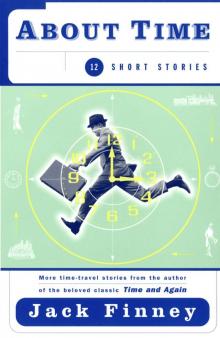
Cover photograph © Archive Photos
Library of Congress Cataloging-in-Publication Data
Finney, Jack.
About time/Jack Finney. 1st Scribner Paperback Fiction ed.
p. cm.
1. Fantastic fiction—American. I. Title.
PS3556.I52A6 1986
813′.54 86-10077
CIP
ISBN 0-684-84866-X
ISBN 978-1-4391-4448-0 (ebook)
Jack Finney, About Time