

The Ultimate Invader, page 1


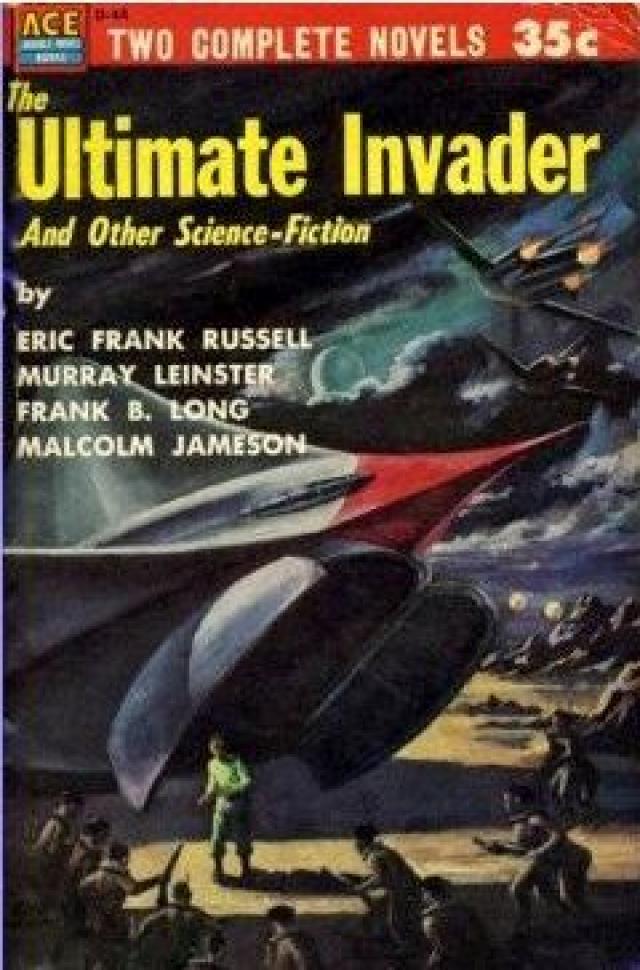
THE ULTIMATE INVADER
by Eric Frank Russell
CHAPTER I
THE little ship, scarred and battered, sat on the plain and cooled its tubes and ignored the armed guard that had sur-rounded it at a safe distance. A large, bluish sun burned over-head, lit the edges of flat, waferlike clouds in brilliant purple. There were two tiny moons shining like pale specters low in the east, and a third was diving into the westward horizon.
To the north lay the great walled city whence the guard had erupted in irate haste.
It was a squat, stark conglomeration of buildings in gray granite, devoid of tall towers, sitting four-square to the earth. An unbeautiful, strictly utilitarian place suitable for masses of the bumble living in subservience to the harsh.
At considerable altitude above the granite mass roamed its aerial patrol, a number of tiny, almost invisible dots weaving a tangle of vapor-trails. The dots displayed the irritated rest-lessness of a swarm of disturbed gnats, for their pilots were uncomfortably aware of the strange invader now sitting on the plain. Indeed, they would have intercepted it had that been possible, which it wasn't. How can one block the path of an unexpected object moving with such stupendous rapidity that its trace registers as a mere flick on a screen some seconds after the source has passed?
Upon the ground the troops kept careful watch and awaited the arrival of someone who was permitted the in-itiative that they were denied. All of them had either four legs and two arms or four arms and two legs, according to the need of the moment.
That is to say: the front pair of under-body limbs could be employed as feet or hands, like those of a baboon. Superior life does not establish itself by benefit of brains alone; manual dexterity is equally essential. The quasi-quadrupeds of this world had a barely adequate supply of the former compensated by more than enough of the latter.
Although it was not for them to decide what action to take against this sorry-looking object from the unknown, they had plenty of curiosity concerning it, and no little apprehen-sion. Much of their noseyness was stimulated by the fact that the vessel was of no identifiable type despite that they could recognize all the seventy patterns common to the entire galaxy. The apprehension was created by the sheer nonchalance of the
visitor's arrival. It had burst like a superswift bullet throng] the detector-screen that enveloped the entire planet, treate+ the sub-stratosphere patrols with disdain and sat itself dowi in clear view of the city.
Something drastic would have to be done about it, on tha point one and all were agreed. But the correct tactics woudc be defined by authority, not by underlings. To make up hi; own mind one way or the other was a presumptuous task no one of them dared undertake. So they hung around in dip; and behind rocks, and scratched and held their guns ant hankered for high brass in the city to wake up and come run•
ping.
In much the same way that planetary defenses had been brought to nought by bland presentation of an accomplished fact, so were the guards now disturbed by being confronted with an event when none were present who were qualified to cope.
Giving distant sluggards no time to make up their minds and spring into action, the ship's lock opened and a thing came out.
As a sample of unfamiliar life he was neither big nor fear-some. A biped with two arms, a pinkish face and close-fitting clothes, he was no taller than any of the onlookers and not more than one-third the weight. A peculiar creature in no way redoubtable. In fact he looked soft. One could jump on him with all four feet and squash him.
Nevertheless one could not hold him entirely in contempt. There were aspects that gave one to pause and think. In the first place, he was carrying no visible weapons and, more-over, doing it with the subtle assurance of one who has reason to view guns as so much useless lumber. In the second place, he was mooching airily around the ship, hands in pockets, inspecting the scarred shell for all the world as if this landing marked a boring call on tiresome relatives. Most of the time he had his back to the ring of troops, magnificently indifferent to whether or not anyone chose to blow him apart.
Apparently satisfied with his survey of the vessel, he sud-denly turned and walked straight toward the hidden watchers. The ship's lock remained wide open in a manner suggesting either criminal carelessness or supreme confidence, more prob-ably the latter. Completely at peace with a world in the midst of war, he ambled directly toward a section of guards, bring-ing the need for initiative nearer and nearer, making themsweat with anxiety and creating such a panic that they forgot to itch.
Rounding a rock, he came face to face with Yadiz, a com-mon trooper momentarily paralyzed by sheer lack of an order to go forward, go backward, shoot the alien, shoot himself, or do something. He looked casually at Yadiz as if different life-forms in radically different shapes were more common than pebbles. Yadiz became so embarrassed by his own futility that he swapped his gun from hand to hand and back again.
"Surely it's not that heavy," remarked the alien with com-plete and surprising fluency. He eyed the gun and sniffed.
Yadiz dropped the gun which promptly went off with an ear-splitting crash and a piece of rock flew into shards and something whined shrilly into the sky. The alien turned and followed the whine with his eyes until finally it died out.
Then he said to Yadiz, "Wasn't that rather silly?"
There was no need to answer. It was a conclusion Yadiz already had reached about one second before the bang. He picked up the gun with a foot-hand, transferred it to a real hand, found it upside-down, turned it right way up, got the strap tangled around his fist, had to reverse it to get the limb free, turned it right way up again.
Some sort of answer seemed to be necessary but for the life of him Yadiz could not conceive one that was wholly satis-factory. Struck dumb, he posed there holding his weapon by the muzzle and at arm's length, like one who has recklessly grabbed a mamba and dare not let go. In all his years as a trooper, of which there were more than several, he couldn't recall a time when possession of a firearm had proved such a handicap. He was still searching in vain for a verbal means of salvaging his self-respect when another trooper arrived to break the spell.
A little breathless with haste, the newcomer looked askance at the biped, said to Yadiz, "Who gave you orders to shoot?"
"What business is it of yours?" asked the biped, coldly dis-approving. "It's his own gun, isn't it?"
This interjection took the arrival' aback. He had not ex-pected another life-form to speak with the fluency of a native, much less treat this matter of wasting ammunition from the angle of personal ownership. The thought that a trooper might have proprietary rights in his weapon had never occurred to him. And now that he had captured the thought he did not know what to do with it. He stared at his own gun as if it had just miraculously appeared in his hand, changed it to another hand by way of ensuring its realness and solidity. "Be carefuI," advised the biped. He nodded toward Yadiz "That's the way he started."
. Turning to Yadiz, the alien said in calm, matter-of-face tones, "Take me to Markhamwit."
Yadiz couldn't be sure whether he actually dropped the gun again or whether it leaped clean out of his hands. Anyway, it did not go off.
CHAPTER II
THEY met the high brass one-third of the way to the city. There was an assorted truckload ranging from two to five-comet rank. Bowling along the road on flexible tracks, the vehicle stopped almost level with them and two dozen faces peered at the alien. A paunchy individual struggled out from his seat beside the driver and confronted the ill-assorted pair. He had a red metal sun and four silver comets shining on his harness.
To Yadiz he snapped, "Who told you to desert the guard-ring and come this way?"
"Me," informed the alien, airily.
The officer jerked as if stuck with a pin, shrewdly eyed him up and down and said, "I did not expect that you could speak our language."
"I'm fully capable of speech," assured the biped. "I can read, too. In fact, without wishing to appear boastful, I'd like to mention that I can also write."
"That may be," agreed the officer, willing to concede a couple of petty aptitudes to the manifestly outlandish. He had another careful look. "Can't say that I'm familiar with your kind of life."
"Which doesn't surprise me," said the alien. "Lots of folk never get the chance to become familiar with us."
The other's color heightened. With a show of annoyance, he informed, "I don't know who you are or what you are, but you're under arrest."
"Sire," put in the aghast Yadiz, "he wishes to—"
"Did any one tell you to speak?" demanded the officer, burning him down with his eyes.
"No, sire. It was just that—"
"Shut up!"
Yadiz swallowed hard, took on the apprehensive expression of one unreasonably denied the right to point out that the bar-rel is full of powder and someone has lit the fuse.
"Why am I under arrest?" inquired the alien, not in the least disturbed.
"Because I say so," the officer retorted.
"Really? Do you treat all arrivals that way?"
"At present, yes. You may know it or you may not, but right now this system is at war with the system of Nilea. We're taking no chances."
"Neither are we," remarked the biped, enigmatically. "What do you mean by that?"
"The same as you meant. We're playing safe."
"Ah!" The other licked satisfied lips. "So you are what I suspected from the first, namely, an ally the Nileans have dug up from some very min
"Your suspicions are ill-founded," the alien told him. "How-ever, I would rather explain myself higher up."
"You will do just that," promised the officer. "And the explanation had better be satisfactory."
He did not care for the slow smile he got in reply. It ir-resistibly suggested that someone was being dogmatic and someone else knew better. Neither had he any difficulty in identifying the respective someones. The alien's apparently baseless show of quiet confidence unsettled him far more than he cared to reveal, especially with a dopey guard standing nearby and a truckload of brass looking on.
It would have been nice to attribute the two-legger's sang-froid to the usual imbecility of another life-form too dim-witted to know when its scalp was in danger.
There were plenty of creatures like that: seemingly brave because unable to realize a predicament even when they were in it up to the neck. Many of the lower ranks of his own forces had that kind of guts. Nevertheless he could not shake off the uneasy feeling that this case was different. The alien looked too alert, too sharp-eyed to make like a cow.
Another and smaller truck came along the road. Waving it to a stop, he picked four two-comet officers to act as escort, shooed them into the new vehicle along with the biped who entered without comment or protest.
Through the side window he said to the officers, "T hold you personally responsible for his safe arrival at the interroga-tion center. Tell them I've gone on to the ship to see whether there's any more where he came from."
He stood watching on the verge while the truck reversed its direction, saw it roll rapidly toward the city. Then he ' clambered into his own vehicle which at once departed for the source of all the trouble.
Devoid of instructions to proceed toward town, return to the ship, stand on his head or do anything else, Yadiz leaned on his gun and patiently awaited the passing of somebody qualified to tell him.
The interrogation center viewed the alien's advent as less sensational than the arrival of a Joppelan five-eared munkster at the zoo. Data drawn from a galaxy was at the disposal of its large staff and the said information included descriptions of four hundred separate and distinct life-forms, a few of them so fantastic that the cogent material was more deductive than demonstrative. So far as they were concerned this sample brought the record up to four hundred and one. In another century's time it might be four hundred twenty-one or fifty-one. Listing the lesser lifes was so much routine.
Interviews were equally a matter of established rigmarole. They had created a standard technique involving questions to be answered, forms to be filled, conclusions to be drawn. Their ways of dealing with recalcitrants were, however, a good deal more flexible, demanding various alternative methods and a modicum of imagination. Some life-forms responded with pleasing alacrity to means of persuasion that other life-forms could not so much as sense. The only difficulty they could have with this specimen was that of thinking up an entirely new way of making him see reason.
So they directed him to a desk, giving him a chair with four arm-rests and six inches too high, and a bored official took his place opposite. The latter accepted in advance that the subject could already speak the local tongue or communi-cate in some other understandable manner. Nobody was sent to this place until educated sufficiently to give the required responses.
Switching his tiny desk-recorder, the interviewer started with, "What is your number, name, code, cipher or other verbal identification?"
"James Lawson."
"Sex, if any?"
"Male."
"Age?"
"None."
"There now," said the interviewer, scenting coming awk-wardness. "You must have an age."
"Must I?"
"Everyone has an age."
"Have they?"
"Look," insisted the interviewer, very patient, "nobody can be ageless."
"Can't they?"
He gave it up, murmuring, "It's unimportant anyway. His time-units are meaningless until we get his planetary data." Glancing down at his question sheet, he carried on. "Purpose of visit?" His eyes came up as he waited for the usual boring response such as, "Normal exploration." He repeated, "Pur-pose of visit?"
"To see Markhamwit," responded James Lawson.
The interviewer yelped, "What?", cut off the recorder and breathed heavily for a while. When he found voice again it was to ask, "You really mean you've come specially to see the Great Lord Markhamwit?"
"Yes."
He asked uncertainly, "By appointment?"
"No."
That did it. Recovering with great swiftness, the interviewer became aggressively officious and growled, "The Great Lord Markhamwit sees nobody without an appointment."
"Then kindly make one for me."
"I'll find out what can he done," promised the other, having no intention of doing anything whatsoever. Turning the re-corder on again, he resumed with the next question.
`"Rank?"
"None."
"Now look here—"
"I said none!" repeated Lawson.
"I heard you. We'll let it pass. It's a minor point that can be brought out later."
With that slightly sinister comment he tried the next question. "Location of origin?"
"The Solarian Combine."
Flip went the switch as the unlucky desk instrument again got put out of action.
Leaning backward, the interviewer rubbed his forehead. A passing official glanced at him,
stopped.
"Having trouble, Dilmur?"
"Trouble?" he echoed bitterly. He mooned at his question sheet. "What a day!
One thing after another! Now this!"
"What's the matter?"
He pointed an accusative finger at Lawson. "First he pre-tends to be ageless.
Then he gives the motive behind his arrival as that of seeing the Great Lord without prior arrangement." His sigh was deep and heartfelt. "Finally, to top it all, he claims that he comes from the Solarian Combine."
"H'm! Another theological nut," diagnosed the passer-by. "Don't waste your time on him. Pass him along to the mental therapists." Giving the subject of the conversation a cold look of reproof he continued on his way.
"You heard that?" The interviewer felt for the recorder-switch in readiness to resume operation. "Now do we get on with this job in a reasonable and sensible manner or must we resort to other, less pleasant methods of discovering the truth?"
"The way you put it implies that I am a liar," said Lawson, displaying no resentment.
"Not exactly. Perhaps you are a deliberate but rather stupid liar whose prevarications will gain him nothing. Perhaps you may have no more than a distorted sense of humor. Or you may be completely sincere because completely deluded. We have had visionaries here before. It takes all sorts to make a universe."
"Including Solarians," Lawson remarked.
"The Solarians are a myth," declared the interviewer with all the positiveness of one stating a long-established fact.
"There are no myths. There are only gross distortions of half-remembered truths."
"So you still insist that you are a Solarian?"
"Certainly."
The other shoved the recorder aside, got up from his seat. "Then I can go no further with you." He summoned several attendants, pointed to the victim. "Take him to Kasine."
CHAPTER III
THE individual named Kasine suffered glandular maladjust-ment that made him grossly obese. He was just one great big bag of fat relieved only by a pair of deep-sunk but brilliantly glittering eyes.
Those optics looked at Lawson in much the same way that a cat stares at a cornered mouse. Completing the inspection, heoperated his recorder, listened to a play-back of what had taken place during the previous interview.
Then a low, reverberating chuckle sounded in his huge belly and he commented,
"Ho-ho, a Solarian! And lacking a pair of arms at that! Did you mislay them someplace?" Lean-ing forward with a manifest effort, he licked thick lips and added,
"What a dreadful fix you'll be in if you lose the others also!"
Lawson gave a disdainful snort. "For an alleged mental therapist you're long overdue for treatment yourself."
It did not generate the fury that might well have been aroused in another. Kasine merely wheezed with amusement and looked self-satisfied.





