

Xenocultivars, page 1


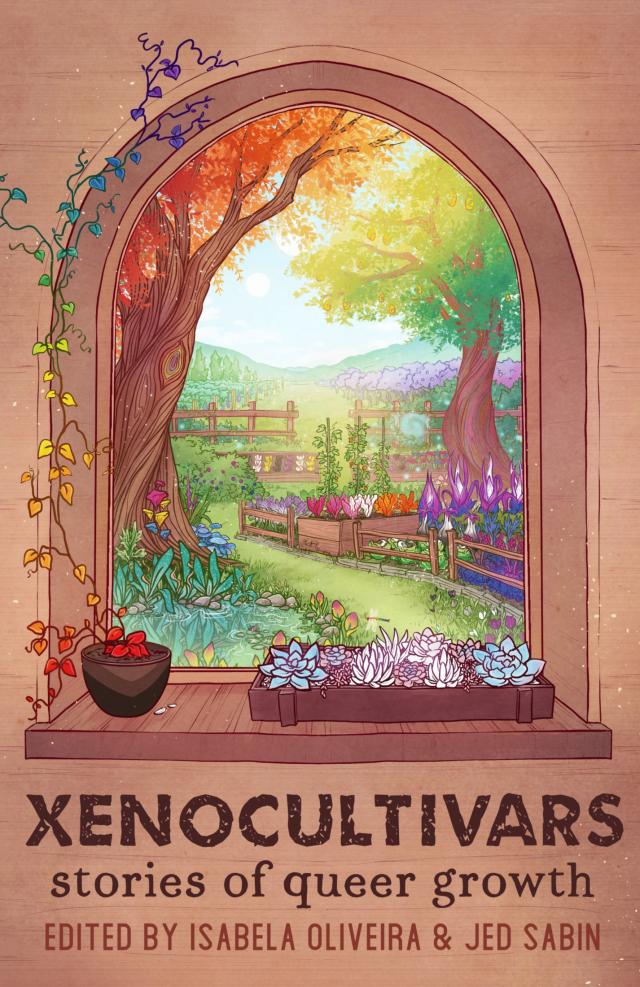
Xenocultivars: Stories of Queer Growth
Copyright © 2022 by Speculatively Queer, LLC
All rights reserved
Cover art and design © 2022 by Laya Rose
Typeset by Ryan Vance
Seedlings © 2018 by Audrey R. Hollis, first published in Strange Horizons
A Lumberjack’s Guide to Dryad Spotting © 2017 by Charles Payseur, first published in Flash Fiction Online
All other stories © 2022 by the authors
First Printing: January 2022
Printed in the United States
ISBN: 978-1-7366182-3-3
Published by Speculatively Queer
Seattle, Washington
www.speculativelyqueer.com
Edited by
Isabela Oliveira and Jed Sabin
Introduction — Isabela Oliveira and Jed Sabin
The Aloe's Bargain — Julian Stuart
This Story is Called "The Transformation of Things" — P.H. Lee
Uncharting Territory — Jessica Yang
The Thing About the Jack-o'-Lanterns — Maggie Damken
Midnight Candy — Wren Douglas
The Mandrake Loves the Olive — Sonia Sulaiman
Seedlings — Audrey R. Hollis
Dandelion Wishes — Leora Spitzer
The Princess and the P. Sativum — Jennifer Lee Rossman
Sapspear Syrup — Bradley Scott
A Lumberjack's Guide to Dryad Spotting — Charles Payseur
Folded Into Tendril and Leaf — Bogi Takács
Feeding Coals — Mile H.
Reclaiming Our Roots — Hanna A. Nirav
How to Make a Spell Jar — EA Crawley
The Tree Whisperer — Oluwatomiwa Ajeigbe
what the water gave — Cynthia Zhang
To Build a Garden — C.B. Blanchard
Content Notes
Our Community
Dedicated to the sturdiest petals
and to the most delicate of trunks.
Introduction
by Isabela Oliveira and Jed Sabin
You can’t tell plants what to do. A plant might decide to lean to the left one day, or spread out much wider than the salesperson at the garden center said it would, or survive a winter that should have been too harsh, or grow one leaf three times the size of the rest for no discernible reason. They can be influenced with the right tools and conditions, but they don’t take orders. They grow as they please.
Growth is part of the joy of being queer, and it looks different for everyone. Our awareness of ourselves can grow, as can our identities, and our relationship with being perceived as queer; some grow to embrace and claim their true self, and some grow from one true self into another and another throughout their lives.
This collection of speculative short fiction is about all kinds of queer growth, from emerging and developing to flourishing and cultivating. Whether they’re tender sprouts just beginning to discover themselves or deeply-rooted leaders fiercely defending those they love, the people in these stories have this in common: you can’t tell them what to do. They grow as they please.
Content Notes
The Aloe’s Bargain
Julian Stuart
The plant says, [Hello.]
Vera knows better than to tell anyone this. She knows a lot of things nobody wants to hear, and they tell her so. But that doesn’t make them not true. She is six years old, and she is a girl, and her name is Vera (which is the most beautiful name in the world, a name for princesses and glamorous ladies), and she put her soft little hand on the plastic of the pot because she wanted to feel its sun-warmed smoothness and this plant said hello.
Oma heads toward the flats of nasturtiums, but Vera trails farther behind to look closer. Her eyes focus on the plastic tag sprouting from the pot next to the small shock of sturdy green leaves, just slightly larger than her hand.
Slowly, her mouth makes the shapes of Aloe barbadensis. It reminds her of the Barbie dolls the girls at school have, which she is not supposed to want. And then in parentheses, in small print: (Aloe Vera).
She wonders what it means that the plant with her name has another name too, like her. She wonders which one it likes best.
Next to it is one with differently-shaped leaves, Aloe... something else, a long name that she doesn’t know how to read; and then another one, the same shape as the Aloe Vera but a dark red. She likes them too, but not as much.
Her hand brushes the pot again.
[Yes,] says the plant.
It costs five dollars. She knows she has five dollars in her piggy bank at home. And it has her name. And it said hello.
Oma turns back and huffs, in that way that she does so much when Vera is there. “Keep up,” she says, not unkindly but not expecting disagreement. “Or I’ll lose you, and then you’ll have to live with the plants.”
Vera thinks about that. She wouldn’t mind being a plant, but she wouldn’t like to eat dirt. And the water from the gardeners’ hoses is cold when it spatters her arms.
“Oma,” she says, gathering all her courage and her words, as slippery as they are. “Can — may I. May I. Have a plant. This one. Please. I have the money at home.”
She doesn’t say, It has my name. Oma wouldn’t like that. But she thinks it very hard.
Oma looks at Vera, and then at the plant. “An aloe,” she says. “You would water it too much, child.”
“I wouldn’t,” Vera says desperately. “Please?”
Oma sighs. “Well, they’re good to have around. All right. Put it in the basket.” She holds out the basket hanging off her forearm. But Vera pulls the plant off its spot on the shelf and carefully hugs it to her chest. It’s hers. She’ll carry it.
[Yes,] says the plant.
* * *
The aloe sits up on the windowsill over the kitchen sink. After a few weeks, Vera’s mother complains about the ugly black pot in her pristine white kitchen, so Vera and Oma go to the garden centre and pick out a nicer one to cover the plastic. It’s white ceramic with blue and orange dots, like a sweater the plant can slip into.
It stays there, in its sweater, slowly growing larger. Every Sunday Vera clambers up on the step stool, diligently pours half a tumbler of fresh cold water onto the dirt, and listens to the plant hum in gratitude. It sounds a little like a very small motor, and when she is alone she tries to make the sound in her small chest. It’s not the same, but it’s something like it.
When the sunbeams come through the window, the hum is loud enough to hear from the kitchen doorway, louder than the faint electrical shriek of the wires in the walls — another thing Vera has learned not to tell anyone about. She loves the plant even more for drowning out the wires.
One Sunday she is perched gingerly on the step stool with her cup of water while Oma stirs a pot of boiling potatoes and pretends she isn’t watching. Vera gently strokes the smooth skin of the largest leaf, avoiding the blunt spines on the edges. It feels like her own skin, yielding and soft, and the plant is burbling happily at Vera as she pets it. [Yes,] it says. [Yes, yes.]
It doesn’t know many words. It has learned some, from Vera whispering. Today it sends her the noise of her small footsteps, and a feeling, like the sun coming out from behind a cloud.
“Friend,” Vera whispers.
“Don’t talk to the plant,” Oma says, from the stove.
“You do,” Vera says, although her cheeks go hot. “You talk to the garden. You tell it to grow. I want my plant to grow.”
Oma tsks. “That’s different.”
[Friend,] the plant says, under her fingertips. The sunshine feeling gets warmer.
Vera focuses deeply on the vivid green of the leaf, dotted with pale spots. It’s beautiful. It’s the most beautiful thing in the world.
“Love,” she whispers to the sunshine feeling.
Oma says something behind her, but Vera doesn’t hear. All she hears is the aloe, thrumming louder and louder: [Yes. Love.]
Then there is a bump at her hip, and she wobbles, and a sudden cloud of steam obscures her vision and something sears over her outflung hand.
It hurts, it hurts. Her whole world narrows to that bright-crimson place as sharp as a hundred knives, and she screams. The pot of potatoes clatters into the sink. Hot steam wafts over the burn again, like a licking flame.
Oma’s hands are strong, and steady, and fast; they grab Vera and keep her from falling. She buries her face in Oma’s shoulder and wails. Oma mutters something, half comfort and half reprimand, but Vera doesn’t process it.
And then, from behind her: a high and wordless scream, smaller and shriller than her own. It is brief. It leaves behind it a silence filled with questions.
Something cool, wet, drippingly juicy, touches Vera’s outraged hand. The pain is immediately muted.
She sniffles hard, scrubs her uninjured hand roughly over her eyes, and looks.
There is an aloe leaf, split hastily down the middle, pasted to the burn on her hand. Uncomprehending, she looks over her shoulder at her plant.
The leaf she was petting, the biggest and juiciest, is gone. Where it was, there is only an oozing stub.
Where the thrum was, in her chest, there is silence.
She bursts into tears.
In her room, out of the way, she cries as the split leaf withers on her hand. Oma comes to fetch her for dinner, and under the brighter lights in the kitchen she peels the limp plant flesh away, inspecting Vera’s hand from all angles.
“It will be fine,” she pronounces eventually.
Vera doesn’t feel fine at all.
“Oma,” she quavers, “why did you cut my plant?”
Her grandmother blinks at her. “It’s an aloe,” she says. “That’s what they’re for. They’re good for burns, they help you heal faster. What did you think I kept it for?”
“Oh,” Vera says.
She doesn’t say, It’s mine.
She doesn’t say, It’s my friend.
She doesn’t say, I love it and it loves me back.
She looks at the strip of wilted leaf in her grandmother’s fingers and then down at the pinkened stripe on her hand, half as raw as it was.
It helped her.
“Don’t worry,” Oma says. “It doesn’t kill the plant. Now come eat.”
As Vera eats her mashed potatoes, she glances again and again at the windowsill, and at the silent plant.
After she’s finished helping with the dishes, she lingers by the sink, damp dish towel twisted between her small fists. “I’m sorry,” she whispers. “I’m sorry I took your leaf. I didn’t mean to.”
Vera knows better than to go and get out the step stool, but she stretches as far as she can, and her fingertips just brush the base of the pot.
[Love?]
The plant is quiet, but it is there, solid like always.
“Love,” Vera whispers, and her heart twists like the dish towel. “I’m sorry.”
[Grow.] The plant sends her the feeling of new leaves pushing up and apart, from deep within its core. [Grow. Yes.] And then a slice of her Oma’s voice: [“That’s what they’re for.”]
She stares at the stub of the most perfect leaf, beginning to become leathery and scabbed now, and nods slowly. Reluctantly. Remembering how it screamed.
“Love,” she whispers again. “I’ll be more careful.”
[Love,] the aloe hums.
The burn heals without a mark. But although Vera wishes as hard as she can, and new leaves do come in time, the perfect leaf stays a brown and withered stub.
* * *
The aloe grows, and so does Vera.
[Don’t fit,] it tells her one afternoon. It is larger than its pot now, on all sides. She can reach it easily now without the step stool, which is the best thing about how the last few years have changed her. She, too, is bigger on all sides. She doesn’t mind it inherently, but she doesn’t like hearing the comments from her classmates that make it harder to pretend to be a dainty and glamorous queen.
“I know how you feel,” Vera tells it wearily. “But we can get you a new container.”
It stretches in a way that makes it look like a small, lazy octopus. [Big.]
“Yeah,” she agrees. “You need space.”
From her allowance, she buys it a new pot twice the size, and a pretty container painted like Delft china in whites and blues. At the kitchen table, in a riot of dirt that her mother theatrically disapproves of, Vera turns the aloe out of its pot and teases apart the snarls of strong white roots that have bent themselves into the shape of the plastic.
[Tickle,] the plant says, but it’s humming happily. Vera wiggles her fingers a little deeper into the roots and the aloe sends her a moment of her own laugh, high and bubbly.
[Big, big big big,] it chants. [Grow grow grow. Grow tall, grow tall.]
She lifts it up, remembering how small her hands used to look, remembering the weight of the aloe feeling so much more considerable, and tucks it into the new soil.
[Ahhh,] the plant says, relaxing visibly. [Good. Love. Now you.]
“Now me?” She raises an eyebrow at the plant. “It’s not that easy.”
[Easy,] the plant insists. [You big. You grow. Tall. Strong. Fat.]
It doesn’t sound the way her classmates say it, the way her mother says it, the way her doctor says it. The way she says it when she wants to explain to herself why they hate her.
She has never said it to the aloe that way. She loves the pudgy fleshiness of its leaves, so solid, so healthy.
[You need space. Grow more.] The plant beams sunlight and approval at her. [Big. Tall. Full of juice, like me. Full of love.]
“Like you,” she murmurs.
[Like me.]
She looks down at the curve of her belly and the softness of her arms, and tries to see herself deep green and mottled with pale dots. She imagines her own growth as a sign that she is becoming stronger and more filled with power.
She squeezes the base of a leaf gently, and then pinches her forearm.
“Juicy,” she says, testing it out. “Like you.”
[You get big. Good good. Proud.]
Her whole chest feels warm and full of thrumming. “I’m proud of you too,” she says, and pats the dirt around the base of the aloe’s stem just enough to make sure it’s stable.
* * *
She does get big, and tall, and she stays fat, and the aloe does the same. At the secondhand shop she finds it an even larger pot — and herself a flower-patterned dress that skims the edges of her hips instead of digging in like her jeans do. She is only brave enough to wear it when she’s home alone, but she puts it on and twirls for the plant. It is delighted, and talks about flowers for days. She feels like a queen again.
It no longer fits on the windowsill, and its leaves spread out so much that she has to take it out of the kitchen and up to her room. She misses it when she’s making dinner and washing up, but it sings to her while she does her homework, and she dreams of warm rocks and sunshine and hundreds and hundreds of aloes.
She wonders if it would like to have friends. She wishes she had any. There’s Bayley, who is in her history and English classes, and has the most amazingly fluffy curly hair, and actually picked Vera for a team project — but that’s not quite being friends, really. That’s just being classmates. Even if Bayley did ask about the plants Vera was doodling on her papers, and actually listened when Vera explained that it was a sempervivum, which means “lives forever,” and how you can grow one from a single leaf if you’re patient with it. She thinks about the curiosity in Bayley’s dark eyes, sometimes. It might be nice to have a friend like that.
Maybe the aloe doesn’t want to be alone either. In the old pots, Vera starts new succulents from the garden centre — a sedum with bright glossy jellybean leaves, and a kalanchoe like a stack of edgewise mint candy melts. Then more sedums, and an armour-plated haworthia, and an echeveria she can’t touch without leaving fingerprints on its waxy coating. They don’t talk to her, which is a little disappointing; but the aloe adopts them like a hen taking on a flock of ducklings, and sings songs to them, and they grow.
Bayley passes Vera a note in English class: We should work on the Shakespeare project this weekend. Your place?
On the corner of the page, Bayley has drawn a sempervivum.
Vera swallows something large and unexpected, and meets Bayley’s eyes long enough to nod.
* * *
“Wow,” Bayley breathes, two steps into Vera’s room. “You grew those?”
Vera nods. She’s never had anyone in her room before besides family, and Bayley being in her space fills her with a strange electricity, jittery but thrilling.
“You’re really good at plants,” Bayley says. “I can never keep them alive.”
Vera doesn’t know how to be admired.
“It’s easy,” she says, hating how awkward she sounds. “You just have to know what they need.”
Bayley drifts toward the window, as if pulled on an invisible string. Her sea-green sweatshirt, her favourite, matches the kalanchoe, but it’s the aloe she’s staring at. “This is the biggest aloe I’ve ever seen. How long have you been growing it?”
“Since I was little. Six.” Her words line up almost without her meaning to say them. “It’s my favourite. Because of the name. Vera.”
Bayley smiles. “It’s a pretty name.”
“I.” Vera blushes and doesn’t know why. She hasn’t told Bayley it’s her name. But something clenched inside her relaxes all the same. “...Thanks.”


