

Other Evolutions, page 39


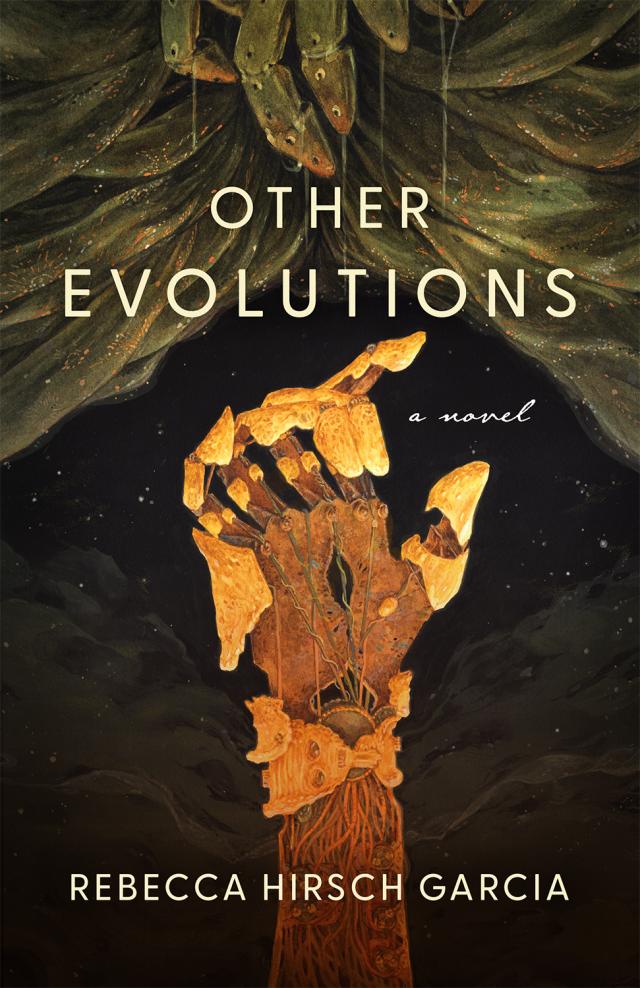
Other Evolutions A Novel
Rebecca Hirsch Garcia
Contents
Dedication
Epigraph
Part I
Part II
Part III
Part IV
Acknowledgements
About the Author
Copyright
Dedication
3To my mother, Trudi Hirsch Garcia, who taught me how to keep the dead alive.
Epigraph
5The future is perhaps a wave that will wash us away.
—Agnès Varda
Part I
7Vanishing
Nothing Ever Happens in Ottawa
9I always feel too human at parties. By which I mean parties begin at the point at which I am my most artificial: plucked, shaved, and made up, and all the effort reminds me that threatening to burst through all this grooming at any moment is my natural self. She is always there waiting for me at the end of the night: hair frizzing, dress stained, the smell of sweat, familiar, claiming dominion over the sweet, fading notes of perfume.
Parties are always a disappointment too. In the movies of my youth, which always took place elsewhere, impossibly gorgeous women in beautiful gowns were always being romanced by impossibly handsome men in tuxes. At real parties no one, even at their best, can compare to that soft-lens movie magic. I always see the flaws: the lines of undergarments underneath the silky sheen of polyester satin; the men’s shoes, stiff and shiny from disuse, announcing their owners’ arrival with little mousey squeaks. Women’s powdery makeup gathers in the folds of their wrinkles, men’s carefully curated stubble doesn’t quite cover the acne scars left behind from teenagedom. There’s always a dead ant floating miserably in a bowl of flower arrangements and the tablecloths aren’t made of linen or any sort of natural fabric; instead they are scratchy to the touch polyester, the easier to wash the inevitable stains out.
This inability to ignore the uglier side of things is why I never go to parties, and yet recently Marnie called me to beg me to go a wedding as a favour for the brother of a friend.
I said no, because I always say no, even though I knew that Marnie would, as she always does, get her way in the end.
I also said no because I couldn’t remember if this brother of a friend remembered about my arm or if, when he showed up to collect me, his face would twist in disgust before it would correct itself, smoothing into the placid look of neutrality that Ottawans are so good at. Then we 10would have to spend a whole dreadful night together pretending both that his face hadn’t betrayed him and that I hadn’t seen it.
He remembers, Marnie told me.
And when he showed up at my doorstep there was absolutely no disappointment when he saw me.
You’re saving me, Alma, he said, lifting up my left hand and holding it tight.
For hours I stood beside him and introduced myself over and over again to people whose names I didn’t bother trying to learn.
I averted my eyes from the cracks and did my best at playing the role of Guest.
But then my feet began to burn in my heels and I noticed the smallest snag in the fabric of my dress, a favourite of mine, and I noticed people kept sliding their eyes over to me and then sliding their eyes away as soon as they noticed me noticing.
I felt an itch running down my spine, unbearable, and muttered my excuses and walked away, very slowly.
There was nowhere really to go, the dance floor and dining area all one. So I circulated in the true meaning of the word, ambling in a loop around the room, trying to get as far away as possible from my companion, knowing that every step only brought me closer to him and his friends and their stares.
And then I was spared, for a minute, when I saw another friend of Marnie’s, whose name I could not recall but who, seeing me, smiled at me and drew me into the sphere of people she was talking to with the warmth of her gaze.
There are people who meet you when you are a child and who always, forever after, see you that way even when you are an adult. That was the way it was for this friend of Marnie’s. She brought me close to her body, to the soft swell of her chest, and the smell of alcohol and sweat and perfume all in one, ushering me close to her as if I was a child.
11Alma, beloved, they are saying that Ottawa is boring. The most boring place on earth. Tell them it isn’t, Alma, tell them.
And the man beside her said, Ottawa is where fun comes to die, and everyone made noises of amusement, shadows of laughter at this truism.
And I thought of how everyone I had ever loved lived within the borders of the city, this city I had been born in and raised in and would likely die in, had laughed and cried and loved and hated and nearly died in, and I said, Oh, absolutely, I agree.
Marnie’s friend laughed a real laugh at that and because she had just taken a swig of champagne it was glorious. Alcohol droplets misted out of her like a fountain and everyone in the little circle either screamed in horror or laughed themselves and backed away and went in search of napkins and in the chaos I excused myself and went back and found my date and was somehow able to bear the night a little better.
At the end of the night when we were all in line to get our coats at the coat check I noticed that the man who said Ottawa was where fun came to die was behind me.
He blushed when he saw me looking at him.
Hello there, he said.
Hello.
I didn’t mean to offend you, he said.
You didn’t.
I’m sure lots of interesting things happen in Ottawa. For example—and he gestured at my arm.
Or rather, he gestured at the prosthetic arm I was wearing.
He was a lot older than me, this man. He had reached that age when all old men begin to look a little like old women and all old women 12begin to look a little like old men. Somehow, though, they never look like each other.
Not everything is a story, I told him. Goodnight.
It felt as though the very house was asleep by the time I got home. So as not to wake it I didn’t turn on the lights. In the dark I abandoned the prosthetic and stripped off my dress and let it fall to the floor where it would wrinkle helplessly. It didn’t matter to me. I had already ruined it with my sweat, with my being, when I was careless and looked away and had let it snag. It was ruined, like all things were in the end.
In the dark I scrubbed off my makeup and then in my sulky, feral, undressed state, I sat in my favourite chair in the dark.
My arm was aching where it wasn’t, phantom pains that I couldn’t rub out.
I thought about the old man at the party, the one I had not wanted to converse with, and in the dark I talked to him.
I told him:
Everything is a story.
But not everyone deserves to hear it.
The Story of My Arm
Fourteen was the last age when I had two arms. After that I had one.
When I am in a decent enough mood and the person asking is not particularly offensive the story I tell them about my arm is this:
When I was fourteen I was in a car accident.
And that is all they need to know.
Another Story, for Example, Which Not Everyone Deserves to Hear
13If I were to tell someone the story of my life, I wouldn’t start with my birth. I wouldn’t start with the birth of my parents either, or their parents, or their parents, whose names have been lost to me, are as untouchable, as untraceable, as if they never lived.
I would start the story of my life with the birth of my older sister.
I would start with Marnie.
When my mother was pregnant with Marnie she had been in Canada long enough to know that it would be better for the baby if the baby was white. My mother, Merced, was an immigrant from Mexico, never able to slough off a thick accent which marked her as being Not of This Place. Despite her bronzed skin, there lurked inside her murky connections to the white-skinned Spaniards who had colonized and raped upon their arrival in her mother country. She hoped that between her Jewish husband (brown-haired but fair of skin) and the shame in her past it would be enough to give the baby a good life. A white life.
When the baby was born she was a mottled dark berry colour. My father counted baby fingers and toes, which added up every time to a perfect set of ten of each. His mother was pleased with the baby. She was an immigrant herself, a survivor, a refugee. Her entire family had been murdered, leaving her to create a new one with her own flesh. She cried every time she saw Marnie, the baby named for the favourite sister, the one she remembered as a naughty teenager who wore lipstick when she was too young for it and took out her violin at parties, the sister who didn’t survive.
At her birth my father Aaron’s sister, aunt Eshkie, prophesized that Marnie would turn browner than my mother.
14But Marnie lightened up day by day.
By the time my father and mother sat at the kitchen table of their tiny Toronto apartment, which I would never see in life, only in pictures from that happy time, and decided that they needed to move to Ottawa to take care of my grandmother—still years away from dementia but already an old woman—by that time Marnie’s skin had lightened to a pale and luminous white. Her eyes were still an unsettling steel-grey that would eventually morph into a soft moss-green that belonged to no relative in memory, and the first of the bright blonde strands of her youth had begun to appear upon her formerly bald dome.
My parents cried hugging friends they would lose touch with and gave away, sold, or packed up everything they owned, and travelled by car to Ottawa, where nothing ever happens and I was finally born.
I was born into a different world. I was born to parents who were five years older, and were tired. My mother especially. She was tired of trying to teach Marnie the language of her colonizers when Marnie was learning the languages of the Canadian colonizers, English and French seeping into school, home, play. She was tired of taking care of my father’s mother despite loving her, loving her with all the misplaced affection of a daughter separated by that great big ungovernable country, America, from her own mother. But mostly she was tired of walking with the child she had grown and fed from her own body and being constantly mistaken for The Help. The women in her new Ottawan neighbourhood assumed she was a babysitter or a nanny or a friend. When they were corrected they blushed, the pink coming through under their patchy makeup. They were so sorry. They hadn’t meant to assume. Once or twice some supposedly liberal-minded woman called my mother Marnie’s stepmother. My mother, a lapsed Catholic married to a conservative Jew, the word divorce unthinkable for either of them, bristled at the thought of being anyone’s second anything.
So when my mother found out she was pregnant once more, she wished again. For a child who would be hers and would look it. And 15once again her wish came true: I was born with black hair, full and thick already, and mottled skin that lost its purple sheen but stayed a convincing brown, all the melanin from her past reasserting itself in my body.
My mother told us, that is Marnie and me, this story all the time when we were growing up. It made us sound like the princesses in the storybooks my father read to us at bedtime. Sisters were always different, one taking after the moon, the other the sun, one golden-haired and one with hair black as night (though they were always white, the princesses in these books). When I was a little older I thought of the story a bit differently. It seemed that my mother was claiming witch-like powers though I had never known a woman less like a witch, a beautiful woman, a tidy woman, a woman who still crossed herself every time she passed a church but who had long ago abandoned the practical aspects of Catholicism.
One day it occurred to me to ask her what she was trying to say when she kept telling me this story. She pinched my earlobe for asking.
But what’s the point?
She looked at me like she couldn’t believe she had raised a daughter so stupid.
That you were always so wanted.
Blood Everywhere You Look
Marnie and I, the loved children, the wanted children, grew up side by side as Ottawans, as Glebites, on a street named Linden Terrace. We were raised in the house that my grandparents—my zaide, who died long before I was ever born, and my bubbe—had purchased when the neighbourhood was rundown, before civil servants took 16over and the prices skyrocketed and it turned into a home that neither Marnie nor I would have ever been able to purchase but that we would inherit anyway one day when everyone we loved or who had loved us was dead.
My grandparents bought the land to replace that other land in those other countries where they came from. Countries, whole swaths on the map, that they could not look at without feeling bites of pain, countries that my father, who had been expressly forbidden to do so, would never visit, where Marnie and I (who had not been expressly forbidden) would never choose to visit, where everyone they had previously loved had lived and then, for no reason I could ever understand, had been rounded up, tortured, and murdered. They bought the new house and they bought another and they hoarded it, afraid that someone would come and claim it one day.
Oh but in this land, my mother said, away from my father’s ears. On this land they are the colonizers.
Maybe she didn’t say colonizers. It was a word that would have felt strange in her mouth, in her accent. She would have said it in a more euphemistic way, sifting through the second-hand language for the right words for her meaning.
She would have said something like, All this land, it was stolen too.
Or maybe: Remember Alma, that this land used to belong to someone else.
Or maybe: No one ever forgets the land they have lost.
She didn’t need to say that last bit. Marnie and I learned those lessons as infants, aware of the injustice of the other people living shadow lives on the other land, the land that should have been ours by right.
We didn’t even know where it was but we wanted it.
When someone steals something the stolen-from never forget.
Someone, somewhere, is always waiting to get it back.
In the recent past and the far—all through the carefully curated neighbourhoods where city planners had parcelled lots and planted 17trees and cut through the earth and eliminated all traces of the original caretakers—everywhere under everything if you looked hard enough, if you bothered looking at all, there was genocide.
You have everything to be grateful for, aunt Eshkie shouted at me once after I lost my arm. Why can’t you be happy?
An Introduction to Death and the Concept of Unhappiness
My grandmother died when I was four and Marnie was nine.
This was incredibly difficult on both my parents. My mother loved my grandmother. When my father asked if they could move back to take care of her, my mother couldn’t understand why it was phrased as a question.
My grandmother loved my mother back, unquestionably, as a second daughter. They had so much in common. They were both immigrants. They had both chosen to make Canada their home, though for my grandmother, the refugee, it was less a matter of choice than of survival. They were both very traditional women in that they deferred, or pretended to defer, to their husbands, always wore skirts, never swore, prayed to God daily, and thought sleeveless tops were something only loose women wore. They were both exactly the type of people to understand and use the phrase loose women. And of course my grandmother, who had lost her whole family in the war and then created a new one, venerated my mother for bringing her grandchildren.
I learned later on in biology classes what this had cost her. That babies are like parasites, taking the nutrients they need from their host bodies, and the host will give up anything, no matter the cost to 18themselves, to protect their invader. Women who have experienced pregnancy have fewer teeth than other adults because their babies leach the calcium from their bones. My grandmother had a gold tooth that glinted in the light. My mother a porcelain one dyed to match her extant set.
They were thick as thieves, both of them laughing across their versions of English. It was not that either of them was particularly funny or that either understood what the other was trying to say in particular, only that each knew that the other was trying to make a joke and the other laughed in appreciation of the spirit in which the mishmashed words had been intended.
I was never old enough to appreciate this camaraderie. As she aged the English drained away from my grandmother. By the time I knew her she frequently reverted back to Yiddish, the language she used in the kitchen in Canada where she raised her children with her husband, a little island of Jewishness.
In our kitchen, in the Glebe, she spoke a mixture of German and Yiddish to me, her little kluge mädchen, her bubbeleh, and I answered back in English.
By the time I was old enough to have conscious memories Marnie was at school and my mother’s charges had dwindled down to two: myself and my grandmother. My mother found it easier to treat us as if we were both children, one small and strong, one adult-sized but weak.
When we went out we were given instructions to hold each other’s hands and look both ways before we crossed the street. We were served our lunches at the same time and reminded to wash our hands before eating and clean our plates. We each took a seat on either side of my mother during the daily ritual of soap opera watching. If we sat and watched quietly and if I refrained from sucking my thumb and my grandmother refrained from trying to wander off, then we were each rewarded later with a cookie, which we chewed over quietly at the kitchen table.


