

IndianSF-Issue-2-Mar-April-epub, page 1


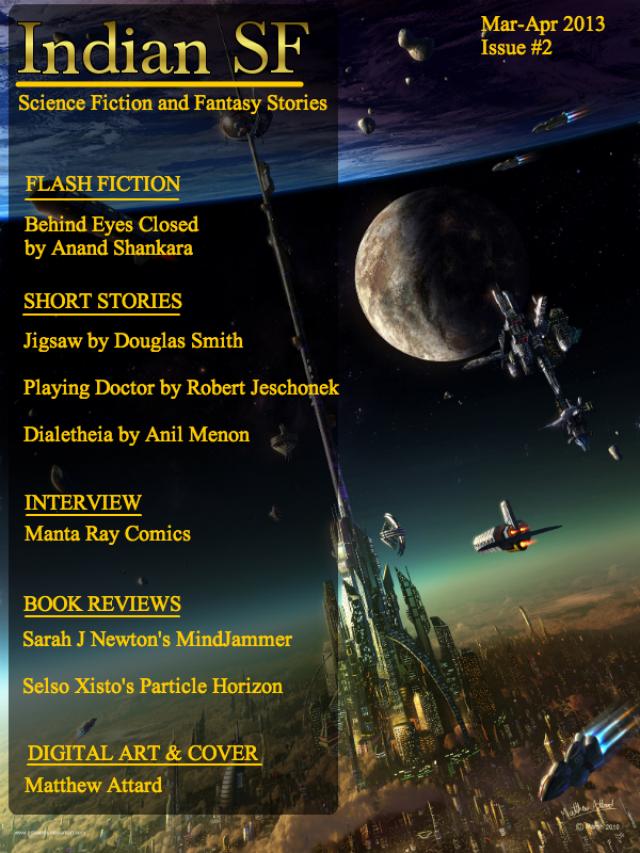
FLASH FICTION
Behind Eyes Closed by Anand Shankara
~1000 Words
“Have you ever wondered what it would be like if we were a molecule of water?” she asked me.
I shook my head, looking down at our reflections in the puddles as they quivered with each drop of rain that hit them. In my hand was a wet cigarette, soggy with its unfulfilled destiny, and in her hand was an unopened umbrella.
The rain was unrelenting. We walked on nonetheless.
She took my hand in hers, and gestured expansively with the umbrella. “We could see the whole world. We could fly with the clouds, swim in the rivers and streams and lakes and seas,” she said.
I smiled and nodded. I hadn't seen much of the world. It would indeed be good to travel. I hoped I had left the rest of the cigarettes at home.
She leaped, trying to reach for a couple of leaves that drooped lowest from a tree. I glanced down at the footpath, wary of jutting stones. I could hear the water gushing, meandering, indifferent to the path it couldn't choose even if it wanted to. It flowed to wherever it could, from high to low, from full to empty.
We found a bench, painted green. The metal underneath was showing in places, black as night. We sat down. She set the umbrella aside and put her head on my shoulder. We watched the clouds for a while.
“Have you ever wondered what it would feel like to kiss in the rain?” she asked me.
I kissed her. She tasted of strawberry. She tasted like tears. She tasted like the sun peeking between darkened clouds.
After a while, we got up and walked again. The rain seemed a little hesitant then, a little uncertain, perhaps, as so many endings began.
Leaves hung down trees like the sodden green beard of a giant. Our clothes were soaked through. My shoes made squeaky noises. We didn't know where we were going and we didn't care. Her umbrella lay forgotten on the bench.
I looked at her, her long dark hair plastered to her face, and felt strange for having thought of forgotten things. She looked at me with brown eyes so dark they were almost black. I put my hands into the pockets of my jeans.
“Have you ever wondered what it would be like, if you were someone else’s dream?” she asked.
I clutched my wet cigarette tightly, my chest ached, and there was a lump in my throat. I heard her words, I felt them, but try as I might, I couldn't understand them.
I hoped I had left the matchbox at home but I knew somehow that I would never know. She looked at me, with tears trickling down her face. I wanted to comfort her, to tell her that when she came back I would be there, but suddenly I realized I didn't know if I would. How could dreams know?
She closed her eyes, and all was light.
______________________________________________________________________________
Author Bio: Anand is a fantasy and sci-fi geek from Bangalore. He likes reading books, playing the guitar, and creating universes in his head. He occasionally dabbles in the real world during his day job as a software engineer. This is his first published story.
SHORT STORIES
Jigsaw by Douglas Smith
~4900 Words
Still in shock, Cassie Morant slumped in the cockpit of the empty hopper, staring at the two viewplates before her.
In one, the planet Griphus, a blue, green and brown marble wrapped in belts of cloud, grew smaller. Except for the shape of its land masses, it could have been Earth.
But it wasn't. Griphus was an alien world, light-years from Sol System.
A world where nineteen of her shipmates were going to die.
And one of them was Davey.
On the other viewplate, the segmented, tubular hull of the orbiting Earth wormship, the Johannes Kepler, grew larger. Cassie tapped a command, and the ship's vector appeared, confirming her fears.
The ship's orbit was still decaying. She opened a comm-link.
“Hopper two to the Kepler,” she said. “Requesting docking clearance.”
Silence. Then a male voice crackled over the speaker, echoing cold and metallic in the empty shuttle. “Acknowledged, Hopper two. You are clear to dock, segment beta four, port nine.”
Cassie didn't recognize the voice, but that wasn't surprising. The Kepler held the population of a small city, and Cassie was something of a loner. But she had no trouble identifying the gruff rumble she heard next.
“Pilot of hopper, identify yourself. This is Captain Theodor.”
Cassie took a breath. “Sir, this is Dr. Cassandra Morant, team geologist.”
Pause. “Where's team leader Stockard?” Theodor asked.
Davey. “Sir, the rest of the surface team was captured by the indigenous tribe inhabiting the extraction site. The team is...” Cassie stopped, her throat constricting.
“Morant?”
She swallowed. “They're to be executed at sunrise.”
Another pause.
“Did you get the berkelium?” Theodor finally asked.
Cassie fought her anger. Theodor wasn’t being heartless. The team below was secondary to the thousands on the ship.
“Just a core sample, sir,” she said. “But it confirms that the deposit's there.”
Theodor swore. “Dr. Morant, our orbit decays in under twenty hours. Report immediately after docking to brief the command team.” Theodor cut the link.
Cassie stared at the huge wormship, suddenly hating it, hating its strangeness. Humans would never build something like that, she thought.
Consisting of hundreds of torus rings strung along a central axis like donuts on a stick, the ship resembled a giant metallic worm. A dozen rings near the middle were slowly rotating, providing the few inhabited sections with an artificial gravity. The thousands of humans on the ship barely filled a fraction of it.
This wasn’t meant for us, she thought. We shouldn’t be here.
Humans had just begun to explore their solar system, when Max Bremer and his crew had found the wormships, three of them, outside the orbit of Pluto.
Abandoned? Lost? Or left to be found?
Found by the ever curious, barely-out-of-the-trees man-apes of Earth. Found with charted wormholes in Sol System. Found with still-only-partly-translated, we-think-this-button-does-this libraries and databases, and we-can’t-fix-it-so-it-better-never-break technology. Incredibly ancient yet perfectly functioning Wormer technology.
Wormers. The inevitable name given to Earth’s unknown alien benefactors.
Five years later, humanity was here, exploring the stars, riding like toddlers on the shoulders of the Wormers.
But Cassie no longer wanted to be here. She wished she was back on Earth, safely cocooned in her apartment, with Vivaldi playing, lost in one of her jigsaw puzzles.
She shifted uncomfortably in the hopper seat. Like every Wormer chair, like the ship itself, it almost fit a human. But not quite.
It was like forcing a piece to fit in a jigsaw—it was always a cheat, and in the end, the picture was wrong. Humans didn’t belong here. They had forced themselves into a place in the universe where they didn’t fit. We cheated, she thought, and we've been caught. And now we're being punished.
They faced a puzzle that threatened the entire ship. She’d had a chance to solve it on the planet.
And she'd failed.
Cassie hugged herself, trying to think. She was good at puzzles, but this one had a piece missing. She thought back over events since they'd arrived through the wormhole four days ago. The answer had to be there...
#
Four days ago, Cassie had sat in her quarters on the Kepler, hunched over a jigsaw puzzle covering her desk. The desk, like anything Wormer, favored unbroken flowing contours, the seat sweeping up to chair back wrapping around to desk surface. Viewplates on the curved walls showed telescopic shots of Griphus. The walls and ceiling glowed softly.
Lieutenant David Stockard, Davey to Cassie, lay on her bunk watching her.
“Don’t you get tired of jigsaws?” he asked.
She shrugged. “They relax me. It’s my form of meditation. Besides, I’m doing my homework.”
Davey rolled off the bunk. She watched him walk over, wondering again what had brought them together. If she could call what they had being “together”— sometimes friendship, sometimes romance, sometimes not-talking-to-each-other.
They seemed a case study in “opposites attract.” She was a scientist, and Davey was military. She was dark, short and slim, while he was fair, tall and broad. She preferred spending her time quietly, reading, listening to classical music – and doing jigsaw puzzles. Davey always had to be active.
But the biggest difference lay in their attitudes to the Wormers. Davey fervently believed that the alien ships were meant to be found by humans, that the Universe wanted them to explore the stars.
To Cassie, the Universe wasn’t telling them everything it knew. She felt that they didn’t understand Wormer technology enough to be risking thousands of lives.
He looked at the puzzle. “Homework?”
“I printed a Mercator projection of topographic scans of Griphus onto plas-per, and the computer cut it into a jigsaw.”
The puzzle showed the planet’s two major continents, which Dr. Xu, head geologist and Cassie’s supervisor, had dubbed Manus and Pugnus. Hand and fist. The western continent, Pugnus, resembled a clenched fist and forearm, punching across an ocean at Manus, which resembled an open hand, fingers and thumb curled ready to catch the fist. Colored dots, each numbered, speckled the map.
“What are the dots?” Davey asked.
“Our shopping list. Deposits of rare minerals. That is, if you believe Wormer archives and Wormer scanners—”
“Cassie, let’s not start—” Davey said.
“Davey, these ships are at least ten thousand years old—”
“With self-healing nanotech—” Davey replied.
“That we don’t understand—”
“Cassie...” Davey sighed.
She glared, then folded her arms. “Fine.”
Davey checked the time on his per-comm unit. “Speaking of homework, Trask wants surface team rescue procedures by oh-eight-hundred. Gotta go.” He kissed Cassie and left.
Cassie bit back a comment that this was a scientific, not a military, expedition. The likely need for Trask's “procedures” was low in her opinion.
She would soon change her mind.
An hour later, Cassie was walking along the busy outer corridor of the ring segment assigned to the science team. Suddenly, the ship shuddered, throwing Cassie and others against one curving wall.
The ship lurched again, and the light from the glowing walls blinked out. People screamed. Cassie stumbled and fell. And kept falling, waiting for the impact against the floor that never came, until she realized what had happened.
The ring’s stopped rotating, she thought. We’ve lost artificial gravity.
She floated in darkness for maybe thirty minutes, bumping into others, surrounded by whispers, shouts, and sobbing. Suddenly, the lights flicked back on. Cassie felt gravity returning like an invisible hand tugging at her guts, followed by a sudden heaviness in her limbs. Hitting the floor, she rolled then rose on shaky legs. People stood dazed, looking like scattered pieces in a jigsaw that before had been a coherent picture of normality.
What had happened?
The intercom broke through the rising babble of conversations. “The following personnel report immediately to port six, segment beta four for surface team detail.” Twenty names followed. One was Davey’s.
One was hers. What was going on?
An hour later, her questions still unanswered, she and nineteen others sat in a hopper as it left the Kepler. Hoppers were smaller Wormer craft used for ship-to-surface trips and exploration. With a tubular hull, a spherical cockpit at the head, and six jointed legs allowing them to rest level on any terrain, they resembled grasshoppers.
The team faced each other in two rows of seats in the main cabin. Cassie only knew two others besides Davey. Manfred Mubuto, balding, dark and round, was their xeno-anthropologist. Liz Branson, with features as sharp as her sarcasm, was their linguist. Four were marines. But the rest, over half the team, were mining techs. Why?
Davey addressed them. She’d never seen him so serious.
“The Kepler’s power loss resulted from the primary fuel cell being purged. Engineering is working to swap cells, but that requires translating untested Wormer procedures. We may need to replenish the cell, which means extracting berkelium from Griphus for processing.”
That’s why I’m here, Cassie thought. Berkelium, a rare trans-uranium element, was the favored Wormer energy source. It had never been found on Earth, only manufactured. Her analysis of Griphus had shown possible deposits.
“Like every planet found via the wormholes,” Davey said, “Griphus is incredibly Earth-like: atmosphere, gravity, humanoid populations—”
Liz interrupted. “We purged a fuel cell? Who screwed up?”
Davey reddened. “That’s not relevant—”
“Operator error, I hear,” Manfred said. “A tech misread Wormer symbols on a panel, punched an incorrect sequence—”
Liz swore. “I knew it! We’re like kids trying to fly Daddy’s flitter—”
Cassie started to agree, but Davey cut them off.
“We’ve no time for rumors,” he snapped, looking at Cassie, Liz, and Manfred. “Our orbit decays in three days. I remind you that this team’s under my command–including science personnel.”
Manfred nodded. Liz glared, but said nothing.
Davey tapped the computer pad on his seat. A holo of Griphus appeared. “Dr. Morant, please locate the berkelium.”
Cassie almost laughed at being called “Dr. Morant” by Davey, but then she caught his look. She tapped some keys, and two red dots blinked onto the holo, one in the ocean mid-way between Pugnus and Manus, and another offshore of Manus. The second site was circled.
“Wormer sensors show two sites. I've circled my recommendation,” Cassie said.
“Why not the other site?” a mining tech asked.
A network of lines appeared, making the planet’s surface look like a huge jigsaw puzzle.
“As on Earth,” Cassie said, “the lithosphere or planetary crust of Griphus is broken into tectonic plates, irregular sections ranging from maybe fifteen kilometers thick under oceans to a hundred under continents. This shows the plate pattern on Griphus.
“Plates float on the denser, semi-molten asthenosphere, the upper part of the mantle. At ‘transform’ boundaries, they slide along each other, as in the San Andreas Fault on Earth. At ‘convergent’ boundaries, they collide, forming mountains such as the Himalayas.”
A line splitting the ocean between Pugnus and Manus glowed yellow. The line also ran through the other berkelium site.
“But at ‘divergent’ boundaries,” Cassie continued, “such as this mid-oceanic trench, magma pushes up from the mantle, creating new crust, forcing the plates apart. The other site is deep in the trench, below our sub’s crush depth.”
Davey nodded. “So we hit the site offshore of Manus. Any indigenous population along that coast?”
“Yes,” Manfred said. “From orbital pictures, they appear tribal, agrarian, definitely pre-industrial. Some large stone structures and primitive metallurgy.”
“Then defending ourselves shouldn’t be a problem.” Davey patted the stinger on his belt. The Wormer weapon was non-lethal, temporarily disrupting voluntary muscular control.
“Could we try talking before we shoot them?” Liz said.
Davey just smiled. “Which brings us to communication, Dr. Branson.”
Liz sighed. “Wormer translator units need a critical mass of vocabulary, syntax, and context samples to learn a language. Given the time we have, I doubt they’ll help much.”
“With any luck, we won't need them,” Davey said. “We’ll locate the deposit, send in the mining submersible, and be out before they know we’re there.”
Looking around her, Cassie guessed that no one felt lucky.
The hopper landed on the coast near the offshore deposit. The team wore light body suits and breathing masks to prevent ingesting anything alien to human immune systems.
Cassie stepped onto a broad beach of gray sand lapped by an ocean too green for Earth, under a sky a touch too blue. The beach ran up to a forest of trees whose black trunks rose twenty meters into the air. Long silver leaves studded each trunk, glinting like sword blades in the sun. She heard a high keening that might have been birds or wind in the strange trees.
Southwards, the beach ran into the distance. But to the north, it ended at a cliff rising up to a low mesa. Cassie walked over to Davey, who was overseeing the marines unloading the submersible and drilling equipment.
“Cool, eh?” he said, looking around them.
She pointed at the mesa. “That’s cooler to a rock nut.”
He looked up the beach. “Okay. But keep your per-comm on.”
Cassie nodded and set out. The cliff was an hour’s walk. Cassie didn’t mind, enjoying the exercise and strange surroundings. She took pictures of the rock strata and climbed to get samples at different levels. Then she walked back.
They captured Cassie just as she was wondering why the hopper seemed deserted. The natives appeared so quickly and silently, they seemed to rise from the sand. Cassie counted about forty of them, all remarkably human-like, but taller, with larger eyes, longer noses, and greenish skin. All were male, bare-chested, wearing skirts woven from sword-blade tree leaves, and leather sandals.
They led Cassie to stand before two women. One was dressed as the men were, but with a headdress of a coppery metal. The other was older and wore a cape of cloth and feathers. Her head was bare, her hair long and white. Beside them, pale but unharmed, stood Liz Branson, flanked by two warriors.


