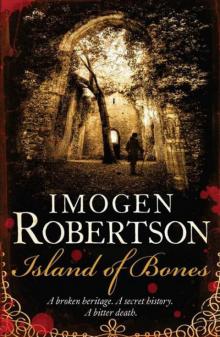
Island of Bones, page 23
part #3 of Crowther and Westerman Series


Harriet held out her hand. ‘Sophia, you have not yet told me . . .’ the door closed behind the fleeing woman ‘. . . how you came to be in Keswick,’ she finished to the empty room.
She sighed and thought of the party at Silverside, then pulled her watch into her hand. They had dined at five the day of their arrival, and it wanted only half an hour to that now. She had left poor Mrs Briggs with another corpse in her outhouse and only information of the servants to let her know what had passed. She would have to follow Miss Hurst’s story another time. The most pressing thing was to try and smooth over any offence she had caused at Silverside, and speak carefully to her son.
She met Mr Sturgess and Miss Scales in the hallway. On hearing that Fräulein Hurst wished to be left alone the rest of the day, Miss Scales was nothing but understanding. Mr Sturgess, however, seemed annoyed. His reply, though apparently polite, made it quite clear to Harriet that he was marking this inconvenience up as the first result of her meddling.
‘I am surprised you wish to speak to the girl, Mr Sturgess,’ Harriet said flatly. ‘You are so convinced that Casper is the guilty man. Have you taken him into custody?’ She heard Miss Scales draw in her breath. Mr Sturgess smoothed a hand over his forehead.
‘Casper was no longer at the stone circle when I arrived. The Constable is conducting a search. He will be found. I came here because I wished to express my condolences.’
Miss Scales replied in slightly clipped tones, ‘I shall carry them this evening to Sophia with her supper tray, Mr Sturgess.’
He was forced to bow and depart unsatisfied at that. As soon as the hall was free of him, Miss Scales turned to Harriet. Her face was a little pink, which made her scars look all the more angry.
‘Casper kill a man? Nonsense!’
Harriet replied mildly, ‘Perhaps Casper believed that Hurst attacked him?’
Miss Scales looked as if she were in danger of stamping her foot. ‘Why on earth should he think such a thing? In any case, Casper has dealt with that business in his own way, as you may have heard. And I know for a fact that you would never allow Stephen to keep company with Casper unless you were absolutely certain he had no part in this.’
Harriet blushed a little. ‘Miss Scales, I did not know that Stephen had gone to Casper again after he delivered the body to us.’ There was a pause.
‘I see.’ Her voice had become suddenly colder.
‘I hope, for Stephen’s sake, you do not think Casper might be guilty,’ Harriet said.
‘I cannot think it. I pray he is not – for the sake of our town, as well as for your son. The people trust in him and his abilities; he is part of the fabric of this place. There are other cunning-men and women in the area, but few use their influence with the care that Casper does. We have been friends of a sort since I was a child.’ Miss Scales put her hand out to touch the wallflowers cut and arranged on the side-table of the hall, and Harriet caught a breath of their fragrance.
‘Miss Scales, this walk through town to the Druid circle. What did Casper mean to achieve?’
Miss Scales continued to examine the flower blossoms for a moment before she replied. ‘He is playing Hamlet, Mrs Westerman. As the Prince with the play, so Casper with his march to the stone circle. He will have watched the reactions of the village, and he will have frightened those who hurt him into thinking the fair-folk will be after them for insulting their friend. Such is the power of a cunning-man.’ She tapped her foot. ‘Those men must have had a powerful motive for doing so bold-faced a thing. Most of all, I am distressed by Mr Sturgess’s hypocrisy in this matter.’
Harriet frowned. ‘You think Mr Sturgess a hypocrite?’
Miss Scales glanced over towards her father’s study rather guiltily. ‘I should make no such charge, but it burns me a little. When Sturgess first arrived in Keswick he sought Casper out! He was in the grips of his fascination with the local history even then, and spoke most respectfully to him in order to find out what he could. That was before he tried to excavate at the stone circle, of course. I believe that when he found he could not ride roughshod over the people in such a matter, it decided him to buy his way into the role of magistrate. Then when he became magistrate and found the people were still as likely to go to Casper as to him for redress against their neighbours he cast himself as a warrior of reason and has sought to condemn him at every turn. Pride. The people of these villages are as good or bad as any, but their respect must be earned. Mr Sturgess seems to think that respect should be his by rights.’
‘So you do believe Casper is innocent of this killing?’
‘Yes,’ Miss Scales said simply.
Harriet hesitated. ‘There was mistletoe in the man’s pockets.’
‘No doubt Casper put it there, to protect the man’s spirit and stop it wandering.’
Harriet shook her head. ‘This mix of pagan and Christian confuses me, Miss Scales. I cannot understand it.’
‘Dear Mrs Westerman, do not even try! Just know this: belief in these old ways, braided as they are with Christian teachings, lie deep in these hills. And belief makes things powerful, very powerful, and we would all do well to respect that. Do not understand it. Respect it. That is all.’
It didn’t take Casper long to find the place where Agnes had reburied the poppet. There was a spot between the roots of a rowan where the earth had been turned. He scraped the loose stuff away until he could see the pale straw figure wrapped in rowan leaves and berries. He lifted it out. It was neatly made. Agnes had set harebells in its face as eyes, the same blue as Stella’s. Clumps of raw dark wool had been worked into the straw for hair and it was wearing a folded blue handkerchief as a dress. It had been washed as he instructed, and he could see no trace of blood on it now. He pulled the handkerchief loose and a handful of leaves fell from it. Henbane and rue. He could feel the power on it. He would burn it on his own fire among healing herbs. Agnes would need guiding, but she would be powerful indeed in time.
Blanche Grice was eavesdropping in his mind. ‘Shame she’s lost then, isn’t it? Shame you most likely went and dropped her in a hole.’
He ignored her, and looked about him. The sudden rain of last night had caused a dozen little riverlets to run, but the earth in which the poppet had been buried was still dust dry, so she had been here before the waters came. He tried to think about the beating. He was sure that the storm had come while they were still at work on him. Yes, it had scared them. There had been a pause, a consultation with another man, then they had dropped him and gone into his cabin. He looked about him again. He had told Agnes to wait here till dawn. Where would she have hidden when the rain came? He turned round slowly. Perhaps she had gone higher first to try and get sight of the fireworks, though missing them was supposed to be part of her penance. He walked up the slope away from the trees then looked towards the lake, then back down the way he had come. He could see the three cabins that made up his summer home.
Blanche Grice had started to sing. She made Joe sound like an angel, but Casper smiled. She did that when she wanted to stop him thinking on something. He went back into his memory of the night before, felt the blow to his ribs, the taste of his own blood in his mouth. In the rain, when they seemed to have it in mind to start in on him again, a shape had come through the woods. He had heard a call, then another blow across his head had made him stupid. The next memory he could find was the heat of morning and Stephen’s voice calling him.
‘I did her no harm,’ he said aloud. ‘She came to my aid.’
The witch gave up singing now that the memory had come back to him. ‘Where is she then?’ she said, sulky and slippery.
‘I shall find her.’
He turned back towards his camp, his fire and his duties.
Mrs Briggs was nothing but welcoming when Harriet arrived in the drawing room finally dressed for dinner, full of apologies and half an hour late.
‘No, Mrs Westerman, you have done quite the right thing.’ She said this with a significant glance at the Vizegräfin and Harriet realised that the town’s display of displeasure with Mrs Briggs’s uncomfortable guests had given her courage. ‘You and I shall speak of all these matters after we have dined, I hope. In the meantime I shall say only I am glad that you are here to aid us in these difficult times. Cook is quite happy to hold dinner for such an insignificant time when you are doing so much for us.’
Harriet thought briefly how pleasant the world would be, were more people in it like Mrs Briggs, and they went into dinner.
‘How did Miss Hurst take the news?’ Felix asked, after they had been seated some time.
‘Calmly,’ Harriet replied. The thought of the girl being insulted and turned away by the Vizegräfin, then Felix’s refusal to deliver word to Sophia himself made her angry. Felix deserved no news about her. She thought of the flat empty voice in which Miss Hurst had told her of her past; it made her hate all men and Felix in particular.
‘Did you know, Felix, that Miss Hurst left the convent in which she had spent most of her life only six months ago, since when her father tried to prostitute her to the men he had gulled into playing cards with him?’ She put some of the game pie onto her plate. ‘She had to fight, and was beaten for her resistance.’
Harriet felt the movement of one of the footmen behind her, and her glass was filled. She cursed inwardly. She had, in her anger, forgotten about the presence of the servants, and here was Mrs Briggs’s footman in the most subtle of ways reminding her of it himself.
‘I did not,’ Felix said. For a moment he sounded almost like Crowther.
Mrs Briggs began to talk about the danger of chills with a certain determination, and went on to say how glad she was Stephen had fetched a brew from Casper.
The Vizegräfin was largely silent, till waving away the joint that Mrs Briggs was offering her, she looked at Harriet and demanded, ‘Where is my brother? Is he cutting up the Austrian?’
Harriet wet her lips slightly. ‘He wished to visit your old housekeeper, then I believe it was his intention to call on Mr Askew.’
‘What – Lottie Tyers?’ The Vizegräfin shuddered. ‘I can’t believe that old woman is still living; she seemed ancient when I was a child.’
Mrs Briggs put down the joint. ‘I told you of her on the first day you arrived, Vizegräfin,’ she said very precisely. ‘I thought you might wish to see a woman so intimately associated with your childhood.’
The Vizegräfin shrugged. ‘She was a servant.’
The rest of the meal passed in silence.
Mr Askew was never absolutely punctual about the hour his museum closed. He lived in fear of shutting his door just as some member of the quality, whose name could add further lustre to his visitors’ book, might be pondering a visit. At around a quarter to the hour advertised of five o’clock he would generally appear in the square, looking up and down the street for any ladies or gentlemen who seemed to be at leisure to let them know his museum was still at their disposal, and in their absence he mourned the looks of his town. He could not help feeling that most of the houses which surrounded his museum looked hunched and low. He wished he could white-wash the whole settlement. The same thought came into his mind every night as the clock-chimes faded, regular as the bells. Only some minutes after the hour had struck would he, with a last look about him and a sigh, confess that he had had all the custom likely in the day, and return to his front door with slow steps and draw it closed. Such were his actions now.
He had his hand on the door when he saw a movement in the shadows of the alley opposite and saw Mr Crowther emerging from the gloom. He started. The man unnerved him at the best of times, and he had seen nothing in Crowther’s behaviour to suggest to him they were likely to become friendly. His manners were cold to the point of incivility. Mrs Westerman seemed a pleasant enough woman; she had praised his fireworks. He had mentioned the fact in his paragraph about the event for the London papers, hoping that the mention of her name and the account of the storm might make the gentlemen in the capital think it worthwhile to set his letter in type. Mr Askew paid her the compliment in his mind of being certain that she would never of her own volition become involved with the sordid business of murder, and was privately convinced Crowther must have some dark power over her to force her to aid him in his investigations. If she had appeared on his doorstep in this way, he would have known what to say, and how to say it. With Mr Crowther before him, Mr Askew felt his tongue stick in his mouth.
‘May I see your museum, Mr Askew?’ Crowther said. Askew opened the door and bowed him in, though the skin on the back of his neck prickled and, given the choice, he would rather have welcomed a devil into his living room. He turned the key in the door behind them, then turned to watch Crowther as he examined the displays. He felt his usual enthusiasm for his little establishment wither like cut grass. He watched Crowther move his gaze from the case of minerals, to the examples of stuffed birds, to the portrait of the Luck, and saw only shabby, provincial attempts at science, at art. He dropped his gaze to the floor, and the dusty toes of his own boots, unwilling any more to see his museum suffer under that cold regard.
‘Mr Askew?’
He looked up like a schoolboy in front of a headmaster.
‘Yes, my lord?’
‘Where are the materials relating to my father’s murder?’
It seemed to Mr Askew that he had tied his cravat with too much enthusiasm this morning, though he had not noticed the pressure on his throat before now.
‘Materials?’
Crowther pointed his stick to the alcove where an unfortunate stuffed fox mouldered.
‘There. I see the engravings and notes you have assembled on the unfortunate history of Lord Greta. If I were in your trade I would relate the misery of his successor to these lands about there. Instead I see areas where I can tell by the brightness of the paint that certain items have been removed, and an example of vulpes vulpes that does no credit to the museum, the art of the taxidermist, or the works of nature herself. So I ask again, where are the materials relating to my father’s murder?’
Mr Askew swallowed. ‘Small display, merely the facts, my lord, tasteful . . . Taken down at your sister’s request.’
‘You have them here, however?’ Mr Askew nodded and pointed mutely in the direction of his office. ‘May I examine them, Mr Askew, if that would not inconvenience you?’
The civility of the question brightened Mr Askew considerably. He bustled towards the office door and unlocked it with his usual buoyant stride and then invited Mr Crowther to sit in his own chair, at his own table, before leaning into the press and dragging out a packing case in which any number of papers seemed to have been crammed in haste. It occurred to him that the murder of Mr Hurst might not do as much damage to his trade as he had feared. If Mr Crowther and Mrs Westerman happened to discover the killer, perhaps the loss of Mr Hurst would not be much of a loss at all, especially if they found that some mysterious foreigner had been responsible. That would be an excellent outcome. Their names would be even more closely linked with the area, and he was in a perfect position to describe events for the press. Perhaps even write a little book on their investigation, to be sold exclusively in the museum. He was aware that people enjoyed reading about such things.
‘As you see, sir,’ he said, pulling a framed engraving free, ‘here is our portrait of your father, and one of your brother. It was their marks you noticed on the wall.’ He placed them on the blotter in front of Crowther, and was about to place his other papers over them when Crowther held up his hand. He was staring at the two portraits with steady concentration.
After a significant pause, Crowther let his hand drop. ‘They are faithful likenesses,’ he said, then looking up again added, ‘What else have you there, Mr Askew?’ Askew put down the volume that was in his hand delicately on top of the 1st Baron’s portrait. Crowther examined the first page. A collection of the most remarkable and interesting trials with the defence and behaviour of the criminals before and after condemnation. Mr Askew coughed slightly, then turned the pages till he reached the relevant section. The words swam rather in front of Crowther’s eyes. Mr Askew, however, was beginning to brighten. Mr Crowther had not come to insult him, or his museum. Indeed, he seemed to be seeking his help. Mr Askew was glad to offer it. Mr Askew only wished he could do more. Mr Askew began to say so.
‘I think it vital that little establishments such as my own gather together materials relating to the history, the geography and the personalities in a place such as this. I am sure many guineas have been spread around this town because of our humble display on the Luck of Gutherscale Hall, for instance, which perhaps you noticed; and to those whose interest is more scholarly, we may offer materials to aid them in their own researches. Again I mention our display on the Luck. Mr Sturgess is an enthusiast for the legends of this area and has read every reference I could gather on the fall of Lord Greta.’
‘Indeed?’
‘Oh yes. For an out-comer he has gathered a quantity of information. Indeed, I hope his business will allow him to visit me soon, as I have just taken possession of a rather good likeness of the last Lord Greta, superior to that already in my museum and am keen to share it with him.’ He delved back into the press and emerged with a neatly rolled paper which he unravelled and held aloft.
Crowther glanced up briefly. ‘Very fine.’
‘I am so glad you agree, sir. Yes, this likeness was taken in Lord Greta’s last years in exile in France. They say he was quite poor by that time, though of course the artist has still discovered that aristocratic nature which remained to the last. A fine eye for detail is what an artist requires . . . How very strange!’
‘What is strange?’ Crowther asked, without looking up.
‘Oh, nothing – nothing at all,’ Askew said hurriedly. ‘Have you found anything of interest in the volume, my lord?’
Crowther lifted it by one corner. ‘May I take it away with me, Mr Askew? I shall return it tomorrow.’ Mr Askew bowed his consent and Crowther slipped the book into his coat-pocket and stood. Mr Askew watched him; he was staring again at the portraits of his father and brother, but Askew could see no sign of great emotion on his face, only those of quiet study. Then Crowther nodded once, as if to his own thoughts, and with a final bow left the room and the museum to its proprietor’s sole care.
She sighed and thought of the party at Silverside, then pulled her watch into her hand. They had dined at five the day of their arrival, and it wanted only half an hour to that now. She had left poor Mrs Briggs with another corpse in her outhouse and only information of the servants to let her know what had passed. She would have to follow Miss Hurst’s story another time. The most pressing thing was to try and smooth over any offence she had caused at Silverside, and speak carefully to her son.
She met Mr Sturgess and Miss Scales in the hallway. On hearing that Fräulein Hurst wished to be left alone the rest of the day, Miss Scales was nothing but understanding. Mr Sturgess, however, seemed annoyed. His reply, though apparently polite, made it quite clear to Harriet that he was marking this inconvenience up as the first result of her meddling.
‘I am surprised you wish to speak to the girl, Mr Sturgess,’ Harriet said flatly. ‘You are so convinced that Casper is the guilty man. Have you taken him into custody?’ She heard Miss Scales draw in her breath. Mr Sturgess smoothed a hand over his forehead.
‘Casper was no longer at the stone circle when I arrived. The Constable is conducting a search. He will be found. I came here because I wished to express my condolences.’
Miss Scales replied in slightly clipped tones, ‘I shall carry them this evening to Sophia with her supper tray, Mr Sturgess.’
He was forced to bow and depart unsatisfied at that. As soon as the hall was free of him, Miss Scales turned to Harriet. Her face was a little pink, which made her scars look all the more angry.
‘Casper kill a man? Nonsense!’
Harriet replied mildly, ‘Perhaps Casper believed that Hurst attacked him?’
Miss Scales looked as if she were in danger of stamping her foot. ‘Why on earth should he think such a thing? In any case, Casper has dealt with that business in his own way, as you may have heard. And I know for a fact that you would never allow Stephen to keep company with Casper unless you were absolutely certain he had no part in this.’
Harriet blushed a little. ‘Miss Scales, I did not know that Stephen had gone to Casper again after he delivered the body to us.’ There was a pause.
‘I see.’ Her voice had become suddenly colder.
‘I hope, for Stephen’s sake, you do not think Casper might be guilty,’ Harriet said.
‘I cannot think it. I pray he is not – for the sake of our town, as well as for your son. The people trust in him and his abilities; he is part of the fabric of this place. There are other cunning-men and women in the area, but few use their influence with the care that Casper does. We have been friends of a sort since I was a child.’ Miss Scales put her hand out to touch the wallflowers cut and arranged on the side-table of the hall, and Harriet caught a breath of their fragrance.
‘Miss Scales, this walk through town to the Druid circle. What did Casper mean to achieve?’
Miss Scales continued to examine the flower blossoms for a moment before she replied. ‘He is playing Hamlet, Mrs Westerman. As the Prince with the play, so Casper with his march to the stone circle. He will have watched the reactions of the village, and he will have frightened those who hurt him into thinking the fair-folk will be after them for insulting their friend. Such is the power of a cunning-man.’ She tapped her foot. ‘Those men must have had a powerful motive for doing so bold-faced a thing. Most of all, I am distressed by Mr Sturgess’s hypocrisy in this matter.’
Harriet frowned. ‘You think Mr Sturgess a hypocrite?’
Miss Scales glanced over towards her father’s study rather guiltily. ‘I should make no such charge, but it burns me a little. When Sturgess first arrived in Keswick he sought Casper out! He was in the grips of his fascination with the local history even then, and spoke most respectfully to him in order to find out what he could. That was before he tried to excavate at the stone circle, of course. I believe that when he found he could not ride roughshod over the people in such a matter, it decided him to buy his way into the role of magistrate. Then when he became magistrate and found the people were still as likely to go to Casper as to him for redress against their neighbours he cast himself as a warrior of reason and has sought to condemn him at every turn. Pride. The people of these villages are as good or bad as any, but their respect must be earned. Mr Sturgess seems to think that respect should be his by rights.’
‘So you do believe Casper is innocent of this killing?’
‘Yes,’ Miss Scales said simply.
Harriet hesitated. ‘There was mistletoe in the man’s pockets.’
‘No doubt Casper put it there, to protect the man’s spirit and stop it wandering.’
Harriet shook her head. ‘This mix of pagan and Christian confuses me, Miss Scales. I cannot understand it.’
‘Dear Mrs Westerman, do not even try! Just know this: belief in these old ways, braided as they are with Christian teachings, lie deep in these hills. And belief makes things powerful, very powerful, and we would all do well to respect that. Do not understand it. Respect it. That is all.’
It didn’t take Casper long to find the place where Agnes had reburied the poppet. There was a spot between the roots of a rowan where the earth had been turned. He scraped the loose stuff away until he could see the pale straw figure wrapped in rowan leaves and berries. He lifted it out. It was neatly made. Agnes had set harebells in its face as eyes, the same blue as Stella’s. Clumps of raw dark wool had been worked into the straw for hair and it was wearing a folded blue handkerchief as a dress. It had been washed as he instructed, and he could see no trace of blood on it now. He pulled the handkerchief loose and a handful of leaves fell from it. Henbane and rue. He could feel the power on it. He would burn it on his own fire among healing herbs. Agnes would need guiding, but she would be powerful indeed in time.
Blanche Grice was eavesdropping in his mind. ‘Shame she’s lost then, isn’t it? Shame you most likely went and dropped her in a hole.’
He ignored her, and looked about him. The sudden rain of last night had caused a dozen little riverlets to run, but the earth in which the poppet had been buried was still dust dry, so she had been here before the waters came. He tried to think about the beating. He was sure that the storm had come while they were still at work on him. Yes, it had scared them. There had been a pause, a consultation with another man, then they had dropped him and gone into his cabin. He looked about him again. He had told Agnes to wait here till dawn. Where would she have hidden when the rain came? He turned round slowly. Perhaps she had gone higher first to try and get sight of the fireworks, though missing them was supposed to be part of her penance. He walked up the slope away from the trees then looked towards the lake, then back down the way he had come. He could see the three cabins that made up his summer home.
Blanche Grice had started to sing. She made Joe sound like an angel, but Casper smiled. She did that when she wanted to stop him thinking on something. He went back into his memory of the night before, felt the blow to his ribs, the taste of his own blood in his mouth. In the rain, when they seemed to have it in mind to start in on him again, a shape had come through the woods. He had heard a call, then another blow across his head had made him stupid. The next memory he could find was the heat of morning and Stephen’s voice calling him.
‘I did her no harm,’ he said aloud. ‘She came to my aid.’
The witch gave up singing now that the memory had come back to him. ‘Where is she then?’ she said, sulky and slippery.
‘I shall find her.’
He turned back towards his camp, his fire and his duties.
Mrs Briggs was nothing but welcoming when Harriet arrived in the drawing room finally dressed for dinner, full of apologies and half an hour late.
‘No, Mrs Westerman, you have done quite the right thing.’ She said this with a significant glance at the Vizegräfin and Harriet realised that the town’s display of displeasure with Mrs Briggs’s uncomfortable guests had given her courage. ‘You and I shall speak of all these matters after we have dined, I hope. In the meantime I shall say only I am glad that you are here to aid us in these difficult times. Cook is quite happy to hold dinner for such an insignificant time when you are doing so much for us.’
Harriet thought briefly how pleasant the world would be, were more people in it like Mrs Briggs, and they went into dinner.
‘How did Miss Hurst take the news?’ Felix asked, after they had been seated some time.
‘Calmly,’ Harriet replied. The thought of the girl being insulted and turned away by the Vizegräfin, then Felix’s refusal to deliver word to Sophia himself made her angry. Felix deserved no news about her. She thought of the flat empty voice in which Miss Hurst had told her of her past; it made her hate all men and Felix in particular.
‘Did you know, Felix, that Miss Hurst left the convent in which she had spent most of her life only six months ago, since when her father tried to prostitute her to the men he had gulled into playing cards with him?’ She put some of the game pie onto her plate. ‘She had to fight, and was beaten for her resistance.’
Harriet felt the movement of one of the footmen behind her, and her glass was filled. She cursed inwardly. She had, in her anger, forgotten about the presence of the servants, and here was Mrs Briggs’s footman in the most subtle of ways reminding her of it himself.
‘I did not,’ Felix said. For a moment he sounded almost like Crowther.
Mrs Briggs began to talk about the danger of chills with a certain determination, and went on to say how glad she was Stephen had fetched a brew from Casper.
The Vizegräfin was largely silent, till waving away the joint that Mrs Briggs was offering her, she looked at Harriet and demanded, ‘Where is my brother? Is he cutting up the Austrian?’
Harriet wet her lips slightly. ‘He wished to visit your old housekeeper, then I believe it was his intention to call on Mr Askew.’
‘What – Lottie Tyers?’ The Vizegräfin shuddered. ‘I can’t believe that old woman is still living; she seemed ancient when I was a child.’
Mrs Briggs put down the joint. ‘I told you of her on the first day you arrived, Vizegräfin,’ she said very precisely. ‘I thought you might wish to see a woman so intimately associated with your childhood.’
The Vizegräfin shrugged. ‘She was a servant.’
The rest of the meal passed in silence.
Mr Askew was never absolutely punctual about the hour his museum closed. He lived in fear of shutting his door just as some member of the quality, whose name could add further lustre to his visitors’ book, might be pondering a visit. At around a quarter to the hour advertised of five o’clock he would generally appear in the square, looking up and down the street for any ladies or gentlemen who seemed to be at leisure to let them know his museum was still at their disposal, and in their absence he mourned the looks of his town. He could not help feeling that most of the houses which surrounded his museum looked hunched and low. He wished he could white-wash the whole settlement. The same thought came into his mind every night as the clock-chimes faded, regular as the bells. Only some minutes after the hour had struck would he, with a last look about him and a sigh, confess that he had had all the custom likely in the day, and return to his front door with slow steps and draw it closed. Such were his actions now.
He had his hand on the door when he saw a movement in the shadows of the alley opposite and saw Mr Crowther emerging from the gloom. He started. The man unnerved him at the best of times, and he had seen nothing in Crowther’s behaviour to suggest to him they were likely to become friendly. His manners were cold to the point of incivility. Mrs Westerman seemed a pleasant enough woman; she had praised his fireworks. He had mentioned the fact in his paragraph about the event for the London papers, hoping that the mention of her name and the account of the storm might make the gentlemen in the capital think it worthwhile to set his letter in type. Mr Askew paid her the compliment in his mind of being certain that she would never of her own volition become involved with the sordid business of murder, and was privately convinced Crowther must have some dark power over her to force her to aid him in his investigations. If she had appeared on his doorstep in this way, he would have known what to say, and how to say it. With Mr Crowther before him, Mr Askew felt his tongue stick in his mouth.
‘May I see your museum, Mr Askew?’ Crowther said. Askew opened the door and bowed him in, though the skin on the back of his neck prickled and, given the choice, he would rather have welcomed a devil into his living room. He turned the key in the door behind them, then turned to watch Crowther as he examined the displays. He felt his usual enthusiasm for his little establishment wither like cut grass. He watched Crowther move his gaze from the case of minerals, to the examples of stuffed birds, to the portrait of the Luck, and saw only shabby, provincial attempts at science, at art. He dropped his gaze to the floor, and the dusty toes of his own boots, unwilling any more to see his museum suffer under that cold regard.
‘Mr Askew?’
He looked up like a schoolboy in front of a headmaster.
‘Yes, my lord?’
‘Where are the materials relating to my father’s murder?’
It seemed to Mr Askew that he had tied his cravat with too much enthusiasm this morning, though he had not noticed the pressure on his throat before now.
‘Materials?’
Crowther pointed his stick to the alcove where an unfortunate stuffed fox mouldered.
‘There. I see the engravings and notes you have assembled on the unfortunate history of Lord Greta. If I were in your trade I would relate the misery of his successor to these lands about there. Instead I see areas where I can tell by the brightness of the paint that certain items have been removed, and an example of vulpes vulpes that does no credit to the museum, the art of the taxidermist, or the works of nature herself. So I ask again, where are the materials relating to my father’s murder?’
Mr Askew swallowed. ‘Small display, merely the facts, my lord, tasteful . . . Taken down at your sister’s request.’
‘You have them here, however?’ Mr Askew nodded and pointed mutely in the direction of his office. ‘May I examine them, Mr Askew, if that would not inconvenience you?’
The civility of the question brightened Mr Askew considerably. He bustled towards the office door and unlocked it with his usual buoyant stride and then invited Mr Crowther to sit in his own chair, at his own table, before leaning into the press and dragging out a packing case in which any number of papers seemed to have been crammed in haste. It occurred to him that the murder of Mr Hurst might not do as much damage to his trade as he had feared. If Mr Crowther and Mrs Westerman happened to discover the killer, perhaps the loss of Mr Hurst would not be much of a loss at all, especially if they found that some mysterious foreigner had been responsible. That would be an excellent outcome. Their names would be even more closely linked with the area, and he was in a perfect position to describe events for the press. Perhaps even write a little book on their investigation, to be sold exclusively in the museum. He was aware that people enjoyed reading about such things.
‘As you see, sir,’ he said, pulling a framed engraving free, ‘here is our portrait of your father, and one of your brother. It was their marks you noticed on the wall.’ He placed them on the blotter in front of Crowther, and was about to place his other papers over them when Crowther held up his hand. He was staring at the two portraits with steady concentration.
After a significant pause, Crowther let his hand drop. ‘They are faithful likenesses,’ he said, then looking up again added, ‘What else have you there, Mr Askew?’ Askew put down the volume that was in his hand delicately on top of the 1st Baron’s portrait. Crowther examined the first page. A collection of the most remarkable and interesting trials with the defence and behaviour of the criminals before and after condemnation. Mr Askew coughed slightly, then turned the pages till he reached the relevant section. The words swam rather in front of Crowther’s eyes. Mr Askew, however, was beginning to brighten. Mr Crowther had not come to insult him, or his museum. Indeed, he seemed to be seeking his help. Mr Askew was glad to offer it. Mr Askew only wished he could do more. Mr Askew began to say so.
‘I think it vital that little establishments such as my own gather together materials relating to the history, the geography and the personalities in a place such as this. I am sure many guineas have been spread around this town because of our humble display on the Luck of Gutherscale Hall, for instance, which perhaps you noticed; and to those whose interest is more scholarly, we may offer materials to aid them in their own researches. Again I mention our display on the Luck. Mr Sturgess is an enthusiast for the legends of this area and has read every reference I could gather on the fall of Lord Greta.’
‘Indeed?’
‘Oh yes. For an out-comer he has gathered a quantity of information. Indeed, I hope his business will allow him to visit me soon, as I have just taken possession of a rather good likeness of the last Lord Greta, superior to that already in my museum and am keen to share it with him.’ He delved back into the press and emerged with a neatly rolled paper which he unravelled and held aloft.
Crowther glanced up briefly. ‘Very fine.’
‘I am so glad you agree, sir. Yes, this likeness was taken in Lord Greta’s last years in exile in France. They say he was quite poor by that time, though of course the artist has still discovered that aristocratic nature which remained to the last. A fine eye for detail is what an artist requires . . . How very strange!’
‘What is strange?’ Crowther asked, without looking up.
‘Oh, nothing – nothing at all,’ Askew said hurriedly. ‘Have you found anything of interest in the volume, my lord?’
Crowther lifted it by one corner. ‘May I take it away with me, Mr Askew? I shall return it tomorrow.’ Mr Askew bowed his consent and Crowther slipped the book into his coat-pocket and stood. Mr Askew watched him; he was staring again at the portraits of his father and brother, but Askew could see no sign of great emotion on his face, only those of quiet study. Then Crowther nodded once, as if to his own thoughts, and with a final bow left the room and the museum to its proprietor’s sole care.