

Hard Rain, Cold Hearts, page 1


For Emme, my little ray of sunshine
Also by the Same Author:
Where the Larkspur Grow
A Parcel of Rogues
Dead Birds Don’t Sing
Contents
Dedication
Also by the Same Author
Acknowledgements
Chapter 1
Chapter 2
Chapter 3
Chapter 4
Chapter 5
Chapter 6
Chapter 7
Chapter 8
Chapter 9
Chapter 10
Chapter 11
Chapter 12
Chapter 13
Chapter 14
Chapter 15
Chapter 16
Chapter 17
Chapter 18
Chapter 19
Chapter 20
Chapter 21
Chapter 22
Chapter 23
Chapter 24
Chapter 25
Chapter 26
Chapter 27
Chapter 28
Epilogue
Copyright
Acknowledgements
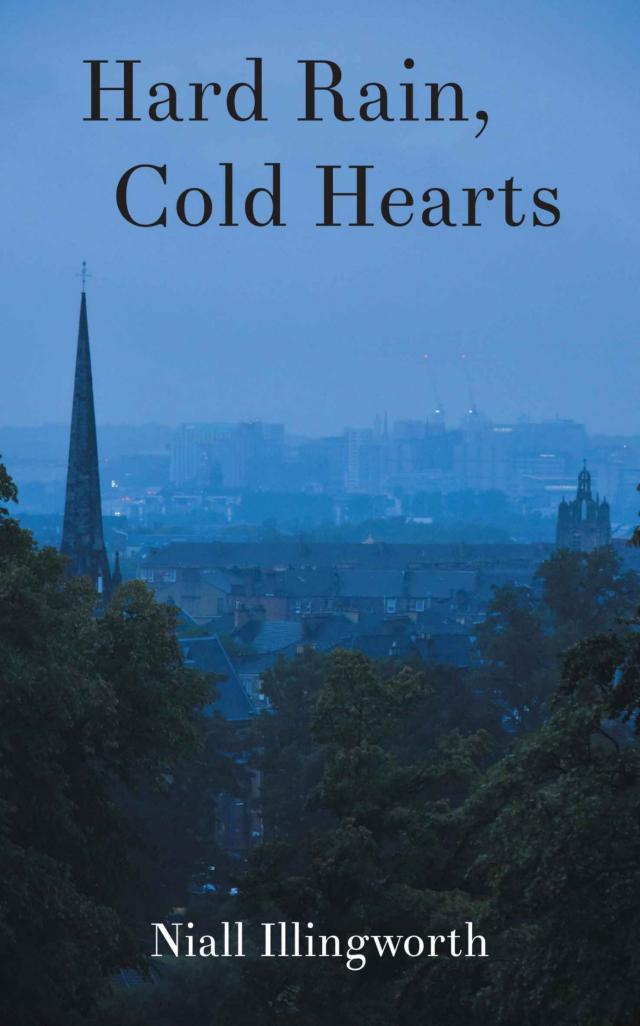
Fourth novel in, and my grateful thanks go to the usual suspects, Deborah and Eunice. Deborah, as she has done for all my previous books, read the early draft, and provided useful feedback. Eunice, once again, drew the short straw and undertook the unenviable task of correcting my grammar - a job she undertakes with unfailingly good grace. Thanks also to Charlie Curran for enduring a filthy wet evening in Queen’s Park to take the cover photo for this book.
Lastly, a word of thanks to Alan Foulis, his professional expertise, and gentle pointers shared over an agreeable lunch, proved very useful when writing this book.
Chapter 1
Southside of Glasgow, November 2002
Asif Butt was not usually perturbed by a bit of rain. As a child growing up in Lahore, he had experienced his fair share of downpours and he’d become something of a weather expert quickly learning how to look out for the tell-tale signs that the first rain of the summer monsoon was on its way. Anytime, from early July onwards, when the wind suddenly changed direction and blew from the southwest, the anticipation of what was to come was almost too exciting for a small boy to bear. Months of unremitting heat that baked the ground bone hard would soon give way to thunderous, glorious, life supporting rain.
The summer monsoon was always accompanied by a south-westerly wind. If the wind was from the north or east, Asif and his friends could complete their game of street cricket safe in the knowledge that it wasn’t going to be abandoned because of rain. But in July, when the wind strengthened from the southwest, you’d better lookout and be prepared to take cover. Soon after the change in wind direction came the darkening clouds and the first rumbles of thunder. Now there was no going back, the waiting was over, this was the start of monsoon season.
It was also the cue for Asif and his friends to strip down to their underpants and stare up to the heavens. By the time the first shafts of lightning arced and ripped across the city skyline their excitement was at fever pitch. It was here. Great globules of water fell from the sky smashing onto the parched earth like water filled balloons.
Unable to penetrate the rock-hard soil, immense torrents of water ran down streets flash flooding low-lying buildings and ground. Most people were prepared, they had experienced this phenomenon many times before, so any valuables, the aged and small children were safely ensconced on the upper levels of the pukka two storey houses that proliferated in Asif’s neighbourhood.
That first day of rain was the best. It was almost spiritual in its intensity. It was difficult for a young boy to put his feelings into words, but Asif understood that the monsoon was profoundly important, the heartbeat of the South Asian continent. Its arrival became an annual rite of passage for him and all the local children. That first day they would dance, create huge mud slides and swim in flooded fields. The first rains of the monsoon could last for a couple of days. 48 hours of solid rain. Typically, each day thereafter would have a couple of hours of intense rain until finally, usually sometime during September, the rain would suddenly stop, and days of unrelenting sunshine would return.
Those memories may have been nearly 15 years ago, but right now, Asif wished he could replace this latest Glasgow deluge with the glorious warm rain of his childhood. Glasgow rain was nothing like the monsoon. It was cold and penetrating. Tonight, it was attacking him from every angle as it arrowed and swirled in a biting easterly wind. It was nights like this when you felt autumn become winter on your skin.
Tall and rake thin, Asif wasn’t built for the West of Scotland climate. He didn’t have a pick of fat on him, so for six months of the year he fought a constant battle to stay warm. The winter cold seeped deep into his bones freezing his feet and fingertips. This may have been his fifteenth year in the city, but he had never got used to the weather. Even on the warmest summer days it was nothing like Lahore. In the searing heat of a Pakistan June, when temperatures averaged in the 90’s, he and his friends could fry eggs on paving slabs it got so hot. He longed for just a taste of the heat of his childhood. He wouldn’t trade many things from his new life in Scotland, but a few weeks of guaranteed sunshine in the spring and summer would certainly be one of them.
Asif had only just managed to get his police issue blouson dry from last night’s downpour. But now, not even three hours into his nightshift, his jacket was defeated and letting in copious amounts of water at the shoulder seams. His polyester jumper and cotton shirt offered little protection and the thermal vest he religiously wore through the autumn and winter months clung to his back, clammy and damp.
He stared forlornly at his trousers. The creases he’d diligently ironed ahead of his shift had all but disappeared in the torrential rain. His obsession with his daily ironing routine was looked upon with amusement by many of his colleagues whose own uniforms hadn’t felt the touch of an iron for weeks. But standards were important to Asif. He made sure that his thick black hair was cut every three weeks at Eddies, a family run barbers’ shop, just beyond the railway bridge on Holmlea Road, that he’d frequented since being stationed on the southside several years ago. Seven on the top, two at the sides and the back tapered into the wood by means of a very sharp razor. Tulliallan standards. Although his days of probationer training at the Scottish Police College were long past, his hair, and the care of his uniform were habits from the strict college routine that he had always kept up. It was one way he could demonstrate his application to the job.
His obsession with standards and regulations was looked on suspiciously by his peers who, for reasons best known to themselves, seemed to want to keep him at arms-length. Perhaps unsurprisingly, it turned out that Asian officers were not exactly thick on the ground in Strathclyde Police. He was the only ethnic minority officer at his office, he was, therefore, very visibly a minority. With kindred spirits or natural allies in short supply he was often left isolated and feeling like an outsider. His ethnicity also affected the way he was treated by some of his less open-minded colleagues. While not openly hostile, they rarely extended the hand of friendship, and it was clear that they didn’t regard him as one of them.
It was difficult to describe how he was treated differently, but the feeling that he wasn’t really part of the tribe never quite left him. Whatever it was, the behaviour was usually subtle. It was almost never directly in his face. There was no overt racism; no one used the ‘P’ word in his presence. But it was always there, hanging about in the background making him feel uneasy. That feeling of not being part of the gang was the most hurtful thing and hardest to accept. When you’re a police officer, you’re expected to work hard and play harder. The Sunday morning pouring, when a crate of beer and a bottle of whisky would be shared with shift colleagues immediately the nightshift finished, or the 5-a-sides, followed by the pub on the midweek days off, were seen as bonding sessions that few dared to miss. It cemented that ‘esprit de corps’ that underpins policing and creates that sense of belonging. You stand shoulder to shoulder and look out for your mates. Have each other’s back, that’s the police mantra. The problem, as Asif knew too well, was those unwritten rules didn’t always apply to him. Of course, it didn’t help that he didn’t drink. Much of the shift’s extracurricular activities seemed to revolve around alcohol, but as a devout Muslim that was off limits. He would still do his best to integrate by attending shift social events, Christmas nights out or someone’s leaving do, but usually he found himself on the side-lines nursing an orange juice. It was a difficult circle to square.
All of this left him with the feeling that he constantly needed to prove himself. To be accepted, he needed to go above and beyond what was regarded as standard behaviour for his peers. His obsession with ironing his uniform was just one example of his constant struggle to prove he was as good as any of them. He may have been a poor boy from Lahore, but he knew he had what it takes to cut it as a Strathclyde police officer.
*
The dark mood that seemed to have enveloped him wasn’t helped by the fact that someone had helped themselves to his waterproof trousers which he’d left in the office drying room after last night’s soaking. He could, of course, have returned the favour and taken any of the other half dozen pairs that, like his own, had been left hanging up to dry. But Asif Butt wasn’t like that. He didn’t want to deprive their rightful owner of their use, particularly given that tonight’s rain was now approaching biblical proportions. And an
Moments like this made Asif wonder if he had done the right thing in joining the Police. His parents, particularly his father, had desperately wanted him to be a doctor or at the very least a dentist. That was the Asian way. What was the point of emigrating five thousand miles to Scotland for a better life if their only son wasn’t going to aspire to wealth and a professional career? The family had sacrificed much. Settling in Woodlands on the west side of Glasgow, his parents, both trained tailors, ploughed their modest savings into opening Ruby Stores, a clothing shop specialising in bespoke Asian clothes. Although the store made them a living, the Butts were far from what might be considered wealthy. The family home was a modest two-bedroom top floor tenement flat in Arlington Street that had a temperamental roof that leaked at the chimney breast causing a permanent damp patch to appear on the gable end bathroom wall. The original wooden sash windows were rotten and badly needed replacing. The one in Asif’s bedroom rattled annoyingly whenever it was caught by the prevailing wind. None of this seemed to bother Mr Butt. When considered in the round, a small damp patch in a bathroom and some decrepit windows were nothing compared to the trials and tribulations that the family had endured while trying to eke out a living in Pakistan.
Asif had been three months short of his 13th birthday when his life had been turned upside down. Seemingly out of nowhere, his father announced that the family was uprooting and moving to Scotland. Asif was distraught at the thought of leaving his friends and moving thousands of miles away to a new home.
He had only the vaguest notion of where Scotland was. He knew it was part of the UK as he’d done a school project in primary school. He could also tell you that the men wore tartan skirts called kilts and that it had its own monster. As a keen sports fan, he’d researched its sporting achievements but had been disappointed to find out that they weren’t very good at cricket. They were, he discovered, marginally better at football. The fact that stood out from his project research was that in 1967 Glasgow Celtic became the first team from Britain to win the prestigious European Cup. That was about the only thing he could tell you about the second city of the Empire, but it was enough to know that Celtic would be his team when he arrived in Glasgow.
The first six months in his newly adopted city had been the hardest. It was certainly a culture shock. The weather was awful too. Cold and wet and it was supposed to be summer. He desperately missed his friends and for the first couple of weeks he didn’t know a soul. The only other kid living in his tenement was a five-year-old girl who liked to push her collection of soft toys up and down the street in a pink plastic pram. To make things even more difficult he had to start his first year at Hillhead High School a fortnight after the term had started. It was a miserable time. For those first few months he seemed to be playing catch up at everything he did. With English as his second language, and with an array of new subjects to study, just trying to follow what his teachers were saying was challenging, even for a bright kid like him. As for being able to decipher what the other kids in class were talking about, well, you could forget that. They spoke quickly and their strong Glaswegian accents were unfamiliar to his untrained ear. Looking back now he could see the funny side of it. His misinterpretation of what they were saying caused no end of amusement. How was he supposed to know what, ‘You’re talking mince,’ or ‘That’s pure minging’ was supposed to mean. But in its own way it was the icebreaker that was needed to allow him to make friends and become immersed in this strange new culture. He learned to laugh at himself, a valuable life lesson it turned out, as it helped break down barriers and allowed him to become part of a new friendship circle, of boys and girls, whose life experiences were, when all was said and done, not so very far removed from his own.
After the initial shock of those first few months, his transition through secondary school was relatively seamless. He made lots of new friends, and through a regular customer to his parents’ shop, he had been taken along to Poloc Cricket Club on the southside of the city where he turned out to be a proficient off spinner and useful middle order batsman for the various age group teams he played for.
At school he studied hard, particularly during his Higher year, only narrowly missing the grades he needed to apply for medicine at university. While his father was disappointed, Asif was not unduly perturbed. He had no burning desire to be a doctor, so had he been accepted to medical school, he would have gone more out of a sense of obligation than anything else. The two ‘A’s and three ‘B’s that he did achieve were more than enough for him to secure a place at Strathclyde University to study pharmacy. Again, he had no great ambition to become a pharmacist, his application was more a choice to appease his parents, who saw it as the next best thing to studying medicine. His school guidance teacher also thought it was a good option, given that his grades, particularly in the science subjects, were very strong.
It didn’t take long for Asif to realise that a career in pharmacy was not for him. The tedium of dispensing pills into small bottles during his first-year placement knocked any enthusiasm he might have had for the job right out of him. He just found it mind-numbingly dull. He knew then that he wasn’t going to pursue it as a career, but he was wise enough to know the benefits of having a degree when looking for another job, so he pinched his nose and stuck it out. But boy, it was a long four years.
His journey to the police service could only be described as one of chance. Heading to the university library to study ahead of his final exams, he passed through a hall where a careers convention was being held. Perusing the various displays, he soon found himself talking to a uniformed Sergeant at the police stall. During their conversation the Sergeant seemed positively effusive about his prospects should he choose to make an application. It appeared that Strathclyde Police were actively encouraging applications from ethnic minority candidates. He’d never considered a career with the police. He didn’t know much about them as an organisation, and he’d had next to no contact with them. He certainly didn’t know anyone who was a police officer.
Strangely, one of the classes he’d found most interesting during his studies was the afternoon he spent deciphering the handwritten prescriptions of doctors. Seriously, some doctors, despite the availability of computer printed scripts, still chose to hand write prescriptions. From what Asif had been told by his lecturer, all the examples they had been given had been written by men. For the next four hours, he and his fellow students tried to make sense of the unintelligible scribbles. The writing displayed the misplaced confidence, common enough in professional men of a certain age, that the accepted conventions didn’t apply to them.
Somehow using technological aids like computers were deemed beneath them. They were old school and it mattered not that it wasted hours of other people’s time.
Despite the frustration, Asif found that lesson weirdly stimulating. There was a puzzle to solve that involved patience and some detective work. Whether the reality of police work would offer anything similar he wasn’t entirely sure. The detective thrillers he grew up watching on the TV always made it seem exciting. One thing was certain, it couldn’t be any more boring than pharmacy had turned out to be. After mulling it over his mind was made up. He would apply and give it a whirl. If he didn’t like it, he could always leave, but if the Sergeant’s enthusiasm was anything to go by there was clearly a place for a smart, ambitious young Pakistani guy like him.
That had been nearly five years ago. It would be putting it too strongly to say that Asif regretted joining the police. Like any other job, it had its share of ups and downs. On the positive side, there was the uncertainty of what each day would bring. A serious road accident or just occasionally a stabbing in a pub, you just never knew what would happen next. Asif liked that, he found it stimulating, it’s what kept him going.


