

I Do Not Sleep, page 1


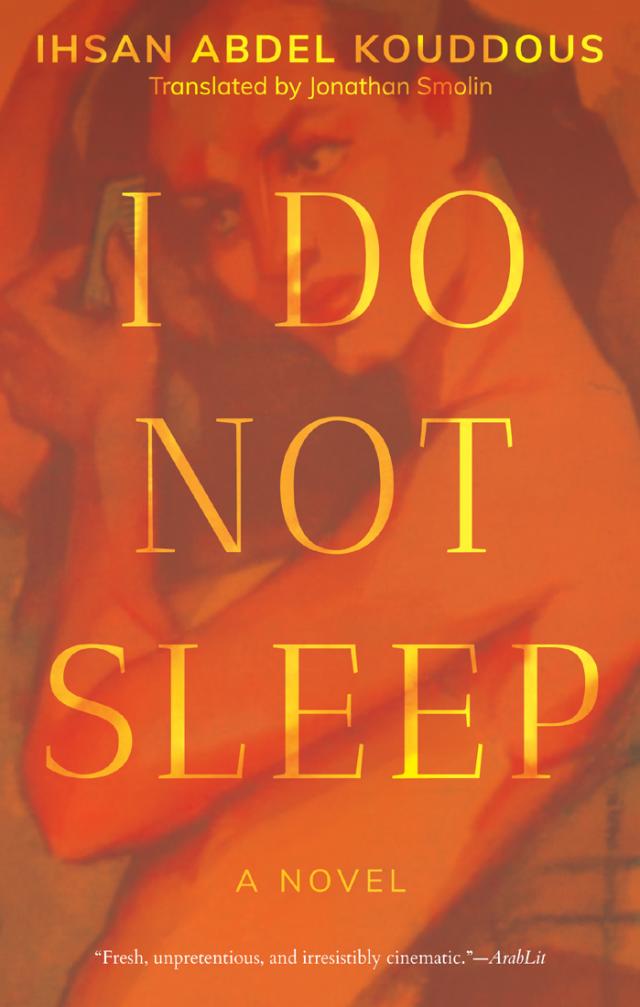
Ihsan Abdel Kouddous (1919–1990) is one of the most prolific and popular writers of Arabic fiction of the twentieth century. Born in Cairo, Egypt, Abdel Kouddous graduated from law school in 1942 but left his law practice to pursue a long and successful career in journalism. He was an editor at the daily Al-Akhbar, the weekly Rose al-Yusuf, and was editor-in-chief of Al-Ahram. The author of dozens of books, his controversial writings and political views landed him in jail more than once.
Jonathan Smolin is the Jane and Raphael Bernstein Professor in Asian Studies at Dartmouth College in the US. He is the translator of several works of Arabic fiction, including Whitefly by Abdelilah Hamdouchi and A Rare Blue Bird Flies with Me by Youssef Fadel.
I Do Not Sleep
Ihsan Abdel Kouddous
Translated by
Jonathan Smolin
This electronic edition published in 2021 by Hoopoe
113 Sharia Kasr el Aini, Cairo, Egypt
One Rockefeller Plaza, 10th Floor, New York, NY 10020
www.hoopoefiction.com
Hoopoe is an imprint of The American University in Cairo Press
www.aucpress.com
Copyright © 1955 by Ihsan Abdel Kouddous
First published in Arabic in 1955 as La anam by Rose al-Yusuf
Protected under the Berne Convention
English translation copyright © 2021 by Jonathan Smolin
All rights reserved. No part of this publication may be reproduced, stored in a retrieval system, or transmitted in any form or by any means, electronic, mechanical, photocopying, recording, or otherwise, without the prior written permission of the publisher.
Hardback ISBN 978 1 649 03134 1
Paperback ISBN 978 1 649 03098 6
eISBN 978 1 649 03099 3
Version 1
I’m both good and evil, because I’m human.
To the girl with the best heart, who feels her soul the most. Her entire crime was that she wanted to be more than human.
To “N.” She gave me her story, and then went far away after she took a handful of my days and a piece of my heart.
Introduction
IT IS SHOCKING THAT IHSAN Abdel Kouddous is still largely unknown outside of the Arab world. In the Middle East and North Africa, he was perhaps the most popular and prolific writer of the twentieth century. Known affectionately throughout the Arab world by just his first name, Ihsan began his literary career in the 1930s as a teenager writing humorous articles of youthful misadventure for Egypt’s leading weekly political-cultural magazine, Rose El Youssef, which his mother founded and owned. By the mid-1940s, he was already a rising star as an incendiary journalist. He stirred up scandals to inflame public anger against the corruption of the old guard, laying the groundwork for the public embrace of the coming 1952 revolution. Ihsan would go on to become editor-in-chief of not only Rose El Youssef, but also important weeklies such as Sabah al-Khayr (Good Morning) and Akhbar al-Yawm (News of the Day). During the Sadat and Mubarak eras, he was in charge of al-Ahram (The Pyramids), Egypt’s daily newspaper of record. From the early 1940s until his retirement in the 1980s, Ihsan was among the most prolific journalists in the Arab world, consistently publishing at least one weekly political or cultural article, frequently two or three.
Yet it was not Ihsan’s journalism that made him a household name. Instead, it was his fiction. When he began writing I Do Not Sleep in 1955, Ihsan was already considered Egypt’s most popular writer. By the time he died in 1990, he had published more than sixty books, including twenty novels and some six hundred short stories. Ihsan was known in particular for writing about sex, love, and romantic obsession, typically employing first-person narratives by young women as they discover their sexuality and seek love—or carnal desire—in the face of repressive and outmoded social traditions. Highlighting sexual desire—especially as seen through the eyes of young female protagonists—was shocking for many segments of Egyptian society in the 1950s and 60s. Just as Ihsan began gaining popularity for his taboo-breaking fiction in the late 1940s, the well-known critic and writer Abbas Mahmud al-Aqqad labeled him the “writer of the bed,” dismissing Ihsan as someone who focused on sexual titillation instead of serious literary matters. This title stuck with Ihsan throughout his literary career. Although it certainly helped the sales of his books and magazines, it turned “respectable society” against him. Despite his popularity, Ihsan later recalled that during the 1950s and 60s, people would frequently not invite him to their houses or even admit to reading his work for fear of being associated with questionable morality. Young people—and women in particular—did not want to be caught by their parents or husbands reading his fiction, or even in possession of Rose El Youssef magazine, where most of his fiction was serialized. Of course, these parents or husbands might have had their own copies of Ihsan’s work or magazines, which they read when their children or wives were not around.
Ihsan was not simply one of the most popular and prolific writers in the Arab world during the twentieth century. His work was disseminated more widely than any other writer’s. All of his novels and short stories were first serialized in the pages of the highest circulation weeklies in Egypt before they were collected in book form and subsequently reprinted in dozens of editions. His fiction formed the basis of some of the most important and popular films in the history of Egyptian and Arab cinema, such as I Do Not Sleep, There’s a Man in My House, and My Father’s Up a Tree. Legends of the Arab silver screen such as Omar Sherif, Lubna Abdelaziz, Abdel Halim Hafez, and Faten Hamama bolstered their careers thanks to their performances in his films. In total, forty-nine Egyptian films were based on Ihsan’s short stories and novels. Dozens of radio plays and television series were also adapted from his work, some lasting for hours and broadcast over months, and aired repeatedly by state radio. Ihsan’s work is still being revitalized for new audiences, most recently with the 2017 Ramadan television serial adaptation of Don’t Extinguish the Sun.
While Naguib Mahfouz won the Nobel Prize for literature in 1988, Ihsan Abdel Kouddous has been almost entirely ignored by critics and academics, both in Egypt and abroad. My forthcoming book on Ihsan will be the first in any language focusing on his fiction and his central role in the production and dissemination of Arabic popular culture in the twentieth century. Until this translation of I Do Not Sleep, not a single novel by Ihsan has been available in English. There are many reasons for this neglect. In addition to discomfort over the depiction of sexuality in his fiction, critics dismissed him because of his simple, direct style. Unlike Naguib Mahfouz, Ihsan employed simple vocabulary and sentence structure in a way that appealed to the widest possible readership—especially young people—but not to literary critics. Starting as early as 1943, he repeatedly called for the simplification of literary Arabic so that it could be used as a vehicle not only to build large audiences for the press but also to touch the emotions of ordinary Egyptians. Throughout his career, both in his journalism and fiction, Ihsan strove to transform Arabic from the language of the elite to that of the masses, occasionally making fun of the complex vocabulary and syntax of writers like the “Dean of Arabic Literature,” Taha Hussein, and the future Nobel laureate, Naguib Mahfouz. The pressures and demands of press serialization—not only selling magazines, but also keeping readers coming back week after week for the next installment—played a critical role in Ihsan’s style. Nearly all of Ihsan’s novels were serialized weekly for months, sometimes for over a year. He was highly attuned to the importance of sales since his magazines depended on circulation, not advertisement, for revenue. His clear, crisp, simple prose had been a key element in his success as a political journalist. Employing a similar style in his fiction gained him a massive audience but cost him the attention of critics, who insisted that his work was neither serious nor literary. Thus, while his books remain wildly popular in the Arab world, the lack of support by critics meant that publishing houses outside of the Middle East neglected his fiction. The publication of I Do Not Sleep in English is, thankfully, a first important step in rectifying this decades-long oversight.
We now know that when Ihsan began serializing I Do Not Sleep in October 1955, he had been deeply involved in the 1952 Egyptian Revolution and had a close personal relationship with Gamal Abdel Nasser in particular. During the 1940s and early 1950s, when Egypt was still a monarchy, Ihsan had used his platform at Rose El Youssef to call repeatedly for revolution, urging a strong, masculine leader to rise up, uproot the old system, and cleanse the political terrain of corruption. He met secretly with members of the Free Officers—including Nasser and Anwar Sadat—collaborating with them to uncover and publish scandals designed to spark outrage at the ruling elite. When the Free Officers finally launched their coup on 23 July 1952, they invited the ecstatic Ihsan to the barracks to participate in negotiations to form a new government. While Ihsan later claimed that he did not know about the coup beforehand, he was a particularly enthusiastic supporter of the Officers and the coup in the weeks and months that followed. No doubt, Ihsan initially believed that Nasser and the Free Officers were carrying out his own vision of the revolution, performing the cleansing operation that he had envisioned, eliminating the monarchy and the collaborating elite while laying the groundwork for democracy.
By early 1953, however, it became clear that the Officers were instead establishing a military dictatorship. Ihsan was horrified. He once again took to his platform in Rose El Youssef, this time dissenting against the Free Officers, and calling for the rapid implementation of de
Ihsan left jail in summer 1954 chastened. He would never again contest Nasser so openly in his editorials. That did not mean that Ihsan abandoned writing as an act of dissent. Starting in fall 1954 and continuing for a decade, Ihsan began publishing fiction—either a short story or an installment of a novel—almost weekly. As I show in my forthcoming book on Ihsan, in many of these works he used the cover of metaphor and symbolism to explore his deep sense of guilt, anxiety, and regret for his personal role in laying the groundwork for the 1952 coup and inadvertently helping to install Nasser as a dictator. Starting after his release from jail, Ihsan repeatedly returned to the theme of a very particular type of family betrayal. In his novels and stories, a protagonist suffers psychological trauma after inadvertently bringing a traitor into the family home. Since the details of Ihsan’s complex relationship with Nasser and the 1952 coup were little known, most readers never picked up on the significance of the repeated echoes of anxiety, guilt, and regret in his fiction.
I Do Not Sleep is Ihsan’s first masterwork from this period, the first in a series of classics that he would write over the next decade. It was his first long novel, serialized in Rose El Youssef on a weekly basis for over five months. The novel captivated the public, leading to skyrocketing sales of the magazine. I Do Not Sleep seized the imagination of readers unlike any of Ihsan’s work up to that point. Nearly every issue of Rose El Youssef during its serialization included at least one reader’s letter about the novel. Some readers were shocked and appalled at the supposed immorality of the novel, writing to the magazine to accuse Ihsan of spreading heresy and atheism—or, even worse, existentialism. Others, believing that the narrator Nadia Lutfi was indeed a real person, had fallen in love with her. One man even wrote to Ihsan to put him in touch with Nadia so that he could propose marriage. The Emir of Kuwait at the time, Abdullah al-Salim al-Sabah, was so taken with the novel that he wrote to Ihsan: “I Do Not Sleep cannot be fiction. The author cannot have made up all these situations from his imagination. They have to be real, and they must have happened to the author himself!”
No doubt, the novel suggests many readings. It could be read as a metaphorical confession of regret and guilt about plotting to orchestrate the 1952 coup and the horror of subsequently embedding a traitor into the fabric of the nation. Or, with its enticing language and sexual sensationalism, it could be read as a celebration of the new freedoms of popular culture in Nasser’s Egypt. It could also be read as one of the first explorations of the complexities and nuances of a female narrator in modern Arabic literature. Regardless, what matters is that readers outside of the Arab world can finally discover Ihsan, this giant of Arabic literature and popular culture, for themselves.
Jonathan Smolin
Norwich, Vermont
Part One
1
Dear Ihsan,
I’m Nadia Lutfi.
YOU DON’T KNOW ME, EVEN if I did turn your head both times you saw me. Once on Sidi Bishr beach in Alexandria and another time at the Semiramis Hotel in Cairo. Each time, I didn’t pay much attention to you, as I’d gotten used to turning men’s heads.
I’ve been writing you this letter or notebook for three months. I never meant to write you such a long story . . . my story. All I meant was to ask you a single question.
Does God exist?
But I realized it was a ridiculous question. I really do feel the existence of God.
Terror fills me whenever I mention Him. I even spent years praying five times a day, wrapping a white veil around my head, wearing a white shirt that rose up to my neck, with long sleeves hanging down by my sides, whenever I stood praying like an angel being conducted to heaven, to the unknown, to God.
Yes, I’m convinced that God exists; so convinced that it made my pen tremble as I wrote those words, doubting His existence—tremble from fear. And here I am, repeating to myself, “I take refuge in God the Magnificent, I take refuge in God the Magnificent.”
Maybe I wanted to ask you: what is God?
Yes.
What is God?
Tell me.
God is truth, virtue, and goodness, since the Prophet couldn’t have called us to worship deception, sin, and evil.
He’s the Powerful One, since the people of the earth couldn’t have united to worship a weak god with no power or strength.
So, why does the Powerful Truth leave us to practice weak deception?
Why does virtue abandon us to sin?
Why is evil victorious over goodness in us?
Tell me.
Why?
Tell me.
What is God, then?
I was told that God the Almighty created us; that He created our intellect and will so we could distinguish between good and evil. And that He left us in life to put our behavior to the test, like an exam. Whoever passes has paradise as the reward and whoever fails has hell.
I was told this. I tried to be convinced, but I wasn’t.
There can’t be a ministry of education in heaven that gives us sheets of questions and then takes the answers to give them to committees for grading.
And then suppose that I failed the test. Who’d be responsible?
My ignorant mind and weak will.
And who put this ignorant mind in my head and furnished me with this weak will?
Who created me like this?
God.
God is the one responsible for me failing the test of heaven. How can I be punished for a crime for which I’m not responsible? How can I be burned for a sin I didn’t commit, simply because heaven oppressed me by giving me a limited mind and weak will?
No, a thousand times no. This can’t be God. God doesn’t need to give people a test, because He has known them ever since He created them. He’s too merciful to leave them to a fight in which they’re torn between good and evil. He’s not like the Roman emperors who used to let lions loose on their subjects, to be entertained by the sight of the battle between wild animals and men, by the sight of blood spilled in the Colosseum. He’s God, the Merciful, the Compassionate. He’s love and peace. There has to be another explanation. There has to be another explanation for good and evil, for heaven and hell, for the scales of judgment in heaven.
Or have I become an infidel?
I feel my heart pound. I feel as if there’s another woman inside me slapping her cheeks, screaming and wailing as if she’s throwing me down to hell.
I repeat again: “I take refuge in God the Magnificent, I take refuge in God the Magnificent!”
God will no doubt forgive me, since He knows that He didn’t push me to all this questioning and doubt and that I’m a victim of myself, which always defeated me and always pushed me to evil, to sin.
Yes, dear Ihsan, I’m evil. I’m hooked on evil.
Despite that, you can’t see evil on me. My face is innocent like a child’s, untouched by age even after I’ve stood on the earth and walked in crowds of people, my purity unpolluted by the crush of life. My eyes are the color of green fields wet with dew. None of what is inside me ever flashes in them. Even when I cry, they don’t express my grief. Instead, tears flow over them like a strange hand coming forward to cleanse them. My small mouth is traced by two firm lips. I never need to put on lipstick since my lips are always the color of cherries, as you would describe them in one of your stories, Ihsan, so that as soon as you touch them, you’d think that blood would burst out. My hair is blond like eighteen-karat gold, a deep color without sparkle, like a valuable treasure left to rust. Sometimes I tie up my long hair and sometimes I let it hang down in two braids like arrows of tightly woven gold pointing to my chest and my heart.


