You've Changed, page 28


change in our presence.
You waited for both of us to leave. I waited for Gluten to leave on his own. Gluten waited for a giant egg to descend, who knew? He looked like he wanted to tell me something. But I couldn’t let that happen in front of you. I had worked too hard, repairing this sham of a marriage to have my efforts smashed up again.
Before I could lead him back down the stairs, he spoke: Could I talk to you?
Not now, I said.
No, not you. Gluten pointed his chin at you. To you.
You staggered a step backward into the walk-in closet, covering your chest with your gym clothes.
Beckett, would you excuse us? Gluten said.
I looked to you for a clear sign. I began, I don’t think she—
Scat, he said. Then to you again, softer: Can I talk to you?
About you guys? you asked.
About me, mostly. Gluten flashed a smile and when it had no effect, he added, his voice suddenly plaintive: But maybe it’ll help you understand him.
I’m not interested in any kind of arrangement you have in mind.
Nothing like that. I just need to give you what I owe you. What you do with it is up to you. And you can give me what you want, whether I want to hear it or not. Trust me on this.
Trust you? Trust you? You must be out of your mind, you said, taking a large step forward, the first of us to move, but instead of attacking one of Gluten’s pressure points, you paused a long time to consider the offer. Finally you replied, I’m biking to work.
Meaning, if Gluten could keep up to you, the conversation was open until you dismounted.
Gluten locked eyes with you. My bike is outside, he said.
You stuffed your clothes into a backpack and a few minutes later, you both smoothly swung your legs over your bikes and biked away. The last I saw, from the upstairs bedroom, was Gluten erect, riding with one hand and gesticulating with the other, and Princess besting him by releasing both handlebars and folding her arms while pedalling.
* * *
Labour Day. After the house was cleaned, I cleaned it again. Upstairs in the guest suite, the converted attic, I took down the curtains, then I unscrewed the curtain rods and, why not, unmounted the blinds. I had wiped the walls, but I couldn’t shake the image of urine beading down them and settling behind the baseboards. I took a utility knife and scored the caulking then I began prying off the baseboards. I had my earbuds in, listening to Gluten’s podcast.
You said, What are you doing, Beckett?
I’m cleaning.
You don’t need to remove the baseboards.
I looked at what I had done. The baseboards were piled up, brad nails jutting from them.
I’ll put them back on, I said.
Like his podcasts, his accompanying videos had taken a woke, cryptic turn. There was one episode where he read, shirt off: The master’s tools will never dismantle the master’s house. And I thought, Of course, they will. A tool’s a tool. Any man could take apart his house. But his smug tone made me realize that I was the master in all of this and it was my house that he and the Princesses were coming after.
How many times have you cleaned the house, Beckett?
I’m going to repaint, I said.
You looked concerned.
After I removed the baseboards, I decided to remove the trim from around the doors and windows. I wouldn’t have to worry about cutting in, except at the ceiling. Then I had the idea to take the doors off their hinges so I could paint those easily later. I gathered everything in the middle of the room. Why save the baseboards? They were cheap and stolen from a job site. I would upgrade all the trim. Instead of taking them down the stairs and through the garage, I started throwing the pieces out the window onto the driveway. The door couldn’t fit through the window. Unless. I got my driver and unscrewed the front window. I let it fall out the house onto the driveway. The crash was loud. I threw the door out the opening. In fact, I should replace the other window that faced the back lawn. I’d expand the rough size opening and insert a bigger window. I think I should go bigger.
I had tried asking you what you and Gluten talked about when you sped away on bicycles without me. You never answered me. You liked having something on me, over me. In the dark, on my half of the bed, hands folded on my chest like a corpse in a coffin, I imagine Gluten telling you, I think you and I want the same thing. You asked, Which is what exactly? Beckett? And Gluten responded, But not the same way. At this point in the nightmare version of this speculation, you both carve up a map of Africa and divide me among yourselves.
When you were a girl in France, you wanted to buy a palmier at a patisserie but the French shopkeeper took a broom and swept your dark feet onto the street. When you were a girl in Côte d’Ivoire, you bicycle-kicked goals with the boys on the grassless soccer field although you burned easily.
It might have been the light, but I saw blotches on the wall from where the cleaning chemicals had changed the colour of the paint. I’d prime the walls again with some moisture barrier primer then paint everything Chantilly Lace OC-65. I could paint the attic suite Unimaginable. The permit would get approved and I could wear a white hard hat and direct all the tradesmen. I could say, Load the nail gun. Any day, the permit would come through and Viv would have the best house on her block.
At one of our therapy sessions, I asked you, confrontationally, Are you still Black? And you stuttered, reddening, I’ve never been Black, maybe a little brown, my grandmother’s Moroccan and I was born in Africa. I’m sure they have dreams too. He squinted. They change. They change colour when they dream. But no yeah I mean I will always be a bit mixed, I guess. Shortly afterward, we stopped seeing Clara Simmons, registered psychologist, communist, political activist, social agitator.
I’d go to the SPCA next week and get an Irish setter or terrier. I would see myself in its eyes, through its eyes. Its jaw would fit in the palm of my hand. I would tilt her face up to me and she would come home and eat from my plate and lay her belly on my feet and meet all the dogs at the park. He asked if I wanted to meet more of his friends, the Boys. I asked, In what capacity? And she would make friends with the bulldog and I would name her Moss and we’d hike the forest. The present would return to the past.
I tried scraping the paint. Then I got my hammer and punched a hole through the drywall. I could remove the drywall from the areas that were most affected and install new drywall. No trace of the vandalism would remain, not a molecule.
There was a passenger on an Air France flight who discovered he was sitting in a seat where someone had hemorrhaged on the previous flight, Gluten told me on his podcast. And the service crew made him clean it (It’s not his mess) when he brought it to their attention. (It’s not my mess either.) They gave him disposable wipes to clean up the bloody carpet and when he got down on the floor, he discovered it wasn’t just blood, but urine and feces as well.
I could just drywall the whole guest suite and bathroom again. Maybe soundproof it so people wouldn’t have to pee against the side of the toilet bowl to avoid being heard downstairs, so the occupants of the master principal primary bedroom could yes yes yes without being heard upstairs. Maybe I needed to sell the house, not just the mattress, like after a murder. Start again in a neighbourhood where no one knew me, us. I threw the drywall piece by piece out of the opening where the window used to be and onto the driveway. I’d have to rent a dumpster.
It was late. Almost eleven and I should not have been making any noise. The neighbour from Georgia came out and stared up.
But the floors. I unclicked the laminate and threw the boards through the opening.
Soon I was standing amid the frame of the house. I could see the plumbing and some of the ductwork exposed. Above me, through the former window, I saw the moon pass behind a cloud. Below, on the lawn where you had pitched your tent, I saw you standing, pinching your bathrobe closed around your neck, and looking up at me. To me. At me. Through me. At me. Stop objecting to every solution I offer you. Beyond me. I had mistakenly thought that the choice was mine to make, to decide between the two of you, that I was entitled to whatever I chose. Any day now, only you had the power to return our lives to scrubbing dead skin from our heels, monitoring gas prices, cleaning the bathtub, hosing the truck, selecting the active wear cycle, shaking cereal boxes, returning shopping carts, switching internet packages, tapping screens, setting appointments, trimming fingernails, tying shoe laces, thumbing the remote, squeezing avocados, holding open plastic bags for grapefruit, getting married, growing a beard, dyeing a beard, shaving it all off, texting each other, deciding which of six emojis best conveyed the present emotion, taking out the recycling on Wednesdays, unlocking the truck, sending e-transfers, pricing lumber, paint, blades, drywall anchors, soaking the frying pan, opening cans of chickpeas, declining spam calls, rinsing the mouthguard, sniffing the armpits of undershirts, sniffing the crotch of underwear
ACKNOWLEDGEMENTS
Nothing much has changed in my feelings for the following people.
As usual, I wrote this book in secrecy, barely even talked about it with anyone who asked. Thanks for your curiosity, all the same. You can now redirect that energy elsewhere. Thanks, Nathan Dueck, for your daily enthusiasm; Phanuel Antwi, for your lava-lamp feelings; Myronn Hardy, for all the commiseration; Tariq Hussain, for your eternal youth; Jane Munro, for your eternal warmth; Sheryda Warrener, for your arrow to the heart of matters; Sarah Milstein, for deprogramming two grown robots; and Aaron Rabinowitz, who is pretty much my mirror image, for making me giddy with friendship again. Just knowing that you were all writing books alongside me was encouragement enough.
Thanks to Random House Canada, especially to my editors Anne Collins, who places her hand over the heart of each character, and Sarah Jackson, who holds them by the hand. You care as much about writers as you do about readers. Thanks to the rest of the team at Random House Canada: Lisa Jager for the design, Natasha Tsakiris, Sue Kuruvilla, Deirdre Molina, Polly Beel, Evan Klein, Trina Kehoe, Sean Tai, Catherine Abes, Madison Hendricks, Stephanie Alleyne, and Sonia Vaillant. My books can be technically exacting. Thank you for extending yourself to get them right. Thanks to my agent, Denise Bukowski, who fed me a diet of art through wintry months.
Thanks to the Banff Centre for the Arts and Creativity, the Penny Lou Cottage on Bowen Island, and especially to the American Library in Paris and the de Groot Foundation for a transformative period in France. I am also grateful for all the intricate, overlapping communities and conversations in the English Department, Victoria College, and Massey College at the University of Toronto, and for my students and colleagues.
To write this book, I took a construction course and built a house inside of a warehouse. Thanks to B, Steve, and all the guys who got dusty with me.
Thanks to my assistants Pablo Pizarro Janczur and Stephen Chankov; to my any-hour-of-the-day-or-night tennis partner Johann Loewenstein; to the golden retrieverly people Paul Dhillon and Zackery Hobler; to the Frenchy people Daniel Levin Becker and Kristina Kearns; and to people I don’t see enough: Suzanne Andrew, Claire Battershill, Kevin Chong, Jessica Johnson, Nancy Kang, Jean Claude Kwizera, Doretta Lau, Bob McGill, Anne Michaels, P&P, Emily Pohl-Weary, Paolo Pietropaolo, Adam Sol, Souvankham Thammavongsa, Rhea Tregebov, Francine Tulloch and the fam, and Ira Wells. You’re all in the People I Like folder in my inbox.
Finally, words run out with Chiayi, Moon, my family. I can’t thank you any more.
IAN WILLIAMS is the author of seven acclaimed books of fiction, poetry, and nonfiction. His debut novel, Reproduction, won the 2019 Giller Prize. His nonfiction collection Disorientation: Being Black in the World was a finalist for the Hilary Weston Prize for Nonfiction, as well as a CBC and Boston Globe best book of the year. His poetry collection, Word Problems, won the Raymond Souster Award, and his previous collection, Personals, was shortlisted for the Griffin Poetry Prize and the Robert Kroetsch Poetry Book Award. Williams’s short story collection, Not Anyone’s Anything, won the Danuta Gleed Literary Award for the best first collection of short fiction in Canada. In 2024, Williams delivered the CBC Massey Lectures, which became the bestselling book What I Mean to Say, on rehabilitating conversation in divisive times. A trustee for the Griffin Poetry Prize, Williams is a professor of English and director of the Creative Writing program at the University of Toronto.
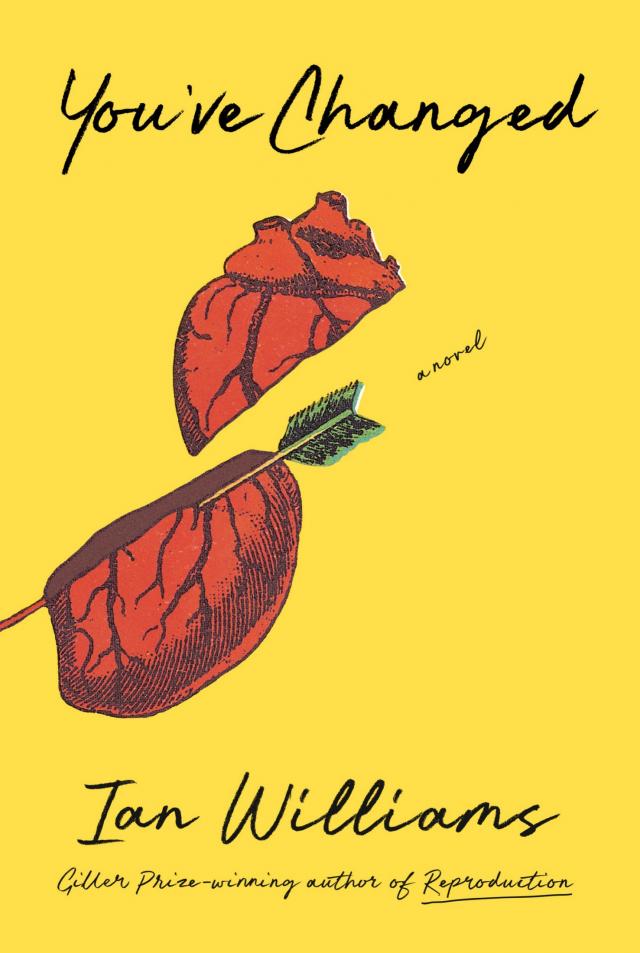
Ian Williams, You've Changed
Thank you for reading books on Archive.BookFrom.Net
Share this book with friends
You waited for both of us to leave. I waited for Gluten to leave on his own. Gluten waited for a giant egg to descend, who knew? He looked like he wanted to tell me something. But I couldn’t let that happen in front of you. I had worked too hard, repairing this sham of a marriage to have my efforts smashed up again.
Before I could lead him back down the stairs, he spoke: Could I talk to you?
Not now, I said.
No, not you. Gluten pointed his chin at you. To you.
You staggered a step backward into the walk-in closet, covering your chest with your gym clothes.
Beckett, would you excuse us? Gluten said.
I looked to you for a clear sign. I began, I don’t think she—
Scat, he said. Then to you again, softer: Can I talk to you?
About you guys? you asked.
About me, mostly. Gluten flashed a smile and when it had no effect, he added, his voice suddenly plaintive: But maybe it’ll help you understand him.
I’m not interested in any kind of arrangement you have in mind.
Nothing like that. I just need to give you what I owe you. What you do with it is up to you. And you can give me what you want, whether I want to hear it or not. Trust me on this.
Trust you? Trust you? You must be out of your mind, you said, taking a large step forward, the first of us to move, but instead of attacking one of Gluten’s pressure points, you paused a long time to consider the offer. Finally you replied, I’m biking to work.
Meaning, if Gluten could keep up to you, the conversation was open until you dismounted.
Gluten locked eyes with you. My bike is outside, he said.
You stuffed your clothes into a backpack and a few minutes later, you both smoothly swung your legs over your bikes and biked away. The last I saw, from the upstairs bedroom, was Gluten erect, riding with one hand and gesticulating with the other, and Princess besting him by releasing both handlebars and folding her arms while pedalling.
* * *
Labour Day. After the house was cleaned, I cleaned it again. Upstairs in the guest suite, the converted attic, I took down the curtains, then I unscrewed the curtain rods and, why not, unmounted the blinds. I had wiped the walls, but I couldn’t shake the image of urine beading down them and settling behind the baseboards. I took a utility knife and scored the caulking then I began prying off the baseboards. I had my earbuds in, listening to Gluten’s podcast.
You said, What are you doing, Beckett?
I’m cleaning.
You don’t need to remove the baseboards.
I looked at what I had done. The baseboards were piled up, brad nails jutting from them.
I’ll put them back on, I said.
Like his podcasts, his accompanying videos had taken a woke, cryptic turn. There was one episode where he read, shirt off: The master’s tools will never dismantle the master’s house. And I thought, Of course, they will. A tool’s a tool. Any man could take apart his house. But his smug tone made me realize that I was the master in all of this and it was my house that he and the Princesses were coming after.
How many times have you cleaned the house, Beckett?
I’m going to repaint, I said.
You looked concerned.
After I removed the baseboards, I decided to remove the trim from around the doors and windows. I wouldn’t have to worry about cutting in, except at the ceiling. Then I had the idea to take the doors off their hinges so I could paint those easily later. I gathered everything in the middle of the room. Why save the baseboards? They were cheap and stolen from a job site. I would upgrade all the trim. Instead of taking them down the stairs and through the garage, I started throwing the pieces out the window onto the driveway. The door couldn’t fit through the window. Unless. I got my driver and unscrewed the front window. I let it fall out the house onto the driveway. The crash was loud. I threw the door out the opening. In fact, I should replace the other window that faced the back lawn. I’d expand the rough size opening and insert a bigger window. I think I should go bigger.
I had tried asking you what you and Gluten talked about when you sped away on bicycles without me. You never answered me. You liked having something on me, over me. In the dark, on my half of the bed, hands folded on my chest like a corpse in a coffin, I imagine Gluten telling you, I think you and I want the same thing. You asked, Which is what exactly? Beckett? And Gluten responded, But not the same way. At this point in the nightmare version of this speculation, you both carve up a map of Africa and divide me among yourselves.
When you were a girl in France, you wanted to buy a palmier at a patisserie but the French shopkeeper took a broom and swept your dark feet onto the street. When you were a girl in Côte d’Ivoire, you bicycle-kicked goals with the boys on the grassless soccer field although you burned easily.
It might have been the light, but I saw blotches on the wall from where the cleaning chemicals had changed the colour of the paint. I’d prime the walls again with some moisture barrier primer then paint everything Chantilly Lace OC-65. I could paint the attic suite Unimaginable. The permit would get approved and I could wear a white hard hat and direct all the tradesmen. I could say, Load the nail gun. Any day, the permit would come through and Viv would have the best house on her block.
At one of our therapy sessions, I asked you, confrontationally, Are you still Black? And you stuttered, reddening, I’ve never been Black, maybe a little brown, my grandmother’s Moroccan and I was born in Africa. I’m sure they have dreams too. He squinted. They change. They change colour when they dream. But no yeah I mean I will always be a bit mixed, I guess. Shortly afterward, we stopped seeing Clara Simmons, registered psychologist, communist, political activist, social agitator.
I’d go to the SPCA next week and get an Irish setter or terrier. I would see myself in its eyes, through its eyes. Its jaw would fit in the palm of my hand. I would tilt her face up to me and she would come home and eat from my plate and lay her belly on my feet and meet all the dogs at the park. He asked if I wanted to meet more of his friends, the Boys. I asked, In what capacity? And she would make friends with the bulldog and I would name her Moss and we’d hike the forest. The present would return to the past.
I tried scraping the paint. Then I got my hammer and punched a hole through the drywall. I could remove the drywall from the areas that were most affected and install new drywall. No trace of the vandalism would remain, not a molecule.
There was a passenger on an Air France flight who discovered he was sitting in a seat where someone had hemorrhaged on the previous flight, Gluten told me on his podcast. And the service crew made him clean it (It’s not his mess) when he brought it to their attention. (It’s not my mess either.) They gave him disposable wipes to clean up the bloody carpet and when he got down on the floor, he discovered it wasn’t just blood, but urine and feces as well.
I could just drywall the whole guest suite and bathroom again. Maybe soundproof it so people wouldn’t have to pee against the side of the toilet bowl to avoid being heard downstairs, so the occupants of the master principal primary bedroom could yes yes yes without being heard upstairs. Maybe I needed to sell the house, not just the mattress, like after a murder. Start again in a neighbourhood where no one knew me, us. I threw the drywall piece by piece out of the opening where the window used to be and onto the driveway. I’d have to rent a dumpster.
It was late. Almost eleven and I should not have been making any noise. The neighbour from Georgia came out and stared up.
But the floors. I unclicked the laminate and threw the boards through the opening.
Soon I was standing amid the frame of the house. I could see the plumbing and some of the ductwork exposed. Above me, through the former window, I saw the moon pass behind a cloud. Below, on the lawn where you had pitched your tent, I saw you standing, pinching your bathrobe closed around your neck, and looking up at me. To me. At me. Through me. At me. Stop objecting to every solution I offer you. Beyond me. I had mistakenly thought that the choice was mine to make, to decide between the two of you, that I was entitled to whatever I chose. Any day now, only you had the power to return our lives to scrubbing dead skin from our heels, monitoring gas prices, cleaning the bathtub, hosing the truck, selecting the active wear cycle, shaking cereal boxes, returning shopping carts, switching internet packages, tapping screens, setting appointments, trimming fingernails, tying shoe laces, thumbing the remote, squeezing avocados, holding open plastic bags for grapefruit, getting married, growing a beard, dyeing a beard, shaving it all off, texting each other, deciding which of six emojis best conveyed the present emotion, taking out the recycling on Wednesdays, unlocking the truck, sending e-transfers, pricing lumber, paint, blades, drywall anchors, soaking the frying pan, opening cans of chickpeas, declining spam calls, rinsing the mouthguard, sniffing the armpits of undershirts, sniffing the crotch of underwear
ACKNOWLEDGEMENTS
Nothing much has changed in my feelings for the following people.
As usual, I wrote this book in secrecy, barely even talked about it with anyone who asked. Thanks for your curiosity, all the same. You can now redirect that energy elsewhere. Thanks, Nathan Dueck, for your daily enthusiasm; Phanuel Antwi, for your lava-lamp feelings; Myronn Hardy, for all the commiseration; Tariq Hussain, for your eternal youth; Jane Munro, for your eternal warmth; Sheryda Warrener, for your arrow to the heart of matters; Sarah Milstein, for deprogramming two grown robots; and Aaron Rabinowitz, who is pretty much my mirror image, for making me giddy with friendship again. Just knowing that you were all writing books alongside me was encouragement enough.
Thanks to Random House Canada, especially to my editors Anne Collins, who places her hand over the heart of each character, and Sarah Jackson, who holds them by the hand. You care as much about writers as you do about readers. Thanks to the rest of the team at Random House Canada: Lisa Jager for the design, Natasha Tsakiris, Sue Kuruvilla, Deirdre Molina, Polly Beel, Evan Klein, Trina Kehoe, Sean Tai, Catherine Abes, Madison Hendricks, Stephanie Alleyne, and Sonia Vaillant. My books can be technically exacting. Thank you for extending yourself to get them right. Thanks to my agent, Denise Bukowski, who fed me a diet of art through wintry months.
Thanks to the Banff Centre for the Arts and Creativity, the Penny Lou Cottage on Bowen Island, and especially to the American Library in Paris and the de Groot Foundation for a transformative period in France. I am also grateful for all the intricate, overlapping communities and conversations in the English Department, Victoria College, and Massey College at the University of Toronto, and for my students and colleagues.
To write this book, I took a construction course and built a house inside of a warehouse. Thanks to B, Steve, and all the guys who got dusty with me.
Thanks to my assistants Pablo Pizarro Janczur and Stephen Chankov; to my any-hour-of-the-day-or-night tennis partner Johann Loewenstein; to the golden retrieverly people Paul Dhillon and Zackery Hobler; to the Frenchy people Daniel Levin Becker and Kristina Kearns; and to people I don’t see enough: Suzanne Andrew, Claire Battershill, Kevin Chong, Jessica Johnson, Nancy Kang, Jean Claude Kwizera, Doretta Lau, Bob McGill, Anne Michaels, P&P, Emily Pohl-Weary, Paolo Pietropaolo, Adam Sol, Souvankham Thammavongsa, Rhea Tregebov, Francine Tulloch and the fam, and Ira Wells. You’re all in the People I Like folder in my inbox.
Finally, words run out with Chiayi, Moon, my family. I can’t thank you any more.
IAN WILLIAMS is the author of seven acclaimed books of fiction, poetry, and nonfiction. His debut novel, Reproduction, won the 2019 Giller Prize. His nonfiction collection Disorientation: Being Black in the World was a finalist for the Hilary Weston Prize for Nonfiction, as well as a CBC and Boston Globe best book of the year. His poetry collection, Word Problems, won the Raymond Souster Award, and his previous collection, Personals, was shortlisted for the Griffin Poetry Prize and the Robert Kroetsch Poetry Book Award. Williams’s short story collection, Not Anyone’s Anything, won the Danuta Gleed Literary Award for the best first collection of short fiction in Canada. In 2024, Williams delivered the CBC Massey Lectures, which became the bestselling book What I Mean to Say, on rehabilitating conversation in divisive times. A trustee for the Griffin Poetry Prize, Williams is a professor of English and director of the Creative Writing program at the University of Toronto.
Ian Williams, You've Changed