Night of the Gunslinger, page 1


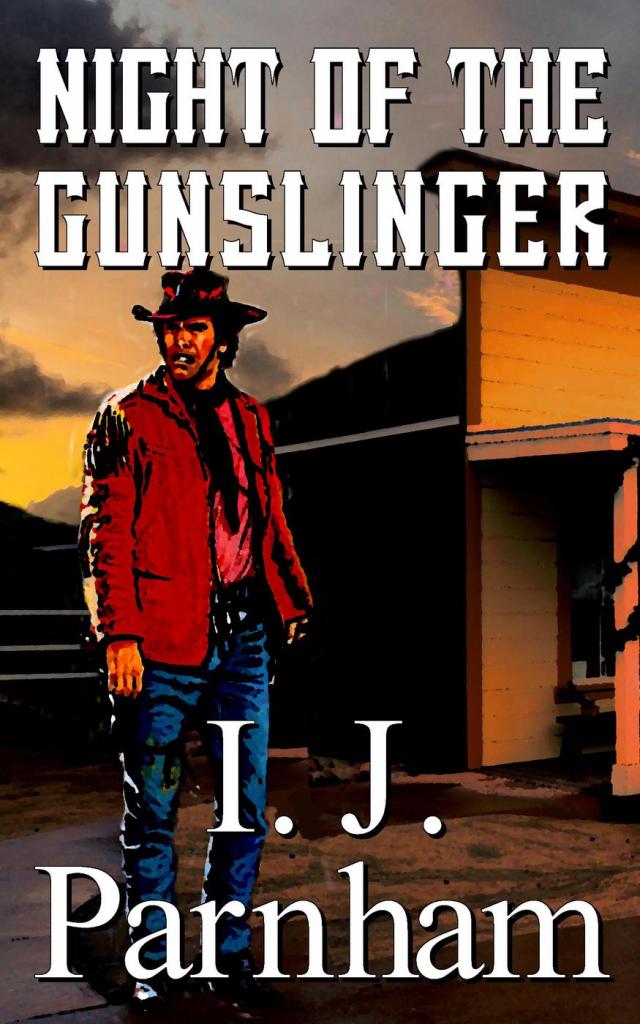
Night of the Gunslinger
I. J. Parnham
Published by Culbin Press, 2022.
Names, characters and incidents in this book are fictional, and any resemblance to actual events, locales, organizations, or persons living or dead, is purely coincidental.
First published in 2013 by Robert Hale Limited
Copyright © 2012, 2022 by I. J. Parnham
All rights reserved.
No part of this book may be reproduced, or stored in a retrieval system, or transmitted in any form or by any means, electronic, mechanical, photocopying, recording, or otherwise, without express written permission of the author.
Table of Contents
Title Page
Copyright Page
Chapter One
Chapter Two
Chapter Three
Chapter Four
Chapter Five
Chapter Six
Chapter Seven
Chapter Eight
Chapter Nine
Chapter Ten
Chapter Eleven
Chapter Twelve
Chapter Thirteen
Chapter Fourteen
Chapter Fifteen
Chapter Sixteen
Sign up for I. J. Parnham's Mailing List
Further Reading: Clementine
Also By I. J. Parnham
Chapter One
Kirby Jarrett had disappeared. For the last thirty minutes Deputy Rick Cody had followed him down New Town’s main drag. He’d kept him in sight while never getting too close. Kirby had wandered into saloons, giving the impression he was searching for someone until he had appeared to accept he couldn’t find his quarry and he’d headed to the station.
When Rick had reached the corner of the station house, nobody was on the platform. With his Peacemaker held low, Rick walked beside the station house wall. The door was open for a few inches, so he stopped and waited.
When he heard nothing he pushed the door fully open. The room had only one grimy window and, as it was sundown on this dull winter day, the interior was shadow-shrouded. He counted to five and then went in low.
The retaliation he’d feared didn’t come. When he pressed his back to the wall beside the door he faced only a table in the center of the room and several chairs. He still checked behind the door and beneath the table, but Kirby wasn’t here.
So, while considering where his quarry had gone to ground, he headed out onto the platform, but then Kirby barged into him, knocking him into the wall before he dropped to his knees. He just had enough time to register what had happened.
Then he pushed off from the platform. He had yet to gain his feet when Kirby kicked his chin and sent him sprawling onto his back. With his vision whirling, Rick raised his gun hand, but the hand moved up unusually quickly. Only then did his befuddled senses tell him that when he’d fallen over he’d dropped his gun.
“You weren’t sneaky enough,” Kirby said with confidence. “I knew you were following me.”
Rick shook his head and blinked several times until he could focus on Kirby’s form standing over him.
“That’s no matter,” Rick said. “You shouldn’t have returned to New Town.”
Kirby shrugged. Then he drew his six-shooter and aimed down at Rick’s chest. His eyes narrowed, suggesting he was about to fire. So, in desperation, Rick rolled to the side while scrambling around for his dropped gun.
He had yet to locate it when two rapid explosions of gunfire sounded. Rick raised his head, surprised and relieved that Kirby hadn’t shot him, but Kirby was stumbling to the side. Then Kirby walked into the wall, where he grabbed hold of a notice board.
The board failed to support his weight and it peeled away from the wall, making him drop to the platform and onto his back. Beyond his form stood a man, his hat pulled down low, his long coat, which brushed the platform, spread open to reveal his drawn gun.
A tendril of smoke rose up as he moved forward to stand over Kirby, whose pained face protruded out from under the notice board. Then he hammered lead repeatedly into his body.
“You were right,” the man said as the last gunshot echo faded away. “He shouldn’t have returned to New Town.”
“Who are you?” Rick said, lost for anything else to say.
“My friends call me Logan,” the man said. Then he turned on his heel and walked away.
Norton Wells never turned away a customer, but this afternoon he was minded to make an exception. The newcomer had a patch over one eye, and ridged scars had ruined half of his face.
He stood with his back to him in the mercantile doorway as if he expected he’d been followed. Then he sidled up to the counter with his right hand buried deep beneath his coat in a way that suggested he was clutching a weapon.
“What do you want?” Norton asked. He leaned on the counter with one hand lowered so that he could quickly reach the hidden rifle he kept close to hand.
“Put both hands where I can see them,” the man said. His one eye accurately picked out where the rifle was lying.
“Who are you?”
The man leaned forward in a conspiratorial manner with his head cocked to one side. Accordingly, Norton, too, leaned over the counter, but then he wished he’d been cautious when the man whipped his hand from his coat and metal gleamed. A knife appeared and the man thrust it up until the point jabbed into the skin beneath Norton’s chin.
“I’m George Fremont.” His one eye narrowed when Norton shrugged in a bemused manner. “I work for Hedley Beecher.”
Norton raised his chin from the knife, but when he didn’t retort, George raised the knife to again jab it into Norton’s chin. This time Norton couldn’t crane his neck any higher to avoid the point.
“Everyone’s heard of him,” Norton said.
The newcomer grinned, revealing an arc of yellowed teeth.
“They have, but only you know what he wants.” George waited, but Norton didn’t volunteer an answer. So he inched the knife higher, forcing Norton up onto tiptoes. “We figured out you have the map. Hand it over or I’ll cut you the biggest smile you’ve ever made.”
Norton gulped, the motion making the knife pierce the skin. Damp warmth slithered down his neck and to his vest.
“You’ve made your point.”
Norton offered a smile that made George sneer, and then gestured to the back store. George kept the knife held firmly for several seconds. Then he lowered it encouragingly downward.
“No tricks, and you have one minute,” he said.
Norton gave the biggest nod he could manage. Then, when George rolled over the counter to stand at his shoulder, he led him into the back store. Norton stopped a few paces beyond the doorway.
No good ideas came for a way out of his predicament, so he settled for the only option he could think of. He headed to the huge corn sack that he had dumped on a high shelf. Norton reckoned he wouldn’t be able to move it without making the shelf collapse, but it had been lying there for a month, so it might provide a convincing subterfuge.
“I put the map in here,” he said, patting the bulky object.
“Bring it down,” George said, eyeing the large sack dubiously.
For his ruse to work Norton reckoned he had to act confidently. So, eager to please, he clambered onto a lower shelf, took hold of the sack and tugged. The contents had settled and the sack didn’t move.
After apparently struggling for several seconds, he drew himself up onto the shelf beneath the top one. He tugged again and grunted loudly, seemingly straining every sinew, while only pulling lightly.
“I can’t move it,” he said between gasps.
“Step aside,” George said, becoming exasperated with his failure.
He moved in and raised the knife to a gap in the shelving. He had pressed the blade to the bottom of the sack when Norton gave up his pretense. He drew the sack up and then tipped it over.
At the last moment George realized what he was doing, but he was too late to stop the sack slapping him in the face and knocking him over onto his back. The shelf creaked ominously and then rocked forward, but when Norton jumped down it righted itself with a clatter.
Then Norton was on George, pinning him down to the floor beneath the sack. A well-placed knee on George’s wrist kept the knife from inflicting damage. Then he bore down on the sack with his chest, this time not holding back.
George struggled and shouted, his voice muffled beneath the bulky sack, but quickly his efforts became weak. Norton didn’t move, sure that relenting for even a moment would give his opponent a chance to turn the tables on him.
Five minutes passed before he peeled off the sack to reveal the scar-faced man, his patch lying askew to reveal the full horror of his burned face. He stepped back, planning to leave the body so that he could explain the situation to Deputy Cody.
Then he noticed the bulge beneath George’s coat. He opened the coat and jerked backward in surprise. The lining had ribbing that secured wads of bills. He estimated that George had $500 secreted about his person.
Norton hurried to the door and checked out New Town’s main drag. Few people were about and none of them was paying any attention to his mercantile. George hadn’t even left a horse outside. He put that surprise from his mind and, when he returned to his storeroom, he was clutching an empty saddlebag.
Chapter Two
“You did well,” Marshal Hannibal said when Rick Cody had told him who was lying beneath the blanket, although he cocked an eyebrow when he removed the blanket from Kirby Jarrett’s form.
“That wasn’t my doing,” Rick said.
While Hannibal hobbled back across the law office to his desk, Rick detailed events after he’d recognized Kirby’s face from one of the Wanted posters devoted to Hedley Beecher’s outlaw gang.
“You’ve never seen the man who saved your life before?” Hannibal asked, his voice gruff.
“No.” Rick replaced the blanket over Kirby’s body. “So if you’ve got no more questions, I’ll find him.”
Hannibal leaned on his desk as he caught his breath after his exertions, although he took longer than Rick thought necessary to reply.
“I don’t want you to talk to him tonight.”
Hannibal didn’t meet Rick’s eye. Instead he maneuvered himself into his chair. Then he raised his splinted leg onto a second chair and fussed over the broken limb until he was comfortable.
Last month Hannibal had broken his leg. At the time Rick had been a barman in his brother-in-law Jasper Snyder’s saloon, the Lonesome Trail. Jasper’s old friend Edison Dent had returned and, as he always did on his frequent visits, he’d regaled everyone with tales of the town’s history.
Tunneling had made the original mining camp at Old Town dangerous, so when the mine had been worked out, the people who had remained had built New Town a mile away. With the benefit of the railroad, the town had flourished and Edison had prospered, too.
After one too many whiskeys, Edison had claimed he’d ridden with Hedley Beecher, the leader of an outlaw band that last year had raided $10,000 in silver from the train on its way through New Town. When Marshal Hannibal heard about the boast, Edison had retracted his story.
Afterward, in the Lonesome Trail’s private gaming-room, Edison had played poker with Jasper, the marshal and two other old friends from Old Town, Norton Wells and Carl Schmidt. They had enjoyed a jovial night until Jasper had accused Edison of cheating.
Edison had protested his innocence, but even though the pot had been only ten dollars, Jasper had told Ogden Reed, the man who kept the peace in his saloon, to throw him out. Later that night Ogden had been found shot up, lying over the poker table.
Despite the lack of witnesses, Hannibal reckoned Edison had killed him. While he pursued his own leads, he had deputized Rick to lead a posse. The posse had scouted around fruitlessly and, when they returned to town, Edison was behind bars and Hannibal had a broken leg, courtesy of a fall in Hollow Cavern while apprehending Edison.
With Hannibal incapacitated, Rick had stayed on as his deputy and for the last month the marshal had slept in the law office. The strain had soured his mood, so Rick wasn’t perturbed when the marshal scowled at him.
“Do you mean you want me to stay here until tomorrow’s trial?” Rick said.
“No!” Hannibal snapped. He sighed and took a deep breath. “I deputized you to help me deal with Edison, but you knew I’d have to decide if I could justify employing you permanently.”
“I know,” Rick said. Hannibal’s low tone suggested that he wouldn’t like his decision, but he pressed on anyhow. “Your break’s a bad one. You won’t be able to sit a horse for another month. You still need a deputy.”
Hannibal coughed. “I do, but that man isn’t you.”
Rick couldn’t think of a suitable reply so a minute passed until the uncomfortable silence was broken by the door opening. Todd Snyder, Rick’s young nephew, wandered in and, adopting his usual manner, he leaned against the wall with his hands in his pockets. His arrival made Hannibal smile.
“Him?” Rick said, unable to hold his silence or keep the surprise from his tone.
Hannibal nodded. “I intend to appoint Todd as my new deputy. I’d be obliged if you’d spend time with him tonight and show—”
“You can go to hell,” Rick said.
“I know you’re angry,” Hannibal said, “but you still have your duties to perform and they won’t end until the circuit judge arrives tomorrow.”
When Rick didn’t retort immediately, Todd spoke up.
“Can you two work this out?” he whined while regarding in horror Kirby’s shrouded form lying beside the door. “It’s dinner time and I’m hungry.”
Rick uttered an exasperated sigh and, now that his anger had worn off, he accepted that Hannibal wouldn’t have employed Todd on his own volition. This was his sister’s doing.
“One man’s been killed already today. As Kirby was connected to Hedley, I don’t reckon he’ll be the last. You need a competent deputy.” Rick waved a dismissive hand at Todd, struggling to find the right words to describe him. “You don’t need a kid who’s more interested in his next meal.”
As he’d said everything he wanted to, he turned to the door before Hannibal could retort. He planned to walk away, tell his sister what he thought of her meddling and never return to the law office, but before he reached the door pattering footfalls sounded outside. A breathless man hurried in while pointing back over his shoulder.
“Come quickly,” he shouted. “I’ve found a body in Norton Wells’s mercantile.”
“You’re doomed,” the drunk man shouted. “We’re doomed. The whole town’s doomed!”
Logan leaned over his whiskey and tried, as the other drinkers in the Lonesome Trail were doing, to ignore the distraction, but the newcomer jostled his elbow, spilling his drink across the counter. When Logan turned to him the man was waving his arms, oblivious to the mess he’d made.
Logan waited until an arm swung toward him. Then he grabbed the wrist, yanked down hard and turned the raving man so that he bellied up to the bar. Several customers murmured their support of Logan’s action, letting him learn that his captive was Carl Schmidt, a babbling fool who owned the Lucky Star saloon. With his free hand, he pushed Carl’s face down so that his nose dipped into the pool of whiskey.
“The whole town’s not doomed, but you sure will be if you don’t apologize real nicely,” he said in his ear.
Carl squirmed frantically, his nostrils blowing bubbles in the whiskey, but Logan held his arm firmly, so that he slumped against the bar.
“Get off me,” Carl whined, his voice strained in his contorted position. “I’ve come to warn you. I’ve seen them. They’re coming for you. They’re coming for us. They’re—”
“Annoy someone else,” Logan snapped, but he couldn’t stop Carl babbling and, with a desire to get this pointless confrontation over with, Logan dragged him away from the bar and then pushed.
“It’s them,” Carl shouted, stomping to a halt. He raised a finger and pointed across the saloon room, his manic eyes rolling. “They’re here!”
With an exasperated sigh Logan refilled his whiskey glass, but a gunshot roared, making him swing around. Carl was cringing, while in the doorway a man stood with a raised smoking gun in hand.
Carl turned to Logan, calmness replacing his previous wild behavior. He offered a wan smile that said he had tried to warn him. Then he dropped to the floor and kneeled, with his hands over his head and his body hunched over so that his forehead touched the floor.
Logan turned to the gun-toter, who had already lowered his six-shooter to pick him out. As the rest of the customers peeled away to leave clear space between them, Logan settled his stance. He held his glass casually against his chest so he could reach for his gun if he got the chance.
“What do you want?” Logan asked, keeping his tone light.
“Kirby Jarrett was shot up at the station. He was looking for me.”
“Then I’m sorry you missed your appointment.” Logan waited until his disarming comment made the man narrow his eyes. Then he raised his glass in a salute. “I’ll finish my drink now.”
He turned and leaned on the bar, putting his weight on his left elbow. He figured that with so many witnesses, the man wouldn’t shoot him in the back, so he hoped to catch sight of him in the mirror behind the bar.
“Don’t turn your back on me,” the gun-toter snapped. His voice came from a few paces in from the doorway.
Logan made an obvious gesture of moving his glass to his lips and then down. This time he heard a footfall as the man came closer and, through the mass of people, the man’s reflection appeared, edging forward.