

The Cannibal Who Overate, page 1


Copyright © 1962 by Judson Philips
Introduction, About the Author, and notes © 2026 by Leslie S. Klinger
Cover and internal design © 2026 by Sourcebooks and Library of Congress
Cover design by Sourcebooks
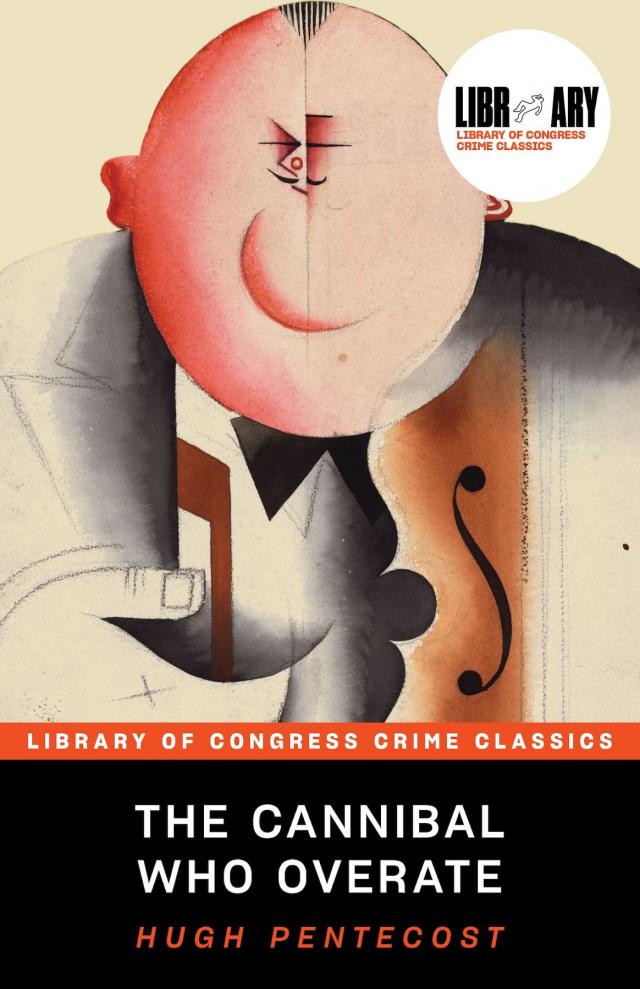
Cover image: Migual Covarrubias, “The Paul Whiteman Cycle,” ca. 1924. Prints and Photographs Division, Library of Congress, LC-DIG-ppmsca-15874. Courtesy of Carla Gonzalez de la Fuente Rico.
Sourcebooks, Poisoned Pen Press, and the colophon are registered trademarks of Sourcebooks.
All rights reserved. No part of this book may be reproduced in any form or by any electronic or mechanical means including information storage and retrieval systems—except in the case of brief quotations embodied in critical articles or reviews—without permission in writing from its publisher, Sourcebooks.
No part of this book may be used or reproduced in any manner for the purpose of training artificial intelligence technologies or systems.
The characters and events portrayed in this book are fictitious or are used fictitiously. Any similarity to real persons, living or dead, is purely coincidental and not intended by the author.
Published by Poisoned Pen Press, an imprint of Sourcebooks, in association with the Library of Congress
1935 Brookdale RD, Naperville, IL 60563-2773
(630) 961-3900
sourcebooks.com
This edition of The Cannibal Who Overate is based on the first edition in the Library of Congress’s collection, originally published in 1962 by Dodd, Mead.
Cataloging-in-Publication Data is on file with the Library of Congress.
Contents
Foreword
Introduction
Part 1
One
Two
Three
Four
Part 2
One
Two
Three
Part 3
One
Two
Part 4
One
Two
Three
Four
Five
Reading Group Guide
Further Reading
About the Author
Foreword
Crime writing as we know it first appeared in 1841, with the publication of “The Murders in the Rue Morgue.” Written by American author Edgar Allan Poe, the short story introduced C. Auguste Dupin, the world’s first wholly fictional detective. Other American and British authors had begun working in the genre by the 1860s, and by the 1920s we had officially entered the golden age of detective fiction.
Throughout this short history, many authors who paved the way have been lost or forgotten. Library of Congress Crime Classics bring back into print some of the finest American crime writing from the 1860s to the 1960s, showcasing rare and lesser-known titles that represent a range of genres, from cozies to police procedurals. With cover designs inspired by images from the Library’s collections, each book in this series includes the original text, reproduced faithfully from an early edition in the Library’s collections and complete with strange spellings and unorthodox punctuation. Also included are a contextual introduction, a brief biography of the author, notes, recommendations for further reading, and suggested discussion questions. Our hope is for these books to start conversations, inspire further research, and bring obscure works to a new generation of readers.
Early American crime fiction is not only entertaining to read but it also sheds light on the culture of its time. While many of the titles in this series include outmoded language and stereotypes now considered offensive, these books give readers the opportunity to reflect on how our society’s perceptions of race, gender, ethnicity, and social standing have evolved over more than a century.
More dark secrets and bloody deeds lurk in the massive collections of the Library of Congress. You are welcome to explore these works for yourself, here in Washington, DC, or online at www.loc.gov.
Introduction
In 1962, The Cannibal Who Overate was hailed by critics1 and was a featured title in the “Detective Book Club” three-in-one volume that included the newest Perry Mason tale. The book’s welcome was due in part to a shift in the audience’s tastes. The “hard-boiled” private eye fiction that had dominated the 1940s and early 1950s—the literary equivalent of film noir, with its gritty realism—seemed finished. Black Mask magazine, which had popularized the genre, ceased publication in the 1950s, and popular hard-boiled authors Dashiell Hammett and Raymond Chandler had both died (in 1961 and 1959, respectively). While a new genre had arisen—“police procedurals” with “regular” working cops as the heroes2—mysteries with clever sleuths were as popular as ever. Between 1952 and 1962, Rex Stout published eighteen books in the Nero Wolfe series, five Ellery Queen books appeared, and Erle Stanley Gardner published an astonishing thirty books in the Perry Mason series (and ten in his Cool and Lam series)—all with many more to come.
By 1962, Judson Philips, working under his own name and as Hugh Pentecost, had already written scores of short stories and novels, creating a wealth of mildly successful series characters. Then—in a time that predated The Love Boat and The White Lotus—he struck upon the idea of combining unusual characters in a setting that was exotic but instantly understandable: a luxe hotel, operated by a hard-working staff for the wealthy and famous. As with the highly successful Philo Vance novels of S. S. Van Dine3 and the Ellery Queen novels of the 1920s and 1930s,4 The Cannibal Who Overate gave its audience a glimpse into the world of the rich—in this case, the residents of the fictitious Hotel Beaumont, overlooking Central Park in Manhattan.
However, unlike Van Dine and Queen, Pentecost focused on the interaction of these unusual creatures with “normal” folk. The Beaumont’s resident manager Pierre Chambrun (featured in twenty-two novels) is markedly different from characters like the effete Philo Vance (and the similarly effete young Ellery of the early Ellery Queen novels), the eccentric Nero Wolfe, or the thinly characterized Perry Mason. Instead, Chambrun is a person whom the reader might recognize (were the reader to patronize such a hotel)—a no-nonsense business operator. Born in France, he was raised in the US; although he was an agent in France’s World War II underground, now he has an establishment to run, and mysteries are grit in the gears of that establishment. Over the course of the series, Chambrun infects his staff with what a character in a later book describes as “Chambrun’s Disease, a passion for the smooth running of the hotel.”5
While Chambrun is required to interact regularly with the often-unpleasant patrons of the hotel, he has long-running, companionable relationships with the hotel’s workers. It is the switchboard operators, house detective, public relations representative, restaurant manager, bartender, and the like who are the constants of life at the hotel, as ordinary as the hotel residents are not. Chambrun depends on his knowledge of the world, his organizing power over the Beaumont, and his innate shrewdness rather than the resources of the police detective or the dogged tenacity or brilliant deductions of the fictional private investigator.
The Cannibal Who Overate, like all of the Hugh Pentecost mysteries, is a pleasant entertainment. While Philips is a shrewd observer of personalities, the story is no psychological study. Violence is not absent, but gore is. Romance is often in the air, but sex is left to the privacy of the hotel’s rooms. Above all, Chambrun is focused on the restoration of order to his hotel when disturbances arise. While the series seldom exposes the reader to the underbelly of society, Pentecost “does open the door to the world of violence that lies just beyond the edges of civilized life.”6 As he wrote in Murder in Luxury (1981), the sixteenth book in the series, “[one] can’t eliminate greed, or jealousy, or a passion for revenge, or the impulse to treachery or betrayal in the individual man or woman. And so, as in every other place on earth, these ugly psychoses disrupt men’s efforts to live peaceful and orderly lives.”7
Mysteries, after all, are explanations of the hidden interactions of people. While Philips was known as a careful researcher who immersed himself in the details of the subject at hand, he observed:
I suppose, after you have written more than a hundred mystery and suspense novels and hundreds of short stories, the most frequently asked question is, “Where do you get your plots?” It has been said that there are only thirty-six dramatic situations, only about half of which are not too raunchy to use. Those usable situations have been used by me and hundreds of other writers over and over again. The only variation any writer has is the people he writes about. There are endless variations in people.… The name of the game is people, and they are endlessly rewarding, never uninteresting, and where everything begins and ends.8
It’s unlikely that the reader won’t have guessed, long before the denouement, who is the “bad guy.” In fact, only one figure exudes villainy, the titular cannibal. But, as Philips promised, the characters—from the harried caterer to the obliging switchboard operator, from the suspicious house detective to the confident publicity doyenne, from the quirky little old lady resident (and her dog) to the suspicious foreign diplomat, even the police officers and the “red herring”—are lively, engaging, and ultimately people whose company we’ve enjoyed. In the judgment of scholar Carlanna L. Hendrick, “[Pentecost’s] characters are what give his novels their appeal; his books escape being mere literary froth by the unique quality of the people they describe.”9
Welcome to the Hotel Beaumont!
—Leslie S. Klinger
1 One reviewer waggishly called it “good in spite of the title” (Lois Wilson, “Mystery Corner,” Miami News, April 22, 1962, 6B). Another called it “as entertaining as it is outlandish… It may not be very believable. But it’s great fun” (Don Keown, “Suspense and Crime for Who-Dun-It Fans,” Daily Independent Journal [San Rafael, CA], March 23, 1962, M16). Frequent reviewer Lewis “Pen” Pendexter, in the Lewiston Journal, noted, “Hugh Pentecost has written a good many excellent detective novels, and his latest entitled ‘The Cannibal Who Overate’ warrants his continued accepted position as one of the best mystery writers” (April 7, 1962, Magazine Section, 8-A). Vivian Mort, in her “Crime on My Hands” column, called Pierre Chambrun “a delightful sleuth” and enthused “Top Honors to Pentecost for originality, skillful plotting, suave writing” (Chicago Tribune, April 29, 1962, part 4, 17).
2 Prominent authors of police procedurals included Lawrence Treat (V as in Victim, 1945), Hillary Waugh (Last Seen Wearing, 1952), and Dell Shannon (Case Pending, 1960)—all available in the Library of Congress Crime Classics series.
3 See The “Canary” Murder Case (Naperville, IL: Sourcebooks in association with the Library of Congress, 2023).
4 See, for example, The Roman Hat Mystery (1929), included in Classic American Crime Fiction of the 1920s, edited by Leslie S. Klinger (New York: Pegasus Books, 2018).
5 Quoted in Marvin Lachman, “Hugh Pentecost,” in Twentieth-Century Crime and Mystery Writers, ed. John M. Reilly (London: Macmillan, 1980), 1162–67, at 1166.
6 Carlanna L. Hendrick, “Hugh Pentecost,” in Critical Survey of Mystery and Detective Fiction, rev. ed., ed. Carl Rollyson (Pasadena, CA, and Hackensack, NJ: Salem Press, 2008), 1407–10, at 1409.
7 New York: Dodd, Mead, 8. Quoted in Hendrick, “Hugh Pentecost,” 1409.
8 Lachman, “Hugh Pentecost,” 1165.
9 Hendrick, “Hugh Pentecost,” 1408.
FOR ANNE TAYLOR—a doll10
10 Anne Haviland Taylor was a patron of the Sharon Playhouse in Sharon, Connecticut, founded by Judson Philips (Hugh Pentecost).
Part 1
One
It was Monday.
The coming Saturday would be the Great Man’s birthday. It would be celebrated lavishly but not lovingly. Mr. Pierre Chambrun, resident manager of the Hotel Beaumont,11 found himself surrounded by tensions he had experienced only once before—the morning of D day at a coastal town in Britain, waiting for Eisenhower to give the final word to “go.”12 Mr. Chambrun had been involved in one other party of the Great Man’s, but he had gone into that one with babelike innocence. Mr. Chambrun was one of the very top hotel operators in the business. A party, no matter how elaborate or expensive, was not a cause for tensions in his world. But he had learned. The Great Man had a kind of genius that could turn the sweet simplicity of a child’s christening into a complete hell. His particular brand of sadism was so complex that not a single member of the Beaumont’s staff nor, in fact, not one of its guests would remain untouched in the next six days.
The Great Man’s diabolism would begin at ten o’clock sharp on this Monday morning and would last until early the following Sunday morning when an exhausted crew of waiters, bus boys, and porters began to clean up the debris left behind in the Beaumont’s ballroom by some two hundred and fifty guests.
While Mr. Pierre Chambrun might feel tensions, he was not nervy or in any sense a coward. He had been a better than good soldier in the war because he wasn’t one of those knuckle-headed heroes who rush into danger without any thought of the risks. His vivid imagination could foresee all the dangers, so that the courage involved in facing them was very real. His daily routine as resident manager of the Beaumont covered a variety of situations that called for tact as well as iron nerve. Despite its reputation as the top luxury residence hotel in New York, the Beaumont was confronted with many of the same problems as lesser establishments. There were always the drunks, the dead beats, the call girls13—the most expensive in New York but nonetheless call girls—the endless cantankerous and baseless complaints, the suicides, the heart attacks suffered by elderly gentlemen, the whims of elderly dowagers with so much money they couldn’t have told you how much it was, the oddities, like the Greek gentleman on the twenty-fourth floor who had been happily whipping two girls tied to his bedposts and would have got away with it if he hadn’t tried to add an innocent chambermaid to his collection of masochists. Mr. Chambrun handled these and many other problems with suave efficiency. But a party by the Great Man—!
At the Beaumont you give extra care and attention, not to pleasant dispositions who are generous with their gratuities, but to dollar signs. The Great Man had paid $194,00014 for his eight-room cooperative apartment and the annual maintenance fee was $32,000. For this the Beaumont and its staff took its own particular kind of beating. You said “sir” to the Great Man even though your thoughts were far from respectful.
Mr. Chambrun, aware of what this week held for him and his staff, lit an Egyptian cigarette and looked out his broad office window facing Central Park.15 He was a small, dark man, stocky in build, with heavy pouches under dark eyes that could be hard as a hanging judge’s or unexpectedly twinkle with humor. He was, as his name suggests, French by birth, but he had come to this country as a small boy and he thought like an American. His training in the hotel business had taken him back to Europe; he spoke several languages fluently; he could adopt a Continental manner to suit an occasion; but he thought like an American.
“Jerk,” he said to the green acres of Central Park.
There were two sensitive areas that needed alerting. Mr. Chambrun swung around in his swivel chair and picked up one of the several phones on his desk.
“Yes, please?”
“Mr. Chambrun here, Jane. May I speak to Mrs. Veach?”
“Right away, sir.”
Mr. Chambrun smiled faintly. In the old days the switchboard operators had answered the phone with the phrase, “May I help you?” The results hadn’t always been pleasant. “How about popping up to room 2404—if you’re blonde and built?” “Yes, please,” was much safer.
Mrs. Veach, the chief operator, was a large, bosomy, motherly woman. She took great pride in the efficiency, tact and down-to-earth sophistication of her girls. With an estimated eighty percent of the male residents of the hotel cheating on their women, the handling of incoming calls and messages required a cynical awareness of the in’s and out’s of hundreds of private lives.
“Good morning, Mr. Chambrun,” Mrs. Veach said in her best headmistress manner.
“Lovely morning.”
“Yes, Mr. Chambrun.”
“To become less lovely.”
“I trust there are no complaints, Mr. Chambrun. My records show we handled eleven hundred calls yesterday without an error.”16
“Your record will not be as good today. Are you sitting down, Mrs. Veach?”
“I beg your pardon?”
“Are you sitting down?”
“Yes, sir.”
“The Great Man is giving a birthday party on Saturday night. The wheels will begin to turn at ten o’clock. I suggest you assign one girl to handle all the calls from Penthouse M, in and out, and all Mr. Amato’s calls.”
“Saturday night!” Mrs. Veach said, her voice cracking.
“Not much time for that kind of brawl, Mrs. Veach. The wires will hum. Do your best.”
“That’s what I’m here for, Mr. Chambrun.”
“Of course. And you always do. Now will you have me connected with Mr. Amato?”
“At once, Mr. Chambrun.”
Mr. Chambrun put out his cigarette in the brass ashtray on his desk. He did it slowly and thoughtfully.
“Banquet Manager!” said a buoyant, cheerful voice.
“Amato? Chambrun here.”
“Good morning, Mr. Chambrun. Beautiful day.”
“Perhaps. I find a memo on my desk, Amato, from the Great Man in Penthouse M. He has decided to give a birthday party for himself in the ballroom on Saturday night for two hundred and fifty guests.”


