H'ard Starts: The Early Waldrop, page 1


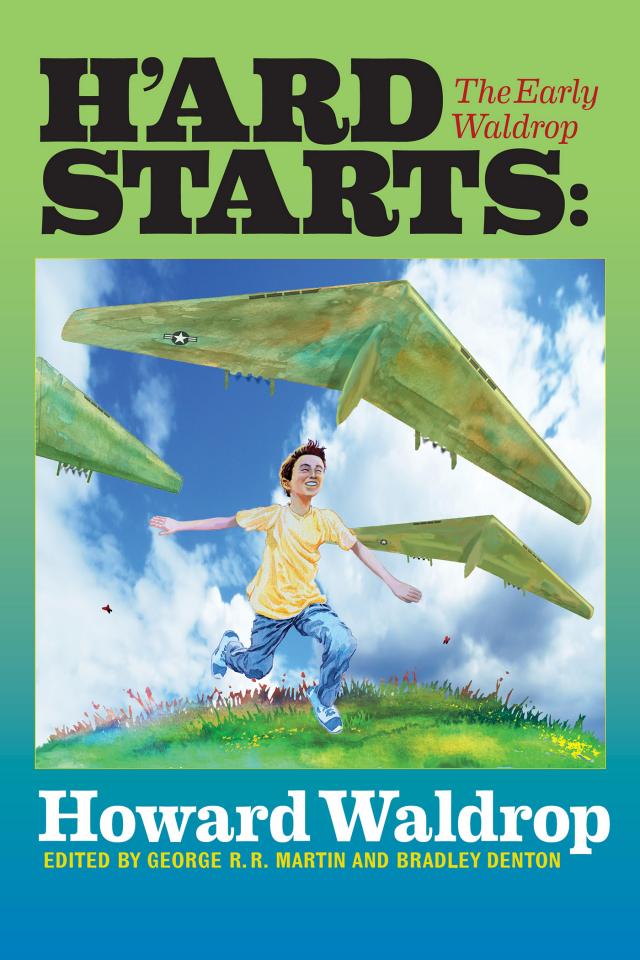
H’ard Starts: The Early Waldrop
Copyright © 2023 by Howard Waldrop.
All rights reserved.
Dust jacket illustration
Copyright © 2023 by D. C. Potter III.
All rights reserved.
Jacket design by John D. Berry.
See copyright information page for individual story copyrights.
Ebook Edition
ISBN
978-1-64524-117-1
Subterranean Press
PO Box 190106
Burton, MI 48519
subterraneanpress.com
For Ms. Ellen B. Brody of Chestnut Hill, MA,
who must have been about seven years old
when the first of these pieces appeared.
Contents
Preface
1. The Four-Color Fanboy
Interview, Part One
“A Lovely Witch”
“Well of Chaos”
“The Soul-Catcher”
“Apprenticeship”
“The Adventure of the Countess’s Jewels”
“Vale Proditor!”
2. The Filthy Pro
Interview, Part Two
“Lunchbox”
“Onions, Charles Ives, and the Rock Novel”
“Love Comes for the YB-49”
“Mono No Aware”
“Billy Big-Eyes”
“Unsleeping Beauty and the Beast”
“My Sweet Lady Jo”
3. Con Man
Interview, Part Three
“The Droog in the Green Flannel Blanket”
“The Great AmeriCon Novel”
“Cthu’lablanca and Other Lost Screenplays”
“Chili from Yuggoth”
4. The Lost Waldrop
Interview, Part Four
“The Pizza” (and CBS rejection letter)
“Youth” (a play in one act)
“The Long Goodnight” (a play in one act)
“Davy Crockett Shoots the Moon”
Preface
Whatever the eventual title of this book is, the subtitle should be What I Wrote Before I Could Write.
I was amazed by a lot of the stuff Jeremy Brett and his colleagues at the Texas A&M Special Collections Library found amongst my papers.
I had absolutely forgotten that I had used certain people, places, ideas, and situations in various published and unpublished works that I also used in later published pieces.
But as Fantasy, Inc. v. Fogerty proved, no matter who holds the copyright, you can’t plagiarize yourself.
I had vowed from the beginning to never write the same story twice, and so far I never have.
This book couldn’t exist without the efforts of lots of people, chief among them George R.R. Martin and Brad Denton.
George has been my friend since I sold him Brave and the Bold #28, which contained the first appearance of the Justice League (“vs. Starro the Conqueror”), in 1962 for twenty-five cents. (It’s worth approximately $12,000.00 now.) We’ve been pen pals and friends since then, sometimes exchanging letters so long and heavy it took four cents to mail them. George always thought there were masterpieces buried in a trunk of my papers somewhere. I hope working on this project has finally disabused him of that notion.
Brad recorded the conversations we had about what I remembered of stuff I had written fifty and sixty years ago. I’ve known Brad since the early ’80s when he and his wife Barb lived in Baldwin City, Kansas, before they moved to Austin so Barb could finish her library degree. I showed them where to not live in the Austin of the time, which had maybe 250,000 people.
The best way I can sum up this book:
I walked into a party at the 1981 Denver World Science Fiction Convention wearing a T-shirt with silk-screened arms clawing up from the beltline.
Someone asked me, “What’s that down your pants, Howard?”
Without missing a beat, the late Terry Carr, over in the corner, said –
“It’s a good writer, trying to get out.”
I laughed so hard I fell down on the floor and couldn’t get up for a couple of minutes.
That’s what you see in this mélange of early stuff.
A good writer, trying to get out.
your old pal
Howard
November 22, 2021
1. The Four-Color Fanboy
Howard’s fanzine stories
“A Lovely Witch”
“Well of Chaos”
“The Soul-Catcher”
“Apprenticeship”
“The Adventure of the Countess’s Jewels”
“Vale Proditor!”
Interview, Part One
1. “A Lovely Witch” and
2. “Well of Chaos”
BRAD: We’ll begin with two of your early fanzine stories, the Wanderer tales “A Lovely Witch” and “Well of Chaos.” I’ll also want to ask you a little about your Wanderer collaboration with Paul Moslander (writing as Victor Baron), “Sound the Hell-Horn.”
You were seventeen when “A Lovely Witch,” featuring your character the Wanderer, was published in Cortana #1. You told me the other day that you were the Art Editor for that fanzine, right?
HOWARD: Right, Art Director. I did the cover of my own character, you know. And I did most of the interior art. Occasionally, Bigglestone would pick up some odd illustrations from other people. But I illustrated most of the stories, except for the people who illustrated their own. Because there were lots of artist/writers at the time.
BRAD: You were still in high school, right? Did you know Clint Bigglestone (editor of Cortana) from school, or did you know him through fandom?
HOWARD: He lived in San Francisco, and I lived in Arlington, Texas. It was all in correspondence. I corresponded with George (George R. R. Martin) from 1962, and I corresponded with Bigglestone and (Paul) Moslander from 1963 and ’64. And Bigglestone and I had a common interest in Conan and Robert E. Howard.
BRAD: Was the fanzine his idea, or did you come up with it together?
HOWARD: He was part of a bunch of people including Moslander and a guy named Steven Perrin. And Johnny Chambers, who later did the “Little Green Dinosaur” cartoons for underground comics. They had a semi-loose publishing collective type of thing. Moslander published a fanzine called Jeddak, which is from A Princess of Mars, of course. And then Bigglestone had the idea of publishing a sword-and-sorcery fanzine. That was Cortana, named for Ogier the Dane’s sword, I believe. In whatchacallit, the Charlemagne crap, right?
BRAD: So he came up with the idea to do this fanzine, and he invited you to participate as Art Director?
HOWARD: Right, we had been corresponding about Amra, a fanzine that was dedicated to Robert E. Howard and the Hyborian Legion.
BRAD: Was Clint Bigglestone also in his teens?
HOWARD: I believe he was maybe twenty, tops. But he was almost the same age as me. Oh, and his girlfriend was the first female mail carrier in San Francisco since the war. Later, when I went out there and met them, she was still workin’ the job.
BRAD: As for the story itself, and the other Wanderer stories – I have a memory that you once told me you decided to start writing fiction after reading a terrible sword-and-sorcery book by Lin Carter, and telling yourself that you could do better. Is that right?
HOWARD: Yes, exactly!
BRAD: Did you read his book and then immediately sit down to write a better story?
HOWARD: Pretty much. I think that was a little bit later. I had already started writing some stuff, but once I read Lin Carter’s The Wizard of Lemuria, I knew I could write better than that. That was when I started going from being an artist to being a writer. It took about five years before I completely left one for the other.
BRAD: It seems as if that’s one of the two ways people start writing. People start writing either because they admire somebody and want to be like them, or because they think, “I can do better than this shmuck.”
HOWARD: Exactly! Lin Carter was a great nonfiction writer. He did all these Lovecraft essays and stuff. He was a good scholar and nonfiction writer, and he was a good editor. But when it came to fiction, he couldn’t write for beans, you know?
BRAD: So he was like a fan himself, except that he managed to get his stuff published at a professional level.
HOWARD: Right. And they started a series of “Forgotten Fantasies” at Ballantine because of him. He’s responsible for a lot of great things in the field … but his writing isn’t one of ’em.
BRAD: What do you remember about collaborating with Paul Moslander on “Sound the Hell-Horn?” That was going to be a serial, right?
HOWARD: It was gonna be a serial novel. God knows how we would have done it. But we thought we could, right?
BRAD: So you kind of jumped in without a plan, like young writers do.
HOWARD: Exactly. The thing was, I wanted to collaborate with him because he was the best writer around at the time. He could write better than either me or George, at the time. This would have been around 1965 and 1966.
BRAD: Way back.
HOWARD: Way back! See, I went out to visit all of them in 1966. I took a bus trip to San Francisco, stayed at Moslander’s house for a week, and met everybody in sf fandom, pretty much, in San Francisco at the time. I met Johnny Chambers, who drew the Little Green Dinosaur. And I met Clint Bigglestone, of course, who was the editor of Cortana. I met everybody who was in comics and sword & sorcery fandom, all at once, in that
BRAD: You were twenty years old, or about to turn twenty. So you just went out there on the bus to meet all these guys?
HOWARD: Well, I had broken up with a girlfriend, and I was pissed off and depressed and stuff. And I decided I needed a trip to San Francisco to meet everybody I’d been corresponding with for years. So I took a forty-four-hour bus ride. And I sat in the exact same spot on the bus back to Texas as I’d sat in on the bus going up to San Francisco. It was right over the back wheels of the bus, too. So I was really tired of that view by the time it was over. Eighty-eight hours of it, right?
And I got to San Francisco with a dollar and twenty-eight cents in my pocket because the Greyhound people had told me the wrong fare. So when I got on the bus, I only had like twelve dollars for the entire trip. And of course I had to buy food two or three times on the way. So I got to San Francisco with a dollar twenty-eight. Buddy (Saunders) had taken me to the Greyhound station, and I told him to send money to Paul’s address for me. So he did. He sent fifteen or twenty bucks, I think. But this was 1966 real money.
BRAD: Yeah, in 1966, you could live for a week on twenty bucks.
HOWARD: Pre-Vietnam money! Real American dollars. Anyway, he sent the money – and it came on, like, Thursday, before I got on the bus and went back home on Saturday. So I didn’t get to enjoy it. But I had a round-trip bus ticket, of course, which was a good thing.
Anyway, Moslander and I talked about collaborating on a serial. And we decided it would have to be set post-apocalypse. One of his characters was a Nazi who turned into a werewolf.
(Laughter.)
But it was deeper than it sounds, knowhaddamean?
BRAD: Hey, I’m not gonna knock it. When I was in college I wrote a story in which the Lone Ranger was a werewolf hunter. Because of the silver bullets.
HOWARD: Sweet! Anyway, that was one of his characters. And his medieval character, Drom Halliburt, was an actual medieval person, right? And I said it would have to be post-apocalypse, because the Wanderer was post-apocalypse, of course. So there would be all these prophecies, and these characters would wind up having to team up. But only the first chapter was published.
BRAD: Had you written more than the first chapter?
HOWARD: No. We wrote the first chapter for what would be the last issue of Cortana.
BRAD: So you discussed this collaboration while you were in San Francisco?
HOWARD: A little bit. And then the rest was in correspondence. We were corresponding all the time, like I was corresponding with George all the time.
BRAD: So I take it that if Cortana had continued, you might have gone ahead and finished the serial, or at least written another installment or two.
HOWARD: Yes, we would have. But everybody just essentially went different ways and did different things all of a sudden.
I met Bigglestone again, right before he died, at BayCon in nineteen ninety-whatever. That was the first time I’d seen him in almost thirty-five years, right? And he was the same guy.
3. “The Soul-Catcher”
BRAD: You self-published your story “The Soul-Catcher.” That was in March 1966, right?
HOWARD: Right.
BRAD: You were just nineteen. So if you don’t remember all of the details, it’s understandable.
HOWARD: Well, see, the used bookstore in Arlington on Main Street – the guy who ran it was real nice. In a forlorn hope, he opened a used bookstore in downtown Arlington, Texas, in 1965. And it was going okay. And he had a mimeograph at the store. Occasionally I would go in and help him with stuff, move boxes and things like that, so we got pretty friendly. He was running off something on the mimeograph at some point, and he said, “Why don’t you do something, and I’ll run it off for you.” And I said, “Sure!”
So I wrote “Soul-Catcher,” and I used orange construction paper for the cover, back and front. Then I ran it off on the mimeograph. And I believe I did an illustration on the front cover, or maybe it was the title page. Because I was still trying to be an artist at the time. Anyway, I did that on a mimeograph stencil, too. It was the first time I had ever worked with mimeograph stencils, as opposed to spirit duplicator masters.
BRAD: The “young folks today” – we were talking about this earlier – tell ’em what you had to go through to run off copies of something back in 1966, and it’s like you’re from a different planet. Because now there are xerox machines, and there’s publishing online . . .
HOWARD: See, with a spirit duplicator, what you do is, you type up on a master that makes a reverse, a negative, of what you type. And then you put the ink and stuff in, and it prints off directly onto the paper. Whereas with mimeograph stencils, you cut a hole in the stencil itself with the typewriter, and the ink comes through from the other side. They were opposite processes of each other.
BRAD: So with a mimeograph machine, you’re literally typing letters that are holes in a piece of paper.
HOWARD: Yes, exactly. But with a spirit duplicator, you’re just typing, and picking up ink on the back of the master where each of the keys hits. And that’s where the ink comes off and prints on the blank paper. But essentially, yes, you poke a hole in the master for a mimeograph stencil. And “corflu,” correction fluid, you put over it and type the letter again if you type the wrong letter. So then you put the right hole in the stencil.
But yeah, you tell people nowadays that you didn’t just throw something in the xerox machine … See, if anyone had xerox machines at the time, they were expensive. It cost a quarter a page or something. And that was in 1966 money.
BRAD: That’d almost be like spending $2.50 now.
HOWARD: Right. So everybody ran stuff off on either a spirit duplicator or a mimeograph.
BRAD: And “The Soul-Catcher” … Let’s see, this says you did twenty-five copies.
HOWARD: Right, twenty-five copies, and I mailed them off to different fanzine editors and people I was tryin’ to impress. And (decades later) somebody got hold of one, and Lawrence (Person) ended up with it at a fanzine auction at some convention. [BD Note: It’s thanks to writer/collector Lawrence Person that we have “The Soul-Catcher” for this collection.]
BRAD: Yeah, that’s incredible – because I’m guessing you didn’t have any copies at that point.
HOWARD: I think I maybe had one, and of course the construction paper cover ate itself eventually, as construction paper does.
But that’s the way fandom was at the time. On my San Francisco trip (to visit Paul Moslander and other fanzine luminaries), I walked into a house I’d never been in before, and on the wall in the living room was a piece of art I had done for some other fanzine editor like six months before. They traded art and stuff (along with trading fanzines back and forth). Now, with the internet, people aren’t surprised by stuff like that.
Back then, like I said, there were twenty-five copies of something, and the fact that one or two of them are still around is incredible to me.
BRAD: That’s what amazed me – that Lawrence was actually able to lay hands on a physical copy of this when you had only made twenty-five, and it was so long ago.
HOWARD: Obviously somebody had hung onto it for some reason, right?
I believe there was a little introduction to “Soul-Catcher” on the inside front cover that said there were twenty-five copies, and when it was done, and all this stuff. And I said something like it was the third Harry Smith story. The first two were not fantasies at all. The first two were political thriller type stories.
BRAD: Yeah, your little intro gives the titles of the first two. One was called “Sawtooth by Starlight,” and the other one was called “Moonlight on Claw Lake.” These stories had gone out to be published in other fanzines, right?
HOWARD: As far as I know, they had. But whoever had them never published them. They went out of business, or gafiated, or whatever. That’s the chance you took back in 1966.
BRAD: Right, because … Just because someone is publishing a fanzine this month, that doesn’t mean there will be another one, ever.
HOWARD: Or even like Crawdaddy. Crawdaddy went out of business like right after I sold to them.
BRAD: So I’m guessing if you sent the first two Harry Smith stories to Paul Moslander or whomever – if they didn’t get published, they’re just gone now.