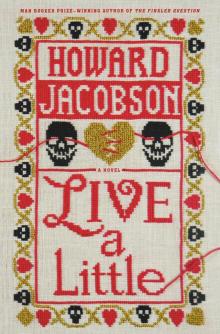
Live a Little, page 7


The only time he left the house was to descend with the rest of the family into the air-raid shelter under the village hall. He pleaded with his parents to let him stay home and take his chance. “So what if I get blown up?” he said. “You’d still have Ephraim.” But down into the shelter they led him. The crowdedness was hell. The closer he got to people, the more he felt they knew about him. Who’d told them? Ephraim? His father? Or did his own face betray him?
If the war largely passed him by, so did the peace. Ephraim danced in the streets, Shimi stayed resolutely within doors, progressing from crayoning atlases of the cranium to making plasticine models of it which he would sit on the mantelpiece in his bedroom, like African skulls dug up after a massacre.
* * *
—
SONYA’S SUDDEN DEATH less than twelve months after the war ended was an altogether bigger event for Shimi than the war itself and ought, he thought, to have been the death of him. She had not been a vivid woman except in her proneness to sadness, terror, and fatigue. But she hadn’t been expected to slide out of life before she was forty-five. Was it his fault? Could he have thought her into dying? Had he, to alleviate his crime, disowned her in his soul until she couldn’t tell his repudiation of her from her own repudiation of herself? Feeling the bumps on his head didn’t provide an answer. What he really needed was a porcelain model of the human heart….
He left her, in his own heart, the moment she became ill. He tried to tap into the sources of sympathy and sorrow but couldn’t find them. Her illness became his inadequacy. He woke each morning not wondering how she was but how he would get through the day. What would be required of him? What would he have to look at? There was so much he couldn’t bear to see. Not just her physical deterioration but the hardware of infirmity: first the walking sticks and frames and wheelchairs, then the foreign objects that suddenly appeared by her bed and in the bathroom—the bins and buckets, the commode chairs, the bedpans, the aids to he-didn’t-want-to-know-what, the bags of waste matter. And then the smell of a body that no longer functioned. Shimi thought he would go mad with his own revulsion. This is my mother, he told himself. I must not be appalled. I must love her the more.
His father and Ephraim worked together as men, tending her, turning her, bringing her whatever she needed. He wondered if they excluded him on principle—not wanting him around them, or around her for that matter, believing he would only make things worse; or were they, out of something like kindly consideration, sparing him responsibilities they knew he couldn’t shoulder? Either way, he moved about the house like a ghost—his mother’s ghost, was he?—not belonging, not noticing, and not noticed.
And when, in her final feebleness, she called for him—but that’s another story.
* * *
—
HE DIDN’T BECOME any less ghostly in the months following her death. He performed badly at school for the brief time he was there when it reopened. His teachers, seeing him looking out the window, threw chalk and blackboard dusters at him. Sometimes he didn’t even notice he’d been hit. Actuality and event passed him by. In another age he might have become a mystic. “Shimi lacks concentration,” his school report said, but he had no mother now to talk to him about this, and his father had started to become abstracted himself. Manolo was lost without his wife. He had loved looking at her sad face from the moment he’d first seen it, and now he missed not only her but the purpose she’d gifted him. He’d been her protector. She’d called to him plangently from the mountains, whereupon the aim of his life had been to help her down, sustain her, and cheer her. Save her from whatever she was afraid of. The more afraid she was the better. The more of a man, in protecting her, that made him. But he had failed.
Though he’d thought of himself as a family man, only Sonya had truly mattered to him. The boys were appurtenant to her. When she left him, they left him.
And Shimi he had given up on years before, anyway.
He had never interested himself much in his wife’s religion. It had been a picturesque shawl she wore, that was all. A woven hiding place. But he arranged for her to be buried in a Jewish cemetery and found a synagogue where they were willing to teach him the prayer for the dead. He recited it conscientiously for a year, not missing a morning.
He didn’t take his sons along with him.
Unless, as Shimi suspected, he sometimes secretly took Ephraim.
To assist her carers in the smooth running of operational matters, the Princess has produced what she calls a maintenance manual, though what it is designed to assist her carers in is not so much the maintenance of her or her apartment, but the personal maintenance of themselves.
She has embroidered the cover with purple smiling pansies in order that it shouldn’t be too off-putting. It is short and titled, briefly, A Guide for Young Serving Women of Foreign Extraction in the Lower and Middle Ranks of Life.
It is divided into five sections:
Hygiene
Respect
Discretion
Gratitude
Language
and is to be kept on top of the fifteen-bottle wine cooler in the kitchen, a place which, by the Princess’s calculations, must present maximum temptation, to Nastya if not to Euphoria, but then Nastya is more in need of behaviour guidance than Euphoria who, if anything, suffers from having received too much.
The Princess prides herself on the accessible, conversational English in which her manual is written, and the soundness of the advice it dispenses. Where her carers might have expected strictures, they find indulgence; where they might have feared condescension, they find only understanding.
That’s Euphoria’s view anyway. Nastya is in two minds.
“Why I have to brush under my fingernails?” she asks Euphoria. “I am not peasant woman.”
“Well you are always saying the British are filthy,” Euphoria replies. “Perhaps Mrs. Beryl agrees with you.”
“Then why doesn’t she clean under own fingernails?”
“I’m sure she does.”
“Have you seen?”
“Have I seen her doing it? No. But if you are asking if I have seen her nails, yes.”
“And?”
“And they are clean.”
“For old woman they are clean. And why must I wear hairnet in shower when I stay at night?”
“To stop your hair getting wet.”
“That’s shower cap. Hairnet different. Hairnet is to stop hair going down plug.”
Euphoria shrugs. That seems a wise enough precaution. It’s always her that has to fish the hair out.
“My hair,” Nastya goes on. “I’m the only one who has hair in this house. You have wire, Mrs. Dusinbery bald.”
“She is not bald. She has beautiful hair.”
“Thin.”
“Your hair will be thin when you’re a hundred.”
“When I’m a hundred I won’t need hair, I’ll have throne.”
* * *
—
IN THE MATTER of respect the Princess has sweetened her advice with a pull-out embroidered sampler of a Persian proverb.
she who wants a rose
must respect
the thorn
Nastya tells Euphoria that Persia is the country we now call Iran and that Iran is the world’s foremost sponsor of international terrorism. Euphoria wonders how Nastya knows such things. Nastya taps her forehead. “I have brain,” she says. Euphoria says she would prefer some harder evidence than Nastya’s brain if she is to believe this. “And I read newspaper,” Nastya says. Euphoria has never seen Nastya so much as look at a newspaper. “When I go out,” Nastya says. “When you go out where?” Euphoria asks. As far as she knows Nastya goes to health food shops when it’s light and nightclubs when it’s dark. “My itinerary is my business,” Nastya declares. “Anyway, I have American boyfriend who tell me.” Euphoria warns her that you can’t always trust the political views of Americans, especially those you meet in clubs. “I meet him in health food shop,” Nastya says.
Euphoria asks the Princess whether Iran was once called Persia and whether it’s true that it is the world’s foremost sponsor of international terrorism.
“I am gratified to see you taking an interest in world affairs,” the Princess says. “It shows my maintenance manual is bearing fruit already. In answer to your question, it depends what you mean by terrorism. It is said by some that one man’s terrorist is another man’s freedom fighter.”
(Euphoria will repeat these words to Nastya later that day. “Typical soft liberal hogwashes,” Nastya will reply.)
But Euphoria isn’t herself entirely certain where the Princess is coming from on this.
“I am being even-handed,” the Princess explains, “in deference to my sons. To one, a terrorist is a terrorist. To the other he is a freedom fighter. Do you see my difficulty?”
“What about your other sons, Mrs. Beryl?”
The Princess doesn’t know what Euphoria is talking about. Aren’t two sons enough? “And now that will do for world affairs for one day,” she says. “It’s time for my lunch. I’d like a lightly boiled egg. With soldiers.”
Euphoria considers making a joke. “Will those be freedom fighters, Mrs. Beryl?” But she has a feeling the maintenance manual warns against making jokes.
Persia might be settled, but the proverb itself goes on causing controversy. This time it’s Nastya who would like clarification. “What means to want rose?” she asks the Princess.
“To long for something beautiful.”
“What if you don’t like rose?”
“Then you can substitute another flower. I am presuming that you haven’t seen many growing things in your life, given the climate of Bulgaria. I could suggest a geranium, a gaudy proletarian flower I suspect would appeal to you, though it would not work in this instance because it lacks a thorn—”
“I like water lily.”
“There again there is a thorn problem. But I could adapt the saying to She who wants a water lily must respect the water.”
Nastya shakes her head. “I like idea of thorn better than drowning,” she says.
“So do I.”
“I’m guessing you must be thorn.”
“You are guessing right.”
“Then are you rose too?”
“I am everything beautiful and dangerous, yes. Or I was.”
She waits for Nastya to say, “You still are, Mrs. Beryl,” but then remembers it’s Terpsichore or whatever her name is who says that.
This one is altogether more self-centred. “My boyfriend tells me I am beautiful and dangerous, ma’am.”
“I am pleased for you but I hope you have no intention of bringing him here. Under Discretion I stipulate no boyfriends.”
“I thought that was under Hygiene, ma’am.”
“Quite possibly, child. But there is no reason why one stipulation shouldn’t appear twice. Or three times. Under Gratitude for example. As a way of showing your gratitude to me you leave your boyfriend at home.”
“My home or his home?”
“Either will satisfy me.”
“His home is America, ma’am.”
“Ah. Then as a way of showing gratitude to this country you should have left him there and found an English boyfriend. Which would have the advantage of helping you when it comes to category five—Language. See how wonderfully everything is interleaved?”
Nastya assures the Princess her American boyfriend speaks like perfectly good English.
“Did you just say ‘like perfectly good English’?”
Nastya smiles. “He teach me.”
“Then you’d better find someone else to teach you pronto—and by that I don’t mean a Mexican. We tolerate no ‘likes’ in this establishment. And I hope you’re wearing your hairnet in the shower.”
“And I scrubbing under nails.”
“Don’t cheek me, child, unless you want to bleed. I am the thorn, remember.”
“But not rose,” Nastya mutters under her breath as she repairs to the kitchen.
* * *
The Princess tries to remember if she has ever slept with an American. She did once meet Ronald Reagan at a ball at the American Embassy but she cannot picture herself in his arms. Bill Clinton, too, who held her hand longer than was necessary when he came upon her in a receiving line. He told her she had beautiful nails. Later she learnt that he held every woman’s hand longer than was necessary and told them all they had beautiful nails. Yes, that took from the compliment marginally but she wasn’t a girl of twenty when she received it. She was eighty. And to have beautiful nails at eighty is no small achievement.
“I’m having an affair with President Clinton,” she told her son on the phone. “He has lovely hands. He puts them on me.”
“Don’t be disgusting, Mother,” Sandy said.
It had to be Sandy. She routinely mixed up her sons but took pains, in this instance, to be ringing the right one. It had to be the Tory she told about Clinton. Just as it had to be the Socialist she lied to about sleeping with Reagan.
Unless she did sleep with Reagan.
In his final year at school Shimi’s class read King Lear aloud. The play suited the national mood. We that are young / Shall never see so much, nor live so long. Shimi, with his air of imminent catastrophe, was chosen to read the old King.
But it was Perkin “Peanut” Padgett, a foul-mouth with dandruff and unsavoury skin, who stole the show. “Pray you undo this button,” Shimi read without much feeling, relieved the ordeal was almost over. “And I’ll show you my peanuts,” Padgett whispered, loud enough for everyone, including Brendon Venvers the English teacher, to hear. Perkin Padgett’s ambition was to introduce a hidden part of the body—but in particular this part of the body—into every lesson, not crudely, by just blurting it out, but subtly, unexpectedly, and even seriously, as though motivated by a selfless linguistic and anthropological scholarliness to reveal the sexuality lying just below the surface of things. “Peanut” was his favourite cover word. He could pronounce it halfway to “Penis” and then deny all salacious intent should any teacher pick him up on it.
It happens among boys that there will be always one who undertakes the sexual education of the others. Perkin “Peanut” Padgett looked after Shimi’s class but in addition offered Shimi private remedial tuition.
Did Shimi need it? In his own estimation he had, the very year war broke out, descended into the sewer of his nature and discovered things which many a grown man would never come to know about. Yet in other regards he was inexperienced and naive. He had never kissed a girl. He had never held a girl’s hand.
Observing his shyness, Perkin Padgett offered to teach him words he would need, if not now then in later life. Words for women’s underclothes for example. Shimi put his hands to his ears. He didn’t want to hear words for men’s underclothes either, he made clear when Perkin had exhausted his list of women’s.
“What, not even jockstrap?”
“Above all, not that.”
“Why? It’s not rude.”
“It’s facetious.”
“Now you’re introducing another criterion.”
“No, I’m not. Facetiousness is vulgarity’s first cousin. It trivialises serious things.”
“What’s serious about your peanut?”
“Everything.”
“What about codpiece? You know what a codpiece is?”
Shimi was determined to get in first. “Of course I know what a codpiece is. A pouch to keep your peanut in.”
It was a mystery to Shimi why Padgett bothered with him. He wouldn’t swear with him or go to football matches with him or hitch a lift with him into Stanmore on a Saturday night to go looking for what Padgett called dolls. But Padgett hung on to him as a friend. Once, when Shimi invited him home, he went straight to a photograph of Sonya as a bride, stared Shimi boldly in the eyes, rubbed the bridge of his nose, shook out a little dandruff, and said, “Now I get it.”
“Now you get what?”
“What a doll! Now I get why you were in love with her.”
* * *
—
AND THEN ONE sticky autumn afternoon, after they’d bunked off from a cross-country run and lay in a corner of the common smoking a Player’s and swigging sherry from Padgett’s hip flask, Padgett propped himself up on one elbow, leaned across Shimi, and said, “I wasn’t being rude about your mother the other week, you know.”
“I know you weren’t. I’d rather not talk about her, that’s all.”
“I understand. I get it.”
“Get what? There isn’t anything to get.”
“We all have secrets. I’m not saying anything other than that.”
Shimi looked up at the sky. Normally he didn’t bother with skies. A sky’s a sky. This sky, though, was of the lightest blue, dotted with cotton-wool clouds like the backs of sheep. A nursery-rhyme sky waiting for “Peanut” to defile it.
Shimi took another swig of sherry and wiped his mouth. To hell with it. Whatever Padgett knew he knew. “Come on,” he said. “Everyone else will be in the showers now. Let’s get back.”
But he felt a hand tugging at the waistband of his shorts and when he looked down it was to see “Peanut” Padgett sliding his hand inside. For all his horror, Shimi tried one of his sepulchral jokes. “Shame I forgot to wear a jockstrap.”