

He Would Never, page 1


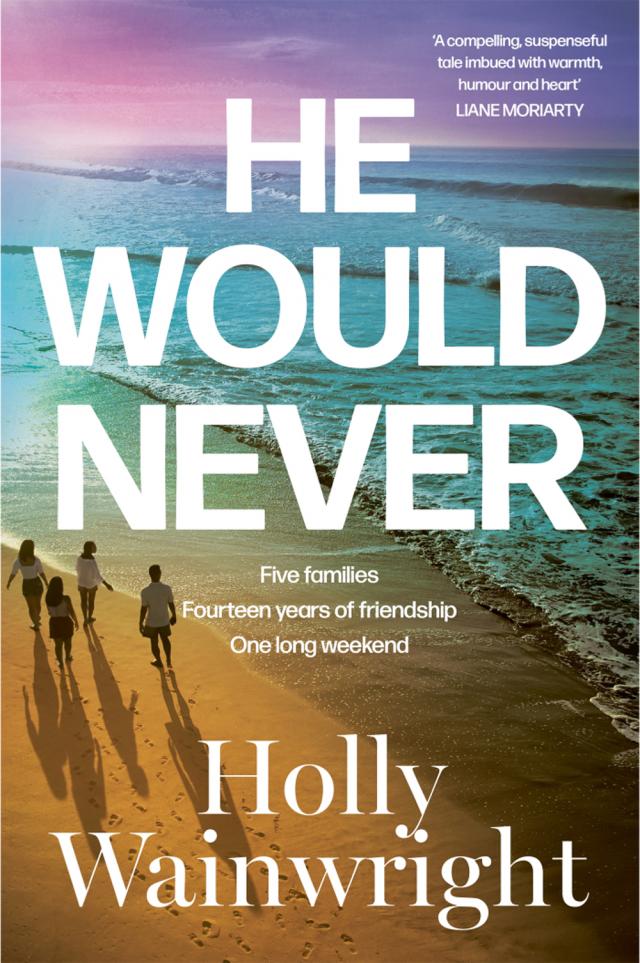
About He Would Never
Welcome to Green River.
Five families on an annual camping trip, a mothers’ group of fourteen years, children starting to look like adults, a father with his own mysterious agenda . . .
He Would Never is a searing page-turner about the bonds we forge in the furnace of early motherhood, the trust we place in other adults, and the chaos that erupts when one man refuses to play by the rules.
Contents
About He Would Never
Title Page
Contents
Dedication
Character List
Map
Prologue
Part 1
Chapter 1
Chapter 2
Chapter 3
Chapter 4
Chapter 5
Chapter 6
Chapter 7
Chapter 8
Chapter 9
Chapter 10
Chapter 11
Chapter 12
Part 2
Chapter 13
Chapter 14
Chapter 15
Chapter 16
Chapter 17
Chapter 18
Chapter 19
Chapter 20
Chapter 21
Chapter 22
Chapter 23
Part 3
Chapter 24
Chapter 25
Chapter 26
Chapter 27
Chapter 28
Chapter 29
Chapter 30
Chapter 31
Chapter 32
Chapter 33
Epilogue
Acknowledgements
About Holly Wainwright
Also by Holly Wainwright
Copyright
Newsletter
For my own camping mothers’ group.
Mel, Becky, Sam, Sarah, Ciara.
And Leanne, who saved my sanity many times
but draws the line at tents.
Character List
Site Four
Ginger and Aiden
James, Abigail and Maya
Site Five
Juno and Emily
Bob
Site Six
Dani and Craig
Lyra and Brigitte
Site Seven
Liss and Lachy
Tia, Grace and Ollie
Site Eight
Sadie
Trick and Lucky
Prologue
Sunday night, 11.55 pm
Green River Beach
This would be a fitting place for Lachy Short to die.
On the edge of a splendid beach he hated with a passion.
If you believed in the afterlife, which Liss definitely did, or ghosts, which Dani most definitely did not, then Lachlan Short’s troubled soul would be bound to walk this stretch of river for eternity, bitching about the absence of decent surf or a proper coffee, and picking tiny shards of crushed lilac river shells out of the soles of his calloused feet.
Some would think it was entirely appropriate for him to end his days in the place that most made him doubt his marriage, his masculinity, his very life choices: a campground.
A hell for a man who liked the finer things. Beds that weren’t in close proximity to the ground. Food that couldn’t be cooked on a one-ring stove or in the coals of a ban-defying fire. Drinks not served with ice scooped from a sandy esky by a sunscreen-smeared hand. No, if Lachy Short was to be doomed to camp for eternity, he would find a way back to the light.
Because, actually, he wasn’t dead yet.
He was lying on the rainforest floor, somewhere between consciousness and unconsciousness, somewhere between the campground and the sand. And someone would find him soon, surely. Liss, or Dani, or Aiden, or Tia. They must all be frantic, beside themselves.
This strip of wilderness wasn’t wide, but it was dense and tricky, as all the Green River Camp regulars knew. At night, you could step away to pee between trees and a thick, dark-green curtain would close in, leaving you banging into branches and tripping over roots, embarrassed at your rising panic.
The forest vibrated with a low thrum of life. Always hungry, inching forward, manoeuvring to reclaim its stolen space. Marching insects and scuttling rodents. Advancing spiders and snakes and slugs and snails. Nibbling, sucking, sliming, gnawing. The strangler vines always reaching. They’d have a thick, nobbled tendril around Lachy’s ankle by morning.
It was strange that no-one was calling his name.
He was still breathing, but not so you’d notice. Shallow, now.
His loud Hawaiian-print shirt might just save him from this terrible misunderstanding. Its hibiscus-bright yellow and pink was still faintly glowing even as the campground’s lanterns and fairy lights flicked off for the night, stealing the last glimmers of light.
The shirt had been ironic. Which was now, of course, extremely ironic.
At the beach, only a few steps away, the river was rising. Lapping closer to the tree line with every sweep in, every pull out. The crabs’ sandball-scrawled masterpieces were being washed away, the fish heading in from deeper water to swirl around the anchors of the dormant boats.
Try to breathe with the waves. It won’t be long. Can’t be long.
A crunch, finally, of footfall. Getting closer. No talking. No chatter, no urgency.
A phone light, held low, sweeping left to right, right to left, below the eye line of campers on the other side of the tree curtain. Invisible to anyone hurrying to the toilet block in their pyjamas and thongs.
Who was coming? His wife? His children? They’d been on the makeshift dancefloor with him, only hours before, bumping, jumping, shrugging to the beat pounding through the trees, out to the sandy flats of the beach and tipping into the river.
The girls had jiggled through clouds of embarrassment, eyes averted, aware of the phones pointed their way by cooler kids. But his daughters would still dance with him, if he asked. They weren’t too old for that.
Nor was Lyra Martin. That little idiot. It was because of her, surely, that Lachy was lying in the roots of this giant fig on the forest floor and not sinking into the double-flocked inflatable mattress inside his giant tent, beer-snoring into Liss’s tolerant ear.
Lyra could have said something. Changed all of this.
The crunching. Closer. Stopping.
‘Lachy. There you are.’
Someone was bending to him.
Feet in thongs by his flickering eyes. Toenails pink and shimmery in the phone’s blond light.
‘Thank God. We wondered how far you’d got.’
A voice as familiar as his own.
‘Such a terrible mess.’
Yes, this would be a fitting place for Lachy Short to die. If you didn’t like him. If you didn’t trust him. If you thought he’d spent a life tainting beautiful things with his touch. If you thought he’d taken something from you, knocked you off course, tormented a person you loved. If you believed the lies spread about him tonight, last night, all weekend.
‘Do you need help?’
Such a question, to a body in the woods. Asked in such a sweet tone.
There could be no answer from swollen, numb lips.
So yes, there might be people who wished to damn Lachy to eternal rest below this fig, but they would be wrong. That wasn’t who he was. Not what he deserved. And there were people here, people only steps away from this mossy, ferny dump who knew that. Knew that he loved his wife. Loved his children. Knew that every decision he made was in the service of protecting them. Even the wrong ones.
Hot breath mingling with the hot breeze. So close it would ruffle the hair above his ringing ear.
‘Good night, Lachy.’
The crunching. Retreating, this time.
An impossible act from a person so beloved.
A roar was building inside him. A rush of furious indignation at having been so misunderstood. A heart-fluttering terror at the idea his children might grow up thinking he was someone he was not.
All of it charging at him now. The ritual of the camping trip. A friendship grown too close. A teenage girl too sure of herself. A marriage almost done. A secret unwrapped and scattered around the campsite like bait.
And now, the worst of it. Humiliation. Betrayal. Abandonment.
Liss. Dani.
Lachy Short would never stand for this.
If only he could stand.
Part One
1
Friday, 1 pm
Green River Campground
Liss
Liss pulled up her underpants and kicked a little dirt over the steaming spot between the roots of the great old fig.
‘Hello to you, too,’ she said to the tree, letting her skirt fall to her bare feet.
She performed this same, small ritual every time she arrived at Green River Beach. Stepping away from the campsite’s yawning car boots and scrubby tent squares and onto the forest floor in just a few steps. She’d been doing exactly that, in this exact spot, since she was six years old; so long that she liked to imagine she was a little bit the fig and it was a little bit her.
She drew breath and looked up into the canopy, the vine-draped palms, the reaching branches of the gums, the drooping blousy blossoms, and she exhaled. Happy place. It was a cliché, an Instagram meme, but it was also accurate. Liss felt happier in this place than any other, and she had never wanted to share her first look at Green River with anyone else.
‘Liss!’
Soon enough, Lachy’s voice, through the tre
‘Hold on!’
She pushed through the vines, instinctively stomping out a warning to snakes, reaching the edge of the green-brown fringe and stepping over the old kayak her kids kept stashed in the tree line, out onto the golden brown of the beach. The tide was out, pulling the water far from her.
Liss pushed her hair back from her sticky face. Despite the proximity of the campsite, there wasn’t a single person on the beach. Tourists didn’t like the mudflats of low tide. There were just the two old fishing tinnies, upturned at the far end of the cove as they always were, two pelicans turning their weighty heads towards her from the stumps of the rotten pier, as they always did, and the exposed pegs of the moorings of the one lifeboat, anchored way out beyond the tideline, waiting for an emergency, as it always was.
She shoved her toes into the mud and looked out to the other side of the river’s bank, where a few homes, accessible only by boat, studded the far river line. No McMansions yet.
‘Liss!’
The campsite wasn’t far enough away. Which was the point, really. Where else could you pitch your tents on the fringe of a rainforest and step straight onto beach, into water? Here.
Lachy, apparently, needed her back at Site Seven. By now he would have unlatched the roof racks, the rolled-up bags of tents, the folded chairs, the air mattresses, the stretcher beds. Everything she’d remembered to pack.
Liss took another deep breath, before throwing her head back and letting out a little whistle. Hello, beach. Hello, river. Hello, hello, hello.
‘You always disappear,’ Lachy was saying as she walked back along the sandy path to the Land Rover, back to the pile of jobs. ‘Just as the work starts.’
Liss smiled. It wasn’t even remotely true. The work of constructing the long weekend’s temporary tent town would be going on for hours yet.
‘Oh well, I’m back now,’ she said lightly, surveying everything she’d carefully stacked and packed into the car boot now tossed all over the sandy ground. ‘Get Tia to help you with the tent. I’ll sort the furnishings.’
‘Furnishings,’ Lachy snorted. ‘Like it’s the beach house.’
‘You’ll survive, babe, you always do.’
‘And as if Tia’s helping. As if any of them are. They’ve already gone . . .’ He gestured, with a clenched fist, towards the beach, the forest.
This mood was typical of the arrival day of camp weekend. What was being asked of Lachy was an hour or two of physical labour. Lifting things, staking things, pulling ropes and fixing pegs. Invariably it would be too hot, or too cold, or wet, or windy.
And when it was done, he and the other men of the group would put down their mallets, pick up their beers and leave the next three days in the hands of the women.
‘I’ll go and find the kids,’ Liss said to him, out loud. But in her head she was already talking to Dani.
Poor Lachy, having to do some actual work for a change.
But Dani wasn’t here, yet. And anyway, she’d heard it all before.
Liss walked away, following the shouts of children. They were running the campsite’s looping central track, naming familiar things.
‘The swing!’ Still there. Hung from the biggest fig on the forest’s edge by Juno, four years ago.
‘The wasps’ nest!’ A dimpled, deflated waxy balloon, still clinging to the weatherboard edge of the toilet block, where last summer it had caused a speedy evacuation.
‘The den!’ A hollowed-out cave on the far side of the campsite, on the edge of the national park, where rocky outcrops formed a barrier between the campers and the wilderness. Giant toothy crags, pocked with caves and squeezy passageways into the wilds on the other side.
Little Liss had pushed herself through one of those scrubby gaps alone only once, scratching her knees and puncturing her hands as she scrabbled, determined to ace a game of hide-and-seek. But when she’d found herself on the other side, and with the cousin she’d been chasing nowhere to be seen, it only took a few steps on spiky ground to realise she was too small to be alone there, dwarfed by trees, spooked by rattling scrub in the shadow of those rocks.
Her mother had found her; of course she had. It must have only been a few long minutes really, before she appeared, also dirt-streaked and sprinkled with bush, wide-eyed but laughing. ‘I thought I’d lost you, little one.’ She’d smiled, and taken Liss’s hand to lead her back to the campground via a less treacherous route. ‘Your cousin’s hiding near the kitchen, you know we don’t come this side of the rocks.’
Liss’s children had the same rules – don’t play in the national park. But the rocky barrier itself was full of welcoming shelters, which, Liss’s mother had explained to her that day, would once have been kitchens and bedrooms and living rooms for the people who had always lived here, for millennia.
Now the caves were the territory of holidaying city kids, with candle stubs, joint butts and mouldering cushions jammed into the smoke-blackened ledges. It was a rite of passage for camp kids to build their dens here, and to venture beyond them, into the woods. Liss eventually had, and now her children ignored the rules, too.
Liss followed the trail of voices to a sighting of her three children, about to head off into the trees to where, doubtless, more secrets were stashed.
‘Tia!’ Liss called out. ‘Don’t go too far, the others will be here soon!’
Her eldest, comfortable here in a way she wasn’t always, threw her a withering look. ‘They know where to find us,’ Tia said, and disappeared into the green murk, her little brother and sister at her heels.
Liss kept on walking, following the loop of the campground’s path, counting sites, taking stock. It was what she always did, after her tree-wee.
Everyone lucky enough to have the rights to sites at Green River was deeply invested in nothing ever changing. They arrived each year praying that the rented sites hadn’t been halved to squeeze more dollars from twice as many visitors. They’d welcomed hot showers in the bathroom block but were quietly pleased that news of the update hadn’t made it to the park’s neglected website. They’d rejoiced when powered sites were introduced, but signed petitions to keep caravans out, swearing that the winding road down the peninsula was way too narrow. They professed to want to protect this pocket of wild beauty but were entirely opposed to it becoming a part of the national park.
If you had the connections or the dumb luck to have bought one of the twenty sites at Green River Campground back when you could, you held on to them tightly. And Liss had her father to thank for that. One thing on a very short list of things he’d Done Right was to secure the right to these camping sites for his family, all summer long.
Now Liss felt a swelling pride in sharing it with her closest friends, if only for these few days every year. As she padded out the boundaries of her special place, she fizzed with the excitement of seeing them all again. Of hosting them all again.
Five families whose bond had been forged in the white-hot fire of early parenthood. The first of those babies were teens now. Some of the men had come and gone, but the gathering of these women, in this place, year after year, was Liss’s own achievement. Welcome, family, she wanted to say to them, let’s bunker down and nurture each other.
She could hear Dani’s cynical snort from here.
Sadie? Dani would say. Who wants to nurture Sadie?
Liss did. Even Sadie. Despite everything.
She passed the office where Ron and Shell had been doling out strict rules and cold ice for decades, fiercely guarding both the campsite entrance and the peace.
‘I hope that mob of kids isn’t getting to troublemaking age,’ Shell had said when they’d arrived, leaning on the counter, one eye on the horseracing on her tiny portable TV, the kind you never saw anymore.
Liss had agreed, since it had been the subject of much group-chat angst this past week. Was it the year the kids were going to sneak out of their tents to pash each other on the beach at midnight? Raid the parental eskies for booze?
‘They start off so adorable,’ Shell had said, handing over the new code to the boom gate and the toilet block, but not the wi-fi, since there wasn’t any. ‘Doing doughnuts on their pink tricycles. And a few years later you’ve got a gang of rampaging yobbos.’





