

A Heart So Haunted, page 1


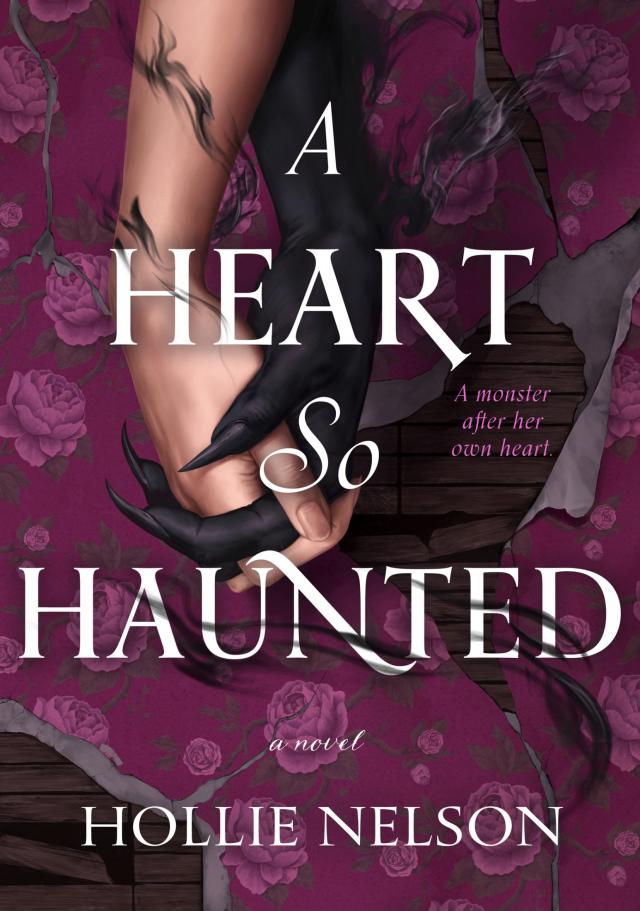
A
HEART
So
HAUNTED
a novel
HOLLIE NELSON
For the younger me, who begged to go to the bookstore after getting her wisdom teeth out. And, with puffy cheeks, said that she’d have a book on the shelf one day.
We did it.
Author’s Note
This novel contains serious topics that might be triggering to some readers. Please proceed with caution if subjects of depression, death of a loved one (off page), insinuations of self-harm, deep self-hatred, eating disorders, tumultuous parental relationships, child abuse (emotional, on page; physical abuse/assault, lightly described), drug addiction, addictive tendencies, or suicidal ideation make you uncomfortable.
Before
The house wanted to eat the child. Swallow her whole, keep her near, like a sock flitting from the clothesline in an unexpected breeze.
Keep keep keep.
She’d come back. The very floorboards of the house expanded when her mother had dropped her off. Could the little girl feel it, like it could? Surely, if she was here, that meant something.
“Get in the car, Landry!” the woman called. The woman, the house knew, was the child’s mother. Harthwait never deigned her worth remembering.
“We’re gonna be late!” The girl’s mother stood with a cigarette between two fingers by a rickety sedan. A back tire sat deflated, the rear windshield marred by a large crack. It slithered from the upper right corner, to the bottom crease where carpet interior met glass. She tapped a cherry nail on the crack, like she might tempt fate, then pushed herself up from the trunk lid.
The house felt the girl. Her pink shoes on the front porch step, hesitant. Hovering. Staring up at Cadence with one hand fisted in the fabric of her dress. Her little knuckles whitened to snowcapped mountains. On her shoes were daisies. One hung crooked, a petal missing, dried and rinsed and repeated from her bout with the mud pit in the backyard.
She wiggled in place, jumped. Almost lost her balance.
“Why can’t I stay with you, Aunt Denny?” the little girl asked. She clutched the porch railing with her free hand. “You promised we’d finish the puzzle.”
Cadence looked at Landry like one might examine an adult. The girl stood taller, puffed out her lip, furrowed her brow. Cadence stepped through the front door, onto the porch, as if she might humor the child.
She wouldn’t.
Still, Harthwait couldn’t complain about Cadence. She fixed what was needed. Kept the windows greased. Replaced the roof a few years ago. Children, however, were not as easy to manage.
“Because my house isn’t pretty after dark,” Cadence said.
Maybe it would complain after all.
“Mommy’s house isn’t pretty, either. There are bugs. I wanna stay with you,” the girl urged. A damp, soon-to-be summer breeze tickled the hem of her dress, caressed the house’s siding.
“Landry!” the woman, who drooped over the back of the car, called again. She exhaled a long stream of smoke. It twirled around her nostrils, her ears. The house could have sworn even the tree branches recoiled.
Aunt Cadence sighed.
“Please? Please, please? I’ll be good, I promise! I won’t—”
Upstairs, a door slammed shut. Cadence flinched, but the child didn’t. She was too focused on Cadence, on the way her jaw ticked ticked ticked like the grandfather clock in the foyer, how her eyes wavered between the mother, who now stomped out the cigarette in the driveway gravel, to the little girl with doe eyes and a massed tangle of red hair.
“Lanny. Honey. Your momma makes the decisions. You know this.”
The girl slumped. “But you said no last time and that maybe this time I could—”
“Keep your head up, chickpea.” Cadence bent down to her niece, both hands landing on the girl’s shoulders. Bony, pointy little things. “I’ll come pick you up tomorrow,” she assured her. The girl looked like she could jump into Cadence’s words—right off the top of the bridge and into the water below.
“But tomorrow is too late. You’ll finish the puzzle without me,” she whispered. “Please.”
“Landry!”
Cadence’s spine curled in. “It’ll be fine. Promise. Won’t even touch what you left. I’ll keep it on that very table you were using in the library, okay?”
The sun heated Harthwait’s roof. Warmed it, straight to its bones. But there was something in Cadence’s voice that wobbled. Like a lie. Like there lay finality in her words.
That couldn’t be, though. The little girl would come back, she’d stay one day—at the very least, return for a moment or two.
Harthwait’s floorboards contracted a bit, irritated.
She had to come back.
“You promise?”
“It’ll be waiting for you. Cross my heart,” Cadence said before giving her niece one final hug. When Landry pulled away, Cadence’s fingers lingered in the space where the little girl had stood. Then the girl slunk off the porch, shoulders drooped, her little pink shoes clip-clopping over the cobbled path toward her mother.
A window jerked open.
Another.
No. No, no, this child—she had it, she could—
The girl’s mother muttered something under her breath—something even the wind didn’t toss back for Harthwait to hear—and climbed into the driver’s seat without so much as a glance at Landry.
The child hauled herself into her own booster seat, snapped her own seat belt, and rolled down her window. She leaned out when the car jerked into reverse, fingers hooked over the window lip, and waved as the car sputtered farther and farther away.
Cadence watched, waited. Until the last of the dirt plume kicked up by the car’s wheels faded, the little girl along with it.
She rubbed both hands over her face. Her skin had fallen in the last couple of years, though Harthwait would bet she wasn’t much over the age of forty. Not much older than he was, nestled in the walls.
“I swear,” Cadence muttered. She pressed down the flyaway hairs, straightened her shirt. Started to talk to herself like she always did, especially when she wanted to ignore the noises at night. Because she always ignored the noises. “Nothing you can do, Denny. She’s not yours, and this place isn’t good for her, either.”
Harthwait bristled. Of course, Cadence would put it off—what was the saying about pulling the wool over the eyes?
The house relaxed, if only a little, as Cadence started locking doors, pulling down windows. The birds hadn’t yet stopped singing for the evening. Cadence circled through the next floor, room after room. She plucked the last of the scattered toys from the old playroom floor. Tossed them in the bins, then waltzed into the hall.
But there sat an empty pit where the little girl had been. Like a hunger, it crawled between the stairs, inside the door hinges, beneath the shingles. An ache that sat suppressed for too many years, stretched its arms and legs and unfurled from the concentrated place it had been curled. Like a starving man, unable to recall the scent of smoked venison—until one day, a hunter in the distance started a spit. The aroma drifted downwind, and then the starving man knew a hunger like never before. The pain snaked down to his marrow, and all he could think of was the venison, the possibilities. The need.
That was this child.
And this woman had sent her away.
Above the toy bin, a window jerked open. Only a hair’s breadth.
The birds still sang.
She wouldn’t notice.
Cadence made it to her bedroom and locked the door behind herself. Every once in a while, she would stop and listen. She did so now. Glanced about the space—her space. No wayward breeze glided in through cracked windows. No settling of the foundation.
She shuffled through baskets of thimbles and twine, old sewing needle containers and crotchet hooks. Until it emerged from the bottom—the radio remote, the two and the four so worn that the numbers were nearly illegible.
Cadence turned the radio up until the birds quieted outside. Even the birds—it couldn’t even have the birds anymore—
One by one, the spare bedroom windows slammed open. One after another, curtains billowing, breeze rustling. If she wanted to do this, then fine. It could wait.
But the radio vibrated through the walls, so obnoxious and loud, Cadence never heard a thing. Not even when the attic door ripped open, just after midnight.
Chapter One
I peeked through the front door’s sidelights and watched the woman hobble down the cobblestone path. If she turned around now, she’d see me with my nose pressed to the glass, counting down the seconds until she reached her car. The thought made me pull back—or at least until I was looking out the window at an angle.
She teetered onto the driveway, and only once she opened the driver’s side door did I let the stained-glass window covers clatter back into place.
I glared down at the covered dish in my hands. How many meals did someone need? I understood the sentiment—the instinct to provide when someone was in need or experiencing a loss. But this … This was too much.
There was no reason for me to find room for another casserole dish in Aunt Cadence’s—no, my—refrigerator that wasn’t going to get eaten, anyway.
“Why does it smell like that?” Sayer muttered. I turned beside the grandfather clock to find my friend leaning against the stair railing, the neck of his penny tee pulled over his nose while he stared at his phone. A search engine reflected in his glasses. Realtors in Colleton County, it probably read.
I lifted the aluminum foil with a cringe. “Because it’s broccoli.” I crunched it back in place. “And cheese.”
“Not enough cheese, apparently,” he said, voice muffled. “That’s absolutely putrid.”
“It’s the thought that counts, right?” My words were flat, even to my own ears. Sayer’s gaze flitted up to me, then back to his phone.
“Right.” He nodded to the floor. “I think she dropped something.”
I glanced at the entry rug. A little folded slip of paper lay half-open, like a duck bill, an inch from the doorframe. I bent down, dish balanced in one hand, and made a mental note to vacuum up the family of dust bunnies that were huddled by the baseboards later.
“What is it, a ransom note? Give me your house or I’ll get the historical society to revoke it from you?” he teased, brows scrunched.
“You watch too much true crime.”
“Blackmail and hiding a body are two completely different things.”
I unfolded the paper, expecting another Our condolences on your loss message. Instead, it read, Haven’t heard from you! But I found something! Let me know.
I frowned. “Sorry to report, but it’s not a threat.” I crumpled the paper and stuffed it in my pocket. “It was probably—”
A crash echoed from another room.
Both Sayer and I stopped breathing.
Upstairs, a set of heels paused. “Ms. Frederick?”
The realtor. At that moment, I wanted to lean against the closest wall, squeeze my eyes shut, and evaporate into thin air. Today wasn’t my day.
But today had to be the day she did a walk-through. Time was of the essence. And I had little enough patience as it was—with wills and deed transfers and debt payoffs running out of my ears, the last thing I needed to tack onto my list was hunting down another realtor.
Hence: The sooner the better.
Now, however, I regretted my past self’s choices.
Sayer and I stared at each other. I shook my head. Talking to anyone outside my clientele circle didn’t usually make my wrists sweat, but this woman intimidated me. “What do I say? Do you think she heard that?”
“Don’t look at me! I didn’t do anything.” He splayed both hands with wide eyes, phone face up. It did, in fact, have another realtor website pulled up.
“I didn’t either,” I whisper-hissed.
“Tell her something.”
My eyes widened. “Me? You brought her here.”
“You said you needed an experienced realtor to look at the place! My mom recommended her!”
I gestured with the casserole dish toward the stairs in a poor attempt to point, as if to say, Help me.
Sayer shook his head.
My mouth pursed. I narrowed my eyes, stepped closer, and whispered, “You owe me for this.”
“You said you need the house sold,” he said, forehead crinkled. “You owe me.”
I sighed. I inched closer to the bottom of the mahogany stairs. “Yes?” I called.
I didn’t remember the woman’s name. It was something elegant with multiple syllables that started with an E—Evanescence or Evangelina, maybe—but I had as much experience handling a realtor as I did with roofing. My clients dealt with the realtors; I dealt with the paint colors and fixtures and anything not requiring a permit.
“What was that? I thought you said there was no road noise,” she called down. Her words sounded nasally and traveled from the left side of the second-floor landing. I tried not to picture her in Aunt Cadence’s room or one of the multiple guest rooms, examining my aunt’s things, trying to get an idea of the square footage of the house and what might look marketable.
“Sayer closed a door, no worries!” I swallowed around a sandy lump in my throat.
Without a response, her steps faded away. Farther into the second floor. Deeper, peeling away at my childhood memories, marking floorboards and rooms with a price.
Another bang.
It sounded like the heel of a palm against a wall. Or a locked door that made hinges rattle.
I whirled. Sayer stood stick straight now, both hands clutching his phone. The tendons in his forearms stood taut.
“I know you heard that,” he whispered. “That was not me. Obviously.”
Obviously not. But if it wasn’t either of us, and no one else was in the house—
I glared at the foyer floor, waiting. Maybe it would come again?
The stained-glass coverings, which hung over the sidelight panes on either side of the front door, cast ribbons of color onto the rug. A draft brushed over the baby hairs at my temple, the back of my neck, hot and soupy. Typical of Lowcountry, even this early in the summer season.
“Don’t lie,” he urged.
I squeezed my eyes shut. The draft—that had to be it. It must have caught momentum when it slipped through a window and shut a door that hadn’t been latched.
“But what if—” I started.
“Landry.” Sayer’s mouth pinched. “You heard it. You told me nothing would happen. You promised you haven’t seen anything weird. You know how I feel about this kind of … stuff.”
“Okay, okay, I heard it,” I whispered. Still, I didn’t move. As much as I didn’t want to admit it, Sayer was right. I’d promised him as much—he wouldn’t have agreed to help me otherwise.
Suddenly, I was ten again, unwinding the balls of yarn in Aunt Denny’s room, asking why she didn’t let me stay at night.
“Are there ghosts? Amber at school says ghosts live in old houses like this one. She had one in her grandma’s house and didn’t wanna stay at night. Said that if this one’s haunted, you wouldn’t let me stay, either,” I blurted, swinging the unspooled yarn in two clenched fists. Aunt Denny folded clothes at the foot of her bed. Every so often, she’d glance to the door, then at me. “Is that why I can’t stay? I can handle ghosts. What if they’re friendly? Would that make it okay for me to stay?”
“There are no ghosts, Lan.”
“Then why can’t I stay?” I whined. The yarn drooped at my sides.
“Because your momma wouldn’t be happy with me. And you have school.”
“But I’m on break and there’s nothing to do and I only see you sometimes and what if the ghosts need—”
Her eyes grew hard; the T-shirt she held up crinkled at the shoulders, all around her fingers. “Have you seen anything here, Lanny? Anything like that?”
This had made me pause. Seen anything? No. Sometimes the birds perched by the breakfast table in the little windows. The sill was extra wide and I liked to watch them there. Their shadows curved over the glass and the table and sometimes it was like those shadows moved on their own, but never anything else.
“No. Don’t think so.”
“See? No ghosts.”
Sometimes the floors creaked, but Aunt Denny said old houses did that. So I believed her.
“But that story you told me, could it be real? Have you seen anyth—”
She shot me a look down the bridge of her nose. “I have not. You know the nursery rhyme is simply that—a rhyme. For eager little minds and imaginations. Now pick out your yarn so we can make those potholders before your momma comes back.”
She’d promised me. And there had never been any reason not to believe her.
I didn’t realize tears had started to burn the backs of my eyes until Sayer’s voice reeled me to the surface.
“Shouldn’t you … go look?”
I blinked them away. Inhaled a shaky breath. Sayer was gangly, stuck in a perpetual state of adult-adolescence, despite being on the eve of thirty-one and a long-since graduate of USC’s MFA program.
“Don’t tell me all those horror novels finally caught up with you,” he said, looking at me over the frames of his glasses. Still, a tinge of wariness—like I might crack—crinkled around his eyes. I drew my shoulders back and garnered my only line of defense: sarcasm.
“At least I’m well read in all genres,” I said.
“Is that supposed to be an insult? Like I don’t read?”
“No, I’m saying your true crime documentary experience makes you better equipped for the situation.”
Sayer took the casserole dish out of my slowly warming hands and pushed it onto the entryway table. It’d gradually become the catch-all spot. Cards perched in a cluster on one side—all sage-greens and muted blues, wishing love, sympathies, and anything else that might sound remotely comforting.


