

The Boy Who Made Dragonfly, page 1


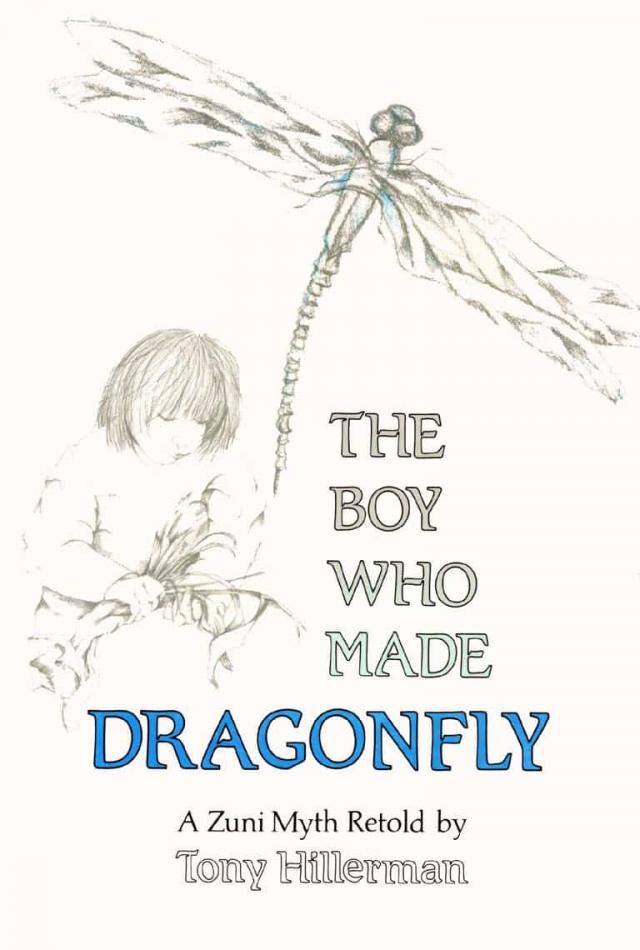
The Boy Who Made Dragonfly
A Zuni Myth Retold by Tony Hillerman
lllustrated by Janet Grado University of New Mexico Press Albuquerque
Library of Congress Cataloging-in-Publication Data Hillerman, Tony.
The boy who made dragonfly.
Reprint. Originally published: New York: Harper & Row, 1972.
Summary: Retells a Zuñi myth in which a young boy and his sister gain the wisdom that makes them leaders of their people through the intercession of a dragonfly.
1. Zuñi Indians—Legends. 2. Indians of North America—New Mexico—Legends. [1. Zuñi Indians—Legends. 2. Indians of North America—New Mexico—
Legends] I. Grado, Janet, ill. II. Title.
E99.Z9H55 1986 398.2’08997 86-6996
ISBN 0-8263-0910-0 (PBK.) Text Copyright © 1972 by Tony Hillerman.
All rights reserved.
University of New Mexico Press paperback edition reprinted 1986 by arrangement with the author.
Illustrations Copyright © 1986 by Janet Grado.
All rights reserved. Third paperbound printing, 1988
For Anne, Jan, Tony, Monica, Steve, and Dan—and all other children (and former children) who have time to listen.
1
It happened before the A’shiwi, the Flesh of the Flesh, finally found the Middle Place and ended their long wanderings. It happened before the A’shiwi came to be called the Zunis, before the Water Strider stretched his arms and legs to the edges of the world and lowered his body to the place where the A’shiwi were to live. It happened when the people still lived in the Valley of Hot Waters in the good stone town they called Ha’wi-k’uh. It happened long before the white man came.
In those days the A’shiwi had been given by the Beloved Ones an abundance of water blessings. In the Valley of Hot Waters, there was a richness of rain. The mud washed down the arroyos and the A’shiwi spread it across their flatlands with dams of brush. It was that way year after year. And in the winter, the Ice God rarely blew his breath toward them because two of the Corn Maidens lived just south of there and looked after the people-who-would-be-called-Zunis. Summer after summer, the A’shiwi grew more corn than they could eat. The storerooms of all the women were filled to the raf-ters and all the A’shiwi were as fat as October go-phers.
One day in the autumn, when the people had brought in their corn, they had so much that they would have to build new storerooms and they piled it in the plaza. The Chief Priest of the Bow was standing on top of his house looking down at this great wealth of corn. As he looked, his mind became swollen with pride in his people. None other of all the tribes around the Middle Place had accumulated such an abundance that their storerooms overflowed.
While he was thinking about this, and what he should tell the A’shiwi to do with this richness of seed food, he noticed some children playing at war.
They were throwing balls of mud at each other, and as he watched their game, this Priest of the Bow, this member of the great Bow Society, this valuable man of the village, began to think as a little child thinks before he learns how to live. The Priest of the Bow thought that it would be good to let the Navajos and the Utes and the Lagunas and the Acomas and the Hopis and all the other nations know how rich the A’shiwi had become.
The Bow Priest called together the valuable men of all the clans, and the Pekwin, and the six A’shi-wa-ni priests, and the leaders of the kiva societies, and the Mudheads, and everybody else who was the most valuable. When they were in council, he spoke to them.
“Listen,” he said. “I think it would be a good thing for the A’shiwi if we showed all the other people how rich we have become. I think it would be a good thing if we had all our people prepare a great feast. It would be good if we had the women bake a great store of hard bread and soft bread, corn cakes, tortillas, and other things, and make a great supply of sweet mush and all other foods. Then it would be good if we sent out our fast-running young men to summon al the other nations to come to Ha’wi-k’uh to join us in celebrating our water blessings. We will have all who come join us in a great battle, such as the children play, and we will use bread, and mush dough, and foodstuffs for our weapons. Valuable men, think on this! Think of how these strangers will marvel at the wealth of the A’shiwi, when they see us treating the food for which others labor so hard as the children treat the mud by the riverside and the stones of the mesas.”
The other valuable men were just as foolish as the Bow Priest. “Ha’tchi!” they all said. “You have thought well, and spoken well. Let it be done as you say.”
And so the village of Ha’wi-k’uh became loud with sounds. There was the noise of the men breaking the wood to fit into the ovens, and the noise of the metates grinding mountains of yellow corn, and the roar of the fires in the hornos where the food was baking. And the village was covered with a cloud of piñon smoke from the ovens and the steam from the boiling pots of mush. And while this was happening, the runners went out in all the directions to tell the other nations.
Now the Corn Maidens heard of what the people of Ha’wi-k’uh were doing. It made them sad that their children would waste the food of the water blessing.
But the White Corn Maiden said that perhaps it was not as they heard it was. And the Yellow Corn Maiden said that perhaps the people of Ha’wi-k’uh were seeking a way to share their seed foods with other people who had been less blessed. So they decided to make a test. They left the Place Where the Summer Stays and came to Ha’wi-k’uh, and as they came they put away all their brightness and their beauty and they made themselves look like old women. Their blankets were torn and dirty and their moccasins were so worn out their toes stuck out through the deerskin, and they made themselves look thin and hungry. They did this because they wanted to give the people another chance. They did not want to believe bad things about them. And when the Corn Maidens stumbled into the village, a misty rain cloud was all around them. They had brought their water blessing right into Ha’wi-k’uh.
There was more rain then, and the A’shiwi weren’t quite as thankful about it as they are now. They thought it was something the Rain God of the South had to send down to them because they had it coming to them. So when the Corn Maidens wandered through the village, the people just looked out their doors at them. Nobody said, “Come in. Sit happy. Eat. Be satisfied.” Everywhere the Corn Maidens went they saw seed food stacked up. The village was filled with the smell of cooking—of pots of mush, corn cakes, hard bread, soft bread, everything good.
Everybody could see the Corn Maidens were tired and hungry, but nobody told them, “Come in. Sit happy. Be satisfied.”
The only people who offered the Corn Maidens food in Ha’wi-k’uh that day were two children. They were a little boy and his baby sister.
They were sitting on the roof of their mother’s house eating corn cakes. When they saw the old women trudging past, they reached down to give the strangers some of their cake. But their mother’s sister saw them and made them stop it.
“Don’t waste good cooked food on those nomads,” the mother’s sister told the children. “They must be Navajos or Apaches who ought to stay home and plant their own corn instead of wandering around following the smell of other people’s cooking pots.”
It was different then. The A’shiwi knew the Navajos and Apaches were their younger brothers, but not all of the lessons of living had been taught to them yet by the Holy People. They had not yet learned that abundance must be shared to be enjoyed. They had not yet learned how to treat the Flesh of Their Own Flesh.
For in those days there was one A’shiwi who could not, because of years of misfortunes, share in the plenty of the people. She was an old mother who lived down at the bottom of the village in a fallen-down house. Her brothers had all been killed in wars and her husband was dead of a disease, and she didn’t have any daughters to bring their husbands into her home, and all her sons had moved away to live with the families of their wives, and all had forgotten her. So she lived alone, with no one to help her plant her corn seeds, or to water the plants, and she was very poor. The old woman had no men to bring her deer hides, and no way to get cotton.
So her clothing was rags. The people of the village threw their trash and garbage down the slope to get rid of it, and it fell all around her house, and even on her roof. So she had to spend much of her time every morning cleaning it up.
That’s what she was doing when she saw the Corn Maidens coming out of the village. At first she didn’t say anything to them, because the people of the village didn’t like her to talk to them or to be around where they could see her. The A’shiwi were rich, now, and the ragged old mother reminded them how it had been when they were poor. But quickly, the old woman saw that the Corn Maidens looked cold and ragged and old and tired, and hungry, too.
She thought they wouldn’t mind. So she shouted to them in her old, weak voice.
“Come in and sit happy,” she said. “Your hunger will put good taste in the poor food I can offer you tonight. Come in and sit happy by my fire, and be satisfied with my little food and rest yourself. And tomorrow it will be better for you. For tomorrow the people of Ha’wi-k’uh will hold a great feast and a great game at which all the good food will be thrown around as if it were nothing but mud from the river. Tomorrow you can go back into the village and pick up all you wish to eat from the ground.
But tonight, your great hunger will add taste to my poor food.”
So the Corn Maidens came in an
“An old mother as kind and gentle as you should not go without your supper,” the Yel ow Corn Maiden said. “Sit happy here and join us at this meal because we, too, have some food.”
Then the White Corn Maiden brought from under her torn blanket a pouch made of buckskin and beaded with turquoise and the whitest shells. From that, she took out honeycomb, corn cakes, and the bread that is made with meal and piñon nuts. Then she took out a pouch of pollen and sprinkled it over the old woman’s lumpy cornmeal mush. A mist rose up from the pot and it smelled like a meadow of spring flowers. And when the old mother saw this happen, she knew that these poor women must be two of the Corn Maidens, or two of the other Beloved Ones whom A’wonawil’ona made to help look after the A’shiwi. The old mother felt ashamed that she had been so bold as to invite the Beloved Ones into her broken old house. She huddled over by the wall away from them.
Then the Yellow Corn Maiden spoke to her. “Old mother, know now who we are and know why we come here. We are Yellow Corn Maiden and White Corn Maiden, and we come to look at our children, the A’shiwi, the Flesh of the Flesh. But now we find that you and two little ones up in the village must be the only true A’shiwi who are left in Ha’wi-k’uh.
So come, sit happy with us and be satisfied. You asked us to eat with you. We ask you now to eat with us.”
The old mother was still afraid but she got out her prayer meal and sprinkled it on the heads of the Corn Maidens, blessing them. And as she sat to eat with them, she saw their hair was no longer grizzled white with age, but black and glossy with youth, and their wrists jangled with perfect silver, and their faces were beautiful with happiness. The old mother dipped her fingers into the coarse corn mush and found it had become sweet and rich to taste, as if it had been mixed with honey. And the Corn Maidens talked to her and laughed and made jokes. The old mother’s lonely old heart forgot its years of solitude and remembered how it had been when her sons had been around her and her house had been full of the sounds of children.
When they had al satisfied themselves, the White Corn Maiden brought out a bundle and unrolled it on the floor. Inside was a white cape of fringed doe-skin. “Hang this on your blanket pole, kind mother,” the White Corn Maiden said, “and on the morning after you hang it there, you will find under it meal, and melons, and all good things to eat, in plenty.
We leave you this because our water blessing wil no longer come to Ha’wi-k’uh.” By then Sun-Father had left the sky and gone to his sacred place, and darkness covered Corn Mountain, and the Corn Maidens breathed on the hands of the old mother, and she breathed on their hands, and they went away.
When the last knot in the calendar cord was untied and the day for the great festival came, the people of Ha’wi-k’uh put on their finest silver and turquoise and their strings of whitest shell and the best of their blankets and the softest deerskin. As Sun-Father came standing out from his sacred place, the pathways to the pueblo were covered in all directions with the strangers coming in, as bidden by the A’shiwi runners.
The housetops of the village were covered with breadstuffs, with hard cakes and soft, and with great pots of batter and meal. As the morning passed, the priests of the Bow Society began dividing up the clans into armies for the great war game. The Bad-ger Clan would be on this side, and the Turkey Clan on that, the Yellow-wood Clan on this, and the Tobacco Clan on that. And when the Sun-Father had reached his highest point in the sky for that day, the mock battle began.
The air over the pueblo of Ha’wi-k’uh at that moment was filled with flying bread, and blobs of boiled mush, and al other food. Some warriors were knocked to the earth by hard bread, and some were splattered across their faces with dough, and everyone’s hair and robes were smeared with cornmeal batter. The A’shiwi shrieked with laughter and the visiting strangers smiled a little, but mostly they talked quietly among themselves—trying to think of the reasons the A’shiwi behaved in this way. The girls were standing on the rooftops, laughing and throwing hard bread down at the young men fight-ing below. As it is when young men are being looked upon by maidens, the warriors began to fight harder with one another, and to get angry, and to cause pain. By the time darkness finally came, almost everybody in the pueblo was angry and disgusted and soon the moon rose over a town that was sul-len with silence.
When dawn came and the people climbed out of their roofs to make their prayer to the Sun-Father, they were astonished by what they saw. A murmur of surprise and worry could be heard all across the village. The great plaza of Ha’wi-k’uh had been covered the night before with the breadstuffs used in the great war game, but now in the light of the dawn the people saw that it had been swept clean.
The A’shiwi were disturbed by this—some because they had planned to gather in the food they had thrown (after the strangers had gone and could not see them do it) to save it for the winter, and some because it seemed strange and unnatural that al the foodstuffs would thus vanish during the night. They soon understood that the seed-eaters had taken it, because all around the pueblo they found the tracks of the animals. But even this seemed unnatural. How had the seed-eaters known to come?
Even so, they said to each other: “What matters it? Be happy. Our storerooms still hold enough corn to last us through the winter. And when summer comes again, there will be another harvest of great bounty.”
For the old mother in the broken house below the village, the view at dawn caused great dismay.
She had gone to her bed the night before thinking that when morning came the people of Ha’wi-k’uh would throw the breadstuffs they had used in the war game down around her hut as they always threw their trash. She awoke that morning happy, thinking to go out from her house and gather in this wasted food and thus have something to keep her old body alive through the winter. But alas! When she climbed through her roof hole and looked about her, she saw there was no wasted food—the village had been picked as clean as an old bone. She climbed back down the ladder, thinking to make herself a breakfast of her rough ground meal. But as she did, she remembered the robe the Corn Maidens had left for her—and the magic they had told her the robe would work. She went into the room where she had hung the robe on the blanket pole. Lo! In that room, under this robe, the old mother saw a sight to startle her eyes. Against the walls were stacked cords of white corn, and yellow corn, and corn of mixed colors. And around it were baskets of squash, and melons, and dried fruits, and piñon nuts, and jerked venison.
When she saw these things, tears came to the eyes of the old woman and a great weight lifted from her heart. Because, now, the winter held no fear. She would survive the days and nights of cold.
But there was also a sadness to her thoughts. She longed for a chance to tell the Corn Maidens of the peace they had brought to her. But she longed even more for someone to tell of her good fortune—and to share it with her.
2
Time and winter passed and then came the winds of spring. But this year the winds blew steadily from the west. Never did they blow with the water blessing from the Rain God of the South, and no rains came to make the flatlands of Ha’wi-k’uh ready for the corn seeds. The people of Ha’wi-k’uh were troubled by this. But they planted even more of their supply of corn seed than they usually would, because they wished to repeat their war-game-with-food festival when the harvest came. The corn sprouted weak and yellow from the dryness of its roots. The A’shiwi planted prayer plumes of the most beautiful feathers, and sang the proper prayers most carefully, and performed the most valuable dances, with every word sung and every step done exactly in the proper fashion. But the water blessing did not come. Each afternoon, the clouds would climb the sky from the horizon. But as the prayers of the A’shiwi drew them toward the cornfields of Ha’wi-k’uh, the monster called Cloud-Swallower would rise into the sky and drink them all down. Day after day through the hot summer this would happen. The priests and valuable men of the kiva fraternities would perform their most precious dances, and bury prayer plumes made in the most valuable way, and the clouds would be drawn toward the cornfields. And then Cloud-Swallower would arise, invisible to the A’shiwi, and suck down all the mist and vapor, so no rain could fall.


