

Beauty and the Beast, page 1


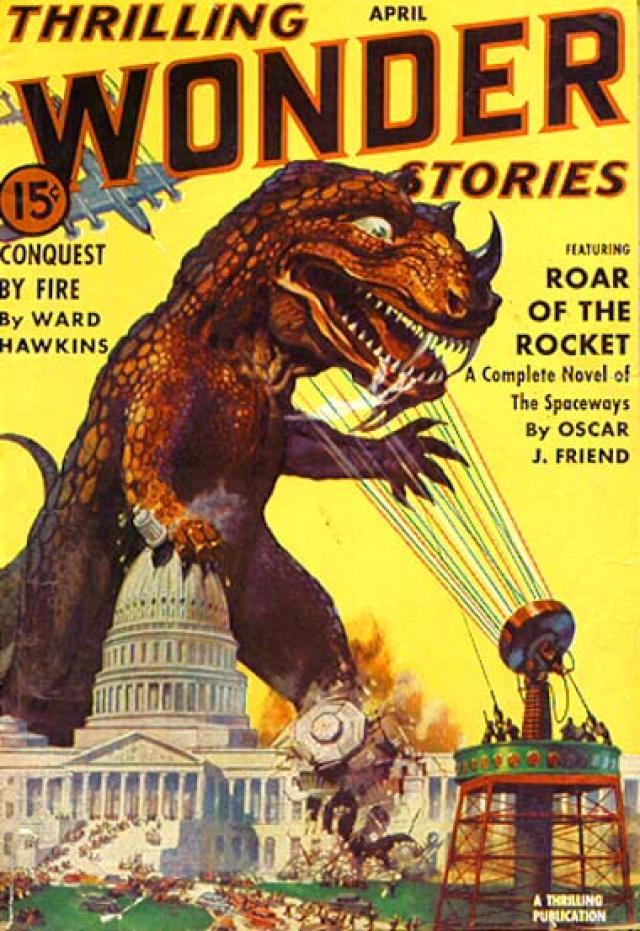
More planes came, wounding the Beast with bombs
BEAUTY
AND THE
BEAST
Out of Rain-Swept Venus’ Gift to Sun-Drenched Earth Comes Life—and Death!
By HENRY KUTTNER
Author of “Hollywood on the Moon,” etc.
First published in Thrilling Wonder Stories,
April 1940.
* * *
Jared Kirth saw the meteor as he lay under the pines, staring up at the stars. He was on the verge of slumber, and the sleeping bag that wrapped his lean body was warm and comfortable.
Kirth was feeling well satisfied with himself, his stomach bulged with crisp, freshly-caught trout, and there was still a week left of the fortnight’s vacation he had allowed himself. So he lay quietly, watching the night sky, and the meteor shrieked its death agony in that last incandescent plunge through the atmosphere.
But, before it went out of sight, the luminous body seemed to turn and arc in midair. That was queer enough. And even stranger was the shape of the thing, an elongated ovoid. Vaguely recalling that meteors sometimes contained precious ores, Kirth marked the spot where the flaming thunderbolt fell beyond a high ridge. And the next morning he shouldered his fishing tackle and hiked in that direction.
So, he found the wrecked spaceship. It lay among the pines, a broken giant, its hull fused in many places by the heat of friction.
Kirth’s pinched, rather mean mouth tightened as he looked down at the vessel. He was remembering that two months before a man named Jay Arden had left the Earth on the first interplanetary voyage.
Arden had been lost in space—so the papers had said. But now, apparently, his ship had returned, and Kirth’s gaunt, gray-stubbled face was eager as he hastened down the slope.
He walked around the ship, slipping on sharp rocks and cursing once or twice before he found the port. But the metal surrounding it had fused and melted, so that entry was impossible at this point. The gray, pitted, rough metal of the craft defied the tentative ax-blows Kirth gave it. Curiosity mounted within him.
He examined the ship more closely. The sun, rising above the eastern ridge, showed a factor he had previously overlooked. There were windows, circular deadlights, so fused and burned that they were as opaque as the metallic hull. Yet they were unmistakably of glass, or some similar substance.
It was not ordinary glass. It did not shatter under the ax. But a small chip flew, and Kirth battered away diligently until he had made a small hole. Vapor gushed out of this, foul, stale and mephitic, and Kirth fell back and waited.
Then he returned to his labors. The glass was easier to shatter now, for some reason, and it was not long before Kirth had chopped away a hole large enough to permit the entry of his lean body. First, however, he took a small flashlight from his belt and held it at arm’s length within the ship.
There was but one room, and this was a shambles. It was a mass of wreckage. Yet the air had cleared, and there seemed to be no danger. Cautiously Kirth squirmed through the deadlight.
So this was a spaceship! Kirth recognized the chamber from newspaper pictures he had seen months before.
In 1942 the ship had been new, shining, and perfect. Now, only a few months later, it was a ruin. The controls were hopelessly wrecked. Metal kits and canisters were scattered about the floor, broken straps on the walls showing whence they had fallen. And on the floor, too, lay the body of Jay Arden.
* * *
Kirth made a useless examination. The man was dead. His skin was blue and cyanosed, and his neck was obviously broken. Scattered about his corpse were a few cellulose-wrapped parcels that had spilled from a broken canister near by. Through the transparent envelopes Kirth detected small black objects, smaller than peas, which resembled seeds.
Protruding from one of Arden’s pockets was a notebook. As Kirth drew it forth, a wrapped parcel fell to the floor. Kirth hesitated, put the notebook aside, and opened the package.
Something fell from it into his palm. The man gasped in sheer wonder.
It was a jewel. Oval, large as an egg, the gem flamed gloriously in the light of the electric torch. It had no color, and yet seemed to partake of all the hues of the spectrum. It seemed to draw into itself a thousand myriad hues—men would have died for such a jewel. Lovely it was, beyond imagination, and it was—unearthly.
Finally Kirth tore his gaze from the thing, and opened the notebook. The light was too dim, so he carried it to the broken deadlight. Arden, seemingly, had not kept a diary, and his notes were broken and disconnected. But from the book, several photographs fluttered, and Kirth caught them as they fell.
The snapshots were blurred and discolored, but certain details showed with fair clarity. One showed a thick bar, with rounded ends, white against blackness. This was a picture of the planet Venus, taken from outer space, though Kirth did not realize it. He examined the others.
Ruins. Cyclopean, strange, and alien in contour, half-destroyed shapes of stone were blurred against a dim background. One thing, however, was clear. The spaceship was visible in the picture—and Kirth gasped.
For the great ship was dwarfed by the gigantic ruins. Taller than the vast Temple of Karnak, monstrously large were the stones that had once been cities and buildings. Vague and murky as the pictures were, Kirth managed to form some conception of the gargantuan size of the structures shown in them. Too, he noticed that the geometry seemed oddly wrong. There were no stairs visible, only inclined planes. And a certain primeval crudeness, a lack of the delicacy noticeable even in the earlier Egyptian artifacts, was significant.
Most of the other photographs showed similar scenes. One, however, was different. It depicted a field of flowers, such flowers as Kirth had never before seen. Despite the lack of color, it was evident that the blossoms were lovely with a bizarre, unearthly beauty. Kirth turned to the notebook.
* * *
He learned something from it, though not much. He read:
“Venus seems to be a dead planet. The atmosphere is breathable, but only plant life exists. The flowers, somewhat resembling orchids, are everywhere. The ground beneath them is covered with their seeds. I have collected a great many of these. . . .
“Since I found the jewel in one of the ruined structures, I have made another discovery. An intelligent race once lived on Venus—the ruins themselves denote that fact. But any inscriptions they might have left have been long since eroded by the foggy, wet atmosphere and the eternal rains. So I thought, till this morning, when in a subterranean chamber I discovered a bas-relief almost buried in mud.
“It took me hours to clear away the muck, and even then there was not much to see. But the pictures are more significant than any inscription in the ancient Venusian language could have been. I recognized, quite clearly, the jewel I previously discovered. From what I have been able to make out, there were many of these, artificially created. And they were something more than mere gems.
“Unbelievable as it seems, they are—to use a familiar parallel—eggs. There is life in them. Under the proper conditions of heat and sunlight—so I interpret the bas-reliefs—they will hatch. . . .”
There were a few other notes in the book, but these were technical in nature and of no interest to Kirth, save for one which mentioned the existence of a diary Arden had kept. He again searched the ship, and this time found the diary. But it was half incinerated by its proximity to the fused port, and utterly illegible.
Pondering, Kirth examined the various containers. Some were empty; others had dusty cinders in them, and emitted a burnt, unpleasant odor when opened. The spoils of Arden’s voyage were, apparently, only the seeds and the jewel.
Now, Jared Kirth, though shrewd, was not intelligent in the true sense of the word. Born on a New England farm, he had fought his way up by dint of hard, bitter persistence and a continual insistence upon his own rights. As a result, he owned a few farms and a small village store, and permitted himself one brief vacation a year. On this furlough neither his wife nor his daughter accompanied him. He was fifty, a tall, spare, gray man, with cold eyes and a tight mouth that was generally compressed as though in denial.
It is scarcely wonderful, therefore, that Kirth began to wonder how he might turn this discovery to serve his own ends. He knew that no reward had been offered for the finding of the spaceship, supposedly lost in the airless void. If there had been treasure of any sort in the vessel, he would have appropriated it, on the principle of “finder’s keepers.” There was nothing, save for the seeds and the gem, and Kirth had these in his pockets as he left the vessel.
The ship would not be found for some time, since this was wilderness country. Meanwhile, Kirth took with him Arden’s notebook, to be destroyed at a more opportune moment. Though skeptical, he thought more than once of Arden’s comparison of the jewel with an egg, and, for a man who owned several farms, the conclusion was inevitable. If this “egg” could be hatched, despite the unlikeliness of the idea, the result might be interesting. Even more—it might be profitable.
* * *
Kirth decided to cut short his vacation, and two days later he arrived at his home. He did not stay there, however, but went to one of his farms, taking with him his wife and daughter.
Heat and sunlight. A topless, electrically warmed incubator was the logical answer. At night, Kirth used a sunlamp on the jewel. Meanwhile he waited.
Intrinsically the gem might have value. Kirth could, perhaps, have sold it for a large sum to some jeweler. But he thought better of this, and planted some of the Venusian seeds instead.
And, in the strange jewel, alien life stirred. Heat warmed it—heat that did not now exist on gloomy, rain-swept Venus. From the Sun poured energy, cosmic rays and other rays that for eons had been barred from the stone by the thick cloud-barrier that shrouded Venus. Into the heart of the gem, stole energy that set certain forces in motion. Life came, and dim realization.
There, on the straw of a filthy incubator, lay the visitant from another world. Unknown ages ago, it had been created, for a definite purpose. And now—life returned.
Kirth saw the hatching. At midday he stood beside the incubator, gnawing on a battered pipe, scratching the gray stubble on his jaw. His daughter was beside him, a lean, underfed girl of thirteen, with sallow skin and hair.
“It ain’t an egg, Pa,” she said in a high, nasal voice. “You don’t really expect that thing to hatch, do you?”
“Hush,” Kirth grunted. “Don’t keep pestering me. I—hey! Look at that thing! Something’s—”
Something was indeed happening. On the straw the jewel lay, flaming bright. It seemed to suck sunlight into itself thirstily. The dim radiance that had come to surround it of late pulsed and waned—pulsed once more. The glow waxed—
Waxed brighter! An opaque cloud formed suddenly, hiding the gem. There came a high-pitched tinkling sound, almost above the threshold of hearing. It faded and was gone.
The gray mist fled. Where the jewel had been was nothing. Nothing, that is, save for a round, grayish ball that squirmed and shuddered weakly....
“That ain’t a chick,” the girl said, her jaw hanging. “Pa—” There was fright in her eyes.
“Hush!” Kirth said again. He bent down and gingerly prodded the thing. It seemed to writhe open, with an odd motion of uncoiling, and a tiny creature like a lizard lay there, its small mouth open as it sucked in air.
“I be damned,” Kirth said slowly. “A dirty little lizard!” He felt vaguely sick. The jewel he might have sold at a good price, but this creature—what could be done with it? Who could want it?
Yet it was strange enough. It was shaped like a miniature kangaroo, almost, and like no lizard Kirth had ever seen before. Perhaps he might sell it after all.
“Go git a box,” he said to his daughter, and, when she had obeyed, he picked up the reptile gingerly and deposited it in the impromptu prison.
* * *
As he carried it into the house, he glanced at the plot of ground where he had planted some of the seeds. A few yellowish, small spears were sprouting up. Kirth nodded approvingly and scratched his jaw.
Mrs. Kirth, a plump, slatternly woman, approached. Her face was prematurely old, sagging in fat wrinkles. Her brown eyes had a defeated look, though there was still something of beauty in them.
“What you got there, Jay?” she asked.
“Tell you later,” he said. “Git me some milk, Nora. And an eye-dropper or something.”
This was done. Kirth fed the reptile, which seemed to like the milk and sucked it down greedily. Its small, glittering eyes stared up unwinkingly.
“Pa,” the girl said. “It’s bigger. Lots bigger.”
“Couldn’t be,” Kirth said. “Things don’t grow that fast. Git out, now, and leave me be.”
And, in its prison, the tiny creature that was to become the Beast, drank thirstily of the milk, while in the dim, alien brain, clouded by the mists of centuries, thoughts began to stir. The first faint chords of memory vibrated . . . memory of a previous life, half forgotten. . . .
Kirth’s daughter had been right. The reptile grew, abnormally and alarmingly. At the end of the second day, it was six inches long from blunt muzzle to tapering tail. When the week was over it was more than twice as large. Kirth built a pen for it and was secretly elated.
“I can sell it, all right,” he exulted. “Some circus’d pay me plenty. But it might git even bigger. I’ll wait a bit.”
Meanwhile he tended his Venusian plants. They were sprouting most satisfactorily now, and the beginnings of buds were evident. They were as tall as hollyhocks, but leafless. The thick, rigid stem, pale yellow in hue, was studded with swellings that presently burst into bloom.
At the end of the second week Kirth’s garden was a riot of color, and he paid a photographer to take snapshots in color. These he sent to several horticultural gardens, which were immediately interested. A reporter got on the trail, and interviewed Kirth.
Kirth was wary and spoke of plant-grafting and experiments he had made. A new species of flower, it was, and he had grown them. Yes, he had some seeds, and would sell them. . . .
The wrecked spaceship had not yet been discovered. And in its sty the Beast ate enormously of vegetables, and of swill which Kirth refused the reluctant hogs, and drank anything it could get. A scientist would have known, by the shape of the Beast’s teeth, that it was carnivorous or at least omnivorous, but Kirth did not know, and the reptile did not appear to object to its menu. It grew, remarkably, and its basal metabolism was so high that its scaly body emitted perceptible heat.
It was as large, now, as a stallion. But it seemed so gentle that Kirth took no warning, though he kept a revolver in his pocket whenever he approached his bizarre charge.
* * *
The dim memories within the Beast’s brain stirred into life from time to time. But one factor predominated, drowning them and lulling them to slumber. The Beast knew, somehow, that it was necessary for him to grow. Before anything else, he must attain his full growth and maturity. After that—
The Beast was intelligent, not with the aptitude of a child, but with the mind of a half-drugged adult. And he was not born of Earth. The alien chemistry of his body sent unknown secretions coursing through his veins, and, as he ate and grew, that strange mind worked. . . .
The Beast learned, though as yet he could not take advantage of his knowledge. The Kirths’ conversation was clearly audible to him through the open windows of the farmhouse, and their televisor was very often turned on. From observing the humans, he grew to recognize their moods, and in turn came to associate, certain word-sounds with those moods.
He learned that certain grimaces accompanied a special set of emotions. He grew to understand laughter and tears.
One thing he did not understand—a look that came into the eyes of Mrs. Kirth and her daughter, and sometimes into Kirth’s eyes, as they watched him. It was repugnance and horror, but the Beast did not know that.
Two months passed slowly. Kirth received many checks in his mail. The new flowers had proved tremendously popular, and florists demanded them avidly. Lovelier than orchids they were, and they did not fade for a long time after being cut.
Kirth was not shrewd enough to keep control of the plants in his own hands, and the distribution of them got beyond him. Since the flowers would florish in any climate, they were grown from California to New York. Fields of them formed a carpet of beauty over America. The fad spread over the world, and in Buenos Aires, London, or Berlin no socialite attended a dansant without a corsage of the Rainbows, as the blooms came to be called.
Kirth might have been satisfied with his growing bank account, but he had already got in touch with the owners of several circuses, and told them he had a freak to sell. Kirth was becoming apprehensive. The Beast was uncomfortably huge, and people were noticing that scaled, swaying back as it moved about. Kirth, with some trepidation, led the monster into the barn, though it followed willingly enough. But the quarters were cramped. One blow from the mighty tail would have wrecked the structure, and that was scarcely a pleasant thought.
Kirth would have been even more disturbed had he realized what was going on in the monster’s brain. The fogs were dissipating as the Beast approached swift maturity. Intelligence and memory were returning. And already, the creature could understand many English words.
That was natural enough. A child does the same, over a period of years, by a process of association, experiment, and mental retention of word-sounds. The Beast was not a child. He was a highly intelligent being, and for months he had been in close contact with human beings. At times, he found it hard to concentrate, and would devote himself to feeding and sleeping, in a dull, pleasantly languorous stupor. Then, the driving, inexorable force within him would awaken him to life once more.


