The Outcast and the Rite, page 1


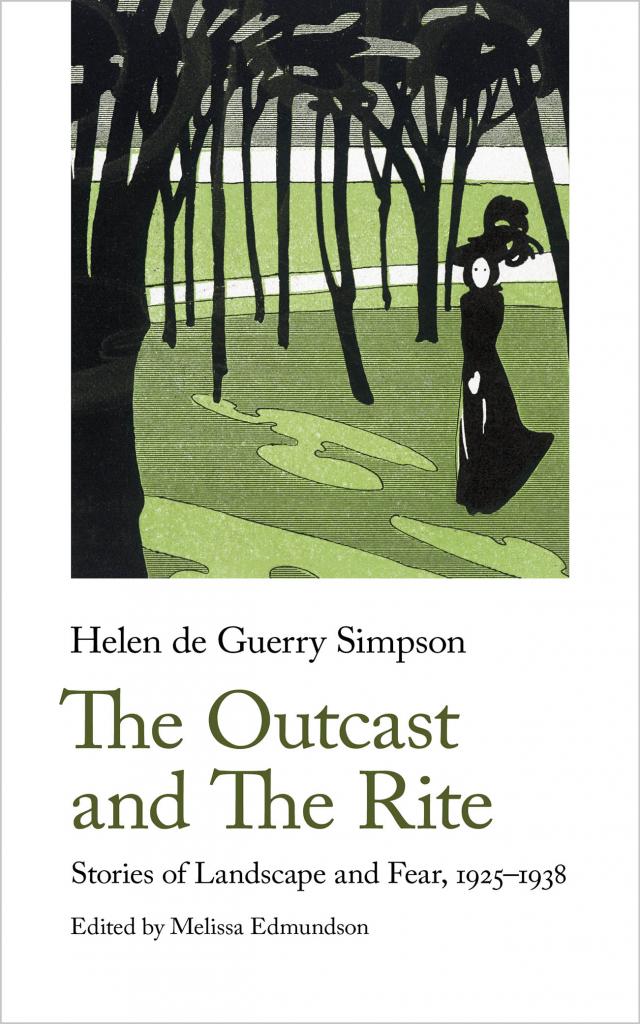
The Outcast and The Rite
Also published by Handheld Press
HANDHELD CLASSICS
What Might Have Been. The Story of a Social War, by Ernest Bramah
The Runagates Club, by John Buchan
Desire, by Una L Silberrad
Vocations, by Gerald O’Donovan
Kingdoms of Elfin, by Sylvia Townsend Warner
Save Me The Waltz, by Zelda Fitzgerald
What Not. A Prophetic Comedy, by Rose Macaulay
Blitz Writing. Night Shift & It Was Different At The Time, by Inez Holden
Adrift in the Middle Kingdom, by J Slauerhoff, translated by David McKay
The Caravaners, by Elizabeth von Arnim
The Exile Waiting, by Vonda N McIntyre
Women’s Weird. Strange Stories by Women, 1890–1940, edited by Melissa Edmundson
Of Cats and Elfins. Short Tales and Fantasies, by Sylvia Townsend Warner
Business as Usual, by Jane Oliver and Ann Stafford
Non-Combatants and Others. Writings Against War, 1916–1945, by Rose Macaulay
Potterism. A Tragi-Farcical Tract, by Rose Macaulay
British Weird. Selected Short Fiction, 1893–1937, edited by James Machin
Women’s Weird 2. More Strange Stories by Women, 1891–1937, edited by Melissa Edmundson
There’s No Story There. Wartime Writing, 1944–1945, by Inez Holden
Where Stands A Wingèd Sentry, by Margaret Kennedy
Personal Pleasures, by Rose Macaulay
The Villa and The Vortex, by Elinor Mordaunt
The Gap in the Curtain, by John Buchan
Jane’s Country Year, by Malcolm Saville
Latchkey Ladies, by Marjorie Grant
This edition published in 2022 by Handheld Press
72 Warminster Road, Bath BA2 6RU, United Kingdom. www.handheldpress.co.uk
Copyright of the introduction © Melissa Edmundson 2022 Copyright of the Notes © Kate Macdonald 2022.
All rights reserved. No part of this publication may be reproduced, stored in or introduced into a retrieval system, or transmitted, in any form, or by any means (electronic, mechanical, photocopying, recording or otherwise) without the prior written permission of the publisher.
The moral rights of the authors have been asserted.
ISBN:978-1-912766-61-1
1 2 3 4 5 6 7 8 9 0
Series design by Nadja Guggi and typeset in Adobe Caslon Pro and Open Sans.
eBook Conversion by Bluewave Publishing
Contents
Acknowledgments
Introduction
Bibliographical details
1 Grey Sand and White Sand
2 The Rite
3 The Outcast
4 As Much More Land
5 Young Magic
6 Disturbing Experience of an Elderly Lady
7 Good Company
8 A Curious Story
9 The Man Who Had Great Possessions
10 Teigne
11 The Pledge
12 The Pythoness
13 An Experiment of the Dead
Notes on the stories
Acknowledgments
My thanks to Kate Macdonald of Handheld Press, for commissioning me to curate the stories in this book.
I would also like to express my sincere gratitude to the family of Helen Simpson. Her daughter Mrs Clemence Hamilton and her granddaughter Kate Hamilton have supported this project from the beginning and have graciously provided documents from Simpson’s private papers and manuscripts.
My appreciation goes as well to the national library of Australia for making so many primary sources freely available through Trove. The introduction to this edition could not have been written without this invaluable resource.
I also wish to thank Jeff Makala for his feedback on the introduction and for his editorial assistance.
And my gratitude, as always, goes to Murray, Maggie, Kitsey, and Remy for their furry support.
This book is dedicated to Mrs Clemence Hamilton, daughter of Helen Simpson
Melissa Edmundson is senior lecturer in British literature and Women’s Writing at Clemson University, South Carolina, and specializes in nineteenth and early twentieth-century British women writers, with a particular interest in women’s supernatural fiction. She is the editor of a critical edition of Alice Perrin’s East of Suez (1901), published in 2011, and author of Women’s Ghost Literature in Nineteenth- Century Britain (2013) and Women’s Colonial Gothic Writing, 1850–1930: Haunted Empire (2018). Her other work includes essays on the First World War ghost stories of H D Everett and haunted objects in the supernatural fiction of Margery Lawrence, as well as a chapter on women writers and ghost stories for The Routledge Handbook to the Ghost Story. She has also edited Avenging Angels: Ghost Stories by Victorian Women Writers (2018). Her Handheld Press titles include Women’s Weird: Strange Stories by Women, 1890–1940 (2019), Women’s Weird 2: More Strange Stories by Women, 1891–1937 (2020), and Elinor Mordaunt’s The Villa and The Vortex: Supernatural Stories, 1916–1924 (2021).
Introduction
BY Melissa Edmundson
In a newspaper feature on Helen Simpson, written during Simpson’s visit in 1937 to her native Australia, the author Coralie Clarke Rees recorded her appraisal of Simpson:
Not content with being a first-rate novelist—one of the few Australian writers who have a wide oversea public— she is a biographer, an expert on cookery and homecraft, a prominent lecturer and radio talker, an authority on witchcraft, and a talented amateur musician. Such is her interest in world affairs that she reads daily papers in four different languages—French, German, Italian, and Spanish—besides her native English. During the recent troublous times she has displayed an active interest in the struggles of the workers of the world against Fascism. Her physical and mental vitality can only be described as super-normal. (Rees 1937)
Rees’s description encapsulates many of the attributes and talents that made Helen Simpson unique. Her writing career spanned roughly two decades, and her time as a novelist was even shorter. In just fifteen years, from 1925 until her untimely death in 1940 at age 42, she distinguished herself as a gifted historical novelist, publishing bestselling books set in her birthplace of Australia and in her adopted home of England. She had a long-standing business partnership with William Heinemann, who published most of her books. This includes one which remains unique in her oeuvre: The Baseless Fabric. This was Simpson’s only collection of short fiction and contains most of her supernatural writing. For almost a century, this collection has been forgotten. Yet its stories represent some of the best—and most chilling—supernatural and macabre fiction written during the interwar years, a period which saw a resurgence in such literature. These stories range from tales of obsession and vengeance to haunted houses, ominous landscapes, and possession. Along with these collected stories, the present edition adds two supernatural narratives which Simpson published later in her life. These once again showcase her lifelong interest in the occult and the paranormal. The Outcast and The Rite is the first modern reprinting of Simpson’s short fiction and reclaims an important and distinctive voice within the supernatural tradition.
***
Helen de Guerry Simpson was born on 1 December 1897 in Sydney, Australia. She was the daughter of Edward Percy Simpson, a solicitor, and Anna Maria Alexandra Guerry de Lauret, daughter of Auguste Pierre Clement, Marquis de Guerry de Lauret. Simpson’s maternal grandfather was a political refugee who had left France for Australia in the 1840s and acquired land near Goulburn, a town in New South Wales that lies between Sydney and Canberra. she was educated at her family home in the Sydney suburb of Point Piper under the direction of her governess, Winifred West. Her parents later separated, and her mother moved to London. Simpson remained with her father and was sent to the Convent of the sacred Heart in nearby Rose Bay, Sydney, from 1910–1911, and later to Abbotsleigh, a private girls’ school in Sydney, from 1911–1912.
When she was sixteen, Simpson left Australia in order to study music in Paris (with the hope of becoming a composer) but because of the outbreak of World War I, decided to go to Oxford to study languages in the hopes of helping with the war effort. There, she joined the society of Oxford Home students (which would later become St Anne’s College). She published her first book while still a student at Oxford and founded the Oxford Women’s dramatic Society.
During the war, Simpson joined the Women’s Royal naval service (WRNS) and worked as a cable decoder with the Admiralty in London. She then volunteered to work as an interpreter in France and Tunisia. She spoke fluent French and spent mornings at the Berlitz School learning Italian and Spanish while working nights at the Admiralty (Ussher 1931, 22). In a 1937 interview, she recalled that this time ‘was really most thrilling, doing interpretations and working on codes’ (Simpson 1937a, 13).
After the war, she returned to Oxford, intending to complete her Bachelor of Music degree. There are different reasons given as to why she left Oxford without a degree. In interviews, Simpson said she failed her exams, but another possible cause is that she staged a play in which both male and female students acted (against the regulations) and was subsequently sent down.
Her first books were published in Sydney by Angus & Robertson
I was deriding the modern novel, and stating that anyone could write one in three weeks: a novel good enough for publication. The girl to whom I made this somewhat boastful statement ridiculed the idea and bet me £25 that I couldn’t write a novel in three weeks and then get it published. I accepted the challenge—set to work with a will—finished the book on the 21st day—sold it to the first publishers I approached … and won my £25! […] And so, after this extremely surprising literary achievement, and realising that I was evidently not cut out to be a composer, I turned to writing as a career. (Simpson 1937a, 13)
Her relationship with Heinemann continued throughout the 1920s and 1930s. Her novel Cups, Wands and Swords (1927), as the Tarot-inspired title suggests, includes mystical and supernatural elements. Mumbudget (1928) is a collection of irish fairy tales for children. The semi-autobiographical Boomerang (1932), a historical novel that moves between eighteenth-century Paris, New South Wales, and France during the First World War, won the James Tait Black Memorial Prize for fiction that same year. Boomerang also represented a substantial increase in Simpson’s earnings as an author. She told Coralie Clarke Rees in a 1933 article, ‘I got £30 for my first novel, £40 for my second, and £600 for “Boomerang”’ (Rees 1933).
In 1933, Heinemann published The Woman on the Beast, a fantasy consisting of three linked novellas across different eras but with common themes. The book begins with a Prologue set in medieval times, then moves to sixteenth-century India, revolutionary France, and finally to Australia in 1999. Her historical romance Saraband for Dead Lovers (1935) was adapted into a film in 1948. Under Capricorn (1937), set in colonial New South Wales in the 1830s, was adapted as a film in 1949. Her final novel was Maid No More (1940), published the year of her death. By all accounts, Simpson was a highly disciplined writer. Her work was a constant source of pride for Australia and throughout her career she was known as an Australian novelist. Most of what we know about her attitudes toward authorship and publishing comes from the many personal interviews and reviews of her work published in newspapers throughout the country. In July 1937, the Melbourne Argus went as far as to say, ‘no other Australian authoress has had such success abroad as Miss Helen Simpson’ (Anon 1937). In a September 1937 article for the Newcastle Morning Herald, Simpson discussed the importance of maintaining a daily routine for her writing and keeping to a schedule. She first wrote everything in longhand using a pencil, then her secretary typed the manuscript. There was a round of editing, then the manuscript was typed again (Simpson 1937c).
Simpson knew many fellow authors in the interwar London literary world. Beginning in the late 1920s, she collaborated with the playwright and novelist Clemence Dane for a popular series of detective novels published by Hodder & Stoughton. These included Enter Sir John (1929), adapted as a film by Alfred Hitchcock in 1930, Printer’s Devil (1930), and Re-Enter Sir John (1932). The two writers formed a lasting friendship, and Helen named her only daughter after Clemence. Simpson was also close to the novelist Margaret Kennedy, who, during Simpson’s illness and hospitalization in wartime London in 1940, took the young Clemence to live with her in greater safety in Surrey along with Kennedy’s own children, and later moved Clemence with her children to Cornwall (Powell 1983, 171–72). Clemence is called ‘Claire’ in Where Stands A Wingèd Sentry (1941), Margaret Kennedy’s memoir of the war.
Simpson and Dane were invited to join the detection Club in 1929, after the publication of Enter Sir John (McDonald 2021, 209). The detection Club’s other members included Agatha Christie, Gladys Mitchell, and Dorothy L Sayers. Through the club, Simpson and Sayers developed a close friendship and after Simpson’s death, Sayers wrote a posthumous tribute to her in The Fortnightly, praising her ability to relate to people and her intense interest in the world around her (Sayers 1941). In a letter to Sir Walter Wilson Greg some months earlier, Sayers had written: ‘We shall feel the loss of Helen Simpson very much; she had one of the finest minds I know and an extraordinarily vivid personality. I don’t think I ever met anybody who was so intensely interested in every kind of person and thing she encountered on her passage through life, and I feel that her death at this moment is a blow not only to her friends but also to the country; she would have taken a vigorous part in the post-war re-building’ (Reynolds 1996, 184).
On 21 April 1927, Simpson married fellow Australian Denis Browne, a prominent paediatric surgeon at The Hospital for Sick Children in London. The couple first lived in Holborn near the Law Courts and then eventually settled in a 200-year-old house in Queen Anne Street, further west. Their only daughter, Clemence, was born in November 1928. In addition to collecting books on witchcraft, Simpson’s hobbies included horse riding and fencing, as well as collecting silver, old musical instruments, snuff boxes, medieval recipes, and Elizabethan cookbooks. She credited her French mother for instilling within her a love of cooking; along with homemade jams and jellies, Simpson made her own wine. in addition to her involvement with the detection Club, she was a member of the Pen Club and served as a committee member for the Stock-Heinemann Prize.
Simpson wrote biographies of Henry Viii and the explorer and folklorist Mary Kingsley. She also wrote about domestic subjects, in The Happy Housewife: A Book for the House That Is or Is to Be (1934) and the cookbook The Cold Table: A Book of Recipes for the Preparation of Cold Food and Drink (1935). Her cookery talks on the BBC were some of the most popular programs broadcast, often resulting in thousands of fan letters. When it came to women and domestic economy, Simpson held progressive views. She told Coralie Clarke Rees: ‘Women should know all about where the money comes from and where it goes to […] and how the domestic economy of each household is linked to the larger economy of the whole country and that in turn to the whole world. […] Girls should have at an early age experience of handling money and of making it go as far as possible’ (Rees 1937). These feminist ideals extended beyond the domestic realm as well. Simpson contributed a chapter titled ‘Man the Magpie,’ to Man, Proud Man, a collection of feminist essays published in 1932. She felt that the literary work of women should stand on its own merit and disagreed with the practice of singling out the achievements of women based purely on their gender: ‘The work of women […] should be judged precisely in the same light as that of men—without the label of sex being attached’ (Simpson 1937b). Though she admitted that men’s literary output was historically greater than that of women, she said that women’s writing was unique: ‘But they have something delicate, delightful, and very real to say for themselves, something no man ever has or can imitate’ (ibid).
Simpson was a frequent contributor to popular magazines throughout the 1930s, including Cosmopolitan, The Illustrated London News, The New Yorker, Nash’s, Pall Mall, The Passing Show, The Strand, The Tatler, and Lovat Dickson’s Magazine. Many of these stories showcase her sharp wit and sense of humor, such as ‘A Posteriori,’ which was published in Lovat Dickson’s Magazine in July 1934 and presents a comical take on the traditional spy story. This humorous side was showcased again when she contributed an updated version of ‘Puss in Boots’ for The Fairies Return (1934), a collection of modern fairy tales contributed by famous authors of the day. In addition to her published writing, Simpson gave lectures and frequent radio talks on a variety of subjects for the BBC. In 1937, she returned to Australia to visit family, as well as to promote her recently published novel Under Capricorn and to do research for a forthcoming novel (left unfinished due to her illness and death). During the trip, she also gave a series of talks for the Australian Broadcasting Commission. She then completed a lecture tour in the United States before returning to England in 1938. The following year, Simpson turned her attention to politics, becoming the prospective liberal candidate for the isle of Wight’s seat in the House of Commons. Her political career was cut short, however, when she was diagnosed with cancer.