

Helen Keller, page 1


Library of America, a nonprofit organization,
champions our nation’s cultural heritage
by publishing America’s greatest writing in
authoritative new editions and providing resources
for readers to explore this rich, living legacy.
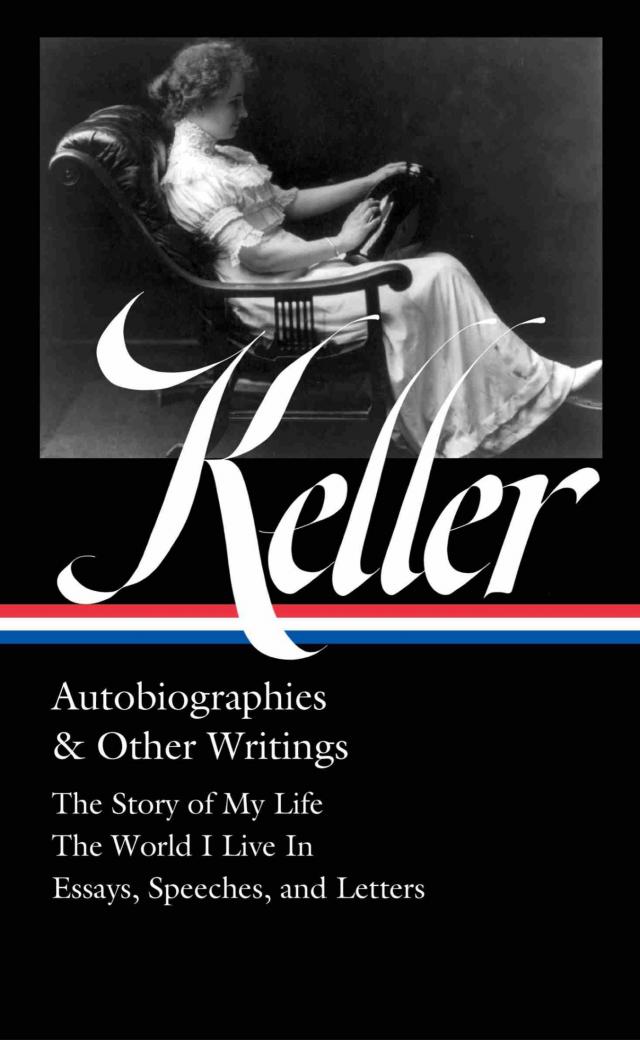
HELEN KELLER
AUTOBIOGRAPHIES
& OTHER WRITINGS
The Story of My Life
The World I Live In
Essays, Speeches, Letters & Journals
Kim E. Nielsen, editor
LIBRARY OF AMERICA E-BOOK CLASSICS
HELEN KELLER: AUTOBIOGRAPHIES & OTHER WRITINGS
Volume compilation and backmatter copyright © 2024 by
Literary Classics of the United States, Inc., New York, N.Y.
All rights reserved.
No part of this book may be reproduced in any manner whatsoever without
the permission of the publisher, except in the case of brief
quotations embodied in critical articles and reviews.
Published in the United States by Library of America.
Visit our website at www.loa.org.
Essays, speeches, letters, and journals reprinted with the permission of the American Foundation for the Blind, Helen Keller Archives.
See Note on the Texts for further information.
Distributed to the trade in the United States
by Penguin Random House Inc.
and in Canada by Penguin Random House Canada Ltd.
ISBN 978–1–59853–772–7
eISBN 978–1–59853–782–6
Helen Keller: Autobiographies & Other Writings
is published with support from
PAULA JEAN (HEIDE) HIRSCH and
ROLAND FELIX HIRSCH
in honor of their children,
Elizabeth, Sallie, and Paul
Contents
List of Plates
THE STORY OF MY LIFE
Editor’s Preface
PART I: The Story of My Life
PART II: Introduction to Letters
PART II: Letters (1887–1901)
PART III: A Supplementary Account of Helen Keller’s Life and Education
I. The Writing of the Book
II. Personality
III. Education
IV. Speech
V. Literary Style
THE WORLD I LIVE IN
Preface
I. The Seeing Hand
II. The Hands of Others
III. The Hand of the Race
IV. The Power of Touch
V. The Finer Vibrations
VI. Smell, the Fallen Angel
VII. Relative Values of the Senses
VIII. The Five-sensed World
IX. Inward Visions
X. Analogies in Sense Perception
XI. Before the Soul Dawn
XII. The Larger Sanctions
XIII. The Dream World
XIV. Dreams and Reality
XV. A Waking Dream
XV. A Chant of Darkness
ESSAYS, SPEECHES, LETTERS & JOURNALS
Letter to Kate Keller, February 10, 1895
My Future As I See It
Blind Leaders
Strike Against War
From My Religion
Our Mark Twain
My Mother
Lux in Tenebris
Woman and Peace
Put Your Husband in the Kitchen
From Helen Keller’s Journal
Testimony Before the House Subcommittee of Labor Investigating Aid to the Physically Handicapped, October 3, 1944
Letter to Nella Braddy Henney, October 14, 1948
Letter to Jo and Florence Davidson, August 1, 1951
Chronology
Note on the Texts
Notes
Index
List of Plates
11. With Anne Sullivan on Cape Cod, July 1888.
12. In a tree with Anne and “Phiz,” c. 1904.
13. With Samuel L. Clemens, January 10, 1909.
14. With Anne Sullivan Macy, c. 1913.
15. With Charlie Chaplin in California, 1918.
16. A playbill for Deliverance, 1919.
17. Meeting Eleanor Roosevelt, March 24, 1936.
18. With Katharine Cornell, c. 1937.
19. Three friends laughing, 1940.
10. At a rally for Franklin D. Roosevelt, September 21, 1944.
11. A visit with blinded veterans, c. 1944.
12. Greeting children in Japan, 1948.
13. In Hiroshima, October 13, 1948.
14. In the Middle East, 1952.
15. In Martha Graham’s studio, c. 1954.
16. With Prime Minister Nehru, February 27, 1955.
17. At the White House, April 8, 1961.
18. On Martha’s Vineyard, c. 1961.
HELEN KELLER
Photograph by Falk, 1895
HELEN KELLER AND MISS SULLIVAN
THE STORY OF MY LIFE
By HELEN KELLER
WITH
HER LETTERS (1887–1901)
AND
A SUPPLEMENTARY ACCOUNT
OF HER EDUCATION, INCLUDING
PASSAGES FROM THE REPORTS
AND LETTERS OF HER TEACHER,
ANNE MANSFIELD SULLIVAN
By JOHN ALBERT MACY
To
ALEXANDER GRAHAM BELL
WHO has taught the deaf to speak
and enabled the listening ear to hear
speech from the Atlantic to the Rockies,
I Dedicate
this Story of My Life.
Editor’s Preface
THIS BOOK is in three parts. The first two, Miss Keller’s story and the extracts from her letters, form a complete account of her life as far as she can give it. Much of her education she cannot explain herself, and since a knowledge of that is necessary to an understanding of what she has written, it was thought best to supplement her autobiography with the reports and letters of her teacher, Miss Anne Mansfield Sullivan. The addition of a further account of Miss Keller’s personality and achievements may be unnecessary; yet it will help to make clear some of the traits of her character and the nature of the work which she and her teacher have done.
For the third part of the book the Editor is responsible, though all that is valid in it he owes to authentic records and to the advice of Miss Sullivan.
The Editor desires to express his gratitude and the gratitude of Miss Keller and Miss Sullivan to The Ladies’ Home Journal and to its editors, Mr. Edward Bok and Mr. William V. Alexander, who have been unfailingly kind and have given for use in this book all the photographs which were taken expressly for the Journal; and the Editor thanks Miss Keller’s many friends who have lent him her letters to them and given him valuable information; especially Mrs. Laurence Hutton, who supplied him with her large collection of notes and anecdotes; Mr. John Hitz, Superintendent of the Volta Bureau for the Increase and Diffusion of Knowledge relating to the Deaf; and Mrs. Sophia C. Hopkins, to whom Miss Sullivan wrote those illuminating letters, the extracts from which give a better idea of her methods with her pupil than anything heretofore published.
Messrs. Houghton, Mifflin and Company have courteously permitted the reprinting of Miss Keller’s letter to Dr. Holmes, which appeared in “Over the Teacups,” and one of Whittier’s letters to Miss Keller. Mr. S. T. Pickard, Whittier’s literary executor, kindly sent the original of another letter from Miss Keller to Whittier.
JOHN ALBERT MACY.
Cambridge, Massachusetts, February 1, 1903.
Contents
Editor’s Preface
PART I
THE STORY OF MY LIFE
Chapters I–XXIII
PART II
Introduction to Letters
Letters
PART III
A SUPPLEMENTARY ACCOUNT OF
HELEN KELLER’S LIFE AND EDUCATION
CHAPTER
The Writing of the Book
Personality
Education
Speech
Literary Style
List of Illustrations
Helen Keller and Miss Sullivan
“Ivy Green,” the Keller Homestead
(Showing also the small house where
Helen Keller was born)
Helen Keller at the Age of Seven
Helen Keller and Jumbo
Miss Keller and Dr. Alexander Graham Bell
Miss Keller at Work in Her Study
Miss Keller and “Phiz”
Miss Keller, Miss Sullivan and Mr. Joseph Jefferson
Miss Keller, Miss Sullivan and Dr. Edward Everett Hale
Miss Keller and “Mark Twain”
In the Study at Cambridge
Helen Keller in 1899
Reading Raised Print
Miss Sullivan Reading to Miss Keller
Facsimile of the braille manuscript of the passage on page 34, with equivalents—slightly reduced. (Underlined combinations of letters have one sign in braille. Note the omission of the vowels before “r” in “learn,” and the joining of the sign for “to” with the word t
Part I
The Story of My Life
Chapter I
* * *
IT IS with a kind of fear that I begin to write the history of my life. I have, as it were, a superstitious hesitation in lifting the veil that clings about my childhood like a golden mist. The task of writing an autobiography is a difficult one. When I try to classify my earliest impressions, I find that fact and fancy look alike across the years that link the past with the present. The woman paints the child’s experiences in her own fantasy. A few impressions stand out vividly from the first years of my life; but “the shadows of the prison-house are on the rest.” Besides, many of the joys and sorrows of childhood have lost their poignancy; and many incidents of vital importance in my early education have been forgotten in the excitement of great discoveries. In order, therefore, not to be tedious I shall try to present in a series of sketches only the episodes that seem to me to be the most interesting and important.
I was born on June 27, 1880, in Tuscumbia, a little town of northern Alabama.
The family on my father’s side is descended from Caspar Keller, a native of Switzerland, who settled in Maryland. One of my Swiss ancestors was the first teacher of the deaf in Zurich and wrote a book on the subject of their education—rather a singular coincidence; though it is true that there is no king who has not had a slave among his ancestors, and no slave who has not had a king among his.
My grandfather, Caspar Keller’s son, “entered” large tracts of land in Alabama and finally settled there. I have been told that once a year he went from Tuscumbia to Philadelphia on horseback to purchase supplies for the plantation, and my aunt has in her possession many of the letters to his family, which give charming and vivid accounts of these trips.
My Grandmother Keller was a daughter of one of Lafayette’s aides, Alexander Moore, and granddaughter of Alexander Spotswood, an early Colonial Governor of Virginia. She was also second cousin to Robert E. Lee.
My father, Arthur H. Keller, was a captain in the Confederate Army, and my mother, Kate Adams, was his second wife and many years younger. Her grandfather, Benjamin Adams, married Susanna E. Goodhue, and lived in Newbury, Massachusetts, for many years. Their son, Charles Adams, was born in Newburyport, Massachusetts, and moved to Helena, Arkansas. When the Civil War broke out, he fought on the side of the South and became a brigadier-general. He married Lucy Helen Everett, who belonged to the same family of Everetts as Edward Everett and Dr. Edward Everett Hale. After the war was over the family moved to Memphis, Tennessee.
I lived, up to the time of the illness that deprived me of my sight and hearing, in a tiny house consisting of a large square room and a small one, in which the servant slept. It is a custom in the South to build a small house near the homestead as an annex to be used on occasion. Such a house my father built after the Civil War, and when he married my mother they went to live in it. It was completely covered with vines, climbing roses and honeysuckles. From the garden it looked like an arbour. The little porch was hidden from view by a screen of yellow roses and Southern smilax. It was the favourite haunt of humming-birds and bees.
Photograph by Collins
“IVY GREEN,” THE KELLER HOMESTEAD
(The small house on the right is where Helen Keller was born)
The Keller homestead, where the family lived, was a few steps from our little rose-bower. It was called “Ivy Green” because the house and the surrounding trees and fences were covered with beautiful English ivy. Its old-fashioned garden was the paradise of my childhood.
Even in the days before my teacher came, I used to feel along the square stiff boxwood hedges, and, guided by the sense of smell, would find the first violets and lilies. There, too, after a fit of temper, I went to find comfort and to hide my hot face in the cool leaves and grass. What joy it was to lose myself in that garden of flowers, to wander happily from spot to spot, until, coming suddenly upon a beautiful vine, I recognized it by its leaves and blossoms, and knew it was the vine which covered the tumble-down summer-house at the farther end of the garden! Here, also, were trailing clematis, drooping jessamine, and some rare sweet flowers called butterfly lilies, because their fragile petals resemble butterflies’ wings. But the roses—they were loveliest of all. Never have I found in the greenhouses of the North such heart-satisfying roses as the climbing roses of my southern home. They used to hang in long festoons from our porch, filling the whole air with their fragrance, untainted by any earthy smell; and in the early morning, washed in the dew, they felt so soft, so pure, I could not help wondering if they did not resemble the asphodels of God’s garden.
The beginning of my life was simple and much like every other little life. I came, I saw, I conquered, as the first baby in the family always does. There was the usual amount of discussion as to a name for me. The first baby in the family was not to be lightly named, every one was emphatic about that. My father suggested the name of Mildred Campbell, an ancestor whom he highly esteemed, and he declined to take any further part in the discussion. My mother solved the problem by giving it as her wish that I should be called after her mother, whose maiden name was Helen Everett. But in the excitement of carrying me to church my father lost the name on the way, very naturally, since it was one in which he had declined to have a part. When the minister asked him for it, he just remembered that it had been decided to call me after my grandmother, and he gave her name as Helen Adams.
I am told that while I was still in long dresses I showed many signs of an eager, self-asserting disposition. Everything that I saw other people do I insisted upon imitating. At six months I could pipe out “How d’ye,” and one day I attracted every one’s attention by saying “Tea, tea, tea” quite plainly. Even after my illness I remembered one of the words I had learned in these early months. It was the word “water,” and I continued to make some sound for that word after all other speech was lost. I ceased making the sound “wah-wah” only when I learned to spell the word.
They tell me I walked the day I was a year old. My mother had just taken me out of the bath-tub and was holding me in her lap, when I was suddenly attracted by the flickering shadows of leaves that danced in the sunlight on the smooth floor. I slipped from my mother’s lap and almost ran toward them. The impulse gone, I fell down and cried for her to take me up in her arms.
These happy days did not last long. One brief spring, musical with the song of robin and mockingbird, one summer rich in fruit and roses, one autumn of gold and crimson sped by and left their gifts at the feet of an eager, delighted child. Then, in the dreary month of February, came the illness which closed my eyes and ears and plunged me into the unconsciousness of a new-born baby. They called it acute congestion of the stomach and brain. The doctor thought I could not live. Early one morning, however, the fever left me as suddenly and mysteriously as it had come. There was great rejoicing in the family that morning, but no one, not even the doctor, knew that I should never see or hear again.
I fancy I still have confused recollections of that illness. I especially remember the tenderness with which my mother tried to soothe me in my waking hours of fret and pain, and the agony and bewilderment with which I awoke after a tossing half sleep, and turned my eyes, so dry and hot, to the wall, away from the once-loved light, which came to me dim and yet more dim each day. But, except for these fleeting memories, if, indeed, they be memories, it all seems very unreal, like a nightmare. Gradually I got used to the silence and darkness that surrounded me and forgot that it had ever been different, until she came—my teacher—who was to set my spirit free. But during the first nineteen months of my life I had caught glimpses of broad, green fields, a luminous sky, trees and flowers which the darkness that followed could not wholly blot out. If we have once seen, “the day is ours, and what the day has shown.”
Chapter II
* * *


