

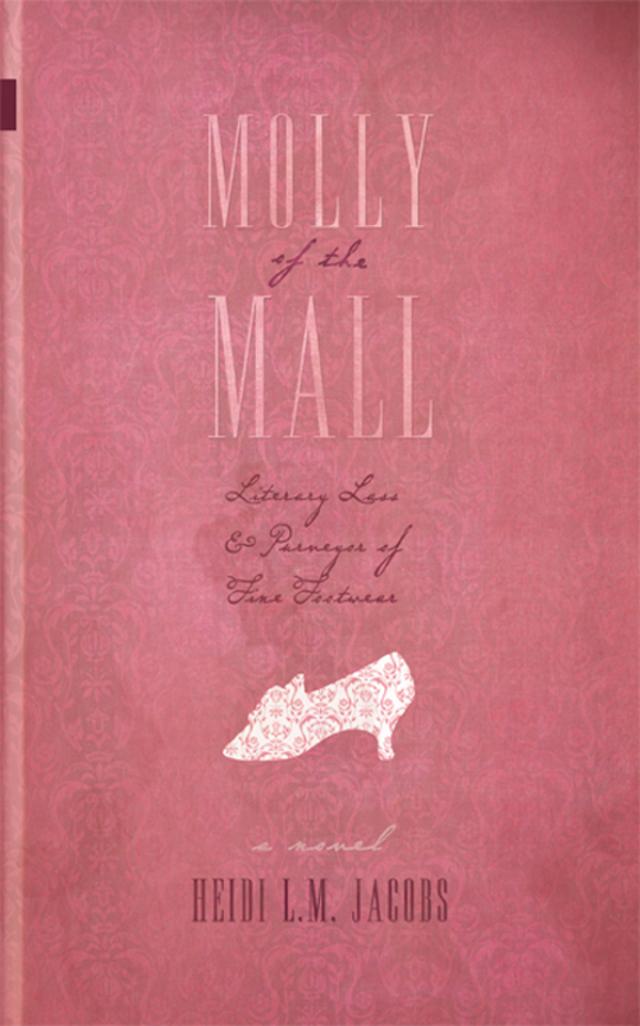
Molly of the Mall, page 1


Copyright © Heidi L.M. Jacobs 2019
All rights reserved. The use of any part of this publication—reproduced, transmitted in any form or by any means, electronic, mechanical, recording or otherwise, or stored in a retrieval system—without the prior consent of the publisher is an infringement of the copyright law. In the case of photocopying or other reprographic copying of the material, a licence must be obtained from Access Copyright before proceeding.
Library and Archives Canada Cataloguing in Publication
Jacobs, Heidi L. M., author
Molly of the mall, literary lass and purveyor of fine footwear : her history and misadventures / Heidi L.M. Jacobs.
(Nunatak first fiction series ; no. 50)
Issued in print and electronic formats.
ISBN 978-1-988732-59-6 (hardcover).--ISBN 978-1-988732-60-2 (EPUB).--ISBN 978-1-988732-61-9 (Kindle)
I. Title. II. Series: Nunatak first fiction ; no. 50
PS8619.A2545M65 2019 C813’.6 C2018-904450-0
C2018-904451-9
NeWest Press wishes to acknowledge that the land on which we operate is Treaty 6 territory and a traditional meeting ground and home for many Indigenous Peoples, including Cree, Saulteaux, Niitsitapi (Blackfoot), Métis, and Nakota Sioux.
Board Editor: Merrill Distad
Cover design & typography: Kate Hargreaves
Cover texture by shaire productions
All Rights Reserved
NeWest Press acknowledges the Canada Council for the Arts, the Alberta Foundation for the Arts, and the Edmonton Arts Council for support of our publishing program. This project is funded in part by the Government of Canada.
201, 8540 – 109 Street
Edmonton, AB T6G 1E6
780.432.9427
www.newestpress.com
No bison were harmed in the making of this book.
PRINTED AND BOUND IN CANADA
For my mum, Merle Whyte Martin
(1940-2018)
“All of us are better when we’re loved”
— Alistair MacLeod
May 1995:
Le Petit Chou Shoe Shop
The Mall, Edmonton
“My True Name is so well known in the Records, or Registers at Newgate, and in the Old-Baily, and there are some things of such Consequence still depending there, relating to my particular Conduct, that it is not expected I should set my Name, or the Account of my Family to this Work; perhaps, after my Death it may be better known, at present it would not be proper, no, not tho’ a general Pardon should be issued, even without Exceptions and reserve of Persons or Crimes.
It is enough to tell you, that as some of my worst Comrades, who are out of the Way of doing me Harm, having gone out of the World by the Steps and the String, as I often expected to go, knew me by the Name of Moll Flanders; so you may give me leave to speak of myself, under that Name till I dare own who I have been, as well as who I am.”
—Daniel Defoe, The Fortunes and Misfortunes of the Famous Moll Flanders, &c., 1722
WHEN YOU’RE NAMED AFTER SOMEONE OR something you spend much of your life asking why. Why Rita? Why Sequoia? Why Wayne Gretzky? Most people are named after a grandparent, a favourite aunt, or, if you live in Edmonton, a hockey player. Your name might illuminate who you are, a historical moment, or what your parents wanted for you as they gazed lovingly into the tiny, squirmy wad of blankets you once were. Maybe your parents say, “You were named after my Great-Aunt Rita who studied art with Matisse, established a safe haven for feral cats in Regent’s Park, and established an art school for underprivileged youth. We wanted to give you a name that conveyed her creative spirit, her compassion, and her commitment to social justice around the world.” Or, maybe you are told, “I named you Sequoia so you would always be strong and deeply rooted to the earth.” Or maybe you are told, “We named you Wayne because you were born the day they sold Gretzky to LA; it’s the least we could do for Wayne after all he gave us.” I am told, “You were named after the novel your father was teaching the day you were born.”
And now, twenty years later, I find myself at Canada’s largest shopping mall trying to explain to someone how it was that I became Molly. I was completing the paperwork for my new summer job at Le Petit Chou Shoe Shop and making small chat with Diana, the regional manager of the company that oversees four shoe stores in the Mall. Polishing my new name tag, Diana said, “Molly. That’s a name you don’t hear often. I was named after Diana, the Roman goddess of the hunt. Are you named after a famous Molly?” I looked up from my paperwork and saw she was well-named with her perfect hair and statuesque posture. I suddenly felt very short and in need of a haircut. I had to confess, “I was named after Daniel Defoe’s novel, Moll Flanders. It was written in 1722.” Without missing a beat, she said, “That is unfortunate, isn’t it?” I had to agree. Perhaps I should have used this opportunity to say, “My name is Molly, but I go by Camilla. Or Lucinda. Or Isabella.” Then I might not have had this hideous name tag in my hand with “Le Petit Chou Shoe Shop” sweeping elegantly across the top in a luxurious italic font, while “Molly, at your service” slumped in the middle in mundane Helvetica. After I signed the last piece of paper, Diana proclaimed, “You must be thrilled to be here, at the premier mall in the country. We think you should be delighted to be part of the Le Petit Chou family.” I noticed she left no room for disagreement, so I nodded and attempted to agree wholeheartedly.
Working at the Mall would be very different from being an English major, but I was feeling up for the challenge. I was no longer Molly, soon-to-be third-year English major. I was now Molly, full-time purveyor of fine footwear, at your service. As I made my way home on the bus, toting a large pink binder with Manual for the Purveyance of Fine Footwear emblazoned on the cover, I was thinking about how my life might have been different had I been named after a Roman goddess instead of a character in a novel neither of my parents like very much. What I didn’t tell Diana was the long story that led to me being named after Moll Flanders.
As the children of an English professor and an art historian, you might assume our names would have been chosen with a critical eye to symbolism. However, on the question of our names, there is a long answer and a short answer. I’m still working on the long answer, but the short answer is this. When my oldest sibling Tess was born, my father was a newly minted English professor, aglow and agog at the wonders of the British novel. The day she was born, he was preparing to teach Tess of the d’Urbervilles for his “The Tragic Vision of Thomas Hardy” graduate seminar, and he thought Tess would be a lovely name for his baby girl. My mother, apparently sedated, agreed. She later confessed that she had not finished the book or read my father’s dissertation (as she claimed she had). When she did read the novel, she sobbed for our Tess’s future: “We named our daughter after a murderess?” If there is an upside to Tess’s name it is this: had she been born a week later, my father’s class was reading The Return of the Native, and Tess would have been Eustacia Vye and thus condemned to roam the heath she loathes. As Tess, she merely has dramatically flawed relationships with men, even when they’re really nice. The downside of Tess’s name is that my parents remained committed to using my father’s class schedules to name their subsequent children.
When my brother was on the way, my mother was convinced she was having another girl, and she thought that Catherine would be a lovely name. My father, feeling perhaps a bit guilty about the whole Tess thing, succumbed to my mother’s lobbying, and scheduled Wuthering Heights (“Love and Thwarted Lust in Victorian Fiction”) around the due date. But Catherine was not to be; their second child was a boy. After emerging from sedation, my mother agreed to name her new baby after another flawed fictional character and they welcomed son Heathcliff. By the time I showed up, my mother had given up trying to stack the syllabus. Part way through his “Eponymy and Eponymity in the British Novel,” I was born and named after Daniel Defoe’s novel Moll Flanders. A class earlier, I would have been Clarissa and two classes later, Belinda. As my mother told me, “Your father first argued for Moll, but I got him to agree to Molly.” I nodded gratefully, though noted that on every birthday card, note, or memo my ever-tenacious father spells my name Moll(y). I’m convinced that when he says my name out loud or even thinks it, he adds the y in parentheses.
In naming us after literary characters, my father, a rising scholarly star, started a bit of a trend in the English department. During Christmas parties at the Faculty Club, graduate students laughed—some with irony, some with compassion, some with derision—at miniature versions of their professors named Tess, Heathcliff, Molly, Prufrock, Pellinore, Isolde, Gawain, Grendel, and the twins Leonard and Virginia. By the time wee Chiasmus Widgett-Jones was born, people realized the trend had gone too far. Besides, newer faculty were rebelling against the old guard on all fronts. The next generation of departmental children had solid Old Testament names. In recent years, the children’s tables at the department parties seemed less like living Norton Anthologies and more like Amish barn raisings.
It wasn’t until I had to read Tess of the d’Urbervilles and Wuthering Heights for a class last semester that I gave much thought to our own names. Neither of my siblings has read their eponymous novels, and so I feel a certain degree of superiority, as if I hold a key to their inner worlds denied to them. I finally understand why Tess broke up with the perfectly acceptable Mark Forster: she was fated by her place in the syllabus to have disastrous relationships with men. I also look at my brother, an aspiring agronomist, with
Even though Moll Flanders is one of those novels every English major should read, I have gleaned enough facts from the back-cover blurb to make me fear it might reveal something horrible about my fate. Here’s what I know: Moll led a life of “continu’d Variety ... she was Twelve Year a Whore, five times a Wife (whereof once to her own brother), Twelve Year a Thief, Eight Year a Transported Felon in Virginia, at last grew Rich, liv’d Honest, and died a Penitent.” I may be even more doomed than Tess.
After handing in my final papers last week, I realized I had a whole summer ahead of me and decided I should use this time constructively to finally read Moll Flanders. I stared at it all last night, but couldn’t bring myself to read more than the first paragraph and the back cover. Instead, I rewrote its back-cover blurb: “After several romantically melancholic years in Paris where the stunningly stylish Moll Flanders dated eighteenth-century equivalents of Jeremy Irons, John Cusack, and Alan Rickman, Moll moved to London where she became a cautiously respected artist, fashionably misunderstood novelist, and discreetly sought-after milliner. After a life-altering disagreement with her eighteenth-century Alan Rickman equivalent (who, while riding in a picturesque landscape in the rain, suffers a tragic fall from a very attractive dapple-grey horse, and utters ‘Moll. Forgive me,’ as his final words. The only one to hear his long-overdue apology was the dapple grey who promptly disregarded these words as inconsequential), Moll set out to make it on her own, possessing only her rapier-like wit and acute sense of style. In due time, she became an Augustan-era It Girl and found almost-true love with an eighteenth-century Noel Gallagher, and then truer love with a John Cusack equivalent.” I wrote twelve more versions of the blurb, all of them involving Alan Rickman, John Cusack, rain in a picturesque landscape, and an attractive horse of varying colours. Some included members of Oasis.
No matter how many times I rewrote the back-cover blurb, I had to come to terms with the fact that this Moll does not live in London, or Paris, nor does she perambulate within a picturesque landscape sodden with melancholic rain. Rather, this Moll lives in Edmonton where the men who love her are imaginary, fictional, or weird, the landscape is flat and snowy eight months of the year, and millinery is confined to the knitting of toques. Maybe instead of reading Moll Flanders this summer, I should write my own fortunes and misfortunes. And so, dear reader, I ask you, as Moll asks her dear reader on the first page, to “give me leave to speak of myself, under that Name till I dare own who I have been, as well as who I am.”
IN THE FIRST CHAPTER OF MOLL FLANDERS, MOLL says nothing about the condition of her feet, so I am assuming this form of suffering is unique to me. True, she suffered, but was she ever required to stand nine hours in ill-fitting pointy pumps of questionable quality? Assuming not, I will take this opportunity to make a clean break from the trajectory of Defoe’s narrative to note the misfortunes I endured today on my unpaid day of training.
While the Manual for the Purveyance of Fine Footwear promised that much of my first morning would be spent exploring the “art and nuances of excellence in shoe purveyance,” my manager-mentor Maureen covered chapters two through six in under five minutes. Perhaps she assumed—rightly—that I had read the manual on my own for the “official” word on shoe purveying.
As we are required to wear only Le Petit Chou shoes on the floor, my first half-hour was spent purchasing a pair of shoes to wear on my training day. Purchasing shoes from Le Petit Chou Shoe Shop (with “a generous 25-percent discount on regularly priced items”) was not just a way of enforcing a chain-wide dress code, it was also “an opportunity,” the manual said, to “literally walk a mile in our customers’ shoes.” The manual went on to say that by purchasing a pair of shoes on my first day, my manager-mentor would model the excellence in shoe purveying that Le Petit Chou (and its four sister stores) prides itself upon. Early on, I was convinced Maureen had never read the manual, since my “shoe purveyance mentoring” amounted to having a box of shoes thrust at me without what the manual calls “relationship building verbal invitations.” Instead she said, “Here, take these. They’re black. They’ll be perfect. We don’t have 7 ½. They’ll stretch. Where’s your Mastercard? Oh, and you’ll need polish and protective spray. They’re not covered in your discount.”
The remainder of my training was spent learning the unofficial version of what it means to succeed at Le Petit Chou, which, as far as I can tell, means not angering Maureen. Here are just a few things I learned. I will note them in case there’s a quiz later. Maureen said there might be and I fear she wasn’t joking.
• There are four nearly identical shoe stores in our retail family at the Mall: Le Petit Chou is the most prestigious store and I should be happy not to have had to work my way up. The next prestigious store is Prima Donna followed by Foliage. Tuesday’s is so far away in Phase One of the Mall, it’s almost not worth thinking about.
• There is a power structure that must be obeyed. At the top is Diana, the regional manager for all the prairie stores. On paper, Tim is the mall manager and oversees the four stores and its managers. In reality, Maureen runs all four stores, but I should never mention this fact to Diana or Tim because it makes them uncomfortable.
• If there are discrepancies between the cash in the till and the closing figures, I should assume the mistake is mine. Maureen’s tills are always balanced. She has never made an error. She is never wrong. Shortages will be taken off of my paycheque, and overages should be put into the empty jar on her desk.
• I must never be late. I must be on time when starting my shift and when coming back from any of my “generous breaks, lunch, or dinner hours.” This is especially true when she is working, because she has very important things to do. The last full-time employee made this mistake a lot. I shouldn’t try it.
• Maureen’s boyfriend is named Gordon and all women immediately fall in love with him when they see him. I should not make that mistake. I am not his type, not at all, so I shouldn’t even think of falling in love with him.
• The last full-timer also made the mistake of saying Maureen took “smoke breaks” when they are, in fact, “business breaks.” Actually, they’re not breaks at all, because she is still working. They are important business networking opportunities that she must undertake, because no one else will. And she smokes during them. But only because she has to. I wouldn’t understand. I shouldn’t even try.
• I must never speak of the last full-timer. Ever. I don’t need to know about her.
• The only reason I have my own name tag is because I’m “seasonal full-time.” I should be grateful to have a name tag because part-timers don’t warrant one until they’ve worked here six months. If we get a new part-time employee, they can use Karen’s name tag. There’s also a “Ken” if we have two part-timers on at the same time. They don’t mind being called Karen or Ken. Sometimes it’s easier not to have to remember their real names. (For contradictions, see chapter ten in the manual for the discussion of “managing personnel.”)
• On the matter of selling shoes, “they practically sell themselves.” But here are some helpful hints. If they’re too big, sell them inserts for the front of the shoe. If they’re too small, tell them they’ll stretch.
• While a customer was in the store, Maureen said, “And another thing: never refer to those really high-heeled shoes as ‘f____-me pumps’ in front of the customers.” The customer and I exchanged mortified looks before she scurried away to another store.
• Maureen contradicted everything I read in chapter eight about the importance of polish and protective spray: “I have no idea whether they work, but push them with every pair of shoes you sell.” She then offered this “how to get ahead” gem: “Polish and protective spray separate the forest from the trees—sell a lot and you’ll go far.”


