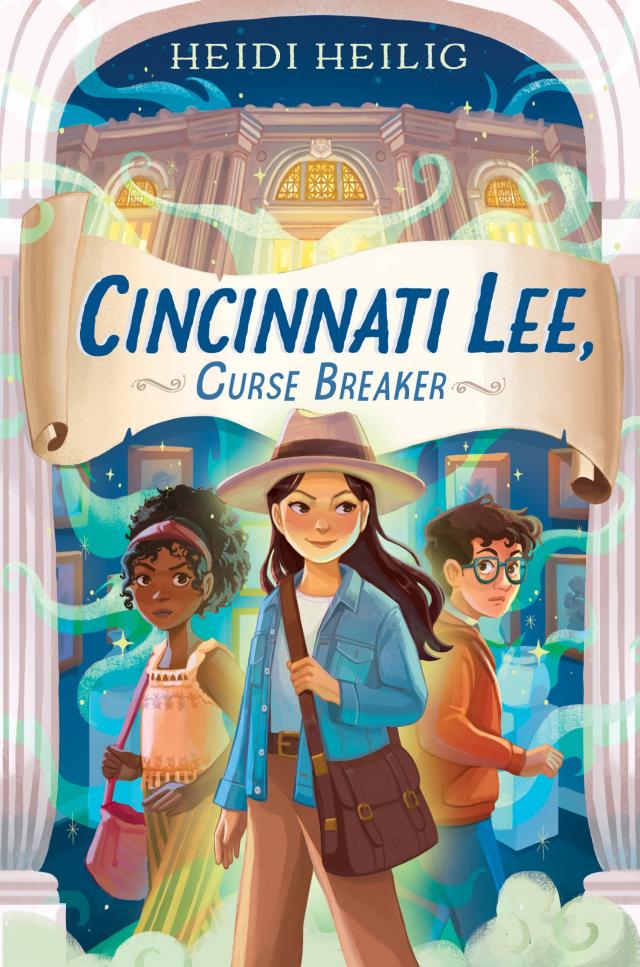
Cincinnati Lee, Curse Breaker, page 1


Dedication
To the Hansen-Youngs, and every girl whose sense of justice is far more powerful than her sense of self-preservation
Contents
Cover
Title Page
Dedication
Chapter 1: It’s All Fun and Games Until Someone Gets Cursed
Chapter 2: The Chachapoyas Idol
Chapter 3: Two Wrongs Make a Fight
Chapter 4: Suspension Is for Bridges
Chapter 5: An Unexpected Invitation
Chapter 6: Two Truths and a Lie
Chapter 7: Opening a Can of Worms
Chapter 8: You’ve Goat to Be Kidding Me
Chapter 9: Auctions Speak Louder than Words
Chapter 10: When the Light at the End of the Tunnel Is an Oncoming Train
Chapter 11: The Ones That Got Away
Chapter 12: Art(ifacts) and Crafts
Chapter 13: A Devil’s Bargain
Chapter 14: Home, Home on the Grange
Chapter 15: A Shot in the Dark
Chapter 16: To Bee or Not to Bee
Chapter 17: X Marks the Spot
Chapter 18: Forging Ahead
Chapter 19: I See London, I See France
Chapter 20: Friends and Enemies
Chapter 21: Second Curse, Same as the First
Chapter 22: A Sight for Sore Eyes
Chapter 23: Holding On and Letting Go
Chapter 24: Nat in the Hat
Author’s Note
Acknowledgments
About the Author
Copyright
About the Publisher
Chapter 1
It’s All Fun and Games Until Someone Gets Cursed
The first thing I ever stole was a diary.
I know, I know. Stealing is wrong. Everyone says that, though it hardly stops anyone. It sure didn’t stop me. Not once that diary was in my hands.
It was one of those real grown-up ones, with a leather cover that smelled like pipe smoke and unlined pages so you could write or draw. But I’m no writer, and less of an artist. I stole that diary to read.
I know, I know! Reading a diary is wrong, too. Even a practiced thief might consider that off limits, though I wasn’t a practiced thief back then. But this wasn’t any old diary. It belonged to my hero. My great-great-(great?)-grandfather. The archaeologist.
He had visited a hundred countries, some no longer on the map. He had seen a thousand cities, many of them lost. He had hacked through snake-infested jungles and outsmarted ancient booby traps on his hunt for priceless artifacts. He had even sipped from the spring of eternal life so he could live forever.
Back then, I wanted to be just like him. What I found in the diary changed my mind.
See, I wasn’t afraid of snakes, I was pretty clever with booby traps, and who wouldn’t want to cheat death? But curses were a whole different can of worms.
The misfortunes of the men who plundered Tutankhamun’s tomb . . . the blues that bedeviled every owner of the Hope Diamond. In archaeology, curses come with the territory. Even so, most people don’t take them seriously. They shrug them off as bad luck (for themselves) or bad decisions (for other people). Half of them are probably cursed and they don’t even know it.
See, curses are tricky little things, ruining your life so patiently that you might never realize there was a curse to lift. Some can even be passed down to your children . . . or your great-great-(great)-grandchildren.
I learned all about the family curse in the diary I’d stolen. Thankfully, I also learned how to break it. Which led me to my second theft: a Chachapoyas idol.
Chapter 2
The Chachapoyas Idol
The diary didn’t blame the Chachapoyas idol directly, but Pops had stolen the ancient clay relic from a mummy’s tomb in Peru. If that wouldn’t curse a person, I don’t know what would.
I only hoped that stealing it back would have the opposite effect.
Sneaking down a rocky tunnel, I pulled my battered fedora low. It wasn’t the one he used to wear on his adventures—Pops would have died before giving up that hat. Mine was from a street vendor on Fifth Avenue, but it was the same deep brown, and I wore it everywhere I could get away with it.
Ancient carvings lined the stony walls—zoomorphic, geometric, anthropomorphic, or “animals, shapes, and people,” for those who didn’t grow up wanting to be archaeologists. Had my great-great-(great)-grandfather seen the same carvings when he’d come to the Altiplano of Peru, where the Cloud People once lived? I wanted to run my hands over the walls—to touch them as he would have—as countless ancient hands would have done. But I was old enough to know to keep my hands to myself. Otherwise I might have left fingerprints.
If I had stretched out my arms, I could have brushed the tunnel on either side. The layout was inspired by the ancient settlement of Kuelap, built to funnel invaders into single file so they could be picked off one by one. I was fairly sure there were no Kuelapian warriors lurking in the shadows, but treasure as rare as the idol was always well protected.
The path led to a stone doorway carved with sacred serpents. In the room beyond, figures loomed in the corners, their painted faces lost in the sharp shadows of their wide jaws. The Sarcofagos de Karajia, built to contain the mummified bodies of revered Chachapoyas elders. They watched me warily, as though they remembered their brush with my own revered ancestor.
Respectfully, I tipped my hat as I approached the pedestal in the middle of the room. Atop it sat a rounded clay figurine, glowing in a ray of light: the idol.
It didn’t seem cursed. There was no roll of thunder, no chill down my spine. The relic just sat there, like a free sample at the supermarket. It would have been easy to take it. Too easy. I was inches away when I saw the thin lines of the pressure plate underneath.
A weight sensor—but I’d come prepared. From the leather bag at my hip, I pulled out an identical figurine. The same pale clay, the same round belly . . . fingers crossed the forgery was the same weight.
Crouching beside the pedestal, I brought the imitation right beside the real figurine. The Sarcofagi watched over my shoulder. I could do this—I could do this.
I took a deep breath. Then a voice from the hall almost made me drop the fake. “Our art department faithfully re-created the sacred serpents on the lintel—”
“Facite,” I cursed. It was now or never. Grasping the idol, I rocked it sideways and tipped the forgery into place in one smooth motion. I half expected the ominous rumble of an earthquake—or a giant rolling rock—but the alarm didn’t even chirp. Still, I barely had time to tuck the real statuette into my messenger bag before a mixed-race woman in a designer gown stepped backward through the stone doorway.
“And here you’ll see the gorgeous replicas of the Sarcofagi at Karajia,” she said to the well-dressed couple following her. “Their presence in the exhibit gives museum guests a sense of the importance ancestors held . . .” Her voice trailed off as she noticed her audience was not looking at the Sarcofagi but over her shoulder. Slowly, she turned, and the careful smile on her face faded. “Nat??”
I hid my grimace at the nickname. “Hi, Mom.”
“What are you doing here?” As she glanced down at my outfit, the surprise on Mom’s face melted into a look of horror. “And what on earth are you wearing?”
It was a fair question, considering she and her guests were dressed like they were at a fundraiser gala at the Cosmopolitan Museum of New York. Which in fact they were.
Just beyond the fake stone walls of the exhibit, the party was in full swing. It was the museum’s most important fundraiser of the year, and the guests were the most important donors, here for a first look at the museum’s newest attraction: Mummies in the Clouds. My own gala dress was in my leather satchel, cushioning the stolen idol, but there was no use telling Mom. She was a lost cause.
Instead, I stuck out my hand and gave her guests my best half-cocked smile. “I’m Cincinnati Lee.”
“Victor Garcia Belaunde,” the gentleman stammered—the very person I needed to find. We’d spent the last few weeks emailing about recovering this very Chachapoyas relic. “And this is my wife, Ariana Fernanda Belaunde-Perez.”
Their expressions were at least as shocked as my mom’s had been. I doffed my hat to the lady. “Charmed.”
“Likewise,” Mrs. Belaunde-Perez said, but I don’t think she meant it. “I would never have expected to see such a very . . . young person so interested in antiquities.”
Perhaps I had forgotten to mention my age in those emails. But Tutankhamun was nine when he took the throne of Egypt, and I was three years older than him. I was about to say so when my mom stepped in. “Nat practically grew up in the museum,” she said with an indulgent smile and a glint in her eyes that meant we’d talk later. “And of course this exhibit is all anyone’s been talking about.”
“My compliments to the curators,” Mrs. Belaunde-Perez murmured. The spotlight glittered on her tasteful gold jewelry as she approached the pedestal at the center of the exhibit—the one on which the replica now sat. “How did they ever get board permission to put such a . . . controversial relic on display?”
“Controversial?” Mom scoffed. “You can say it: ‘stolen.’”
“Stolen?” Mr. Belaunde’s face turned a sickly shade. He shot me a look, and my own stomach flip-flopped. The man couldn’t play it cool. Luckily my mom was just hitting her stride.
“You can’t have missed the protesters on the steps of
That word shouldn’t have stung; sticks and stones, right? After all, it wasn’t like Pops had taken the relic for personal profit. He’d only wanted to protect it—to bring it to a museum for safekeeping lest it vanish into the shadowy world of antiquities dealers and private collections. But reasons aren’t excuses, and actions speak louder than words. So I held the idol a little closer and let Mom keep talking.
“Of course, the museum board knows that controversy makes the news,” she concluded with a shake of her head. “They feel that any publicity is good publicity.”
“Think of the headline if they gave the idol back,” I said, not quite under my breath. Mom shot me a look more deadly than any booby trap, but Mrs. Belaunde-Perez spoke first.
“The Utcubamba Museum has put in several requests,” she said, with just a trace of bitterness. “But the courts have sided with the Cosmopolitan every time.”
“I’m not surprised,” I interjected. Then I cocked my hip, calling attention ever so subtly to the lump in my satchel. “Finders keepers, right?”
Mrs. Belaunde-Perez’s expression didn’t change, but her breath hitched and I could tell she’d caught my meaning. Mr. Belaunde took longer, but when he did, the look on his face made me think it wasn’t so bad that he wore his heart on his sleeve. “That’s what they say!”
For a moment I was worried he was going to hug me, but his wife laid a hand on his arm before he could. “Well, Ms. Lee,” she interjected. “Thank you for the tour. Shall we return to the party? I think I’m ready for dessert.”
“Of course!” My mom’s voice was a touch too bright. Had she caught on, too? No—Mom often said that the richer people were, the weirder they were allowed to act. Too bad I was broker than the Sphinx’s nose. Mom took me firmly by the wrist. “Why don’t you walk with me, Nat?”
I could think of a few reasons, but none as persuasive as her iron grip. So we continued through the rest of the exhibit side by side. Tasteful spotlights illuminated the funerary goods on display: woven regalia, knotted khipu, bone beads, and animal skins. The Belaundes didn’t even look. Maybe they were too excited at the thought of finally getting the relic back—or maybe they didn’t want to see all the other Chachapoyas stuff the museum was keeping.
Finally we passed through the gift shop and entered the massive rotunda. The room echoed with classical music and stilted laughter; the other guests had long since finished their chocolate lava cakes and were impatient for their own look at the new exhibit. I could tell my mom was impatient too. As special guests from the Chachapoyas region, the Belaundes merited a private tour, but there were lots of important museum donors in the waiting crowd.
“Go do your song and dance,” I said to my mom, trying not-so-subtly to shake her off. Her grip only tightened. “I’ll wait for you at the table.”
“You need to change first,” she said, steering me toward the bathrooms. “I don’t know what could get me in more trouble: your sense of style or your smart mouth. Tell me your gala dress is in that dirty old bag, Nat.”
I ground my teeth; she was lucky I had no time to argue about names. “My fancy shoes, too.”
“Good.” With a little push toward the ladies’ room, she released me at last. “I better see you in your dress and in your chair when I get back. And if you speak to the Belaundes while I’m gone, just don’t mention him,” she added.
“I won’t,” I promised; it wasn’t even a lie.
He was Pops, of course. Mom was under the impression that the Belaundes had no idea we were descended from the man who had spirited the relic out of Peru, but it was one of the first things I had told them. I wanted them to know I was serious—which is also why I hadn’t brought up my age.
Good thing, too, because I was one repatriated artifact closer to lifting the family curse—or I would be, as soon as I put the statue into the Belaundes’ hands. I could almost taste my victory, and it was sweeter than any chocolate lava cake.
There was only one other person in the ladies’ room, but of course she was in the extra-wide stall. I was hoping for a little elbow room to change, so I tried to wait her out, but she didn’t so much as shift her feet and the Belaundes were waiting, too. Finally, I gave up, stepping into the first stall, and stepping out again when I saw what the last guest had left behind. I spared a thought for the overnight cleaning crew—poor Ms. Truvello—and slipped into the middle stall instead.
Locking the door behind me, I hung my fedora on the coat hook. Then I set the satchel down carefully on the bathroom floor; the last thing I wanted was to drop the figurine on the tile as I pulled out this year’s gala dress.
It was the opposite of what an archaeologist would wear. The knee-length skirt made it impractical for acrobatics, and the fabric was the eye-catching blue and gold of a pharaoh’s mask. Almost as expensive, too—at least, it had been before it hit the clearance rack. A gown with a missing button was like the holy grail of Bloomingdale’s. Especially since our friends in the museum’s art department could make up a matching button in their sleep.
Wrangling the dress over my head was a struggle. Zipping up the back was worse. As I grunted and muttered, the person in the stall next to me flushed and left in a sudden hurry. After what I’d seen in the first stall, I guess I couldn’t blame them.
At last I got the gown where it needed to go. There was a full-length mirror on the wall near the sinks, so I went to make sure I’d pass muster. I fixed my hat hair and smoothed out the wrinkles in the dress; now all I needed were the shoes. Returning to the stall, I pulled my gold sandals out of my bag. I was buckling the last strap when my heart started to pound.
Slowly, I turned back to my satchel, still lying on the bathroom floor. It was made of leather, with two compartments split down the middle and three smaller pouches on the front. I searched all of them. Then I picked up my white shirt off the tile floor, followed by my cargo pants, and then the bag itself. Lastly, I lifted my hat from the hook, but the only thing behind it was the stall door.
There was a metallic taste in my mouth, and a buzzing in my ears. Someone had stolen my stolen Chachapoyas idol.
Chapter 3
Two Wrongs Make a Fight
When my alarm went off the next morning, I snoozed it three times before I got out of bed.
I’d tossed and turned all night, plagued by the sound of a flushing toilet and the quick footsteps of the person who had plucked the priceless relic right out of my bag. They must have reached under the divider while I’d been distracted by my dress. But who had been lurking in that extra-wide stall?
The only other person who knew my plan was my best friend, Felix Cordova. He’s the one who had made the forgery that now graced the pedestal at the center of Mummies in the Clouds. But his interest in the cursed idol was purely artistic. Besides, Felix was terrible under pressure—there was no way he could pull off a heist like that.
Whoever had was well prepared. They’d known I’d have to change for the gala, and they’d waited who knows how long in that bathroom. They might even have sabotaged the first stall to make sure I’d use the middle one, and sabotage like that showed true commitment. Then they’d vanished without a trace. By the time I’d burst out of the ladies’ room, the only people left in the rotunda were the waitstaff and the poor Belaundes.
Telling them had been the worst part. Mrs. Belaunde-Perez had excused herself with tears in her eyes, and Mr. Belaunde himself had turned a shade of green I’d only ever seen on the jade burial mask of Lord Pakal the Great (third floor, Mayan wing). He had put his hand on my shoulder. “We would never have put you in this position if we’d known,” he’d said. “You’re just a little girl.”
If he’d meant to help me feel better, he’d failed, but I didn’t want to feel better—I wanted to find the idol. So I’d spent the rest of the evening with my eyes on everyone’s shoes, looking for the light brown leather loafers I’d seen under the stall door. It was only once I’d changed back into my sneakers at the end of the night that I remembered how easy it was to stash an extra pair of shoes in a bag.