

The Whole Truth and Nothing But, page 1


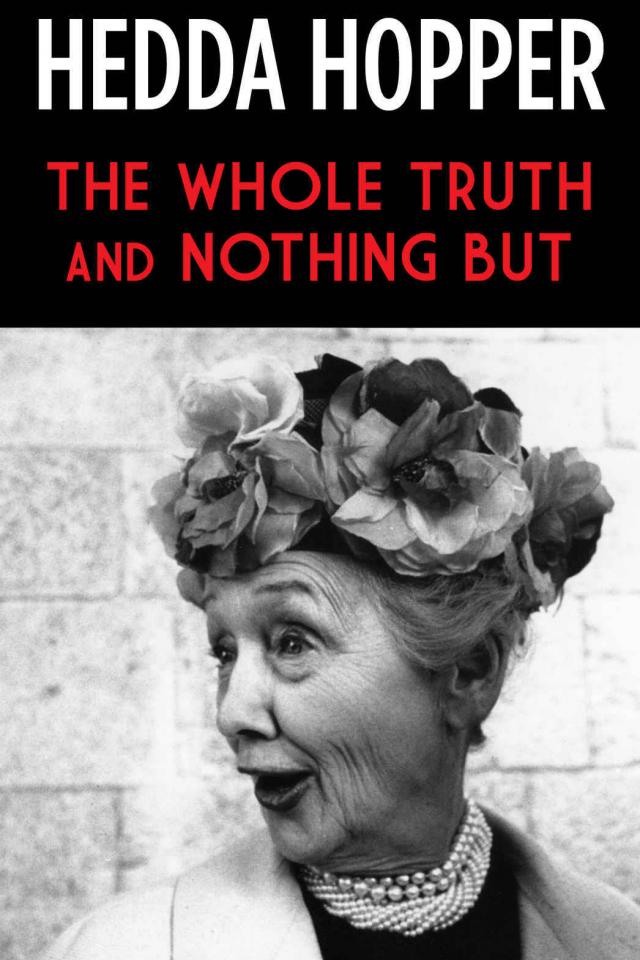
Other Books by Hedda Hopper
FROM UNDER MY HAT
The WholeTruth
and Nothing But
HEDDA HOPPER
[and]
[JAMES BROUGH]
DEDICATION
To my son, Bill, who never took
any sass from his mother
and never gave her any.
Contents
One
Two
Three
Four
Five
Six
Seven
Eight
Nine
Ten
Eleven
Twelve
Thirteen
Fourteen
Fifteen
Sixteen
Seventeen
Eighteen
Nineteen
I’m told that when you write a book with a title like this, you must let your readers know something about your life. Well, I was born into the home of David and Margaret Furry, one of nine children. Seven of us grew up. Three of us are still here, including my sister Margaret and brother Edgar, who played a good game of football when he attended Lafayette quite a while back.
I first saw the light of day in Hollidaysburg, Pennsylvania, a beautiful suburb of Altoona, which used to live off the Pennsylvania Railroad and its affiliates. Since railroads have fallen on lean and hungry years, I don’t know what’s feeding the place today.
My mother, an angel on earth whom I worshiped, named me Elda, from a story she was reading at the time. Years later, after I’d married DeWolf Hopper, a numerologist changed Elda to Hedda. My husband, Wolfie, was much older than my father and had been married four times before. The wives’ names all sounded pretty much the same: Ella, Ida, Edna, and Nella. His memory wasn’t as sharp as it had been, and he couldn’t always remember that I was Elda.
As time went on, this started to irk me, so the numerologist came up with Hedda Hopper. I asked how much. “Ten dollars.” That’s exactly how it happened; it changed my whole life. It was the best bargain I ever made. Wolfie never forgot it, and I’ve never regretted it.
My sister Margaret was my father’s pet. He and I didn’t get on well. He thought women should be the workers; I believed my brothers should share the burden. Mother was ill for six years after Margaret’s birth, and I took on her duties as well as my own, since my older sister Dora had married. I had to catch a brother by the scruff of the neck to get any help, but they all helped themselves three times a day to the meals I prepared. I also did the washing, ironing, cleaning, and helped Dad in his butcher shop.
When I couldn’t take it any more, I ran away—to an uncle in New York. I found a stage door that was open, walked in, and got a job in a chorus, which started a career.
My family now consists of my son Bill, who plays Paul Drake on the “Perry Mason” TV show without any help from me. When he went off to war, he’d already attained stature as an actor. On his return—with a medal for valor which I’ve never seen—not one soul in the motion-picture industry offered him a job. Hell would have frozen over before I’d have asked anyone for help for a member of my family.
So Bill went to work selling automobiles for “Madman” Muntz. One day he woke up to the fact that he was an actor, got himself a part with director Bill Wellman in The High and the Mighty—and asked Wellman not to tell anybody who his mother was. Bill has a beautiful daughter, Joan, who’ll be sixteen next birthday.
I don’t like to dwell on death, but when you reach my age (and I’m still not telling) you realize it’s inevitable. I’ve left instructions for cremation—no ceremony—with my ashes sent to an undertaking cousin, Kenton R. Miller, of Martinsburg, Pennsylvania. I’d wanted a friend to scatter them over the Pacific from a plane, but California law forbids that. You have to buy a plot.
A salesman from Forest Lawn told me they’d opened a new section and I could rest in peace next to Mary Pickford for a mere $42,000. “What do I get for that?” I asked.
“Well, a grave, picket fence, and a golden key for the gate.”
“How do you figure I could use it?”
“Oh, Miss Hopper, that’s for the loved ones who will mourn you.”
That’s when I decided on my cousin.
One
I knew Elizabeth Taylor was about to dump Eddie Fisher in favor of Richard Burton soon after Cleopatra started filming in Rome. Because in forty years in Hollywood I’ve told the truth—though sometimes only in part for the sake of shielding someone or other—I wrote the story. This was in February 1962, one week before the news burst like a bomb on the world’s front pages.
But Elizabeth, Burton, and I have something in common: Martin Gang, a top-notch attorney, has us as clients. He saw my column, as usual, before it appeared, and came on the telephone in a hurry. “Oh, you couldn’t print that,” he said. “It would be very embarrassing for me to sue you, since I represent all three.”
I was in Hollywood at the time, not in Rome, so I was wanting the firsthand information, the personal testimony, which would be important in self-defense. I deferred to his judgment—and kicked myself for doing it when the news from the Appian Way began to sizzle.
I’ve known Elizabeth since she was nine years old, innocent and lovely as a day in spring. I liked, and pitied, her from the start, when her mother, bursting with ambition, brought her to my house one day to have her sing for me. Mrs. Sara Taylor was an actress from Iowa who had appeared just twice on Broadway before she married Francis Taylor, who worked for his uncle, Howard Young, as a manager of art galleries on both sides of the Atlantic. When World War II came along, she was in raptures to find herself with a beautiful young daughter, living right next door to Hollywood—her husband came to manage the gallery in the Beverly Hills Hotel.
Sara Taylor had never gotten over Broadway. She wanted to have a glamorous life again through her child. She had the idea at first that Elizabeth could be turned into another Deanna Durbin, who had a glittering name in those days. “Now sing for Miss Hopper,” she commanded her daughter as soon as our introductions were over and we were sitting by the baby grand in my living room.
“Do you play the accompaniment?” I asked. “I can’t.”
“No, but she can sing without any. Elizabeth!”
It struck me as a terrifying thing to ask a little child to do for a stranger. But in a quivering voice, half swooning with fright, this lovely, shy creature with enormous violet eyes piped her way through her song. It was one of the most painful ordeals I’ve ever witnessed.
I remembered seeing the four-room cottage—simple to the point where water had to be heated on the kitchen stove—in which Elizabeth was born. Little Swallows was its name, and it sat in the woods of her godfather, Victor Cazelet; his English estate, Great Swifts, was in Kent. She had a pony there and grew to love animals like her chipmunk, “Nibbles,” which ran up my bare arm when she brought it around on a visit one day. I screamed like a banshee, but Elizabeth was as patronizing as only a schoolgirl can be.
“It’s only a chipmunk; it won’t hurt you,” she promised scornfully.
You couldn’t have wished for a sweeter child. She would certainly have been happier leading that simple life close to woods and wild things to be tamed, maybe through all her years. But her mother had been bitten by the Broadway bug, and few women recover from that.
Once the family was settled in Hollywood, Mrs. Taylor maneuvered the support of J. Cheaver Cowden, a big stockholder in Universal Pictures, to get a contract for her daughter at that studio. Elizabeth was there for one year, but studio chieftains always resent anybody who’s brought in over their heads through front-office influence. They made sure the girl got nowhere fast. Her mother tried everything to find her another job, but it was her father who happened to land her at MGM through a chance remark he made to producer Sam Marx when they were patrolling their beat together as fellow air-raid wardens. She was given a bit in Lassie Come Home, then blossomed in National Velvet with Mickey Rooney.
I remember the day she cinched in her belt, which showed her charms to perfection, and Mickey turned to me and said: “Why, she is a woman.”
“She is fourteen,” I replied. He started toward her. I caught him by the seat of the pants. “Lay a hand on her, and you will have to answer to me. She is a child.”
He looked hard at me and said, “I believe you would beat me up.”
“I sure would.”
Victor Cazelet, on a wartime mission for the British Government to New York, wanted desperately to get to California to see the godchild he adored. Though he was a millionaire in his homeland, strict currency controls meant that he hadn’t any dollars to pay the fare. He was staying as a house guest of Mrs. Ogden Reid, owner of the New York Herald Tribune in those days, but he had qualms about borrowing from her.
When he telephoned me, I had what I thought was a brain wave: “What about Victor Sassoon? He’s rich as Croesus, and he’s holed up through the war at the Garden of Allah.” I wanted to call him at that exotic sanctuary on the Sunset Strip, where the likes of Scott Fitzgerald, Robert Benchley, and Humphrey Bogart used to frolic before it was demolished to make way for Bart Lytton’s bank.
“He doesn’t do anything for anybody,” Victor warned me, but I couldn’t be convinced until I spoke to Sassoon mys
So I booked Victor into the Ebell Theatre in Los Angeles to give a lecture to earn his passage money west. He stayed with the Taylors for a week, which was the last he saw of Elizabeth. Several months later the Nazis shot down the plane he was in, believing that Winston Churchill was aboard. They were halfway right. Victor was on a mission for his friend Winston Churchill.
I remember Elizabeth visiting my house with Jean Simmons when she was on her way back from the South Seas and the filming there of Blue Lagoon. They sat together on the long settee in the den, bright as birds and chattering nineteen to the dozen. I thought I had never seen two more beautiful young girls.
As the years went by, I saw Elizabeth through many romances and four marriages, starting with Nicky Hilton. He was a boy, and I don’t believe he’d had too much experience. On their European honeymoon he left her too much alone, though everyone wanted to meet his beautiful bride. When she came home, she took a second-story apartment in Westwood with a back entrance on an alley. Before she had a chance to sort out what had happened to her, the parade of suitors began—married men, stars. Did any of them love her and try to help? No. They used her. I’m making no excuses for her, but I’m trying to be objective.
Then she was put into another picture. She was exhausted from working too hard and too fast in the rat race on the sound stages. She was swamped with advice from everybody. She couldn’t tell true from false. Thus it went from one man to another, one picture to another, until she fell in love with Michael Wilding, who was twenty years older than she. Was she unconsciously looking for a strong father? She loved her own, but he didn’t stand up to his wife.
Mike and Stewart Granger were pals and playmates; had been for years. Each married beautiful young girls—Stewart had his eyes on Jean Simmons when she was fifteen. Elizabeth sat on my settee again the night she came in with Michael Wilding. Stewart and I had exchanged some words over the telephone before Michael and Liz arrived.
“You’re not coming here with them,” I said flatly, “and if you do, you won’t be let in. I have nothing to say to you. I want to talk to her.” That was that. So two, not three of them, knocked at the front door.
What was to be said was for their ears only. “Elizabeth, I don’t think you know what you’re getting into. In the first place, he’s too old for you. And the rumor around town is that Michael Wilding and Stewart Granger are very, very close.”
She blushed deep red. “It couldn’t be!”
There was one fair question to ask, and I asked it. “Are you denying it, Michael?” He sat there with eyes downcast.
I turned to Liz. “Are you going to marry a man like that? Do you know what kind of life you’ll have?” He should have got up and hit me, but he sat still.
“I love him,” she exclaimed.
“You don’t know what love is. You don’t know what you’re talking about. He’s sophisticated, he’s gracious, but I beg you not to marry him.”
She didn’t listen then or later. She drove Wilding into marriage. “I am too old for you,” he’d argue. “It will never last, Elizabeth.”
“I love you, and you’re going to marry me, that’s all,” she would say.
The Wildings and the Grangers lived together in Hollywood for a few months. British men like to drink—it’s part of their daily diet—and the girls learned how. Then Mike left for England and Liz followed him. From that marriage came two sons, Michael and Christopher. After each birth she had to go to work too soon. Before she could face the cameras, she had to take off pounds in a hurry, just as Judy Garland did, and it weakened her health.
Mike was given a contract at Metro, her studio, but when it ran out it wasn’t renewed. During this time she bought two homes, the second because the first wasn’t big enough for two children, a nurse, and Mike’s eighty-six-year-old father, whom she brought over from England to stay with them. The studio paid for both houses, deducting the money from her salary, which was standard practice.
I knew the marriage was over when Mike started to criticize her in public—before strangers, before anyone. She never stopped working. She was a lady, America’s queen of queens, who loved her children and was a good mother to them.
She played in Giant with Jimmy Dean, whom she respected and loved like a brother. His senseless death shattered her nerves. Her director, George Stevens, was mad about her and had been since she made A Place in the Sun for him.
I saw her on her good days and bad. In Raintree County and Suddenly, Last Summer, she got to know Montgomery Clift and admired him. Then he raced his car down the hill from her home after a drinking bout with Wilding there, ran into a telegraph pole, and nearly died. Elizabeth sped after him, crawled into the wrecked car, and held his head in her lap until the ambulance arrived. Soaked with blood, she rode to the hospital with him and stayed long enough to know that he’d live.
Then along came Michael Todd, who taught her an awful lot about love and living. He was one of the most sophisticated and ruthless men in show business. He had gone through the jungle of Broadway and come out with many scars.
After Mike had made Around the World in Eighty Days, he wanted someone to help sell it. Who else but the queen of the movies? I don’t think he needed her more than she needed him, but they fell in love, and he taught her everything he knew about sex, good and bad. He proposed to her in the office MGM gave him at the studio when he was shooting Around the World. He said: “Elizabeth, I love you, and I’m going to marry you, and from now on you’ll know nobody but me.” Only he didn’t say “know.”
They were married in Mexico, and they started one of the craziest, fightingest, most passionate love matches recorded in modern times. She appeared in the newspapers and magazines every day, every issue. Every facet of their lives was exploited for the benefit of love-starved fans. Gold poured into the box office for her pictures and his Around the World.
He bought her the world, or as much of it as he could lay hands on: a new jewel or a half dozen of them every Saturday; a plane; a villa in France; dresses by the hundred. Whatever she wanted, she got. He knew he was spoiling her rotten, but he loved to see her face light up when she saw his presents. For the Academy Award show where he expected her to collect an Oscar for Raintree County, he bought her a diamond tiara. “Hasn’t every girl got one?” he asked blandly. He gave her a Rolls-Royce and a $92,000 diamond ring.
“Don’t spoil her,” I told him time and again. “She’s impossible enough already.”
In return she gave him a daughter. Her pregnancy was heralded like Queen Elizabeth’s or Princess Margaret’s. She had an operation that almost took her life. She has two vertebrae in her back that came from a bone bank. I didn’t know about that until she told me. The baby arrived, Liza, a dark-eyed witch who at three months could read your mind.
Mike used to say: “If you want to be a millionaire, live like one.” For the London opening of his picture, Elizabeth was draped in a ruby-and-diamond necklace, with bracelet and earrings to match. It was an occasion straight out of the Arabian Nights.
In London for all the high jinks, I watched Eddie Fisher’s maneuvers to pay court to Elizabeth in the enormous suite at the Dorchester where Mr. and Mrs. Michael Todd were registered. Debbie lingered in the Fisher suite several floors below. I had missed Elizabeth and Mike like the dickens when they left Hollywood in advance. They made me promise I’d be in London with them for the Around the World hullabaloo.
When I checked into the hotel, there was a message from Mike inviting me to see them. I unpacked, changed, then went on up to the top floor, which was taken up entirely by their double suite. I happened to walk first into Liz’s half. There she sat, bulgingly pregnant in a white lace robe, with her bare feet on a coffee table, drinking Pimm’s No. 1 from a pitcher at her side, with the diamond tiara hanging out of a pasteboard box.


