

Truly, Madly, Sheeply, page 1


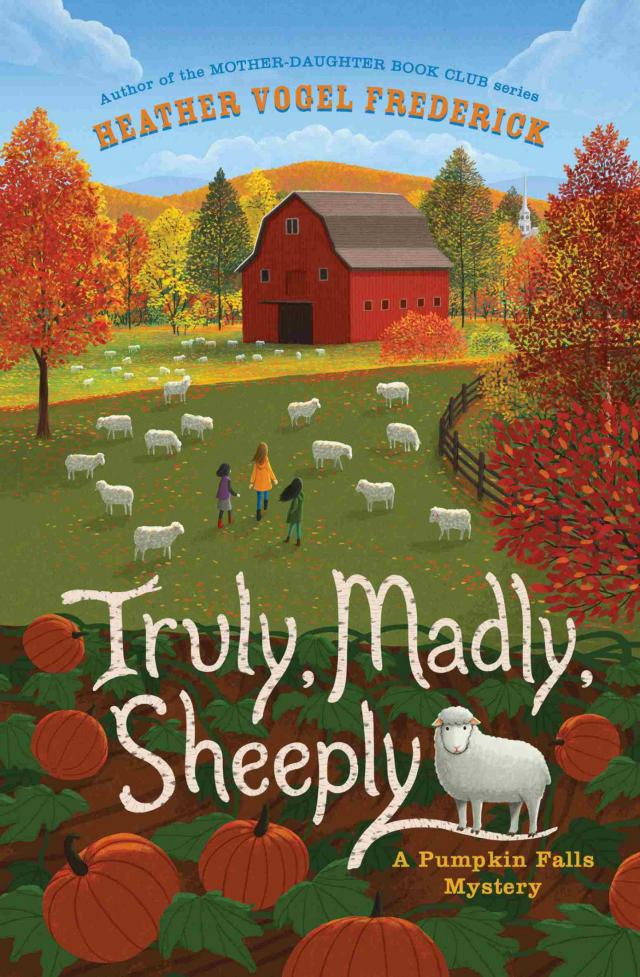
For Jamie and Elisabeth,
our family’s newest little lambs—
and for all my new friends,
both two-legged and four,
at the real Liberty Hall Farm
PROLOGUE
It’s all Ella Bellow’s fault, if you ask me, which nobody ever does.
If only she’d kept her famously big mouth shut, the fall of my eighth-grade year would have been a nice, fat helping of normal.
And here’s the thing—I really like normal.
Unfortunately, my life has been anything but normal since my family moved last winter from Austin, Texas, to Pumpkin Falls, New Hampshire, and I accidentally became a middle school private eye. You wouldn’t think all that much could happen in a town as tiny as ours, but somehow, I keep stumbling over mysteries that need to be solved.
Ella couldn’t resist a juicy piece of gossip, though. Once she’d blabbed to my aunt that the Farnsworths were thinking of selling their dilapidated old farm, in the shake of a lamb’s tail—literally, a lamb’s tail—my life was turned upside down again.
This time around, instead of that nice, fat helping of normal I’d been looking forward to, regular stuff like school and swim team and hanging out with my friends and helping at our family’s bookstore, I found myself knee-deep in sheep droppings in a possibly haunted barn, embarking on a life of crime. Well, okay, maybe not a life of actual crime, but how many eighth graders do you know who’ve had to learn how to pick a lock? I say “had to” because I didn’t have a choice, really—not if I wanted to clear my brother’s name and save our town’s biggest festival of the year. The Halloween Pumpkin Toss may not sound like much to the average person, but here in Pumpkin Falls, it’s like the Fourth of July and Christmas and your birthday all rolled into one.
“Sometimes, crazy is the best thing to do,” my aunt True says, and I certainly did my fair share of crazy this time around. Of course, I had no idea that any of this was on the horizon back when my aunt first told us about the farm. All I’d been thinking about—all any of us Lovejoys had been thinking about—was the wedding.
CHAPTER 1
“Don’t you think you’re being a bit hasty?” said my father, reaching for the platter in the center of the kitchen table.
I watched as the fingers of his prosthetic hand deftly plucked a waffle from the pile and transferred it to his plate. My father had come a long way in the year since he’d lost his right arm to the war in Afghanistan. None of us gave his expertise with his titanium fingers a second thought now, including him.
“Hasty?” Aunt True frowned. “I’ve known Rusty since kindergarten!”
My father snorted. “I’m not talking about the wedding, True—I’m talking about the old Farnsworth place! What do you two know about farming?”
“Living on a farm has always been one of my fondest dreams,” my aunt told him loftily. “Rusty’s, too.”
My father gave her a dubious look. “Since when?”
“Since I spent six weeks on a sheep farm in New Zealand,” my aunt replied.
The titanium fingers, which had now latched onto the pitcher of maple syrup, froze. “That was two decades ago! You were on a high school exchange program!”
My aunt was silent, but only for a moment. “There was also my trip to Tibet.”
“What happened in Tibet?” I asked, hoping for a story. Aunt True was a world traveler, and her adventures in remote corners of the world often sparked epic tales.
“I worked with yak herders” was all she said this time, though.
“What’s a yak?” asked Pippa, my youngest sister.
“It’s like a big, ugly, hairy cow,” my middle sister, Lauren, told her.
Pippa scrunched her nose. “Maybe they should call it a yuck.”
“Good one, Pipster!” My brother Hatcher slapped her a high five.
“Spending a few weeks with sheep, or with yak herders, or whatever other experience you think you’ve had, is a whole lot different from running a farm of your own,” my father persisted. “And what about Rusty? He’s spent most of his life shut up in a library!”
My dad had a point. Aunt True was always insisting that Erastus Peckinpaugh, her history-professor fiancé, had what she called “hidden depths.” But he didn’t exactly strike me—or anyone else in town, for that matter, judging from the talk I’d overheard at the general store—as farmer material. He must have kept that side of himself really well hidden.
“Libraries are fine places to learn a great many things,” my aunt said stiffly.
My father snorted again, and this time, my mother stepped in.
“Perhaps it’s time to mind your own business, J. T.,” she told him. “Everyone’s entitled to their dreams.”
My father speared a piece of syrup-drenched waffle with his fork. “Fine. But everyone knows that place is a wreck. It was a wreck even back when we were kids!”
“I’ll admit it needs work,” allowed Aunt True. “That’s why we can afford it.”
“What it needs,” my father declared, shoving the bite of waffle into his mouth, “is a bulldozer.”
“Daddy’s talking with his mouth full,” Pippa observed, and my mother shushed her.
My father and his older sister had been going around and around like this ever since Aunt True had announced that she and Professor Rusty—soon to be Uncle Rusty after their wedding next weekend—had bought the old farm on the outskirts of town.
It was Ella Bellow, our town’s retired postmistress turned knitting store owner, who broke the news that it was going up for sale. Ella considered herself in charge of gossip in Pumpkin Falls. I’d known something was up when I glanced out the window of our bookshop and saw her burst from the front door of A Stitch in Time and make a beeline across the street. Either her entire yarn supply was on fire, or Ella had news to share.
“True!” she’d called, barging in through the bookshop door. The bells attached to the top of it jangled vigorously, apparently as excited as she was. Miss Marple, my grandparents’ golden retriever, who had been napping in her dog bed by the counter, lifted her head and woofed.
“My aunt’s in the back office, Mrs. Bellow,” I told her. I was killing time before my piano lesson, trying to come up with a concept for a special window display for the leaf peepers. “Leaf peepers” were what the locals called the hordes of tourists who descended on little towns all over New England every autumn, eager for a glimpse of our famous colorful fall foliage.
“True!” Ella called again, louder this time. “Have you heard?”
We were having a quiet afternoon, fortunately. There were only two customers in the store at the moment, neither of whom were local. If Ella had something embarrassing to share, at least they wouldn’t know who she was talking about.
My aunt emerged from the back. “What’s up, Ella? Is everything okay?”
Ella drew herself up to her full height, which was considerable. She was almost as tall as my aunt and me, and we both stood six feet in our socks. After a dramatic pause, she blurted, “The Farnsworths are selling up!”
Aunt True gave her a puzzled look. “What do you mean?”
“I just got off the phone with Thelma Farnsworth. She finally managed to talk Elmer into retirement. They’re moving into town to live with Ethel and Ike.”
Ethel was Thelma Farnsworth’s sister. She was married to Elmer Farnsworth’s brother, Ike. Ike and Ethel owned Pumpkin Falls’s general store.
My aunt looked thoughtful. “Is that right?”
Thelma’s been wanting to do this for a while now,” Ella barreled on, “but you know how Elmer is when he digs his heels in.”
Sadly, I did. Part of living in a small town was knowing exactly this kind of detail about, well, pretty much everybody. Elmer Farnsworth was famously stubborn.
“It was the mix-up with the pumpkin trophy that pushed Thelma over the edge,” Ella continued. “She gave Elmer an ultimatum—he could move into town with her, or she’d go alone.”
That mix-up had been a big part of my summer. The whole town had been in an uproar when the silver pumpkin trophy disappeared after the Fourth of July road race, and while everyone was relieved when it turned up safe and sound again, no one was happy with Elmer, who had inadvertently caused the commotion in the first place.
“They may already have a buyer, in fact. Apparently some developer has been sniffing around.”
Aunt True snapped to attention. “What do you mean, developer?”
“Real estate,” Ella replied, clearly pleased to have delivered such an item of interest. “He’s looking for land to build a strip mall. That’s prime property, right on the road into town.”
“A strip mall?” My aunt stared at her, aghast. “But that would be a crime! That dairy farm has been in the Farnsworth family for generations! It’s a local landmark!”
Ella nodded, trying unsuccessfully to arrange her face into a mournful expression. But she couldn’t hide her smile. My aunt’s gratifying reaction to her exclusive tidbit had clearly made her day. News delivered, Ella swiftly bid us goodbye. I watched as she trotted away down Main Street. Ella was more efficient than the Internet when it came to spreading gossip, and I gave it less than fifteen minutes before all of Pumpkin Falls knew about the Farnsworths’ farm.
She was barely out of sight before Aunt True grabbed her jacket. “Truly, can you watch the store for me for a few minutes? I have an errand to run—I won’t be long, I promise.”
If Elmer Farnsw
Truth be told, I kind of agreed with my father. Aunt True had never mentioned anything to me before about wanting to own a farm. I gave her a sidelong glance. She was dressed in her usual part hippie, part parrot fashion: a shapeless, fuzzy lime-green sweater pulled haphazardly over camouflage leggings. Bright yellow clogs completed the outfit. Her hair was pulled up in a messy bun skewered with what looked like, and probably were, chopsticks. Chopsticks brought back from a trip to some obscure country I’d never heard of on the other side of the world, no doubt.
Was she farmer material? I took a bite of waffle and pondered this question.
My pondering was cut short by a loud honking outside as a rattletrap truck pulled into the driveway. Professor Rusty emerged from the driver’s side, wearing overalls and a huge grin. Spotting my aunt through the kitchen window, he held up a set of keys and dangled them triumphantly.
Aunt True’s face lit up. “Rusty got the keys to the farm!” Darting out the back door, she launched herself at her fiancé. We were all right behind her.
“Congratulations, homeowners!” said my mother.
“Who wants a tour?” asked Professor Rusty.
Aunt True looked over at my parents. “Do we have time?”
“No,” said my father, at the same time that my mother said, “Yes.”
Gramps and Lola were flying in for the wedding from Africa, where they were stationed in the Peace Corps. We were skipping church to drive down to Logan Airport in Boston to meet their flight from Namibia. Lauren and Pippa had been busy for days with colored pens and glitter decorating welcome signs for us to hold up to greet them when they arrived.
“Oh, come on, J. T.,” said my mother. “Stop being such a stick-in-the-mud. We can manage a quick tour and still make it to Boston in time.”
We didn’t even wait for my father to reply. Without another thought for our unfinished breakfast, my brothers and sisters and I all piled into our family’s minivan. My mother slid into the driver’s seat, then leaned out the window and smiled at my father. “Coming?”
“Do I have a choice?” he grumbled, but he gave her a reluctant smile in return. “Although I can’t say I’m not curious to see what kind of a mess True’s gotten herself into this time.”
And with that we followed my aunt and almost-uncle’s truck out of the driveway.
CHAPTER 2
My father was right about one thing. The farm did need a bulldozer. Or maybe dynamite.
“Wow, the farmhouse is so—it’s so…” My mother groped for the right word. “Quaint.”
“Does ‘quaint’ mean it’s the perfect location for a horror movie?” Hatcher whispered to me as we stared at the property that our aunt and soon-to-be uncle were about to call home.
If the farmhouse’s peeling paint and shabby exterior qualified as “quaint,” the barn that loomed beside it was positively scary. I was usually a big fan of barns, ever since Lola had read Charlotte’s Web to us when we were little. But Hatcher was right, this one definitely looked like horror-movie material. Its once-bright-red exterior had faded to the rusty color of an old scab, part of the roof had caved in, most of the windows were either cracked or broken, and the missing clapboards gave it a gap-toothed look, like Pippa back when her baby teeth had fallen out. On top of that, the entire structure was leaning at an alarming angle, as if it was planning to cut and run.
“Elmer and Thelma really let things go around here,” said my father, shaking his head.
Aunt True was oblivious to our dismay. “Sure, it needs a little work, but look at that view! Could it be any more glorious?!”
She was right about that, at least. Situated just down the road from the Freeman family’s farm, where my friend Franklin and his sister Annie and their parents lived, the Farnsworth place shared the same sweeping view of the Pumpkin River Valley. Even though peak color was still a week or two away, according to the weather reports—everybody got involved when leaf-peeping season rolled around, even the weather forecasters—the foliage was impressive, a bright patchwork of reds and oranges and yellows threaded with evergreens.
Technically, I guessed I qualified as a leaf peeper too. Before moving to New Hampshire last winter, we’d only ever visited Gramps and Lola during summer vacation and at Christmastime—never in the fall. I used to think the whole idea of leaf peeping was ridiculous, but as the colors had intensified over the past couple of weeks, I was beginning to understand what people got all excited about. It was pretty amazing.
“The house was built in 1779,” Professor Rusty told us proudly. “It’s one of the oldest in Pumpkin Falls.”
“It looks like it, too,” Hatcher said under his breath.
“Come see the barn and outbuildings, J.T.!” Professor Rusty charged down the driveway without waiting for a reply.
Lauren grabbed Pippa’s hand and followed. “Let’s go see the animals!”
My sister Lauren was a huge animal lover. Aside from Aunt True and Professor Rusty, she was the only one in the family who’d been enthusiastic about the whole farm idea from the start. The fact that it was located practically next door to her best friend, Annie Freeman, didn’t hurt, either.
My oldest brother, Danny, loped off after them, while Hatcher and I followed our mother and aunt toward the house.
“Wait until you see inside, Dinah!” Aunt True enthused, fumbling with the keys to the front door. “It has an open hearth with the original beehive oven, and the most gorgeous wide-plank floors.”
Given the farmhouse’s dilapidated exterior, I was surprised at how inviting it was inside. It was shabby, for sure. The floors were worn from centuries of use, the wallpaper was peeling, and everything smelled faintly of woodsmoke. Other than that, though, it wasn’t bad. No piles of dust, no cobwebs. October sunshine poured in through the front windows, lighting up the enormous brick fireplace in the living room—almost big enough to stand in—along with all the stuff that the Farnsworths had left behind.
“There are some valuable antiques here, True,” said my mother, scanning the room in surprise. “You should get Luke Mahoney out to appraise them for you. That clock on the mantel is a beauty, and I think this desk might be bird’s-eye maple. And heaven knows what’s in all those boxes!”
Aunt True nodded. “Thelma and Elmer don’t have kids, and their nieces and nephews already took what they wanted. They were happy to leave us the rest.”
I was sure they were—especially Thelma. She found Elmer’s piles of junk exasperating. Elmer Farnsworth was a notorious hoarder, famous for picking through trash and surfing yard sales and junk shops. “One man’s trash is another man’s treasure” was his motto, but personally, most of his “treasures” always looked like trash to me.
The farmhouse was much smaller than Gramps and Lola’s house over on Maple Street, where my family was living. Next to the living room was the dining room, and off that was a snug bookshelf-lined room that my aunt told us would be Professor Rusty’s office.
“It’s called a borning room,” she said, opening the door to show it off. “It shares a wall with the fireplace and would have been the warmest room in the house back in the day. Babies were born in here, and if anyone wasn’t feeling well, they would have slept in here, too.”
We went upstairs next. There were three bedrooms, all with sloped ceilings under the eaves.
“Cozy,” my mother pronounced.
“I’m going to check out the attic,” Hatcher said, opening a narrow door at the end of the hallway. “Wanna come?”
I took one look at the steep, cobweb-covered stairway and shuddered. Spiders were at the very top of the list of things I was not good at. “Maybe another time.”


