

In the Shadow of a Queen, page 1


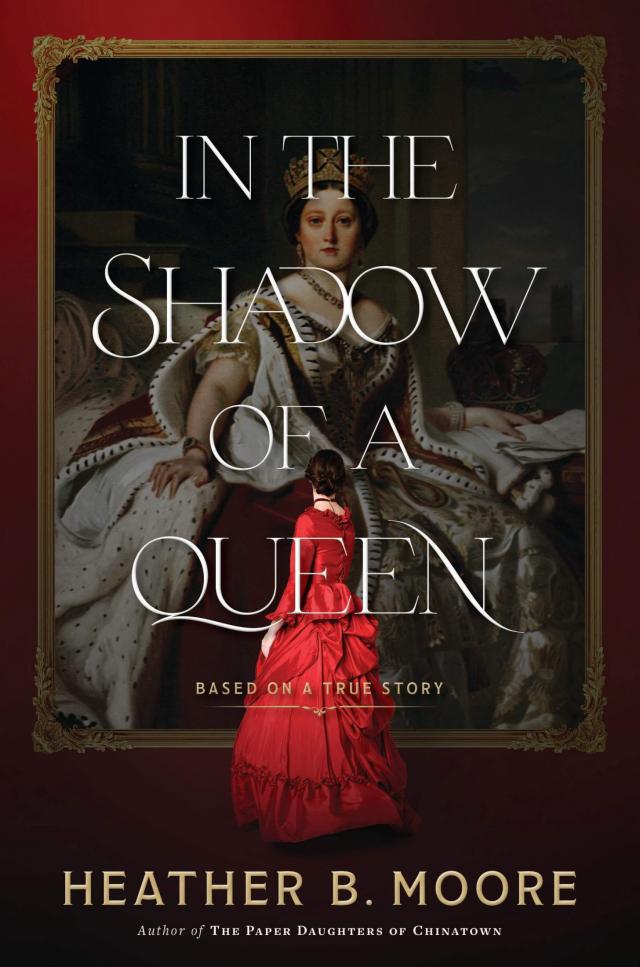
© 2022 Heather B. Moore
All rights reserved. No part of this book may be reproduced in any form or by any means without permission in writing from the publisher, Shadow Mountain Publishing®, at permissions@shadowmountain.com. The views expressed herein are the responsibility of the author and do not necessarily represent the position of Shadow Mountain Publishing.
Visit us at shadowmountain.com
This is a work of fiction. Characters and events in this book are products of the author’s imagination or are represented fictitiously.
Library of Congress Cataloging-in-Publication Data
CIP on file
ISBN: 978-1-63993-050-0 | eISBN 978-1-64933-122-9 (eBook)
Printed in the United States of America
Lake Book Manufacturing, Inc., Melrose Park, IL
10 9 8 7 6 5 4 3 2 1
Book design © Shadow Mountain
Cover design by Sheryl Dickert Smith
Art direction by Richard Erickson
Author photo by Brekke Felt Photography
Cover image by Photo 12/Alamy Stock Photo and faestock/Shutterstock
Dedicated to my ancestors who emigrated from the United Kingdom:
Henry Druce & Harriet Jinks, England, 1846
Ann Blows Gilby Rideout, England/Ireland, 1850
George Shields & Jane Cardy, Scotland, 1853
Philip Pugsley & Martha Roach, England, 1853
Nimrod George Soffe, England, & Mary Ann Harris, Wales, mid-1850s
Francis James Polkinghorne Pascoe &
Margaret Maria Husbands, England, 1860
Contents
Queen Victoria & Prince Albert Family Chart
Author’s Note
Historical Characters
part one
Chapter 1
Chapter 2
Chapter 3
Chapter 4
Chapter 5
Chapter 6
Chapter 7
Chapter 8
Chapter 9
part two
Chapter 10
Chapter 11
Chapter 12
Chapter 13
Chapter 14
Chapter 15
Chapter 16
Chapter 17
Chapter 18
Chapter 19
part three
Chapter 20
Chapter 21
Chapter 22
Chapter 23
Chapter 24
Chapter 25
Chapter 26
Chapter 27
Chapter 28
Chapter 29
Chapter 30
Chapter 31
Chapter 32
Chapter 33
Chapter 34
Chapter 35
Chapter 36
Chapter 37
Chapter 38
Afterword
Chapter Notes
Selected List of Princess Louise’s Art
Notable Contributions by Princess Louise
Notable titles of John Campbell, Marquess of Lorne
Discussion Questions
Selected Bibliography
Acknowledgments
About the Author
Author’s Note
my interest in royal families dates back to the 1980s when I began reading about Queen Elizabeth I. Monarchies have always fascinated me. Queen Victoria became of particular interest to me when I learned more about her five daughters and the contributions they made to women’s causes throughout Europe by establishing schools and founding charities. Not only that, but her daughters also became the voice of the Crown. Queen Victoria relied on them to serve as her private secretaries while she battled with severe depression and kept her eldest son—and heir—at arm’s length.
More specifically, Princess Louise interested me because she deviated from the traditional path of royals during her era by marrying a commoner and pursuing the masculine career of a sculptor. One might consider the modern embodiment of Princess Louise to be Princess Diana, who was also committed to the downtrodden and redefined what it meant to be a royal.
Princess Louise Caroline Alberta was named after both of her grandmothers. Louise for Prince Albert’s late mother, Princess Louise of Saxe-Gotha-Altenburg. Caroline after his step-grandmother, Caroline Amalia of Sax-Gotha. And Alberta, after her father. Sadly, Prince Albert’s step-grandmother passed away a month before Louise’s birth, and with the continent in the throes of revolution, Louise’s birth on March 18, 1848, came at a precarious time.
In early 1848, Europe was in upheaval with the forced abdication of the Hapsburg Emperor in Sicily, the February Revolution in France, the disruption of trade to England and the resulting severe unemployment and threatened revolt, the rise of Chartists in connection with the Irish rebellion, and the German Revolution, which led to the fall of Berlin. Thus, Princess Louise, at the young age of eight days old, was whisked away from London with her family to seek refuge at their holiday home, the Osborne House on the Isle of Wight (Wake 15–18).
Louise was the sixth child to her parents, but she was not the hoped-for male baby. With two older brothers and three older sisters, she quickly established her place in the family as a beautiful baby. She was “extremely fair with white satin hair; large long blue eyes and regular features: a most perfect form from head to foot” (Longford 7). As she grew into a young woman, Louise would never lose the label of beauty, so it was through her talents that she made her value known.
These talents included music, language, drawing, painting, and sculpting. Her work is still on display today, such as the full-sized statue of Queen Victoria erected in 1893, near Kensington Palace, and the memorial sculpture for the Boer War, displayed in St. Paul’s Cathedral in London.
Louise grew up with the privileges of a royal princess as well as the burdens of being sheltered by the system her parents had put into place, guided by her father, Prince Albert. She was a lively child, but like all her siblings, her life completely changed in December 1861 when her father died. Louise’s mother, Queen Victoria, went into deep mourning for years and continued to wear black for the rest of her life. It wasn’t until seven years later, when Queen Victoria determined it was time for Louise to marry, that she let her daughter officially come out of mourning.
Princess Louise’s life has been studied and written about by many talented historians. I’ve included a selected bibliography at the end of the book as well as chapter notes to highlight these sources and provide additional details. In my early research, I came across claims of scandal surrounding Louise, other members of her family, and Lord Lorne. These are also addressed in the chapter notes.
Princess Louise might have been a member of the most prestigious royal family of her time, but she took a step back from glitter and glamour and found ways to positively impact the lives of others, even when the climb was straight uphill. She had a queen for a mother, and Louise’s voice was often strictly controlled and limited to what was considered acceptable for the era. Yet she managed to carve out a fulfilling life and push through barriers in order to achieve her hopes.
Historical Characters
Royal Family
Queen Victoria
Prince Albert
Princess Victoria, Princess Royal (Vicky)
Prince Albert Edward, Crown Prince (Bertie)
Princess Alice
Prince Alfred (Affie)
Princess Helena (Lenchen)
Princess Louise (Loosy)
Prince Arthur
Prince Leopold (Leo)
Princess Beatrice (Bea)
Royal Relations
Princess Alexandra of Denmark
Princess Charlotte of Prussia
Prince Christian of Schleswig-Holstein-Sonderburg-Augustenburg
Uncle Ernest, Duke of Saxe-Coburg and Gotha
Uncle Leopold, King of the Belgians
Prince Ludwig, Grand Duke of Hesse-Darmstadt
Princess Victoire, Duchess of Kent and Strathearn
Prince Wilhelm II of Prussia (Willy)
Royal Household
Fräulein Bauer
Archie Brown
John Brown
Lady Caroline
Lady Jane Churchill
Elizabeth Collins
Reverend Robin Duckworth
Lady Ely
General Charles Grey
Sybil Grey
Madame Hocédé
Doctor William Jenner
Mary Lascelles
Henry Ponsonby
Lady Ponsonby
Marianne Skerrett
Walter Stirling
Mrs. Thurston
Argyll Family
George Campbell, Eighth Duke of Argyll
Elizabeth Sutherland, Duchess of Argyll
John Campbell, Marquess of Lorne
John Campbell’s siblings
Lord Archibald Campbell
Lord Walter Campbell
Edith Percy, Duchess of Northumberland
Lord George Campbell
Lady Elizabeth Clough-Taylor
Lord Colin Campbell
Lady Victoria Campbell
Lady Evelyn Baillie-Hamilton
Lady Frances Balfour
Lady Mary Carr Glyn
Lady Constance Emmott
Others
Lord Ailsa
William Beauclerk, Duke of St Albans
Edgar Boehm
Josephine Butler
Lord Coke
Susan Durant
Lord Henry Fitzroy
Lady Gladstone
Lord Gosford
Lady Granville
Lord Granville
Lord Albert Grey
Lord Hatherley
Lord Ronnie Levenson-Gower
Colonel McNeill
Henrietta Montalba
Lord Rosebery
Lord Stafford
Henry John Temple, Lord Palmerston
Mary Thornycroft
PART ONE
1861–1862
Chapter 1
“Until today I have been unable to write my Journal, which I shall now take up where I left off, though not before I have expressed by heart, felt thanks for God’s merciful protection again on this occasion, & for being so particularly well.— I shall never forget all I suffered from the night of the 16th to the 17th. Dearest Albert was all loving kindness & thoughtfulness. I felt a little better when I got up, & then I saw Clark. Suffered all the morning, nevertheless I saw dear Victoire for a short while. Continued slightly better in the afternoon, & Clém came & sat with me. Went to bed, fairly well, & was awake at 2 on the morning of the 18th, a fine large girl being born at 8. Felt so thankful all was well over.”
Queen Victoria’s journal, April 2, 1848
March 1861
Louise, age 12
loo Loo!” Leopold called as he burst into the room. “Guess what’s happened?” He skidded to a halt, shifting the Aubusson rug next to the desk where Louise sat. “Papa said when the sun comes out, we can play games. Can you play with me, Loo Loo?”
Her seven-year-old brother’s blue eyes were round, his breathing scattered, but he grinned. The nursery maid Mrs. Thurston was steps behind him, her hair askew beneath her white cap, perspiration a fine sheen above her upper lip, and her reprimand ready. “Prince Leopold,” she began, “you are not to run—”
“Yes, I’ll come with you.” Louise held out her hand to her brother.
The steady drum of the rain outside Windsor Castle had slowed four or five minutes before, gradually decreasing until the ticking clock outpaced the sound of raindrops. Perhaps at almost thirteen, Louise was too old to join in with the younger children, but children’s games were preferable to German lessons. Besides, Fräulein Bauer already looked irritated, which made Louise inordinately pleased. The teacher’s eyes narrowed, and the wrinkles about her face deepened, much like a prune.
Leopold grasped her hand and tugged, his laughter bubbling up.
“Surely, His Royal Highness meant after German lessons,” Bauer said.
Louise ignored Bauer and hurried out of the room. If there was one thing that brought Louise joy in life, it was to see Leo happy. His health was fragile, and he didn’t have many good days. Running wasn’t allowed because then he could fall, and if he fell, he could get injured, and if he was injured, he could start bleeding. And never stop.
Leo had been diagnosed with hemophilia after ominous bruises had formed all over his body as an infant. Mama was so protective of him that he wasn’t allowed to run or jump or ride horses. Sometimes he missed their family holidays to Balmoral or Osborne because of his health.
As they hurried down the long corridor lined with gilt-framed paintings, their footsteps muffled by the thick Axminster carpets, Louise noted the particular smell of Windsor Castle. Furniture polish and flowers—old flowers, Leo had claimed once. And lavender in every room, as ordered by the queen.
“Arthur!” Leopold shouted. “She said yes!”
Arthur appeared at the top of the stairs, his grin matching Leo’s. At eleven, Arthur was sturdy compared to Leo, but their enthusiasm was well matched this afternoon. Since Leo often suffered with nosebleeds in the middle of the night and he didn’t want to stay in the nursery with little Beatrice, Mama had allowed him to sleep in Arthur’s room.
Arthur led the trio, his pace brisk and confident as they stepped into Papa’s study. Their father, Prince Albert, was alone, which was excellent. Interrupting adults was never allowed, and so now there would be no waiting.
Papa lifted his gaze from the papers upon his mahogany desk. His dark sideburns were threaded with some gray, and his blue eyes seemed tired, but they warmed at the sight of his children. Beyond him a cheery fire crackled, though it did little to heat the high-ceilinged room.
“Well, what is this?” Papa asked.
His Royal Highness, Prince Albert of Saxe-Coburg and Gotha, was the opposite of Mama in many ways. He knew every detail about each of his children—nine in all—and he managed their tutors and activities. This year, though, he’d been ill more than once, and he frequently appeared overtired.
“The rain has stopped,” Leo pronounced, his chest puffed like a robin’s.
“So it has,” Papa said. “Shall we go outside then? I think we have visitors as well.”
Leo cheered, and Papa chuckled.
Visitors meant other children from peerage families. As they followed after their striding father, Louise said to her brothers, “What about prisoner’s base? Leo can be the prison guard.”
Arthur scrunched up his face. “That game is too fast for girls.”
Louise huffed. “You must be too scared to play with me.”
Arthur’s face flushed. “I’m not scared, Loosy. You’ll see when my side wins.”
Louise didn’t care who won. Losing against Arthur and hearing his ribbing for days was still preferable to Fräulein Bauer’s lesson. Of course she’d never tell her father about her dislike for his German native language. French was just easier to learn.
They bypassed the queen’s drawing room, where Mama met with government officials like the Prime Minister, Lord Palmerston. As they neared the doors that led to the East Terrace Gardens, Mrs. Thurston was waiting, with an overcoat and gloves.
“It’s not cold.” But Leo dutifully pulled on the warmer clothing.
“Oh, look, we already have guests,” Papa said, his tone humorous.
Lord Ronnie Levenson-Gower, Lord Lorne, and his brother Archie Campbell were batting around hoops with sticks along the paths.
John Campbell, titled Lord Lorne, was the oldest of the group at sixteen, and he seemed to be taller each time Louise saw him. His blond hair ruffled in the brisk wind as he turned to see her.
“We’re playing prisoner’s base,” Louise announced. Papa had stopped to speak to one of the gardeners.
“Louise is on my team,” Archie said. “She’s fast. Leo too.”
She cut a triumphant glance at Arthur, who studiously ignored her.
Everyone divided and established their territories. Three against three.
Leo distracted the other team, and Archie made it through their territory. Releasing Louise from her “prison,” they raced back to their side. But not before they had to detour through some trees, startling a flock of roosting rooks.
Louise stumbled and dirtied the hem of her dress, but she refused to be caught. She soon reached Archie’s speed again, and they shouted in triumph as they raced ahead of John and Arthur.
They all collapsed to the ground, catching their breath.
“Your birthday is soon, Princess Louise,” Archie said.
In three days it would be her thirteenth birthday. “Yes, we’re having a children’s ball. Who’s coming?”
“I am,” Archie said immediately.
“Me too,” Leo added.
Everyone laughed because they would all be attending the children’s ball at Buckingham Palace.
“Albert!” Mama called from behind them.
Louise turned to see the queen standing at the edge of the terrace. Her blue eyes were sharp, and the ringlet loops of her hair styled about her ears bobbed as she looked about for Papa.
Louise’s stomach tensed. Had Mama found out that Louise had left Fräulein Bauer and Leo had run in the hallway? Would she be scolded for staining her dress?
Papa stepped into view. “What is it, Gutes Fräuchen?”


