

I Was Better Last Night, page 1


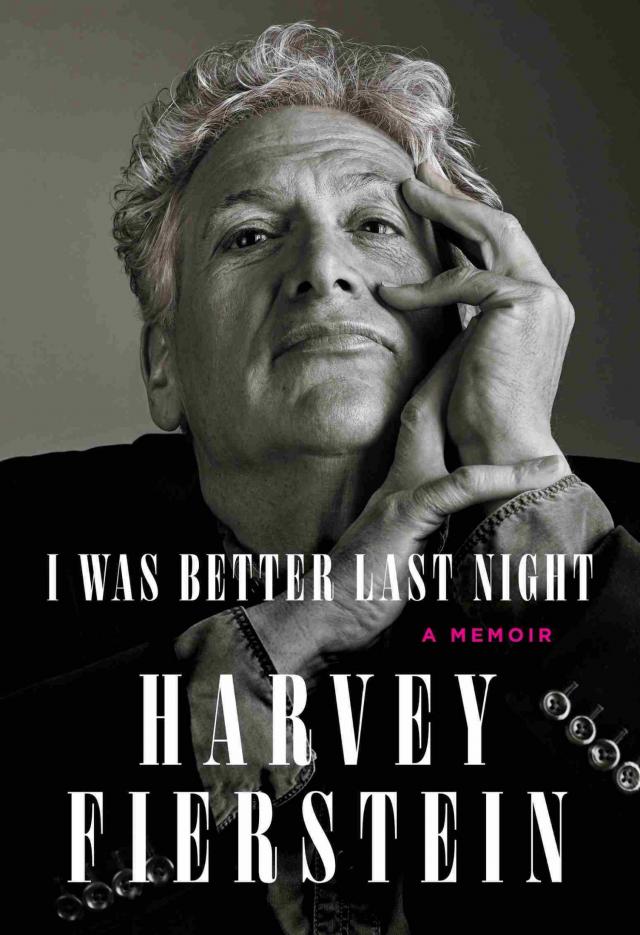
this is a borzoi book
published by alfred a. knopf
Copyright © 2022 by Harvey Fierstein
All rights reserved. Published in the United States by Alfred A. Knopf, a division of Penguin Random House LLC, New York, and distributed in Canada by Penguin Random House Canada Limited, Toronto.
www.aaknopf.com
Knopf, Borzoi Books, and the colophon are registered trademarks of Penguin Random House LLC
Library of Congress Cataloging-in-Publication Data
Names: Fierstein, Harvey, [date] author.
Title: I was better last night : a memoir / Harvey Fierstein.
Description: First edition. | New York : Alfred A. Knopf, 2022. | Includes index.
Identifiers: LCCN 2021018554 (print) | LCCN 2021018555 (ebook) | ISBN
9780593320525 (hardcover) | ISBN 9780593320532 (ebook)
Subjects: LCSH: Fierstein, Harvey, [date] | Dramatists, American—Biography.
| Gay dramatists—United States—Biography. | Actors—United
States—Biography. | Gay actors—United States—Biography.
Classification: LCC PS3556.I4213 Z46 2022 (print) | LCC PS3556.I4213
(ebook) | DDC 813/.54 [B] —dc23
LC record available at https://lccn.loc.gov/2021018554
LC ebook record available at https://lccn.loc.gov/2021018555
Ebook ISBN 9780593320532
Although this is a work of nonfiction some of the names and identifying details have been changed to protect my innocence. Any resulting resemblance to persons living or in hiding is entirely coincidental and unintentional. Still, I’m telling you, this shit happened.
Cover photograph by Guzman
Cover design by Chip Kidd
ep_prh_6.0_139332125_c0_r0
To the radical fairies who flew before me
CONTENTS
Preface: Look Back, but Don’t Stare
1 Queen for a Day
2 Brooklyn Bound
3 “Artistic” Is One Way to Put It
4 High in High School
5 Playing Cards
6 You Never Lose More Than You Gain
7 Funny Things Happen When You Say Yes
8 Even Higher Education
9 Superstar
10 The Private Life of Jesus Who?
11 The Village’s Voice
12 With Creatures Make My Way
13 Leaving Home
14 In Search of the Cobra Jewels
15 Freaky Pussy
16 Flatbush Tosca
17 The Haunted Host
18 Fucking as a Solo Sport
19 The International Stud
20 Fugue in a Nursery
21 Widows and Children First!
22 Fugue On
23 What the Fuck Is a Glines?
24 From the Basement to the Fifth Floor and Back Again
25 Torch Song Trilogy—Off and On Broadway
26 This Is a Job for a Drag Queen
27 Torch Song Trilogy on Broadway
28 La Cage Aux Folles in Boston
29 AIDS
30 Garbo and Doubtfire
31 I’m Gonna Be a Movie Star
32 Yes, I Wrote Legs Diamond
33 Hanging with Madonna, Holly, and Bruce
34 All Talk and No…
35 Sitcom Hollywood
36 Getting Sober
37 Idle Hands Are a No-No
38 Hairspray
39 La Cage’s First Revival
40 Fiddler on the Roof
41 And They Call Him Sondheim
42 Shoot Me or the Dice!
43 La Cage in London
44 A Catered Affair
45 The Tavels
46 Juggling Kinky Boots and Newsies and Casa Valentina
47 Tevye and I Meet Again
48 Strapping My Tits Back On
49 Zaza and Me
50 Back to Kinky Boots and Newsies
51 Kinky Boots
52 Casa Valentina
53 Did Someone Call for a Plumber?
54 The Wiz Live! and Hairspray Live!
55 Gently Down the Stream
56 Torch Song Revived
57 Coming Out: A True Story
58 Bella Bella
59 There’s a Bright Golden Hayes…
Acknowledgments
Index
Illustration Credits
PREFACE
LOOK BACK, BUT DON’T STARE
I was his road not taken. He was retiring from an upstate white-collar job, reassessing his life choices and seeking a path forward.
“I know I really messed things up between us. I never gave us the chance to be happy. That’s all going to change now. I’m going to be the lover you always wanted and deserved. Okay, Harvey?”
“Well…” I stuttered. “Uh…How about we have dinner next time you’re down here?”
“Harvey. Did you hear what I just said?”
“I think so.”
“And?”
“You sound maybe a little…Are you okay?”
“Are you fucking kidding me? You’ve been begging me to do this for years!”
“Forty years ago.”
“I don’t believe you. What are you saying? I’m too old? You’re older than I am! And I’m in a hell of a lot better shape than you ever were.”
“How about I drive up there and we can talk?”
“You know what? Fuck you! You’re a selfish fucking prick. You can go fuck yourself! And don’t call me again.”
“You called me…Hello?…Hello?”
Only science and mathematics offer do-overs. History may echo but never repeats. Humans struggle to get a recipe right twice in a row. I can’t count the times I’ve had friends visit after a performance only to hear myself say, “I was better last night.” Of course I was better last night. I was younger, fresher, braver, and had one less day of life clogging my brain. But most of all, it was last night. Time upgrades survival to triumph.
So, if you can’t go back, what’s the harm in looking back?
Twelve Step programs counsel “Look back, but don’t stare.” Wonder why? Because it’s fucking painful! I’m sitting comfortably at this lovely computer in my homey home office and almost everything coming to mind is about what an asshole I was and am still capable of being. So many stupid mistakes. So much selfishness and ego-driven thoughtlessness to bathe in. Sure, I recall the victories and joys and laughs and lovers, but for reasons beyond me, those happier remembrances are cloudy, dimmed, and distanced. I have to reach for them. Whereas the miseries and hurt, every mistake, misfortune, and betrayal I endured or delivered remains conveniently at my fingertips. The guns are loaded, the knives still cut, and the adage “Time heals everything” makes a lovely lyric but is a fucking lie. Time heals nothing. Amnesia doesn’t come in a bottle. It doesn’t. Trust me. I tried that. Pain and regret are our brains’ legacy residents with great views and easy access to the world outside.
In Twelve Step work we look back to identify the bad stuff we are responsible for and, if it’s possible to do so without causing more harm, we make amends for our wrongdoing. I recommend this cleansing exercise of exorcising. Suddenly, glancing over your shoulder is less frightening. There are fewer shadowy figures following you. You are freer to move about unencumbered, knowing that the scary shit of the past has been peaceably entombed. Unfortunately, entombed is not destroyed. It waits quietly in the dark for someone to dig it up again. Bad shit is patient.
So, here I am with my work clothes on and my shovel in hand. If you’re willing to listen, I’m willing to dig.
1
QUEEN FOR A DAY
1959
Philomena Marano got the role of the Evil Witch and I was cast as the King. The King? Who wants to be the King? Sure, he gets a crown and cape, but the Witch gets green skin, red lips, and long black fingernails. I wanted green skin, red lips, and long black nails! Second grade was not working out the way I’d hoped.
I was given the largest role in Sleeping Beauty because I was generally perceived as having the most theatrical flair in class 2-1 of P.S. 186 in Bensonhurst, Brooklyn. In 1959 they called it “flair.” I have never understood why, but from early childhood, seeking it or not, I’ve stood out in a crowd. I remember years later when I was dead broke and begged director Tom O’Horgan to put me in the chorus of this new show he was doing—Jesus Christ Superstar. He hugged me warmly and said, “If I put you in the chorus, I have no chorus.”
There’s no denying I blossom whenever I’m the center of attention. My high-school painting class was invited to demonstrate life drawing in Macy’s Herald Square store. Thirty of us set up easels around a platform where a live model posed. I began to sketch with brightly colored pastels on an oversized pad of newsprint paper. Before long I had attracted a crowd. The more they grinned, pointed, and nodded their approval, the faster and more wildly my hands flew. I’d never drawn like that before—or since. I was on fire. People were reaching out to catch my drawings as I tore them from the pad and tossed them aside. Others begged to pose for me. I had no idea where this energy and inspiration was coming from. I was possessed. I can still feel the rush of that explosive creativit
But back in the fairy-tale play of second grade, I begrudgingly recited my lines and waved my royal scepter while never allowing my concentration to drift from Philomena awaiting her entrance in the wings. Old Lady Berlant chided me, “I can’t hear you, Harvey F.”
I was Harvey F. because there was also a Harvey S. in my class. There were a lot of Harveys in P.S. 186. Three greatest mistakes of the fifties: Formica, thalidomide, and naming children Harvey.
“I can’t hear you,” Miss Berlant said again. “Speak louder or I’ll have to take the role away from you.”
Take it, my inner voice spat back. You think I’m dying to wear this stupid Reynolds Wrap crown and drag a chenille bedspread cape behind me? Fuck this goatee my mother drew on with her eyebrow pencil. I’m not in this for the art. Give me lipstick or show me the exit!
My inner voice spoke truth. My outer voice just spoke louder.
The day of the performance I begged for color so insistently that my mother finally painted two hot-pink spheres of rouge on my cheeks. I was not mollified.
When Halloween arrived I rushed home from school and stripped off my clothing. I wrapped a bath towel around my chest, went into my parents’ room, and liberated the stash of makeup from my mother’s vanity. I went at my face with abandon. Eyeliner, mascara, blush, and her brightest shade of red lipstick. I stood back and admired the results in the mirror. I gawked. With this act of defiance something shifted. Something magical had happened. Staring into the mirror, squinting away the imperfections, my outsides at last matched my insides, and I heard the voice in my head ask that most frightening of questions: “Are you a girl?”
Where did that come from? Why would a child wonder such a thing? My mind was struggling with jigsaw-puzzle pieces that came in an unmarked box. I had no reference for this. I had no language. No experience. Nowhere had I heard another person ask anything like that. I was demanding explanations from my seven-year-old self, to whom this was all new but not unfamiliar.
Clichéd as it sounds, for years I’d been singing along to Original Broadway Cast albums. In the proscenium of my bedroom mirror I was always the leading lady, although I’d accept a featured role if the number was juicy enough. Let’s not kid each other: no one turns down the chance to sing “I’m Just A Girl Who Can’t Say No” even if it’s not the starring role! Wrapped in a bath-towel dress, a T-shirt wig on my head, the curtain rose on me. Applause. Please note, there was no lip-synching. I sang full-out, leaving Celeste Holm in my dust. All familiar with the dark rasp of my adult voice may be surprised to learn that I once possessed a soaring boy soprano good enough that, for two years, I was a paid soloist in a professional liturgical men’s choir.
But that Halloween’s feature was a dumb show. Hidden behind this mask of makeup, I dared to pull my chubby boy tits up over the tightly tied hem of the towel, pinching the skin together to form cleavage. And when I use the word “dared,” I mean “dared.” My boy boobs were my enemy. They were threats to my normalcy. They were my body’s betrayal of my dark, unacceptable truth. There was no hiding them. There was no shirt loose enough, no coat thick enough to camouflage this 3D scarlet letter announcing to any casual observer the gender war raging within. I was a boy with tits. During puberty I took to wrapping my chest with an elastic Ace bandage whenever leaving the house. An Ace bandage covered with a T-shirt and then a sport shirt over that. By the time I’d get home to undress, my poor skin was rubbed raw. Many times, the bandage had folded up during the day, forcing my boobs out over the top and making them twice as obvious. Who was I fooling? I’d cry while applying lotion to soothe the inflamed skin.
Boy boobs. I hated them, and truthfully, still do. But not on that day. On that day, as I squinted before my bedroom mirror, the puzzle pieces began to ease into place, revealing something I could almost put a name to. I was excited and frightened and…
My mother’s voice: “Harvey. Come down. Your friends are here.”
As quickly as I could I pulled an old housecoat of hers from the laundry hamper and covered my boyish haircut with a kerchief. Reaching up, I smeared the makeup down my face. My mysterious kohl-lined eyes became sunken cavities. The longed-for luscious red lipstick now read as blood trails. I rubbed and blended and manipulated the floral scented creamy filth until I could reasonably claim that I was not trying to be pretty. I was a monster, a zombie. A female zombie, it’s true, but even so, a sociologically acceptable character for trick-or-treating. It wasn’t Sleeping Beauty, but at last my lips were unavoidably painted ruby red. This seven-year-old gender warrior had taken the hill and planted a flag.
Leave it to Philomena to still have this photo of my Halloween experiment, shot in the alley beside my home.
2
BROOKLYN BOUND
Most people know of Bensonhurst, Brooklyn, as home to the Kramdens on The Honeymooners, or the site of the car chase under the elevated trains in The French Connection. Who could forget John Travolta swinging his paint cans down those very streets in Saturday Night Fever, or taking up classroom space in Welcome Back, Kotter?
We lived in a small three-bedroom, one-and-a-half-bath semi-attached house that my folks bought from my grandparents. It stood Jew-centric with the Yeshiva of Bensonhurst down the block to the left and the Jewish Community House occupying the opposite corner. There was a time before my spiritual nullification that I wouldn’t misbehave in my house simply because the rabbi passed by our front door at least six times a day coming and going from prayers. He’d know.
Anyone on the block could recite a recipe for stuffed cabbage, but no one would have heard of jicama, avocado, or chitlins. Ours was an insular world. Entire lives were lived inside a half-mile radius. When families multiplied, they stayed in as close proximity as could be managed. I have childhood friends who only saw Manhattan because our class made the four-mile journey to the Empire State Building. The signs at our subway station offered two directions: “Coney Island” and “The City.” There was a social rule that people from Brooklyn could move to Queens or Staten Island. Manhattan, the Bronx, and (heaven forbid!) New Jersey were all a bridge too far.
The men worked, the women tended to the home, and a kid who studied hard enough could grow up to be President. Jews cautiously befriended Italians, who guardedly befriended the Greeks. We all juggled our positions on the social totem pole knowing we had one thing in common: although we thought of ourselves as white, we lived on the edge of a country that did not see us that way.
The only Asian people I saw worked in the Chinese restaurant on Bay Parkway. Blacks and Hispanics traveled into the neighborhood as domestics or other manual laborers. Until high school most of the people of color I knew as a child worked at the handkerchief factory in Brooklyn’s industrial park, Bush Terminal, that my father managed for the Gindi and Mizrahi brothers. (I’d lay odds he won’t remember, but I first met Isaac Mizrahi at his family’s holiday party in 1961. He was two months old.)
The rest of the world was glimpsed on small oval black-and-white television screens set into great big wooden cabinets or through the pages of the Daily News and the weekend New York Times that my father brought home, along with a dozen bagels, every Sunday morning. My family would rip into those newspapers in a way that would be unrecognizable today. My older brother went straight for the sports sections. It was page one for my father. And I grabbed the colorful comics from the Daily News along with Arts & Leisure from the Times, which I was under strict orders not to cut up before my mother got to read it. But before anything else, I searched for Bloomingdale’s shoe ads. Not that I cared about footwear. But they were drawn by my favorite illustrator, Andy Warhol. It was years until I realized that this same Warhol was breaking into the world of fine art. Back then his pen-and-ink drawings thrilled me. They were raw and still precise. They were cartoons but completely accurate. His lines dissected defined form, using negative space in such an unconscious manner that it was almost a miracle. This little kid could not get enough of them.


