

Vacation with the Phoenix: A Steamy Monster Romance, page 1


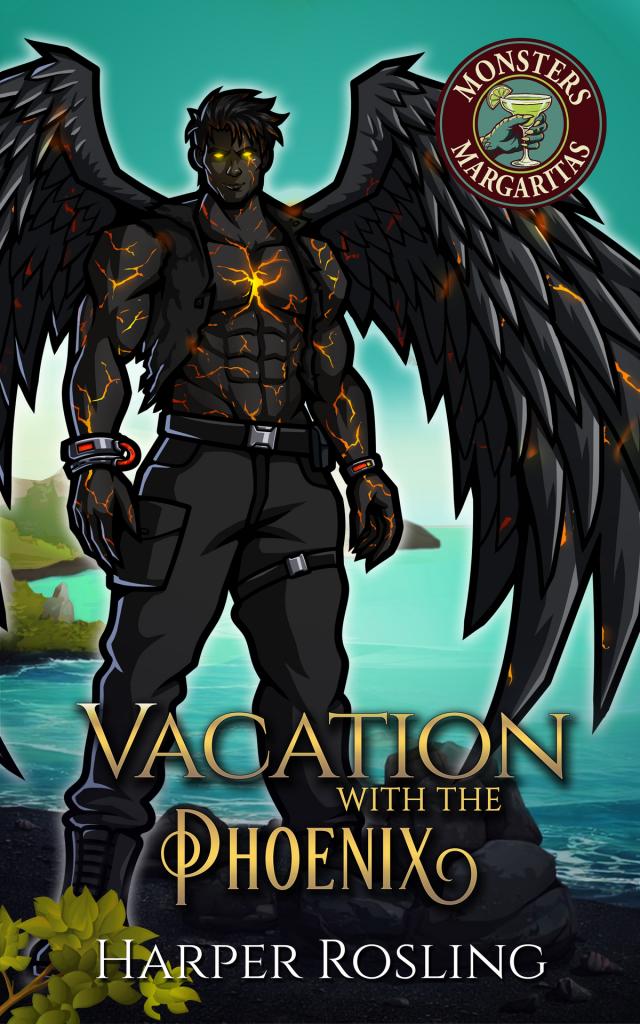
Vacation with the Phoenix
A STEAMY MONSTER ROMANCE
HARPER ROSLING
Copyright © 2026 by Harper Rosling
All rights reserved.
No part of this book may be reproduced in any form or by any electronic or mechanical means, including information storage and retrieval systems, without written permission from the author, except for the use of brief quotations in a book review.
Contents
1. Tove
2. Kaen
3. Tove
4. Kaen
5. Tove
6. Kaen
7. Tove
8. Kaen
9. Tove
10. Kaen
11. Tove
12. Kaen
About the Author
Other Books in the Series
Chapter 1
Tove
The transport shuttle hit the docking ring with a heavy, metallic thud that reverberated through the cabin deck, vibrating the titanium struts of my passenger seat. The deceleration engines whined, shifting pitch from a high-frequency scream to a low, rumbling hum before finally dying out completely. Around me, the other passengers—a loud, anxious mix of wealthy honeymooners and adrenaline-seeking corporate executives—scrambled from their crash couches before the "Fasten Seatbelt" holos even faded. They crowded the starboard viewports, practically pressing their faces against the reinforced transparisteel, jockeying for the first look at our destination.
"Look at it," a man two rows up breathed, his voice trembling with a mixture of reverence and naked, primal terror. "It's literally on fire. The whole planet."
I remained seated. The restraining harness across my chest retracted with a soft click, but I made no move to stand. I adjusted the high collar of my oversized cooling tunic, letting the synthetic, moisture-wicking fabric settle against my sharp collarbones. I didn't need to look out the window to know what was out there. Ignis IV. The travel brochures had called it a majestic display of planetary infancy, a world still bleeding from the violent throes of its own creation. They promised a brush with the chaotic forces of nature, all from the absolute safety of a five-star corporate dome.
I called it a desperate gamble. A last-ditch effort to jolt my nervous system back online.
I checked my wrist chronometer, noting the dull ache in my joints from fourteen hours of transit from the central systems. Then, pressing two fingers to the inside of my wrist, I calculated my heart rate. Sixty beats per minute. Steady. Placid. Flat. Even the violent shudder of the shuttle's atmospheric entry hadn't caused a single flutter.
The main airlock cycled with a sharp hiss of pneumatic pressure, and the heavy blast doors slid apart to reveal the boarding umbilical. This connected the shuttle directly to the Cynder Bay Resort's primary intake lounge—a transparent, shielded tunnel suspended precariously over the planet’s surface.
I stood, slinging my small travel duffel over my shoulder. I joined the herd of tourists shuffling into the tunnel, letting the current of excited bodies carry me forward. The moment we cleared the shuttle's climate-controlled interior, the environment of Ignis IV asserted itself. Even through the massive, high-grade energy shielding that surrounded the tunnel, the heat was a physical, oppressive pressure. It didn't burn the skin, but it hit the invisible barrier like a battering ram, radiating inward. The air inside the tunnel grew thick and heavy.
Outside the glass, the sheer atmospheric weight of the magma oceans created a visual haze, distorting the jagged obsidian peaks and the sprawling rivers of liquid rock into a shimmering, mirage-like painting. It was a chaotic landscape of sharp blacks and blinding, neon oranges.
Without warning, a massive geothermal geyser erupted three hundred yards to the left of the walkway. A plume of superheated rock and liquid fire shot hundreds of feet into the thick, sulfur-choked sky. The sound was muffled by the resort's shielding, reduced from an ear-shattering explosion to a deep, bass-heavy vibration that traveled up through the floor grates, into the soles of my boots, and rattled my teeth.
The tourists around me shrieked—a chaotic chorus of delighted, terrified gasps. Hands clutched at partners; cameras flashed frantically against the glass, capturing the destruction.
I stopped walking. I let the crowd part around me, standing perfectly still in the center of the walkway, and stared directly at the falling arc of the magma fountain. The liquid fire rained down, splattering against the base of the energy shield in a silent explosion of blinding light and molten slag.
A woman in a neon-bright resort wrap bumped into my shoulder, stumbling as the floor shook. She grabbed my arm to steady herself, her eyes wide, pupils dilated with pure adrenaline.
"Did you see that?!" she gasped, squeezing my forearm. "My god, it's terrifying! Aren't you terrified?"
I looked down at her hand gripping my sleeve, then up to her flushed, ecstatic face. I didn't pull away. I just stared at her with the same blank intensity I'd given the magma.
"No," I said, my voice flat.
The woman’s smile faltered. She let go of my arm quickly, stepping back as if the chill radiating from me was more unsettling than the liquid fire outside. She turned back to her partner, whispering something, leaving a wide berth around me.
I waited for the spike of adrenaline. I waited for the primal, evolutionary instinct that should be screaming at me to run, to hide, to survive the lethal proximity of the eruption.
For six years as a crisis negotiator, I had thrived on that spike. I had lived in the space between disaster and salvation, talking down hostages, managing catastrophic systems failures, feeling the intense, burning need to save lives. Until one day, the wire had just snapped. The empathy had burned out, leaving nothing but a vast, frozen wasteland in its wake.
I pressed my fingers against my carotid artery again. Still sixty beats per minute. I watched the magma burst and slide down the invisible shield. It should have been terrifying. It should have triggered a deeply ingrained human panic response. Instead, it just looked like glowing soup.
A hollow, familiar disappointment settled into my chest, heavy and cold. The gamble was failing. Ignis IV wasn't enough.
I let my hand drop to my side and resumed walking. The resort’s interior airlock doors at the end of the tunnel hissed open, blasting the arriving crowd with a wave of aggressively conditioned, freezing air. I welcomed the sharp chill. It felt honest. I stepped through the threshold, leaving the silent, raging fireworks behind.
The arrival lobby of the Cynder Bay Resort was a masterpiece of corporate sterilization. The floor was poured obsidian, buffed to a mirror finish so smooth it looked permanently wet. High, vaulted ceilings arched over a sprawling concourse decorated with sleek, minimalist furniture, brushed steel accents, and subtle, indirect lighting that mimicked a calm sunset. The walls facing the planet were floor-to-ceiling smart-glass, offering a panoramic view of the hellscape outside while perfectly insulating the guests from the lethal reality of it.
I walked toward the main reception desks, my boots clicking softly against the stone. The air in the lobby was artificially crisp, aggressively pumped with the scent of synthetic citrus and crushed mint. It was a calculated olfactory profile, designed by some corporate algorithm to evoke freshness, hygiene, and absolute safety. But beneath the sharp tang of the lemon aerosol, I could still detect the faint, stubborn scent of sulfur. It was clinging to the clothes of the staff, seeping through the micro-seams of the airlocks. The planet was trying to get in.
"Welcome to Cynder Bay," a concierge said, offering a practiced, blinding smile that didn't reach his eyes. He wore a crisp, dark red uniform with silver piping that looked entirely out of place against the backdrop of a lava field. "We are thrilled you chose to spend your hard-earned vacation with us. Can I start you off with our signature welcome drink? The Magma-Margarita?"
He gestured gracefully to a floating grav-tray nearby, where several tall glasses bubbled with a viscous, bright red liquid that emitted a faint, harmless, dry-ice vapor.
"No," I said.
My voice was flat, clinical, unfrilly. I didn't soften the rejection with a polite smile or a fabricated excuse about travel nausea. I simply didn't want it, and I no longer possessed the energy required to perform the basic social niceties that lubricated human interaction. I shifted the strap of my travel duffel. The canvas was heavy, digging into my collarbone, a physical weight I welcomed because it was something real. I dug into my pocket, pulled out my solid-state identification chit—its cool, metallic edges rough against my thumb—and slid it across the slick stone.
The concierge snatched up the chit, his smile never wavering, though the corners of his eyes tightened. "Of course, madam. We can arrange for standard hydration to be sent to your suite. While I process your access code, Ms. Sorenson, might I interest you in booking an appointment at our Obsidian Spa? We offer a deep-tissue volcanic ash wrap that is simply exquisite after a long orbital flight."
"No spa," I said, staring at the bridge of his nose rather than meeting his eyes.
"We also offer guided VIP tours of the Exclusion Zone perimeter. You'll be accompanied by one of our native Wardens for an up-close, absolutely safe encounter with the planetary forces."
"No tours. No spa. No drinks," I said, my tone completely deadened. "Just the room."
The concierge's smile faltered for a fraction of a second, a micro-expression of confusion, before snapping back into its rigid corporate place. "Let me just finalize your room access code."
He tapped rapidly across a holographic terminal embedded in the obsidian counter. I leaned against the polished stone, ignoring him and letting my eyes drift. Behind the concierge, a secondary, larger monitoring station tracked the resort's environmental integrity. The screen was a chaotic, scrolling map of green and yellow readouts, tracking tectonic stress, shield output, and thermal loads across the sprawling compound.
In the upper right corner of the display, a small red indicator began to blink, pulsing with the universal cadence of a critical system stress alert. I couldn't read the specific Cynder Bay schematics from this distance, but the color coding and placement were undeniable—something in their environmental perimeter was failing.
A passing staff member, carrying a stack of fresh, chilled cooling towels, stopped by the console. He barely broke his stride. He glanced at the blinking red light, reached out, and tapped the screen, dismissing the alert without opening the underlying data log to check the severity. The red light vanished, instantly replaced by an artificial, pacifying green checkmark.
I stared at the spot where the warning had been. My mind, trained by years of managing cascading systemic failures, instantly recognized the risk protocol violation. The staff member hadn't investigated the underlying cause. He hadn't dispatched a maintenance drone or cross-referenced the data. He had simply erased the notification to keep the board looking green for the tourists in the lobby. The resort management was actively prioritizing the illusion of safety over actual security. They were ignoring the reality of the planet beneath their feet.
I stood there, processing the sheer scale of the negligence. This was a critical failure in the safety perimeter of a resort built on a geologically unstable death-world. A month ago, a year ago, the old Tove would have immediately demanded to speak to the shift supervisor. She would have escalated the issue to corporate, filed a hazard report, and managed the crisis before the shield inevitably buckled. Her pulse would have raced with the adrenaline of problem-solving.
Now? I just stared at the glowing green checkmark.
I realized, with a chilling wave of complete apathy, that I truly didn't care. If the forcefield failed tonight, if the lobby flooded with thousands of degrees of liquid fire, I would burn along with the smiling concierge and his stupid, bubbling drinks. The sterilized, managed danger of this place was boring me anyway.
"Your access code is loaded to your personal datapad, Ms. Sorenson," the concierge said, his voice breaking through my internal void. "You are in the Obsidian Wing, Suite 402. As a reminder, for your own safety, please remember to stay on the designated Cool Paths if you venture out to the viewing decks. Enjoy your stay."
"I'll try," I said. I picked up my duffel, turned, and walked toward the elevators, leaving the concierge standing alone with his frozen, useless smile.
Suite 402 was vast, dark, and perfectly silent. The moment the heavy, reinforced door sealed shut behind me, the faint, ambient hum of the lobby vanished entirely, replaced by an absolute, suffocating quiet. The room was designed in deep charcoal tones and brushed steel, aiming for a cavernous, luxurious aesthetic that felt more like a tomb than a hotel room. But the centerpiece of the suite wasn't the massive bed or the sleek furniture. It was the wall.
The entire western bulkhead of the suite was a single, uninterrupted pane of reinforced transparent alloy. And just twenty yards beyond that glass, a slow, sluggish river of molten rock flowed down the jagged slope of the mountain.
I didn't immediately walk to the glass. I carried the heavy duffel into the center of the room and set it on the edge of the massive, king-sized bed. The linens were spun from high-thread-count bio-silk, impossibly soft and stark white, a jarring contrast to the grit and ash of the planet outside. On the bedside table sat a complimentary basket of exotic off-world fruits and a bottle of synthetically aged wine worth more than my shuttle ticket.
I ignored the wine. I ignored the sprawling bathroom with its sunken tub and cascading water wall. I mechanically unzipped my duffel. I took out my sparse collection of oversized cooling tunics and stacked them on the corner of the mattress with exact, clinical precision. I pulled out my toiletries bag and set it next to the clothes. I was surrounded by the pinnacle of interstellar luxury, a suite designed to indulge every human sense and desire, and I felt absolutely nothing for it. It was just a holding cell. Another place to not exist.
Once the bag was empty, I left the clothes sitting on the bed. I turned toward the wall.
I walked slowly across the plush, dark carpet. I stopped only when the toes of my boots met the cold metal trim at the base of the window. The room was dark, the automated lights having not yet engaged because I hadn't commanded them to, but I didn't need them. The lava river outside painted the entire suite in shifting, violent shades of crimson, orange, and bruised purple. The ambient light crawled across the ceiling, casting long, wavering, demonic shadows against the walls.
I stepped closer, until my nose was an inch from the glass. I raised my right hand and pressed my bare palm flat against the transparent barrier.
The glass was freezing cold. The resort’s climate control system was fighting a massive, endless war against the thermal radiation of the magma, and the glass was the frontline of that battle. The manufactured cold seeped into my skin, biting sharply at my nerve endings.
I looked past my hand, out into the liquid fire. The magma moved with a heavy, terrifying inevitability. It wasn't fast like water; it was thick and muscular, consuming massive chunks of black rock, melting them down into glowing slag within seconds. The heat out there was absolute. It was a destructive, purifying force that reduced everything it touched to base elements.
Make me feel it, I thought, staring intently into the bright, burning core of the flow. Make me afraid. Make me feel anything.
I squeezed my eyes shut, trying to imagine the glass suddenly shattering under the pressure. I pictured the heat rushing in, the air instantly combusting in my lungs, the violent, fiery end of my long, exhausting numbness. I waited for my heart to race, for my breath to hitch in my throat, for my palms to sweat against the freezing glass.
My chest rose and fell in a slow, steady, infuriatingly calm rhythm. My pulse remained a sluggish, flat thrum. The numbness held fast, an impenetrable glacier sitting heavy inside my chest that simply refused to melt, no matter how close I stood to the fire.
I opened my eyes and looked at my own reflection, superimposed over the river of fire. I looked like a ghost haunting my own expensive vacation. My skin was pale, devoid of all healthy color. My eyes were shadowed by dark, bruising circles that hours of sleep could never fix, because the exhaustion wasn't physical. I was twenty-nine years old, and I looked entirely hollowed out. I was colder than the air conditioning.
A sudden, sharp movement outside the glass broke my grim focus.
I blinked, adjusting my vision past my reflection and looking down toward the rocky embankment that bordered the lava flow. It was an employee-only zone, a narrow strip of hardened, cracked basalt just a few feet from the creeping, lethal edge of the magma.
Someone was walking there.
I leaned forward, my brow furrowing slightly. At first, I thought it was an automated maintenance drone, or perhaps a trick of the distorted, heat-hazed light. But as the figure stepped out from the shadow of a jagged obsidian outcropping, the sheer scale of the silhouette registered in my mind.
It was a man, or at least humanoid. But he was impossibly massive. He had to be over seven feet tall, his shoulders as broad as a shuttle bulkhead. He wasn't wearing a bulky, reflective environmental suit like the human maintenance workers I had seen in the brochures. He was wearing a dark, heavily modified Warden's uniform that looked strained to the absolute breaking point across his chest and arms.
My eyes tracked down his back, widening by a fraction of a millimeter. Folded tightly against his spine, the tips nearly dragging against the rocky ground, were two massive wings. They were covered in dark, leathery scales and jagged, obsidian-like feathers that looked sharp enough to cut glass.


