

Paradise (Deadly Lush Book 1), page 1


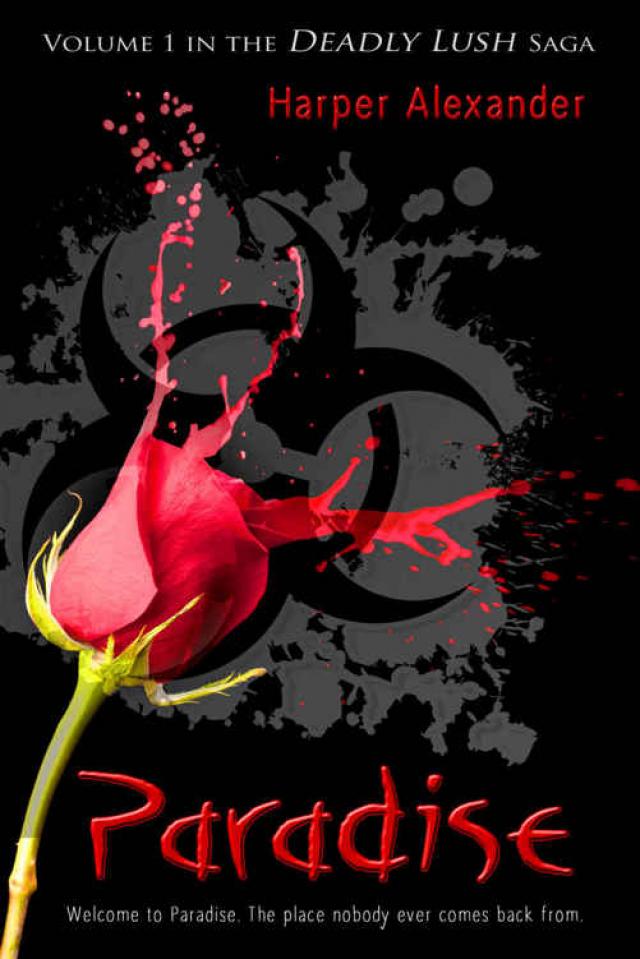
PARADISE
Volume 1 in the Deadly Lush saga
Harper Alexander
3rd Edition
Copyright © February 2016
by Harper Alexander
Original Text Copyright © March 2015
All rights reserved.
No part of this product may be reproduced without the prior written permission of the author.
This is a work of fiction. Any resemblance to actual people, places or events is completely coincidental.
Cover/interior art and design by Laura Moyer
www.thebookcovermachine.com
Dedicated with love to Chad, who inspires me to 'always never forever stop quitting'.
Table OF Content
1 – Shore of Hope
2 – Greetings from Paradise
3 – A Doomed Quest
4 – Message in a Bottle
5 - Stowaway
6 – Stormy Seas
7 – Don't Look Back
8 - Paradise
9 – The Devil in the Details
10 – Beyond the Golden Shore
11 – Dark Water
12 – Beneath the Ivy
13 – Lavender Whispers
15 - Silhouettes
16 – Dreams of Eden
17 – Daylight Demons
18 – Feral Child
19 – Barbarian Camp
20 – Pitter-Patter Triggers
21 - Grounded
22 - Clemency
23 – Fatal Ace
24 – The Bridge
25 – Ruins of a Vision
26 – Rebel Beasts
27 – Nostalgia and Madness
28 – Skylight Circus
29 – Hornet's Nest
30 - Divide
31 - Dauntless
1 – Shore of Hope
The murky tide dragged itself back out toward the ill-colored sea, bubbling and hissing over a broken mosaic of decaying shells. They prattled like clams in the rivulets of bubbles, always pressing closer, always crawling over one another like a horde of ivory beetles. Now and then a crab walked the carnage, click-click-clicking across the shards, and was quickly snatched off the beach by a dirty-nailed hand and stuffed into a bag of other motley tricks.
The people crawled over each other like beetles as well, up beyond the sloping shore and jutting bluffs that sequestered the cove. The once-quaint dwellings nestled about the hillsides were now crowded out by secondary shacks, full of refugees who had made it across the Badlands to the coast. Clogged and tense, there was hardly room to breathe, anymore, not that anyone was enthused to fill their lungs with the stuff that passed for air. It was difficult to recognize friends, or neighbors, in the streets, thanks to the gas masks that rendered everyone a similar wasp-like creature.
Shiloh never wondered if she passed her friends in the streets. She didn't have any. Sentimental malarkey was a burden, a foolish risk, when survival was such a fierce objective. All too well, she'd become acquainted with backstabbing as the code of desperate times, and she had no desire to culture relationships that might compel her to care for others besides herself. She was barely getting by as it was. Scraping together the means to load the dice against fate every day.
Get up. Breathe. Roll the dice, watch them spin. Cheat fate. Reload the dice. Do it all again tomorrow.
It was tempting, far too tempting, to cast those dice into the sea. To hurl them churning into the tide and stand on the beach, finished, and say, “Come what may.”
But 'finished' was never quite something Shiloh could convince herself to be. There was this spark. This bothersome spark lodged in her barren soul like a speck of glass under her skin, that wouldn't let her rest. Get up. Scratch the itch to live, it whispered, mosquito-like. A tiny, annoying squeak that begged to be oiled anew every day.
Why? she asked back.
It doesn't matter.
Because she was a survivor. Just like the sky was the sky. Just like a flower was a flower.
Bad example, she argued. If there was a flower for miles, it would be a sorry excuse for one. Shriveled and decaying, the lovely specimens of days past as good as extinct. Shiloh had seen one, once. A weed with a single yellow blossom.
The most beautiful thing she had ever beheld.
Almost.
One of a few nostalgic memories, the sense of wonder stayed with her, a pin-prick lighthouse piggy-backing through the suppressd nightmares of days past. The wonder of stooping down out of her fast-paced, paranoid routine, the cracked ground cold against her knees, to shield a headstrong little bud from the scouring sea winds. To cradle its tiny mustard petals against a blood-stained, gloved hand, debating whether to pick it, preserve that wonder forever, or leave it to its admirable vigil.
In the end, someone sneaked up behind her in that moment of vulnerability, and warned by their shadow she whirled around and slashed with a sleight-of-hand trick that saw her knife reach her hand before better judgment did, striking down her would-be assailant without any of the same debate dealt the weed. As blood soaked across the ground toward the flower she knew:
If there was an ounce of enchantment to be preserved in this world, she had to do it.
Before the blood could reach the flower, defiling it forever, she plucked it for safekeeping. A motivational reference.
She took it home and pressed it flat and dry in an old, decaying book. Coincidentally, some of the ink from the pages had rubbed off on the petals. A few indistinguishable smudges, as well as two faint but clear words:
Fight. Breathe.
The irony had not been lost on Shiloh.
See? the little mosquito voice said, reminding her of it. You are that flower. You are the same.
So, great. She was a weed. A persistent little bugger that would survive the apocalypse. You could scorch the soil with acid, and still it would push through the blistered pavement in search of the sun, like a broken-doll zombie rising from the grave. You could drop an atomic bomb on the thing, and still it would bloom, sizzling and hissing.
I'm a weed.
Hoisting her sack over her shoulder, she began to scale her pet bluff toward the sagging shelf that hosted her shack. She felt the crab she had collected moving inside the sack, prodding her in the back as she climbed. A strand of red-tinted dark hair stuttered across the eye pieces of her mask in the sea wind, but she had made the climb too many times to need the crutch of sight to find the foot- and hand-holds. Habit saw her shimmy spider-like up the ascension, and then she was weaving in and out of a cluster of shabby shacks to home-sweet-home.
Her rickety door came into view. We meet again, you wretched cluster of boarded-up rot. You had to talk to yourself – and things – when there was no one else to talk to. When friends were scarce and family was as dead as the crab in her sack was about to be.
Shiloh remembered her family vaguely, but they had all been dead by the time she was six, a good twelve years ago, if she'd kept count. Flashbacks of the struggle to keep a mask on her claustrophobic mother haunted her – the panic attacks that continuously compelled the woman to strip off the apparatus, exposing her too often to the tainted air. Eventually the exposure had amounted to a fatal dose, her mother's lungs and body giving out from the radiation and pollution. After that Shiloh's older brother had fallen while scaling the same cliff Shiloh scaled every day, and her father had wandered grief-stricken into the sickly waves.
No doubt opportunists keeping their vulture eyes out for available dwellings expected Shiloh to meet some hapless fate next, and soon. But when days passed and Shiloh realized no one was coming back to feed her, she had risen on wobbly legs, crossed the room to where her mother's mask lay discarded, and exchanged it with her own, whispering into the muffled, masked chamber:
“I'll show you how to do it, Mama.”
I'll fill your shoes. Don't worry. I'll be what you never could.
And though panic attacks gripped at Shiloh now and then too, a similar case of her mother's condition running through her veins, she kept her mask-free indulgences to brief sessions on the rooftops every other night. She liked to sit beneath the sickly stars – which were either twinkling or shorting out; hard to say – and there she gazed seaward, a scarf tied tightly around her face to filter what it could.
With crab in her belly, she sat there now – dark eyes scanning the darker horizon. The ocean fog was a strange color. Gray, but tinged also by a hue you could never quite identify. At times muddy brown-ish, sometimes almost violet, and other times still an eerie green hue. Ever-changing, perhaps. Or multi-colored, like a bruise.
Bruised sky.
A cold breeze gusted over the rooftops, and Shiloh's nostrils flared with the rare opportunity to catch the scents of the world. Her mother had always said she had 'fierce nostrils', which flared every time she was angry, or incensed, or determined, or otherwise roused.
The world smelled of rotting fish and despair. But also...also vaguely of something sweeter. A sense of something that Shiloh could only ever discern as 'hope'.
Because hers was a shore of hope. People braved crossing the Badlands every year to reach the coast, where they might merit an invitation across the sea to the legendary Paradise. All you had to do was end up being one of the lucky souls to stumble upon a fateful message-in-a-bottle granting you passage, washed up on shore from across the Utopian Sea.
Only a certain number of peo
Those that followed in his wake had upheld the tradition of sending back accounts of their deliverance, of their newfound pleasures and good health, feeding the hope of those who still waited, stranded on this far wretched shore, for their chance.
Shiloh was one such dreamer. Her parents had crossed the Badlands before she and her brother had been born, and so she had grown up on the Coast of Hope. Had grown up watching the sea for incoming vessels – little glass ones that carried with them scrolls of sweet deliverance.
Twice, her hopes had been elevated when she stumbled upon corked bottle-necks protruding from the sand, only to discover the contents were accounts from those who had made the crossing.
But it was enough to keep her hoping. To keep her hoping and praying that one day, if she watched the troubled waters carefully enough, it would be her turn to secure an invitation across the sea to Paradise.
2 – Greetings from Paradise
To those across the ocean who love me,
or know me,
or need a reason to keep hoping there is a place free of darkness and despair,
I have made it. I have landed on that legendary shore spoken of on the fragile scrolls of hope that come across the ocean in precious glass cases. I have felt the golden sun on my face, tasted the sugary fruit that explodes in untainted abundance. Sweet, exotic delicacies in so many rich colors and strange shapes, produced in lush groves that grow wild, everywhere.
And creatures like you've never seen, as if out of a dream, ambling about in harmony. Red peacocks and iridescent wolves. Hummingbirds with glowing wings. Bucks with crystal antlers.
Yet even more noteworthy are the flowers. A thousand colors I've never quite imagined before, shades choked out in our spectrum by the gray of our dying world. Petals like velvet, and leaves like lace. Beds of glittering Alyssum, and curtains of gold Wisteria. Roses whiter than snow, with a thousand petals so artfully layered you lose yourself in their dizzying maze of grace. Each flower a kaleidoscope that makes your mind dance. Dance, and twirl, and spin, and soon you are dancing among the roses, without a care in the world.
Do not lament my absence, sweet Lysander. For I have found peace and elation and a pocket of Heaven to call my own.
Do not despair. Keep your eyes ever on the horizon of hope. Rejoice for me, and for the others, that have escaped the dying clutches of our world, and may Paradise open its gates to you in the future.
Farahda Castheart
- From a message lost at sea
3 – A Doomed Quest
Water through his fingers. It was horrid clockwork. His clenched hands, raw against the mocking grains of sand left like a deposit of fool's gold in his useless grasp.
Yes, sifting for fool's gold in the tides.
He had become those tides, breathing in and out with them, as if he could breathe their wayward vessels to him with the same will that anchored him to the fruitless shallows day after day. Loyal with despair.
A pain like glass lodged itself in his chest as the tide washed back out again, its wingspan leaving a wet shadow on the sand before churning under, wasted.
His elbows went to his knees, fists caving into uselessness and spilling wet sand, like brown sugar, down his fingers. Those hands draped there like dead things, fingers like tattered old curtains hanging limp – dusty and blocking the sun of better days from his grasp.
He could not attain it.
His fingers turned cold. He could imagine them blue, beneath their crust. They turned stiff, too, but he wouldn't have known it, for he didn't engage them.
In days past, he had coped – and passed the time – by taking out his whistle, his secondary steadfast companion, and twiddling sad tunes down its flute-like shaft. It had kept his fingers warm and limber, and his heart from exploding due to the unreleased pressure of swelling grief, until the days turned into weeks and he lost heart, trailing off.
Grief was a beautiful muse, but no muse in the world could replace her.
A seagull chortled by, laughing at him. Was he really that pathetic? But he knew the answer. He was. He was like any other shell on the beach. He was surprised the gulls hadn't swooped down, vulture-like, to prod and pick at him yet.
“Lysander.”
The voice turned a key into his thoughts. Wistfulness scattered into a blow of reality. A gentle blow, but a blow nonetheless. Anything that brought him back was a smack in his tender face.
He blinked, and salt pinched between his lashes. He twisted halfheartedly to behold the speaker, his leathers creaking as sand grains chafed in the creases. He peered up at his cousin, knowing his intentions but waiting for the words.
“You prolong your misery.”
Yes. Yes, he did. It had become a habit, and one he was feverishly dedicated to maintaining.
“It is folly, Lysander.”
“You don't know that. And if it is, you might as well leave me to die here. I have to believe she will send word. You know I have to believe that.”
Roland pursed his lips. Lysander could feel the disapproval in the silence that was his response. Then Roland sighed slightly, and came to stand by his cousin. The wind made a hollow flapping sound in the sleeves of his tunic. He surveyed the water.
“Have you gone mad yet, trying to discern each glisten as the entity you hope for?” Roland asked. “The sea glistens in a thousand different ways, and you watch for just one, every day. It has been almost one hundred days. How long will you wait?”
“As long as I have to. Mad or not.”
Roland shifted ruefully. “Cousin...times are dark. Brutal and unforgiving, and more demanding every day. We cannot fasten our energy to fantasies.”
Lysander got to his feet in a rush, strewing sand. “Fantasies? I don't wait here day after day for my bloody, childish dreams to come true,” he spat in defense, but it came out half-choked. “For some fortune to wash up on the tides, freeing me from my wretched misfortunes. I just...” He sagged, but the life going out of him did not match the cold that stiffened him. I just want to know she's okay. And happy, if she's okay. I just...
Roland rested a hand on his shoulder. “You just want to know she's alive.”
A sober wind stirred between them.
“I know.” Roland's fingers squeezed a margin of warmth into Lysander's rigid shoulder. “But they patrol the beach every day. If she sends word, you'll hear. Come inside,” he bade. “Please, cousin. It pains us to see you wandering the beach like a vagabond when you have family.”
“If you wish to persuade me, you would do well not to speak to me of pain.”
Roland's own shoulders fell. “Indeed,” he granted, and his stance admitted resignation. “But know what you have here. There is shelter and family that would wait with you.”
Lysander spared him a nod. Nothing more. Roland bobbed his own head slightly, giving up, and reluctantly left his cousin to his vigil.
Perhaps it was time, Lysander thought. Time to heed his cousin's words and return to what life remained for him here. But it was not so easy. He could still hear Farah's grief-stricken screams, still felt her pain as if it was his own, still recalled with vivid perfection the vision of blood splashed over the white roses of her family's dying garden. Like paint, speckled and glopping, a violent masterpiece. Snowy petals dripping with rich crimson splatters.
Disturbingly beautiful.
It had been surreal, discovering her family thus. Murdered as looters raided their estate.
Things in Vespice had not degraded to the point that they had across the ocean, where it was rumored that people hid behind gas masks and stabbed each other in the back for a motley meal, but the situation had become desperate enough that the well-to-do were being attacked for their resources. It was not the first time an estate had been breached, its superior stock of preserved assets drawing the needy like ravenous wolves.


