

Pints and Prejudice, page 1
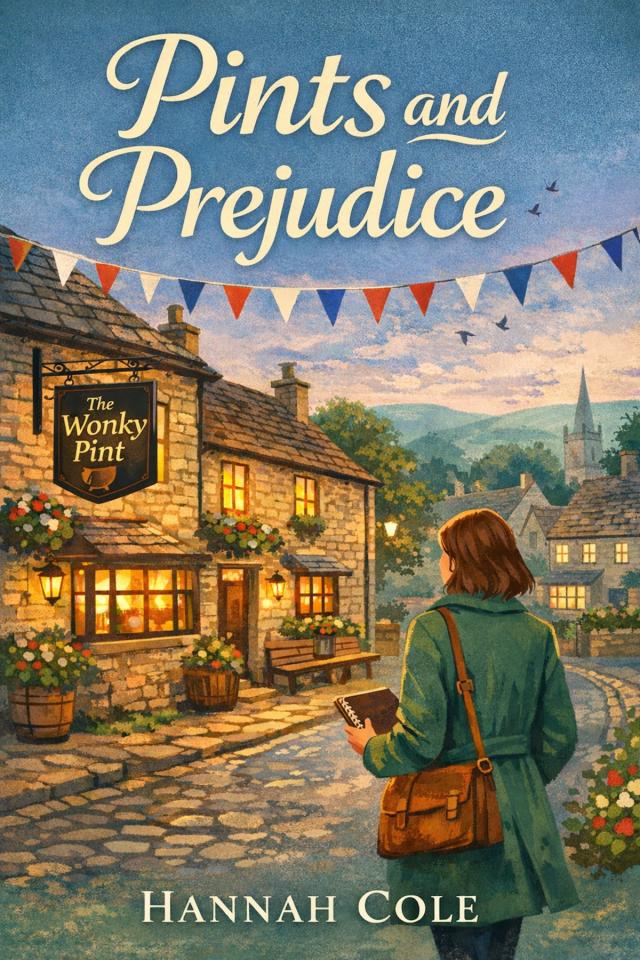


Pints and Prejudice
Hannah Cole
Copyright © 2025 by Hannah Cole
* * *
All rights reserved. No part of this publication may be reproduced, distributed, or transmitted in any form or by any means, including photocopying, recording, or other electronic or mechanical methods, without the prior written permission of the publisher, except in the case of brief quotations embodied in critical reviews and certain other noncommercial uses permitted by copyright law.
* * *
Published by Willow Word Press
* * *
www.willowwordpress.com
Contents
Untitled
1. The City Sceptic Arrives
2. Provincial Pains and Pub Prowess
3. Whispers and Weather Warnings
4. Stormy Revelations
5. The Village Under the Microscope
6. The Cricket Pitch and Crossroads
7. Facing the Music, Finding the Truth
8. Happily Ever After, Cotswolds Style
Pints and Prejudice
* * *
Dedicated to Jonty
Chapter One
The City Sceptic Arrives
Eliza Dalton was not, by nature, a woman who embraced the picturesque. Her world was one of sharp angles, polished surfaces, and the relentless hum of ambition. So, when the assignment landed on her desk – a fluffy, frankly insulting commission to write a feature on “The Charm of the Cotswolds” for a lifestyle magazine that usually trafficked in celebrity shoe endorsements and detox retreats – her initial reaction was a spluttering, incredulous laugh.
* * *
“Rural exposure?” she’d repeated, the words tasting like sawdust in her mouth. “You want me, Eliza Dalton, the queen of the urban exposé, to go and document… lambs frolicking? And I suppose I’m meant to find it ‘charming’?” Her editor, a man whose primary mode of communication was a series of increasingly exasperated sighs, had merely offered a weary shrug. “The readership loves this sort of thing, Eliza. escapism. You’re good at capturing the zeitgeist, even if it’s a slightly… woolly zeitgeist.”
* * *
Woolly. The very word conjured images of damp, smelly sheep and an overwhelming lack of decent Wi-Fi. Upper Wobbleton, the designated village for her deep dive into bucolic bliss, sounded less like a charming hamlet and more like a particularly potent brand of artisanal cheese. Eliza pictured thatched roofs, yes, but also a disturbing prevalence of wellington boots and conversations that revolved exclusively around the vagaries of the local WI bake sale. It was, in her professional estimation, a career death sentence disguised as an assignment. She envisioned her meticulously crafted prose, honed by years of dissecting political scandals and exposing corporate malfeasance, being diluted into saccharine drivel about hedgerows and cream teas.
* * *
“Backwardness,” she’d muttered to herself, pacing her minimalist Shoreditch apartment, the very antithesis of anything remotely rural. “Lack of sophistication.” These were the keywords, the battle cries she would march under. Her article would not be a puff piece; it would be an unvarnished, albeit perhaps slightly exaggerated, account of what truly lay beneath the pastoral veneer. She would uncover the quiet desperation, the stifled ambitions, the sheer, unadulterated boredom that must surely fester in such an isolated pocket of the country. She was a journalist, after all, not a glorified travel blogger. Her job was to dig, to probe, to expose. And if that meant skewering a few overly enthusiastic villagers and a perpetually sun-dappled village green, so be it.
* * *
Her research, conducted with the grim determination of a soldier preparing for a doomed campaign, yielded little to assuage her fears. The village website, a surprisingly robust affair adorned with an almost aggressive amount of floral imagery, spoke of a “vibrant community spirit” and “centuries of tradition.” Eliza translated this as “nosy neighbours” and “excuses for elaborate, time-consuming rituals.” She noted the mention of a local pub, ‘The Wonky Pint,’ and braced herself for the inevitable – a dimly lit, ale-scented establishment where the landlord would undoubtedly sport a tweed waistcoat and offer unsolicited opinions on the weather.
* * *
The very idea of ‘rural life’ seemed to Eliza anathema. London was a symphony of noise and movement, a place where one could disappear into the throng, where anonymity was a shield and ambition a currency. The countryside, on the other hand, felt like a trap. A place where everyone knew everyone else’s business, where a missed church service could be cause for hushed speculation, and where the most exciting event of the year was the village fête. She shuddered. Her editor, in a rare moment of almost-sympathy, had suggested she ‘lean into it,’ to find the humour in the situation. Eliza found it difficult to see the humour in what felt like a professional demotion.
* * *
She packed her bags with a sigh. A few pairs of sensible trousers, a sturdy pair of walking boots that felt utterly alien on her feet, and her most formidable laptop. She also packed a significant amount of sarcasm, a healthy scepticism that bordered on outright cynicism, and a deep-seated conviction that her metropolitan sensibilities were about to be thoroughly offended. She saw the assignment not as an opportunity to discover hidden gems, but as a gauntlet to be run, a trial by tedium to be endured. Upper Wobbleton, she was determined, would not charm her. It would, instead, provide ample material for a scathing, yet undoubtedly compelling, exposé. The stage was set, her biases firmly in place, and she was ready to descend upon the idyllic countryside like a hawk upon a particularly plump, unsuspecting pigeon. Little did she know, the pigeon might just have a sharper beak than she anticipated.
* * *
The journey itself was an exercise in mounting dread. The sleek efficiency of the London Underground gave way to the more leisurely pace of the regional train, and then to a sputtering, diesel-scented bus that seemed to take perverse pleasure in rattling Eliza’s very bones. As the cityscape gradually dissolved into rolling green fields, Eliza felt a growing sense of unease. The landscape, undeniably beautiful in a conventional sense, felt… empty. Lacking the electric pulse of the city, it seemed to exhale a quiet sigh of inertia. She clutched her laptop bag, her knuckles white, as if it were a life raft in a sea of pastoral mediocrity.
* * *
Finally, the bus wheezed to a halt in what appeared to be the village square. Eliza surveyed her surroundings with a journalist’s critical eye, ready to catalogue every perceived imperfection. The cottages, undeniably charming with their honeysuckle-draped walls and window boxes overflowing with geraniums, struck her as almost aggressively quaint. The village green, a vast expanse of meticulously mown grass, seemed to mock her with its pristine emptiness. And the air… oh, the air. It was thick with the scent of damp earth and something else, something vaguely floral and overwhelmingly innocent. It was, in short, everything she had braced herself for.
* * *
“Right,” she muttered, adjusting the strap of her bag. “Let’s get this over with.” Her first order of business was to locate ‘The Wonky Pint,’ the promised hub of village life. The directions she’d been given were vague, involving a turn past the “big oak tree that’s seen better days” and a general “head towards the scent of… well, pub.” It was, she suspected, another testament to the rural penchant for vagueness.
* * *
She found it eventually, nestled at the far end of the green, its stone façade looking less leaky and more robustly ancient. A hand-painted sign, swinging precariously in the gentle breeze, confirmed its identity. Taking a deep breath, Eliza steeled herself and pushed open the heavy wooden door, half-expecting a fanfare of accordions or perhaps a bewildered hen to greet her. Instead, she was met with a blast of warm air, the murmur of low voices, and the unmistakable aroma of ale and frying onions. It was, she grudgingly admitted, a pub. A rather nice-looking pub, at that. Dark wood panelling, low beams, and a scattering of worn leather armchairs created an atmosphere of cosy, if slightly dated, conviviality.
* * *
Her gaze swept the room, searching for the proprietor. And then she saw him. Tall, broad-shouldered, with a shock of dark, unruly hair and a jawline that looked as though it had been carved from granite, he was currently engaged in a vigorous polishing of the bar. He exuded an air of weary authority, a man burdened by the weight of tradition and, Eliza suspected, a general disdain for the outside world. He was, in short, exactly the sort of man she’d expected to find behind the bar of a rural pub.
* * *
As she approached, she noticed a faint smudge of something on his cheek. Perhaps it was dust. Perhaps it was a smudge of something more… revealing. Her journalistic instincts, dormant for all of ten minutes, began to prickle. She cleared her throat, a small, sharp sound in the relative quiet. The man looked up, his eyes, a startling shade of blue, flickered over her with a swift, assessing glance that was devoid of any warmth.
* * *
“Can I help you?” he asked, his voice a low rumble, not unkind, but certainly not welcoming.
“I’m Eliza Dalton,” she announced, trying to inject a note of confident authority into her voice. “I believe I have rooms booked here?”
He blinked, a flicker of something that might have been recognition, or perhaps just mild annoyance, crossing his face. “Ah, yes. Miss Dalton.” He set down his polishing cloth with a deliberate slowness. “William Lacey,” he introduced himself, offering a curt nod rather than
Eliza nodded back, a tight smile playing on her lips. William Lacey The name was almost comically imposing, a fitting moniker for this archetypal country innkeeper. She mentally filed it away, along with the smudge on his cheek and the slightly disdainful glint in his eye. This was going to be even easier than she’d anticipated.
“So,” she began, her tone already tinged with the professional detachment she reserved for subjects she deemed uninteresting, “I’m here to write an article about village life. Upper Wobbleton, specifically.”
Lacey’s expression didn’t change, but Eliza sensed a subtle stiffening of his posture. “Indeed,” he said, his voice flat. “And you’ve decided our humble establishment is the ideal base for your… investigations?”
“It’s the only establishment, isn’t it?” Eliza retorted, a hint of her usual sharpness creeping in. “Unless you have a hidden Ritz tucked away somewhere?”
A muscle twitched in his jaw. “We have a roof and a bed,” he said, his gaze unwavering. “And sustenance. We aim to provide what is needed, not what is desired.”
Eliza decided to push. “And what do you think is needed here, Mr Lacey? Besides a rebranding, perhaps?” She gestured vaguely around the room. “It’s all very… rustic.”
Lacey’s blue eyes narrowed, and for the first time, Eliza saw a flash of genuine fire in them. “Rustic,” he repeated, the word spat out like a curse. “This pub has been in my family for generations, Miss Dalton. It’s seen wars, plagues, and countless village dramas. It is more than just a building; it is the heart of this community.”
“A heart that, I suspect, beats to a rather slow rhythm,” Eliza said, unable to resist. She saw his jaw clench, and a thrill of anticipation ran through her. This was it. The friction she needed. The conflict that would make her article sing.
“Perhaps,” Lacey said, his voice dangerously low, “you’ll find that the quietest rhythms can sometimes hold the most profound truths. Or perhaps,” he added, his gaze fixed on her with an almost predatory intensity, “you’ll simply find them… boring.”
* * *
Eliza felt a jolt of something akin to surprise. He wasn’t just a passive recipient of her barbs; he could spar. And he could, it seemed, see right through her thinly veiled condescension. This was not going to be the walk in the park she’d envisioned. This was going to be a battle. And as she looked at William Lacey, standing there with his arms crossed and a challenge in his eyes, Eliza realised, with a mixture of annoyance and a strange, unexpected thrill, that she might actually be looking forward to it. The assignment, she suspected, was about to become considerably more interesting.
* * *
The jingle of the bell above the door of The Wonky Pint was less a welcoming chime and more a forlorn sigh, a sound Eliza felt perfectly echoed her own mood. Stepping inside, she was immediately enveloped in a comforting fug of malt, hops, and the savoury promise of frying onions. It was, she grudgingly admitted, precisely the sort of atmosphere she’d mentally prepared herself for, yet the reality was somehow less oppressive, more… inviting. Dark, polished wood gleamed under the low, amber light, and worn leather armchairs, each bearing the comfortable imprint of countless patrons, beckoned with a silent promise of respite. It was, in its own quiet way, rather charming. A fact Eliza immediately resolved to ignore.
* * *
Her eyes scanned the room, a practised journalist’s sweep designed to identify key players, potential sources, and escape routes. The bar, a formidable expanse of dark oak, was the undisputed centrepiece, and behind it stood the man himself. William Lacey He was precisely as she’d pictured him, perhaps even more so. Tall, with broad shoulders that seemed to fill the space behind the bar, and a mane of dark, almost black hair that fell with a casual disregard for order. His jaw was set with a firmness that suggested he was accustomed to holding his own, and his eyes, a startlingly bright blue, surveyed the room with an air of weary dominion. He was in the process of polishing a glass, the rhythmic sweep of his cloth against the crystal a soft counterpoint to the murmur of conversation around them. He looked, Eliza thought with a flicker of professional assessment, like a man who knew his own mind, and perhaps, rather too much about everyone else’s.
* * *
She approached the bar, her heels clicking faintly on the flagstone floor. The ambient noise seemed to recede as she drew closer, the low hum of conversation fading into a more focused silence as Lacey’s gaze fell upon her. It was a swift, almost imperceptible flicker, a silent appraisal that lingered just long enough to feel intrusive.
“Can I help you?” His voice was a low timbre, rich and resonant, like the aged oak of the bar itself. It wasn’t exactly unfriendly, but it certainly lacked the effusive welcome she might have expected, or perhaps, in her more cynical moments, anticipated.
“I’m Eliza Dalton,” she announced, her voice clear and carrying a practised note of authority. “I believe I have rooms booked here?”
Lacey’s brow furrowed, a subtle shift that hinted at a flicker of recognition, or perhaps just mild exasperation at the arrival of an unknown entity. He set down his polishing cloth with a deliberate slowness, his gaze holding hers. “Ah, yes. Miss Dalton.” He gave a curt nod, a gesture that felt more like an acknowledgement of a necessary evil than a proper introduction. “William Lacey,” he added, omitting the formality of an outstretched hand. “Proprietor.”
* * *
Eliza returned the nod, a tight, professional smile in place. William Lacey The name itself seemed to carry a certain gravitas, a weighty pronouncement that sat well with the rustic grandeur of his establishment. She filed away the observation, along with the slight tension in his shoulders and the almost imperceptible, almost defiant, set of his chin. This was, she thought, going to be remarkably easy. The predictable archetypes were already presenting themselves, ripe for dissection.
“So,” she began, her tone adopting the detached, analytical air she usually reserved for the preliminary stages of an exposé, “I’m here to write an article about village life. Upper Wobbleton, specifically.”
Lacey’s expression remained largely unchanged, a mask of polite inscrutability, but Eliza detected a subtle stiffening of his posture, a barely perceptible tightening around his jaw. “Indeed,” he said, his voice deliberately neutral. “And you’ve chosen our humble establishment as the ideal vantage point for your… observations?”
“It’s the only establishment, isn’t it?” Eliza countered, a touch of her natural sharpness surfacing. The words, meant to be a simple statement of fact, landed with a faint sting. “Unless you have a secret five-star hotel hidden in the back?”
A muscle in Lacey’s jaw twitched. “We provide lodging and sustenance, Miss Dalton. We aim to meet the fundamental needs of our guests, not to indulge their whims.”
Eliza leaned forward slightly, her journalist’s instinct for provocation kicking in. “And what do you believe are the fundamental needs of Upper Wobbleton, Mr Lacey?” she inquired, her gaze sweeping dismissively over the dark wood and low beams. “Besides, perhaps, a fresh coat of paint and a Wi-Fi signal that doesn’t require a degree in advanced telecommunications to locate?”
Lacey’s eyes narrowed, and for the first time, a spark of genuine annoyance, sharp and bright, ignited within them. “Rustic,” he repeated, the word clipped and laced with disdain. “This inn has been the heart of this community for generations, Miss Dalton. It has weathered storms, celebrated triumphs, and witnessed countless personal histories unfold within these walls. It is more than just a building; it is a testament to continuity, to tradition.”


