

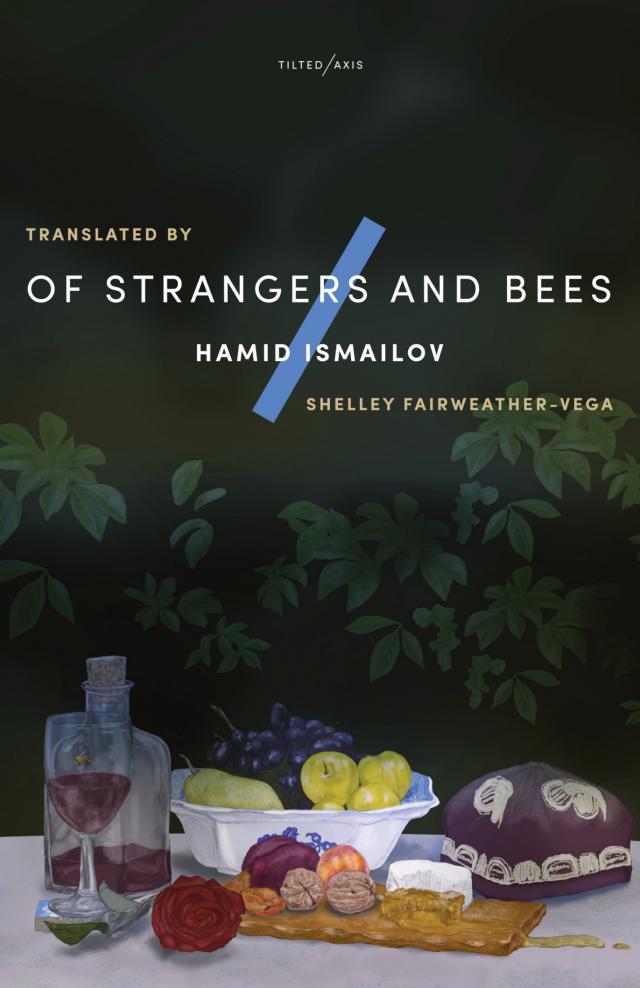
Of Strangers and Bees, page 1


Praise for The Devils’ Dance
Winner of the EBRD Literature Prize 2019
‘[Ismailov is] a writer of immense poetic power.’
— Guardian
‘Ismailov shows that even under extreme duress, a writer’s mind will still swim with ideas and inspiration… Rebellious, ironic, witty and lyrical… A work that both honours and renews that rich tradition [of Central Asian literature]. For all its complexity, The Devils’ Dance is utterly readable.’
— Caroline Eden, Financial Times
‘Captivating… A rare example of Uzbek literature translated into the English language – in this case admirably so by Donald Rayfield.’
— Natasha Randall, Times Literary Supplement
‘With its spies, police, princes, poets and great plot, [The Devils’ Dance] is an Uzbek Game of Thrones. The storytelling style captures perfectly the prose and poetry of Central Asia while being incredibly readable in English.’ — Rosie Goldsmith, chair of judges, EBRD Prize
‘Might Hamid Ismailov’s The Devils’ Dance open Central Asian literature to the world as Gabriel García Márquez’s novels did for Latin America? Probably not – things rarely work out like that – but perhaps it deserves to.’
— Peter Gordon, Asian Review of Books
‘An intricate mixture of fact and fiction… Defiant’
— Jane Shilling, New Statesman
‘Brilliantly translated by Donald Rayfield… A rich and enthralling book’ — Tatler.com
‘Effective and moving… [Ismailov completes] his impressive portrait of the artist and his culture – and his dreadful times’ — Complete Review
‘A beguiling tale of khans, commissars, spies and poet-queens… feature in a rare English translation of modern Uzbek fiction.’ — Economist
‘Throughout these parallel stories, Ismailov finds moments of utter horror and of quiet relief.’
— Words Without Borders
‘A beautiful evocation of different Central Asian historical worlds… The Devils’ Dance is a powerful symbol of hope in Uzbekistan.’ — Calvert Journal
‘My book of the year.’ — Caroline Eden
‘A mesmerising – and terrifying – novel of tremendous range, energy and potency. This brilliant translation establishes Ismailov as a major literary figure on the international scene.’ — William Boyd
‘A great and timeless caravanserai.’ — Barry Langridge, Former Head of Asia Region, BBC World Service
Of Strangers and Bees
Translator’s Introduction
The novel you hold in your hands is not the first to boast the name Hayy ibn Yaqzan. Our present tale spans centuries and half the globe, but it is mostly the quite modern story of a writer in exile in the tumultuous waning days of the twentieth century. The very first Hayy ibn Yaqzan, on the other hand, was the eponymous protagonist of an eleventh-century allegory by the Persian philosopher Avicenna. Or shall we call him the Uzbek philosopher Abu Ali ibn Sino? However we think of him, this great thinker tended to write sweeping tracts covering all available knowledge on a topic: The Canon of Medicine; The Book of Impartial Judgment; essays on the nature of scientific inquiry, physics, psychology and Islamic theology; poetry, even. But one of his more neglected legacies is a short story called ‘Hayy ibn Yaqzan’, a name which translates to something like ‘Alive, son of Awake’. Ibn Sino’s ‘Hayy’ features a wise old sage telling a curious travelling narrator about the nature of life and the world around him. Major sections of Of Strangers and Bees – this current Hayy ibn Yaqzan – open with quotations from the original, as translated from Persian to French, then to English, and later revised by me with an eye to the Arabic-to-Russian translation by Artur Vladimirovich Sagadeyev.
The next writer to seize on the name and the title was the Moorish philosopher Ibn Tufail, in the twelfth century. This newer, longer, Arabic-language Hayy ibn Yaqzan posed a thought experiment: what would happen to a man raised by a deer on an island uninhabited by people? Ibn Tufail’s subject teaches himself science and logic. Later, when he encounters a castaway from the civilised world, he has the opportunity to compare his own pure way of life with the experience of most human beings as they interact with society and material things. The European Renaissance discovered Ibn Tufail’s tale and produced a Latin translation called Philosophus Autodidactus, published in 1671. This seems to have influenced a whole swath of Enlightenment thinkers who conjured up political philosophies based on their ruminations of mankind in a state of nature.
A Moorish physician named Ibn Tufail makes a passing appearance in Of Strangers and Bees, too (though there is a decent chance that this particular Ibn Tufail may simply be a double). More prominently featured is Avicenna, Ibn Sino himself, who, you are going to have to believe, did not in fact die in the eleventh century, but has instead been condemned to roam the world. The hero of this story – whose friends call him The Sheikh – is also consigned to wander as a writer in political exile from his native Uzbekistan. His search for Avicenna, combined with his attempts to earn a living and a little respect in the wider world, sends him on a quest through Western Europe and the United States. Everywhere he goes, he finds traces of Avicenna, and with them, traces of his own ambiguous cultural and religious heritage.
Hamid Ismailov’s imaginative iteration of Hayy ibn Yaqzan tackles big, important ideas of man and society, art and philosophy, but it is a deeply personal novel, too. It’s impossible to forget that this story of an Uzbek writer in exile was in fact written by an Uzbek writer in exile, one who has had to reconcile a Sufi upbringing with a post-Soviet political reality in a multicultural and materialistic Western world. The episodes in this novel that examine late twentieth-century life in exile are plainly written, full of small triumphs and humiliations, and remarkable for their strange mixture of absurdity and banality. Then there are the episodes in between, where the thinking, the magic, the passion in this novel are sunk into its fables and parables and brand new tales from the Arabian Nights. Here you will find talking animals, beautiful princesses, conniving kings, and, of course, a mysterious wandering Stranger.
And then there are the bees. Ismailov has an apparent affinity for the hive insects, and in this book, they take centre stage. Do the bees represent the swarming Soviet (or post-Soviet) masses? Are they humanity, working according to patterns and towards goals of which they have only a dim awareness? If we’re all bees in a hive, then who is in charge? On the other hand, the bees in this novel are part of a larger cultural and religious tradition. Avicenna (and Aristotle) wrote extensively on bees, with the Uzbek philosopher especially interested in the nature of bee venom and the healing properties of honey. The Quran has a whole chapter called The Bee. They must have something to teach us. But you will have to discover what that might be for yourselves.
On Sufism
Like Persian literature, alongside which it is often nonchalantly classified, Uzbek literature was once essentially Sufi in nature. Sufism was mostly born in the Persian and Turkic world, and expressed and transmitted from there in literary form. Ismailov tells me that Sufism was in fact a way of adapting Arabic-born Islam for the Persian and Turkic world. Great Sufi teachers such as Jalaluddin Rumi (Persian) and Ahmad Yasawi (Turkic) retold the Holy Quran and Islamic religious thought in a literary, poetic form in their own languages. There’s a famous saying about the Mesnevi, Rumi’s main work: Masnavii ma’navii Mavlaviy / Hast Qur’on dar zaboni Pahlaviy. Or, in English: The Mesnevi and its meanings by Mevlevi (that is, Rumi) / Is a Quran in the language of Pehlevi (Persian).
One could read this novel as Ismailov’s return to the roots of Uzbek literature with a multilayered Sufi parable, in which the narrator, Avicenna, and the bee called Sino are all on the path of searching for something bigger than themselves. In this Hayy ibn Yaqzan, Avicenna’s lonely spirit is present at the turning points in world history, inviting us to reconsider their significance while applying both logic and intuition, knowledge and emotions, the conscious and the subconscious, the rational and the mystic. Here, the ancient polymath’s presence as the Stranger serves one of the main maxims of Sufism: the idea of annihilating the ego and experiencing one’s own life through the eyes of the Other. That, in fact, is the core principle which shapes this Hayy ibn Yaqzan, just as the others which preceded it.
On dates
Time is marked in Hijri years, which begin with Muhammad’s move from Mecca to Yathrib in 622 AD and go on from there following the lunar calendar. Avicenna’s (first) death is dated here as 18 June in the year AD 1037. Contemporary passages take place in the mid to late 1980s; the first contemporary episode, dated Year of the Hijra 1409, is AD 1988.
Acknowledgments
This novel came to me in several versions, some Uzbek, some Russian. What you have here is a new English alternative that mostly follows the Russian, and which is more complete, and that has been checked against and altered to fit the Uzbek in which Ismailov originally conceived of the tale. This novel is arguably at least as Uzbek as Avicenna. The translation was partly financially supported by a grant from Arts Council England, and morally supported entirely by Hamid Ismailov, to whom I am eternally grateful for entrusting me with his work.
The quotations from Avicenna’s original Hayy ibn Yaqzan are adapted from those in Henry Corbin’s book Avicenna and the Visionary Recital, translated from the French by Willard R. Trask (New York: Pantheon, 1960). A copy is
Lorenzo the Magnificent’s poem is entitled ‘Trionfo’, and the English translation provided is by Lomade Lucchi.
The line ‘I’d tear like a wolf at bureaucracy’ is from a Mayakovsky poem translated as ‘My Soviet Passport’ by Herbert Marshall.
One excerpt from this novel, ‘Events of the Years of the Hijra 1410–1414,’ was first published in Chtenia no. 40. Two fables, under the titles ‘The Fable of the Fox and the Flies’ and ‘The Fable of the Crow and the Bee’, first appeared in the online journal Underpass.
Shelley Fairweather-Vega
Seattle, Washington, 2019
For Professor Ilse Cirtautas, who taught so much to so many, and who set me on this path.
There are three regions on this planet. The first is the region intermediate between West and East. It has been thoroughly studied, and the things that take place there, and the motivations and reasons for those things, are all rightly understood. But two regions are unknown: the first is the region beyond the West, and the second is the region beyond the East…
Avicenna
Prologue
[Voice 1 starts]
There is one episode from my childhood that I will always remember. At that time we lived in a village called Afshona, in the Rometan region of Uzbekistan’s Bukhara province. On the particular day I cannot forget, they had sent us out from school to work in the fields again, though I can’t recall whether we were supposed to be picking mulberry leaves for the silkworms or whitewashing the trees to keep pests away. During a break, I wandered off alone, and I found myself in the garden of the collective farm.
I had never seen this garden before, and I thought it must be the paradise my grandmother had told me about. Clear water gurgled through a canal at my feet. Everywhere, fruit fell to the earth in a hymn to creation. The ground was so soft the fruit was unbruised and untouched by worms. Half of the expanse was a flower garden, and aromas warmed by the midday sun surrounded me on all sides, intoxicating even the air, not to mention so small a person as myself.
I wandered down the paths of baked mud through the roses and, as I had seen my grandmother do, I sniffed cautiously at first, then plucked just one bud and tucked it behind my ear. Before moving my sun-seared head back into the garden’s cool shade, I caught sight of the most majestic flower of all, and I thought I would pick that one for my grandmother. Suffering the pokes and scratches, I pushed further into the thicket of roses.
But when I reached that flower, I froze. It would have been a shame to pluck such a thing.
There are many shades of the colour red, but this red rose had none of the paleness of pink, none of the yellowness of orange, no velvety notes of darkness, and no deep shades of burgundy. This one was the clean scarlet hue of a young child’s blood.
It’s only now that I’m finding these words, of course. Then, as a boy, I saw all of this with unsullied eyes and a pure heart.
That was its colour. Now for the shape.
There are certain types of roses that resemble wide-open tulips, except with no seeds. There are others that look like mushrooms from the outside, or immature bolls of cotton. There are roses that resemble curved teeth, some are like sets of coquettish lips, and some look like something caught and splattered in a mill. But this rose was like a road leading to another world. Or into the very depths, the very core, of this one.
So, instead of taking a sniff, I tried first to penetrate that flower with my eyes, right to its magical centre. And that was when it struck: the most impressive instant of all… I remember seeing a nuclear explosion once, on television. This real-life blast hit my eye with the exact same sort of impact. I didn’t scream. I howled like a wild beast and flung the flower away, cast it straight out of that garden paradise!
I am no longer a young man, but every time I remember that moment, I feel a chill take over my body. I took off running at full speed, flying full throttle, but even then, my childhood curiosity won out and I opened my eye, the eye a bee had flown straight into, and I saw – this you will never believe! – I saw my own eye staring back at me.
Twice as terrified as before, I sprinted away even faster. My eye was starting to swell, making my head feel heavier on that side. Who can say which is more powerful: pain, or the fear of pain? When I think of it now, I also had no idea of where I was running to: if I went back to school I’d get a lecture, that was certain, but if I went back home I’d get a thrashing. So I fled instead onto the open steppe.
Who knows how far I might have run, had a white-haired old man not stepped out of nowhere and into my path?
‘Where do you run in such haste, my son?’ the old man asked. I removed my hand from my eye. My healthy eye was weeping, and the injured one was burning. All the time I was running, I must have been pressing to my eye the bee that had pierced my eyelid. The white-haired old man removed the creature, spread its wings, and blew a puff of air at it – and the bee, wishing me no more harm, soared off on the breeze. The man blew onto my eye, too, and as he led me home the lid began to open.
But I began to feel a surprising affinity, both bitter and sweet, with the bee that had flown away. Maybe our closeness stemmed from having beheld the same majestic flower, or from the moment our eyes had met. Or maybe it was sharing a love of free flight, over an open road…
I could articulate nothing of this at the time, and speaking it aloud seems beyond me even now. Maybe that failure is why I am a writer.
⁂
On the first Friday of the holy month of Ramadan in the Year of the Hijra four hundred and eight, the divine spirit of the bestower of all wisdom, Master of countless realms of secret knowledge, flew like a bird away from its nest, quit its sacred refuge, departed its bodily prison, and, submitting itself to the will of the Almighty, ascended to the heavenly paradise, that blossom of eternal purity. At the time, His Radiancy’s age was fifty-three years.
‘From now on the Creator of my body will be indifferent to my flesh, and for that reason no attempt to heal it will be of any use.’ After those words were uttered, in the Zambur district of the city of Hamadan, under the dome of the heavenly arch, a miraculous vision appeared in bright rays of light: an angel, which unfurled its wings, and proclaimed to the people that the mourning had begun for the death of Avicenna, the Sheikh-ar-Rais, and this news took flight throughout the whole world.
The death of His Radiancy was a staggering blow to all who were present at his departure, and they fell prostrate before his body. At this moment of truth, there was just one person missing from His Radiancy’s bedside: his colleague, student, and confidant Abu Ubayd al-Juzjani, who got there just a little too late. This true friend of His Radiancy, who was also a physician, had the audacity to bend over the hand of the Sheikh to remove from his lifeless fingers a sheet of paper, on which was inscribed not any secret knowledge of healing, but rather some remarks about life in the material world and the soul that, though residing in the body, remains always connected to the heavens, rushing back to that realm after it leaves the body behind.
This unfortunate physician, distressed, grieving, and feeling alone, repositioned His Radiancy so that his head pointed north and his face turned to Mecca, and looked again at the piece of paper. He took from a shelf several glass vials containing potions of reanimation, healing oils and creams, and he sat down at the feet of His Radiancy and began to rub them all in turn over the holy yellowing body of the Sheikh.
Lo and behold, the spirit of the man lying there revived. Tears flowed from his eyes, and his body produced a sound like a young soldier crying out in his sleep. This miracle roused everyone who had fallen prostrate there, but when they recovered and saw what was happening they bowed their foreheads to the earth once again. The blood had come back into the face of the corpse, and his eyelids had come alive.
The physician did not know whether to praise God or ask Him to forgive his sins, and he wavered between the comfort of the present company and his own solitude. Casting one final glance at the piece of paper, he was just extending his hand towards the last little glass vial, which held a floral nectar intended for a queen bee, when in swooped the brave servant of another queen, a villainous bee which thrust its stinger right into the physician’s hand. The priceless vial leaped from his grasp and shattered on the floor, splintering into a thousand tiny shards.


