Natives of Space, page 6
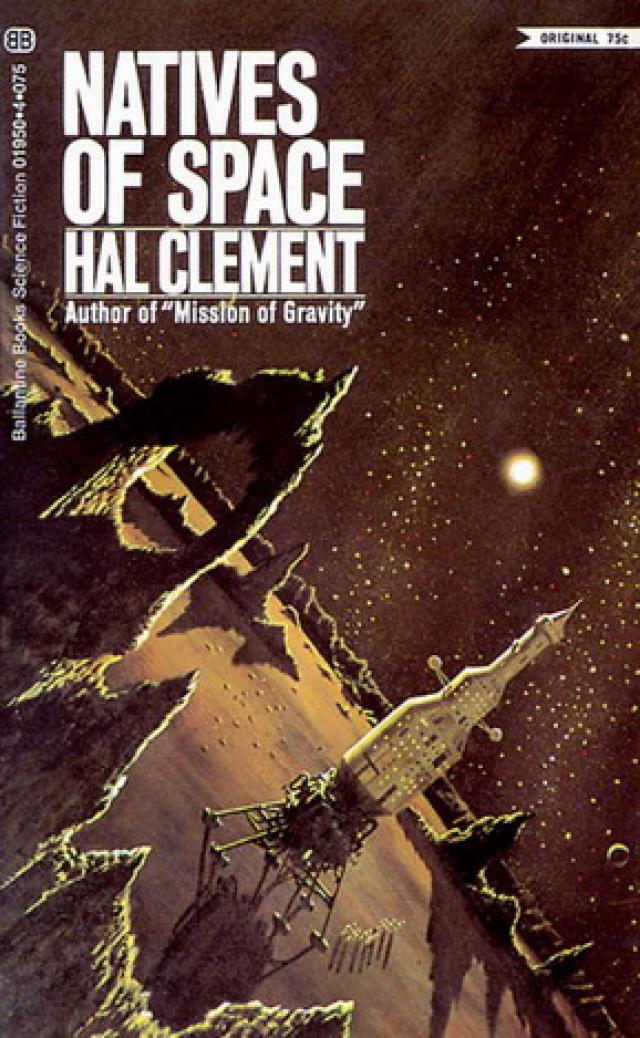


What he did understand was the pound of running feet, diminishing along the drive and turning down the road toward the town. Instantly he rapped out an urgent signal to Tes, and abandoning caution made his way as rapidly as possible to the quarry’s edge. A faint glow a few feet away marked the hatch in the top of the hull, and he plunged into the water toward it. Thirty seconds later he was inside and at the control board, with the hatch sealed behind him; and without further preamble or delay, he sent the little ship swooping silently upward, into and through the dripping overcast, and out into the void away from Earth.
Jackie, questioned by his father while the doctor was at work, told the full truth to the best of his ability; and was in consequence sincerely grieved at the obvious doubt that greeted his tale. He honestly believed that the thing he had seen crouched over his brother’s body had been winged, and had departed by air. The doctor had already noted and commented on the wound in Jim’s throat, and the head of the Wade family had been moved to find out what he could about vampire bats. In consequence, he was doing his best to shake his younger son’s insistence on the fact that he had seen something at least as large as a man. He was not having much luck, and was beginning to lose his temper.
Dr. Envers, entering silently at this stage and listening without comment for several seconds, gleaned the last fact, and was moved to interrupt.
“What’s wrong with the lad’s story?” he asked. “I haven’t heard it myself, but he seems to be sure of what he’s saying. Also,” looking at the taut, almost tearful face of the boy sitting before him, “he’s a bit excited, Jim. I think you’d better let him get to bed, and thrash your question out tomorrow.”
“I don’t believe his story, because it’s impossible,” replied Wade. “If you had heard it all, you’d agree with me. And I don’t like — “
“It may, as you say, be impossible; but why pick on only one feature to criticize?” He glanced at the open encyclopedia indicated by Wade. “If you’re trying to blame Jimmy’s throat wound on a vampire bat, forget it. Any animal bite would be as badly infected as that toe, and that one looks as though it had received medical treatment. It’s practically healed; it was a clean puncture by something either surgically sterile, or so nearly so that it was unable to offer a serious threat to the boy’s health even in his present weak condition. I don’t know what made it, and I don’t care very much; it’s the least of his troubles.”
“I told you so!” insisted Jackie. “It wasn’t one of your crazy little bats I saw. It was bigger than I am; it looked at me for a minute, and then flew away.”
Envers put his hand on the youngster’s shoulder, and looked into his eyes for a moment. The face was flushed and the small body trembled with excitement and indig-nation.
“All right, son,” said the doctor gently. “Remember, neither your father nor I have ever heard of such a thing as you describe, and it’s only human for him to try to make believe it was something he does know about. You forget it for now, and get some sleep; in the morning we’ll have a look to find out just what it might have been.”
He watched Jackie’s face carefully as he spoke, and noted suddenly that a tiny lump, with a minute red dot at the center, was visible on his throat at almost the same point as Jimmy’s wound.
He stopped talking for a moment to examine it more closely, and Wade stiffened in his chair as he saw the action. Envers, however, made no comment, and sent the boy up to bed without giving the father a chance to resume the argument. Then he sat in thought for several minutes, a half smile on his face. Wade finally interrupted the silence.
“What was that on Jackie’s neck?” he asked. “I same sort of thing that — “
“It was not like the puncture in Jimmy’s throat, replied the doctor wearily. “If you want a medical opinion, I’d say it was a mosquito bite. If you’re trying to connect it with whatever happened to the other boy, forget it; if Jackie knew anything unusual about it, he’d have told you. Remember, he’s been trying to put stuffing in a rather unusual story. I’d stop worrying about the whole thing, if I were you; Jimmy will be all right when we get these strep bugs out of his system, and there hasn’t been anything wrong with his brother from the first. I know it’s perfectly possible to read something dramatic into a couple of insect bites — I read `Dracula’ in my youth, too — but if you start reading it back to me I’m quitting. You’re an educated man, Jim, and I only forgive this mental wandering because I know you’ve had a perfectly justifiable worry about Jimmy.”
“But what did Jackie see?”
“Again I can offer only a medical opinion; and that is — nothing. It was dark, and he has a normal imagina-tion, which can be pretty colorful in a child.”
“But he was so insistent — “
The doctor smiled: “You were getting pretty positive yourself when I walked in, Jim. There’s something in human nature that thrives on opposition. I think you’d better follow the prescription I gave for Jackie, and get to bed. You needn’t worry about either of them, now.” Envers rose to go, and held out his hand. Wade looked doubtful for a moment, then laughed suddenly, got to his feet, shook hands, and went for the doctor’s coat.
Like Wade, Tes had a few nagging worries. As Thrykr turned away from the controls, satisfied that the ship was following the radial beam emanating from the broadcaster circling Sol, she voiced them.
“What can you possibly do about that human being who saw you?” she asked. “We lived for three Earth days keyed up to a most unpleasant pitch of excitement, simply because of a law which forbade our making ourselves known to the natives of that planet. Now, when you’ve done exactly that, you don’t seem bothered at all. Are you expecting the creature to pass us off as supernatural visitants, as they are supposed to have accounted for the original surveyors?”
“No, my dear. As I pointed out to you before, that idea is the purest nonsense. Humanity is obviously in a well-advanced stage of scientific advancement, and it is unthinkable that they should permit such a theory to satisfy them. No — they know about u, now, and must have been pretty sure since the surveyors’ first visit.”
“But perhaps they simply disbelieved the individuals who encountered the surveyors, and will similarly dis-credit the one who saw you.”
“How could they do that? Unless you assume that all those who saw us were not only congenital liars but were known to be such by their fellows, and were nevertheless allowed at large. To discredit them any other way would require a line of reasoning too strained to be entertained by a scientifically trained mind. Rationalization of that nature, Tes, is as much a characteristic of primitive peoples as is superstition. I repeat, they know what we are; and they should have been permitted galactic intercourse from the time of the first survey — they cannot have changed much in sixty or seventy, years, at least in the state of material progress.
“And that, my dear, is the reason I am not worried about having been seen. I shall report the whole affair to the authorities as soon as we reach Blalhn, and I have no doubt that they will follow my recommendation — which will be to send an immediate official party to contact the human race.” He smiled momentarily, then grew serious again. “I should like to apologize to that child whose life was risked by my carelessness, and to its parents, who must have been caused serious anxiety; and I imagine I will be able to do so.” He turned to his wife.
“Tes, would you like to spend my next vacation on Earth?”
Technical Error
Seven spacesuited human beings stood motionless, at the edge of the little valley. Around them was a bare, jagged plain of basalt, lit sharply by the distant sun and unwavering stars; a dozen miles behind, hidden by the abrupt curvature of the asteriod’s surface, was a half-fused heap of metal that had brought them here; and in front of them, almost at their feet, in the shallow groove scraped by a meteor ages before, was an object which caused more than one of those men to doubt his sanity.
Before them lay the ship whose heat-ruined wreckage had been left behind them only minutes ago — perfectly whole in every part. Seven pairs of eyes swept it from end to end, picking out and recognizing each line. Driving and steering jet pits at each end; six bulging observation ports around its middle; rows of smaller ports, their transparent panes gleaming, obviously intact, in the sun-light; the silvery, prolate hull itself — all forced themselves on the minds that sought desperately to reject them as impossibilities. The Giansar was gone — they had fled from the threat of its disordered atomic engines, watched it glow and melt and finally cool again, a nearly formless heap of slag. So what was this?
None of them even thought of a sister ship. The Giansar had none. Spaceships are not mass production articles; only a few hundred exist as yet, and each of those is a specialized, designed-to-order machine. A spaceman of any standing can recognize at a glance, by shape alone, any ship built on Earth — and no other intelligent race than man inhabits Sol’s system.
Grant was the first to throw off the spell. He glanced up at the stars overhead, and figured; then he shook his head.
“We haven’t circled, I’ll swear,” he said after a moment. “We’re a quarter of the way around this world from where we left the ship, if I have allowed right for rotation. Besides, it wasn’t in a valley.”
The tension vanished as though someone had snapped a switch. “That’s right,” grunted Cray, the stocky engine man. “The place was practically flat, except for a lot of spiky rocks. And anyway, no one but a nut could think that was the Giansar, after leaving her the way we did. I wonder who left this buggy here.”
“Why do you assume it has been left?” The query came, in a quiet voice, from Jack Preble, the youngest person present. “It appears uninjured. I see no reason to suppose that the crew is not waiting for us to enter at this moment, if they have seen us.”
Grant shook his head. “That ship might have been here for years — probably has, since none of us can place it. The crew may be there, but, I fear, not alive. It seems unlikely that this craft has been registered in the lifetime of any of us. I doubt that it would have remained here unless it were disabled; but you must all have realized by now that it holds probably our only chance of life.
Even if it won’t fly, there may be a transmitter in repair. We had better investigate.”
The men followed the captain as he took a long, slow leap down the slope. Little enthusiasm showed in the faces behind the helmet masks; even young Preble had accepted the fact that death was almost inevitable. At another time, they might have been eager and curious,even in the face of a spectacle as depressing as a derelict usually is; now they merely followed silently. Here, probably,’ a similar group of men had, no one knew how long ago, faced a fate identical to theirs; and they were about to see what had befallen those others. No one saw humor in the situation, but a wry smile was twisting more than one face as the group stopped beneath the circular entrance port. More than one thought of the possible irony of their being taken for a rescue crew.
Grant looked at the port, twenty-five feet above their heads. Any of them could easily have jumped to it; but even that effort was not necessary, for a row of niches, eight inches square and two deep, provided a ladder to the rim. It was possible to cling to them even on the lower curve of the hull, for they were deeply grooved around the inside edges. The captain found that his gauntlets could grip easily, and he made his way up the wall of metal, the others watching from below. Arriving at the port, he found that the niches formed a circle around it, and other rows of them extended over the hull in different directions. It was at the entrance, however, that he met the first of the many irregularities.
The others saw him reach the port, and stop as though looking around. Then he traveled entirely around it, stopped again, and began feeling the mirrorlike metal with his gloved hands. Finally he called out:
“Cray, could you come up here, please? If anyone can find the opening mechanism, you should.”
The engineer remained exactly where he was.
“Why should there be any?” he asked. “The only reason we use it on our ships is habit; if the door opens inward, atmospheric pressure will hold it better than any lock. Try pushing; if the inner door is sealed, you shouldn’t have much trouble — the lock chamber will be exhausted, probably.”
Grant got a grip near the edge of the door, and pushed.
There was no result. He moved part way around the rim and tried again, with the same lack of success. After testing at several more points, he spoke again:
“No luck. I can’t even tell which side the hinge is on, or even if there is a hinge. Cray, you and a couple of others had better come up and give a hand at pushing; maybe there’s a trace of air in the inner chamber.”
Cray grunted, “If there’s anywhere near an atmos-phere’s pressure, it’ll take tons to budge the door — it’s twelve feet across.” But this time he began to climb the bull. Royden, probably the most powerful one present, and a chemist named Stevenson followed him. The four men grouped themselves about the forward edge of the port, their feet braced on the door itself and hands firmly gripping the climbing niches; and all four tensed their bodies and heaved. The door still refused to budge. They rested a moment, and followed Grant to the opposite side of the metal disk.
This time their efforts produced results. The pressure on the other side of the valve must have been only a few millimeters of mercury; enough to give four or five hundred pounds’ resistance to an outside thrust at the edge opposite the hinge. When the door opened a crack, that pressure vanished almost instantly, and the four men shot feet first through the suddenly yawning opening.
Grant and Stevenson checked the plunge by catching the edge of the port frame; the other two disappeared into the inner darkness, and an instant later the shock of their impact upon some hard surface was felt by those touch-ing the hull.
The captain and the chemist dropped to the floor of the lock and entered; Preble leaped for the open door, followed by Sorrell and McEachern. All three judged accurately, sailing through the opening, checking their flight against the ceiling, and landing feet down on thefloor, where they found the others standing with belt lights in their hands. The sun was on the far side of the ship, and the chamber was lighted dimly by reflection from the rocks outside; but the corridors of the vessel themselves must be dark.
The inner valve of the air lock was open — and had apparently been so from the beginning. Cray and Royden had shot through it, and been brought up against the far-ther wall of a corridor running parallel to the ship’s long axis. They were both visible, standing back to back, sweep-ing the corridor in both directions with their lights. Grant took a step that carried him over to them, motioning the others to remain where they were, and added his light to those already in action.
To the right, as one entered it, the corridor extended almost to the near end of the ship — the bow, as the men thought of it for no good reason. in another direction, it ran about ten yards and opened into a large chamber which, if this craft resembled the Giansar as closely within as it did without, was probably the control room. At least, it was just about amidships. Smaller doors opened at intervals along the hallway; some were open, the majority were closed. Nothing moved anywhere.
“Come on,” said Grant finally. He walked toward the central room, and paused on the threshold, the others at his heels. The floor they were walking on continued in the form of a catwalk; the chamber they were entering occupied the full interior of the hull at this point. It was brightly lighted, for it was this compartment that possess-ed the six great view ports, equally spaced around its walls, and the sun shone brightly through these. The men extinguished their own lights. Cray looked about him, and shook his head slowly.
“I still think I must be dreaming, and about to wake up on our own ship,” he remarked. “This looks more and more like home, sweet home.”
Grant frowned. “Not to me,” he replied. “This control layout is the first serious difference I’ve seen. You wouldn’t notice that, of course, spending all your life with the engines. It might be a good idea for you to see if the drive on this ship is enough like ours for you to puzzle out, and whether there’s a chance of repairing it. I’ll look over this board for signs of a transmitter — after all, the Mizar shouldn’t be too far away.”
“Why shouldn’t I be able to understand the drive?” retorted Cray. “It should be like ours, only a little more primitive — depending on how long this boat’s been here.”
Grant shot him an amazed glance. “Do you still think this is a Terrestrial ship, and has been here only a few decades?” he asked.
“Sure. Any evidence otherwise?”
Grant pointed to the floor beneath their feet. All looked down, and for the first time noticed that they left footprints in a thin, even layer of dust that coated the corridor floor.
“That means that the ship held its air for a longer time than I care to think about — long enough not only to reduce the various organic substances on board to dust, but at random currents to distribute it through the open spaces. Yet when we came the air was almost gone — leaked out through the joints and valves, good as they were, so that there was not enough left to resist us when we pushed a twelve-foot piston against its pressure. Point one.”
The finger swung to the control board. “Point two.” He said nothing further, but all could see what he meant.
The center of the control room was occupied by a thick-walled hemisphere — a cup, if you like — swung in gimbals which permitted its flat side always to the uppermost with respect to the ship’s line of net accelera-tion. The control board occupied the inner surface and upper edge of this cup, all around the circumference; andin the center of the assembly was the pilot’s seat — if it could be called a seat.